
Quick answer: An annual maintenance contract (AMC) in Dubai typically costs AED 1,200–3,000/year for a studio/1-bedroom apartment, AED 2,500–4,500/year for a 2–3 bedroom apartment, AED 3,000–12,000/year for a villa depending on size and coverage, and AED 8,000–25,000+/year for commercial spaces. An AMC is worth it if you have multiple AC units, an older villa, travel often, rent out the property, or expect 3+ maintenance callouts a year.
Every Dubai homeowner faces the same annual decision: pay a fixed fee for a maintenance company to look after the property all year, or roll the dice and call someone only when things break. In a city where the air conditioner is a habitability system and summer failures are a matter of when, not if, that decision deserves better than a guess.
This guide explains annual maintenance contracts in Dubai completely: what an AMC actually is, realistic 2026 costs by property type, what’s typically included (and what’s sneakily excluded), AMC vs pay-per-call math, seven red flags that mark a bad contract, and how to choose a provider you’ll still be happy with in month eleven.
Definition: Annual maintenance contract (AMC). A yearly agreement with a maintenance provider covering planned preventive visits (AC servicing, plumbing and electrical checks) plus a set number of reactive callouts, usually with priority emergency response — for one fixed annual fee instead of per-job billing.
What an Annual Maintenance Contract Actually Covers
A well-structured Dubai AMC has three layers:
1. Planned preventive maintenance. Scheduled visits through the year — typically two full AC services (April pre-summer and August mid-season), plus periodic plumbing and electrical inspections. This is the core value: failures prevented are the cheapest repairs of all.
2. Included reactive callouts. A set number of unscheduled visits per year (commonly 2–4) for things that break between scheduled services — a leaking tap, a tripping breaker, a dead AC zone. Labour for these visits is covered; parts are usually charged separately at agreed rates.
3. Priority response. When something fails, contract holders jump the queue. In June–September, when every AC company in Dubai is at maximum load, priority response is the difference between same-day rescue and a week of 40°C nights.
What’s usually included: AC servicing visits, plumbing labour callouts, electrical labour callouts, handyman visits (number varies by tier), and emergency response priority.
What’s often excluded (read the fine print): spare parts and materials, major replacements (compressors, water heaters), painting beyond touch-ups, appliance repair, pest control, water tank cleaning, duct cleaning, and pool/garden work — though many can be added or scheduled alongside.
Annual Maintenance Contract Dubai: 2026 Cost Tables
By property type
| Property type | Basic AMC (AED/year) | Full AMC (AED/year) | Typical inclusions |
|---|---|---|---|
| Studio / 1-bed apartment | 1,200 – 2,000 | 2,000 – 3,000 | 2 AC services, plumbing check, 2 handyman visits |
| 2–3 bed apartment | 2,500 – 4,500 | 3,000 – 5,000 | 2 AC services, electrical check, plumbing, 3 handyman visits |
| 3–5 bed villa/townhouse | 3,000 – 6,000 | 6,000 – 12,000 | Full AC service x2, electrical safety inspection, plumbing, painting touch-up, 4 handyman visits |
| Large villa (pool, garden) | 12,000 – 25,000 | 15,000 – 30,000 | Everything above + pool/garden coordination |
| Commercial office (to ~300 sqm) | 8,000 – 20,000 | 12,000 – 25,000+ | Depends on electrical load and equipment count |

What drives your price within the range
- Number of AC units. The single biggest cost driver — a villa with 8 indoor units needs far more servicing labour than an apartment with 2.
- Property age. Older villas generate more reactive work; providers price that in.
- Visit frequency. Quarterly beats twice-yearly on prevention, and costs more.
- Parts inclusion. Rare at residential level, but some premium contracts include minor parts — verify exactly which.
- Response-time guarantees. Contracts promising 2–4 hour emergency response cost more than “best effort” ones — and are worth more.
Key takeaway: Prices below AED 1,000/year for any property type should raise serious questions. Ultra-cheap AMCs typically exclude emergency callouts, charge hidden labour fees per visit, or use unqualified technicians — you’ll pay more in the long run.
AMC vs Pay-Per-Call: The Honest Math
Neither option is right for everyone. Here’s how to decide:
| Factor | Annual contract wins when… | Pay-per-call wins when… |
|---|---|---|
| Property | Villa, older property, many AC units | New small apartment |
| Usage | You travel often or rent the property out | You’re home and handy |
| History | 3+ callouts last year | 0–1 minor issues last year |
| Risk tolerance | A week without AC in August is unthinkable | You can tolerate scheduling delays |
| Budgeting | You prefer one fixed, predictable cost | You prefer paying only for what breaks |
The ROI case, in numbers: Industry data across Dubai portfolios shows properties with active AMCs averaging around AED 2,800/year in total maintenance spend, versus roughly AED 7,100/year for reactive-only properties — before counting downtime. One avoided compressor failure (AED 5,000–8,000 emergency) pays for several years of preventive maintenance. And the emergency-vs-contract price gap on common repairs is stark:
| Repair | Emergency price (AED) | Contract-holder price (AED) |
|---|---|---|
| AC capacitor | 200 – 400 | 80 – 150 |
| Water heater thermostat | 300 – 500 | 120 – 200 |
| Toilet flush mechanism | 200 – 350 | 80 – 120 |
| AC compressor | 5,000 – 8,000 | 3,000 – 5,000 |
The contract doesn’t just buy servicing — it buys pre-agreed pricing at the moment you’d otherwise have zero negotiating power: midnight, mid-summer, with water coming through the ceiling.

7 Red Flags to Watch Before Signing
Dubai’s maintenance market is competitive and lightly regulated at the consumer level. Walk away if you see:
1. No written scope of works
If the quote doesn’t list exactly what’s included, what’s excluded, and how many visits are scheduled — in a document, not a WhatsApp voice note — it’s worthless in a dispute.
2. Response times not specified
“Priority response” without a number is meaningless. Demand maximum response times in writing: e.g. 4 hours for AC failure, 2 hours for active water leaks.
3. No mention of technician qualifications
Electrical work in Dubai requires properly qualified technicians working to DEWA standards. If the company can’t demonstrate this, you could end up with non-compliant electrical work — a liability problem for you as the owner.
4. Automatic renewal clauses
Many AMCs auto-renew unless you give 30–60 days’ written notice before expiry. Read the fine print, diary the date, and know your exit terms before signing.
5. Everything important is an “add-on”
AC servicing included but every actual repair billed at full emergency rates? That’s not a maintenance contract — it’s a discount card for the sales visit.
6. No trial or exit terms
Reputable providers offer a way out — a trial window or pro-rated cancellation. A contract that locks you for 12 months with no exit is a bet on a company you haven’t tested yet.
7. Cash-only or no proper invoicing
You need invoices for every payment — for your records, for tenancy disputes, and for service-charge claims. Cash with no receipt means no proof the contract exists.
Residential vs Commercial AMCs
Residential (villas and apartments): Focused on living systems — AC, plumbing, electrical, handyman. Our residential annual contracts are built around the April/August servicing rhythm with priority response when things fail.
Commercial (offices, retail, managed buildings): Adds compliance and documentation — scheduled cover with service reports, out-of-hours working to avoid disrupting operations, and coordination with building management and facility managers. Our commercial contracts are scoped per site after a proper survey, because a 300 sqm office and a retail unit have very different maintenance profiles.
Landlords and property managers: an AMC is also a tenancy tool. Documented preventive maintenance protects your deposit disputes, keeps tenants from calling you at midnight, and preserves the asset you’re renting out.
What’s Usually Excluded (and How to Handle It)
Common exclusions and the smart way to cover them:
- Spare parts. Budget separately; ask for a parts price list upfront so there are no surprises.
- Duct cleaning. Schedule it into the yearly plan — see our duct cleaning service and our cost guide for what it should cost.
- Water tank cleaning. Required every six months by Dubai Municipality — our water tank cleaning can be diary-managed inside your contract.
- Painting beyond touch-ups. Full repaints are project work — our painting service quotes them separately.
- Appliances and white goods. Usually excluded; some providers offer it as an add-on tier.
The pattern: a good AMC covers the recurring, predictable maintenance of core systems. Project work and consumables sit outside it — which is fair, as long as it’s stated upfront.
How to Compare Two AMC Quotes (Without Guessing)
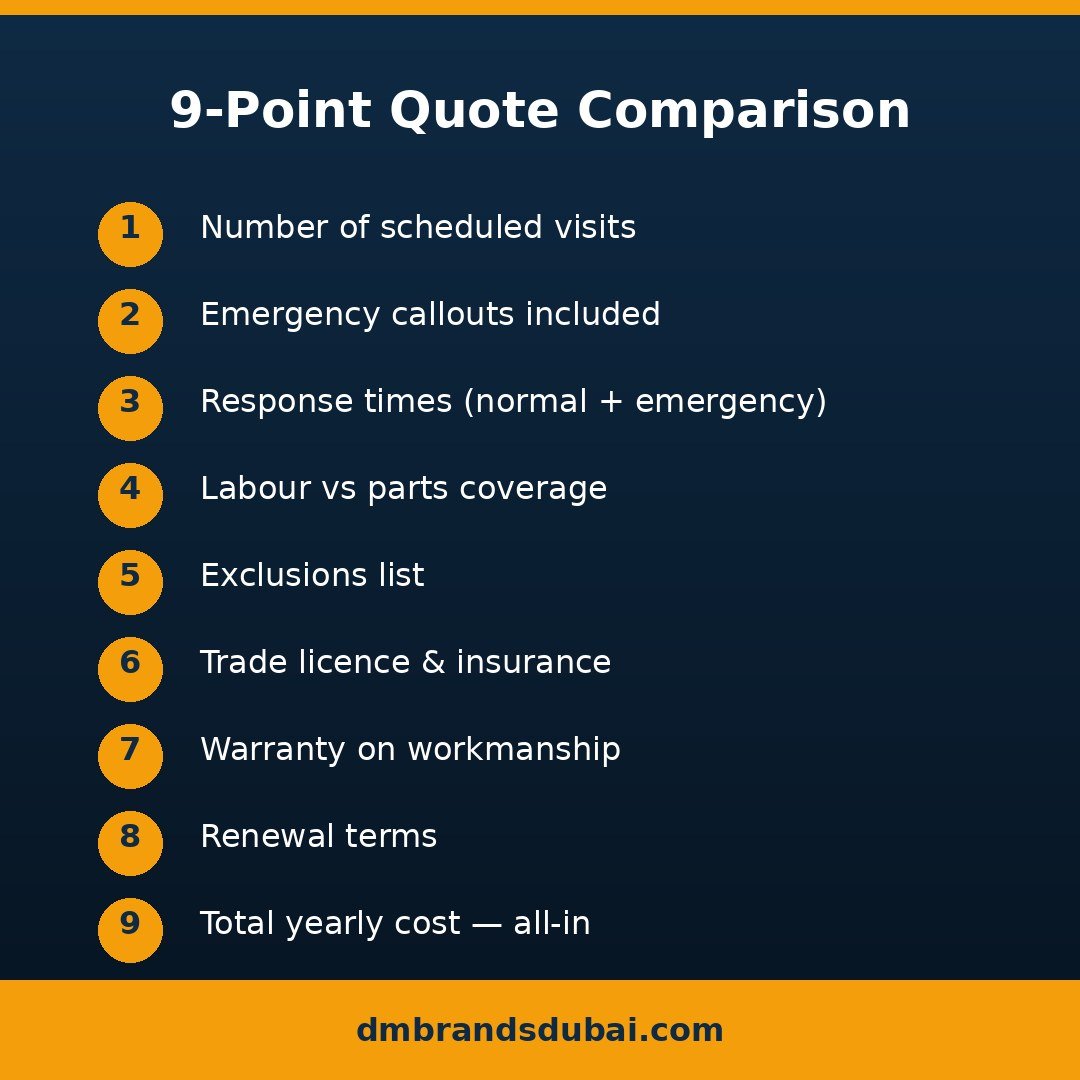
Line them up on these nine points:
- Scheduled visits: how many, in which months, covering which systems
- Included callouts: number per year, and what “a callout” covers (labour only? minor materials?)
- Emergency response: guaranteed maximum times, in writing
- Labour vs parts: exactly where the line is drawn
- Exclusions list: the longer and clearer, the more honest the provider
- Technician credentials: licensed company, directly employed staff vs subcontractors
- Warranty: workmanship warranty period on contract work
- Renewal and cancellation: notice periods, auto-renewal, pro-rated refunds
- Total annual cost vs your reactive history: if you spent AED 6,000 on callouts last year, a AED 4,500 AMC with real coverage is arithmetic, not faith
Ask both providers the same questions, in writing. The one that answers clearly usually delivers clearly.
Why Villas Need Contracts More Than Apartments
It’s structural, not salesmanship. In an apartment, the owners association maintains the chillers, risers, pumps, common areas and water tanks — your AMC only covers what’s behind your own front door. In a villa, you own the whole system: outdoor condensers baking in sand and sun, your own water tank, roof drainage, external lighting, booster pumps, irrigation, sometimes a pool. More systems, more exposure, more benefit from scheduled care. That’s why villa AMCs start higher — and why villa owners feel the value faster.
Three Tiers Compared: What “Basic” vs “Full” Really Means
Providers slice their AMCs differently, but most Dubai contracts fall into three tiers. Here’s what each tier typically means in practice:
| Feature | Basic | Standard | Comprehensive |
|---|---|---|---|
| AC service visits/year | 1–2 | 2 | 2–4 (quarterly) |
| Included reactive callouts | 1–2 | 2–4 | 4–6 |
| Plumbing inspections | Annual check | Annual + 1 callout | Bi-annual + callouts |
| Electrical safety inspection | — | Annual | Annual + thermal imaging |
| Handyman visits | 1–2 | 3–4 | 5–6 |
| Emergency response guarantee | Best effort | 8-hour | 2–4 hour |
| Painting touch-up | — | Minor | Included |
| Water tank / duct scheduling | — | Coordinated | Coordinated + reminders |
| Typical villa price (AED/year) | 3,000 – 5,000 | 5,000 – 8,000 | 8,000 – 15,000 |
How to choose your tier: match it to the property, not the budget. A 5-bedroom villa with 8 AC units on a Basic tier is under-covered — you’ll burn through the included callouts by July and pay emergency rates for the rest of summer. A 1-bedroom apartment on Comprehensive is over-insured. The Standard tier suits most 2–4 bedroom properties; go Comprehensive for large villas, older properties, or anything you rent out.
The Landlord’s Playbook: AMCs as a Business Tool
If you own rental property in Dubai, an AMC isn’t maintenance spending — it’s business infrastructure:
- Void-period protection. A serviced, documented property re-lets faster and photographs better. “Full maintenance history available” is a genuine listing advantage.
- Deposit disputes. Check-in/check-out condition arguments are the most common Dubai rental conflict. Dated service reports from a contract provider are neutral, third-party evidence of the property’s maintained state.
- Tenant retention. Nothing drives a good tenant away like three days without AC in August while you hunt for a technician. Contract priority response protects your rental income directly.
- Cost predictability. One annual figure to budget, instead of random AED 800 surprises through the year. For portfolio landlords with multiple units, this alone justifies the paperwork.
- Handover documentation. When you eventually sell, a multi-year maintenance file adds tangible value to the property’s story.
The portfolio move: if you own 2+ properties, negotiate a multi-property AMC. Providers discount for volume, you get one point of contact, and all properties run on the same service calendar. Ask for it explicitly — it’s rarely advertised.
Facility Managers: Multi-Site and Commercial Considerations
Commercial AMCs operate at a different level of rigour:
- SLA-backed response times. Commercial contracts should specify response in hours, with escalation paths and penalty clauses for misses — not just “priority.”
- Compliance documentation. Electrical safety records, water tank certificates, and service logs that satisfy building management and insurers.
- Out-of-hours servicing. AC and electrical work scheduled for nights/weekends to avoid disrupting operations — confirm this is priced in, not extra.
- Dedicated account handling. One manager who knows your sites, not a call centre reading from a script.
- Consolidated invoicing. Monthly or quarterly billing across sites, with per-site breakdowns for your own cost allocation.
Our commercial annual contracts are built around these requirements — scoped per site after survey, because a 300 sqm office and a retail unit genuinely need different programmes.
Negotiating Your Contract: What to Ask For
Most Dubai AMCs have negotiable elements, especially for villas and multi-property deals:
- Ask for the first-year discount in exchange for a testimonial. Providers value documented case studies; many will trade 10–15% for permission to feature your property (anonymised).
- Negotiate the callout count, not the price. An extra included callout is worth more than a AED 300 discount — it protects you from the exact scenario the contract exists for.
- Get the parts price list attached. Caps, contactors, common spares — agreed rates in an appendix prevent “emergency pricing” on parts during the contract.
- Clarify the renewal increase cap. Some contracts jump 20%+ at renewal. Agree a cap (e.g. max 10%) in year one.
- Trial period in writing. Even 90 days with a clean exit tells you everything about how the company actually performs — which is the whole point.
The First 90 Days: How to Tell If Your AMC Is Working
Sign the contract, then audit it. In the first three months you should see:
- Scheduled visits actually scheduled. The April/August (or quarterly) dates should be diary-confirmed within weeks of signing, not chased by you.
- A written condition report from the first preventive visit — what was found, what was done, what needs watching. This is the baseline everything else is measured against.
- A test of the emergency line. You don’t need a real emergency — but note how quickly they answer a routine query at an odd hour. It predicts the real thing.
- Technician consistency. The same faces learning your property beat a rotating cast re-learning it every visit.
- Invoicing clarity. Every charge matches the contract’s labour/parts split with no mystery line items.
If any of these fail in the first 90 days, raise it immediately — and know your exit terms. A contract that underperforms in month two rarely improves by month ten.
Common AMC Myths, Debunked
“AMCs are just a way to lock me in.” A bad one is. A good one earns renewal through service, not clauses — which is exactly why you should demand trial and exit terms before signing. The lock-in fear is a reason to choose carefully, not a reason to avoid contracts entirely.
“I’ll just call when something breaks — it’s cheaper.” Sometimes, for a new apartment with one minor issue a year. But run the numbers honestly: three emergency callouts in a Dubai summer routinely exceed the annual cost of a proper contract, before counting the stress and the downtime.
“The technicians will invent problems to justify visits.” This happens with commission-driven sales outfits, not with reputable firms. The defence is the same as ever: written scope, no pressure tactics, and the right to a second opinion. Our technicians are directly employed and paid for outcomes, not upsells.
“All AMCs are basically the same.” The price bands above show they aren’t — a AED 2,500 contract and a AED 9,000 contract differ in visit frequency, callout count, response guarantees and parts handling. Compare the nine-point checklist above, not just the headline figure.
“I need to wait until my current issues are fixed before starting.” Backwards. Pre-existing faults are exactly what the first preventive visit is for — it establishes the baseline condition report everything else builds on. Just disclose known issues upfront so the scope is honest.
What if my property is brand new — do I still need an AMC?
New properties need less reactive work, but the scheduled servicing still matters — warranties on AC equipment often require documented maintenance, and the first-year condition report establishes your baseline. A basic tier usually suffices.
Can I transfer my AMC if I sell the property?
Most providers allow transfer to the new owner with a simple novation — it’s actually a selling point. Confirm the mechanism before signing if a sale is on your horizon.
Do AMCs cover the garden and pool?
Standard residential AMCs usually don’t — pool and garden are specialist trades. Large-villa comprehensive tiers sometimes coordinate them. Ask explicitly rather than assuming.
How do I know the technicians are actually qualified?
Ask for the company’s trade licence details and whether electrical work is done to DEWA standards — then check that the same commitments appear in the written scope. A reputable firm states its credentials proudly and in writing; evasiveness is your answer.
What happens at the end of the contract year?
A good provider sends a year-end summary — visits completed, issues found and fixed, upcoming recommendations — alongside the renewal quote. That report is also your leverage: if the year was quiet, negotiate the renewal down or drop a tier.
Conclusion: The Decision Framework
Get an AMC if: you own a villa (especially 3+ bedrooms), your property is more than 8–10 years old, you travel frequently, you rent the property out, or you called a technician 3+ times last year. Skip it (for now) if: you live in a new small apartment, your building covers the major systems, and last year brought at most one minor issue.
Either way, make the decision on numbers, not anxiety — and whichever provider you choose, demand the scope in writing, the response times in writing, and the exit terms in writing.
Get a free quote: Tell us your property type, area and number of AC units — we’ll price an annual contract (or a single service visit, if that’s the smarter buy for you) in writing before anyone comes out. Call or WhatsApp +92 308 862 4813 (24 hours), see what’s covered, or use our free quote form. If a contract doesn’t make sense for your property, we’ll tell you that too.
FAQs
How much does an annual maintenance contract cost in Dubai?
Villas: roughly AED 3,000–12,000/year depending on size and coverage. Apartments: AED 1,200–4,500/year. Commercial: AED 8,000–25,000+/year. Prices below AED 1,000/year for any property type are a red flag.
Is an annual maintenance contract worth it in Dubai?
Yes, if you have multiple AC units, an older villa, travel often, rent out the property, or expect 3+ callouts a year. Portfolio data shows contracted properties spending roughly AED 2,800/year total versus ~AED 7,100/year reactive — before counting downtime.
What is typically included in a Dubai AMC?
Scheduled AC servicing (usually twice yearly), plumbing and electrical inspections, a set number of reactive callouts (labour), handyman visits, and priority emergency response. Parts are usually billed separately.
What’s usually NOT included in an AMC?
Spare parts, major replacements (compressors, water heaters), full repaints, appliance repair, pest control, duct cleaning and water tank cleaning — though these can often be scheduled alongside at preferential handling.
How many AC service visits does an AMC include?
Typically two full services per year (April pre-summer and August mid-season). Quarterly servicing suits heavily-used systems or dusty locations.
Do I need an AMC for an apartment?
Not always. If your building’s owners association maintains the central systems and you had at most one minor issue last year, pay-per-call may be cheaper. AMCs make most sense for villas and older properties.
What should I check before signing an AMC?
Written scope of works, guaranteed response times, included callout count, labour-vs-parts line, exclusions list, technician credentials, workmanship warranty, and renewal/cancellation terms — all in writing.
Can I cancel an annual maintenance contract early?
Reputable providers offer trial windows or pro-rated cancellation terms. Check the contract’s exit clause before signing — avoid 12-month lock-ins with no way out.
Do AMC holders really get faster emergency response?
They should — that’s a core contract benefit. But only if response times are guaranteed in writing (e.g. “within 4 hours for AC failure”). “Priority” without a number is meaningless.
Are spare parts included in the contract price?
Rarely at residential level. Most AMCs cover labour for included callouts; parts are charged at pre-agreed rates. Ask for a parts price list upfront.
Should landlords get an AMC for rental properties?
Usually yes. Documented preventive maintenance reduces midnight tenant calls, protects you in deposit disputes, and preserves the asset. It’s also a selling point to quality tenants.
What’s the difference between residential and commercial AMCs?
Commercial contracts add compliance documentation, out-of-hours working, and coordination with building/facility management. They’re scoped per site after a survey rather than off a fixed menu.
How do I compare two AMC quotes?
Compare scheduled visits, included callouts, guaranteed response times, labour-vs-parts split, exclusions, technician credentials, warranty, renewal terms, and total cost against your actual reactive spending last year.
Is there a trial period for maintenance contracts?
Good providers offer one — e.g. a trial window or cancellation after an initial period with pro-rated refund. Ask before signing.
Does an AMC cover AC replacement?
No — replacement is project work, quoted separately. But a good provider will give you honest repair-vs-replace advice (and contract holders typically get preferential handling on the project quote).
What happens if I don’t use all my included callouts?
They generally don’t roll over — but that’s fine. The preventive visits alone usually justify the contract; unused callouts just mean it was a quiet year, which is the goal.
Can I get an AMC mid-summer?
Yes, though you’ll pay the same annual rate and miss the pre-summer servicing benefit. The best time to start is February–April, before peak season.
Do maintenance contracts cover plumbing emergencies?
Included callouts normally cover plumbing labour (leaks, blockages, fixture failures). Major pipework replacement is project work. Active water damage always qualifies for priority response.
Are electrical works in an AMC DEWA-compliant?
They must be — insist on it. Ask the provider to confirm their electricians work to DEWA standards, and that compliance is part of the written scope.
Which areas of Dubai do you cover for AMCs?
All of Dubai — villas in Arabian Ranches, Dubai Hills, Palm Jumeirah, Jumeirah, Mirdif and Emirates Hills; apartments in Marina, JLT, JBR, Business Bay, Downtown, JVC, DIFC, Deira and Bur Dubai; commercial across the city.