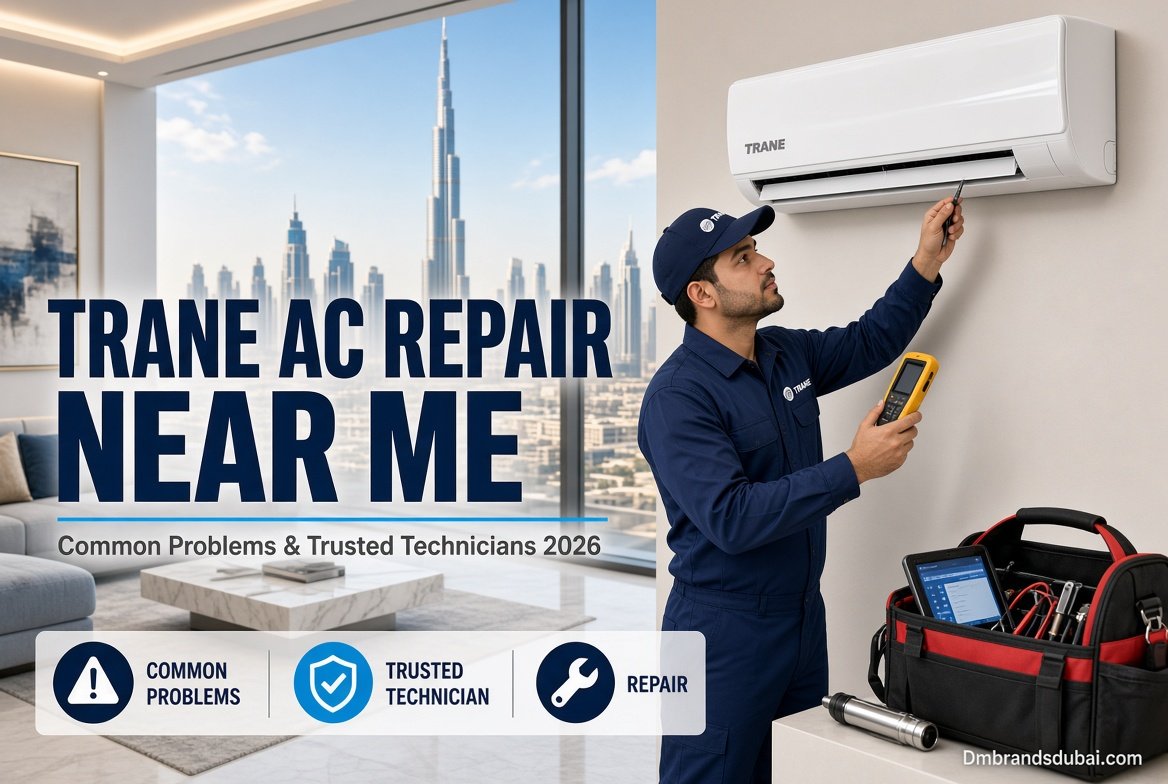
Trane AC repair near me is one of the most urgent searches a homeowner can type when the house starts heating up. It means finding a qualified local technician who can diagnose and fix a Trane air conditioner quickly, safely, and at a fair price.
A good repair brings back steady cooling, protects your warranty, and prevents a small fault from turning into a compressor replacement. A bad one wastes money and leaves the same problem waiting for you next week.
Trane builds some of the most durable residential and commercial cooling equipment on the market. Even so, every air conditioner has parts that wear out, such as capacitors, contactors, fan motors, and drain lines.
Knowing what usually fails, what each repair costs, and how to choose the right technician puts you in control of the process.
Table of Contents
What Does Trane AC Repair Involve?
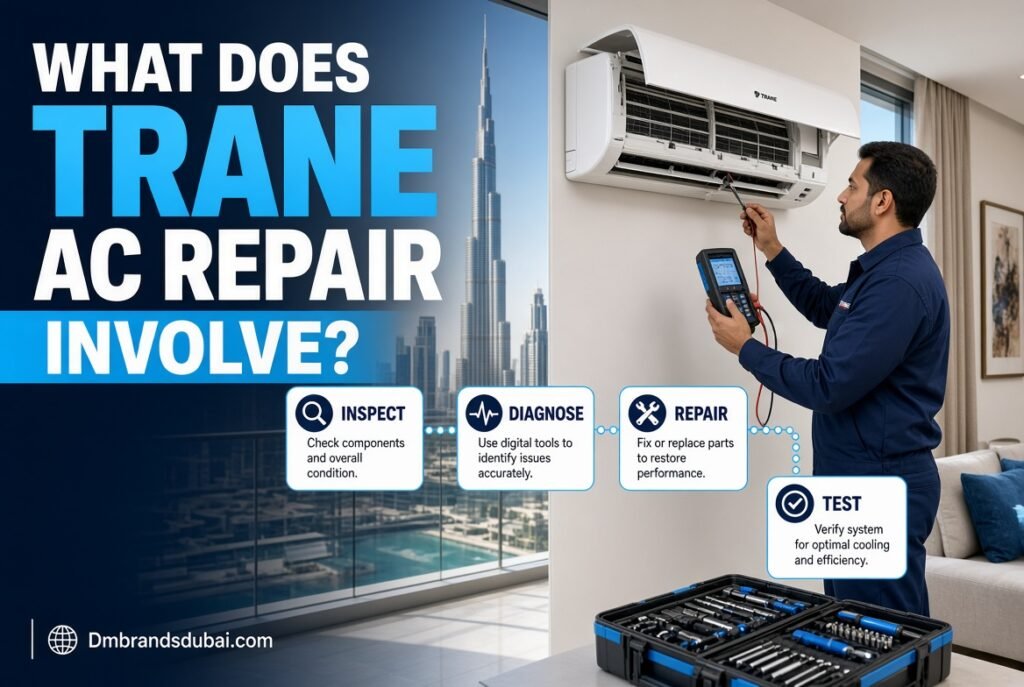
Trane AC repair is the process of diagnosing and fixing a fault in a Trane air conditioner or heat pump. A technician inspects the outdoor condenser, indoor coil, blower, thermostat, and electrical parts, then repairs or replaces the failed component.
Most common Trane repairs are small jobs. A national average of about $350 is widely reported, and many repairs fall between $150 and $650.
Major repairs such as compressor or coil replacement cost much more. Trane’s own repair guide lists compressors at roughly $900 to $2,900 and evaporator coils at $1,000 to $5,000 or more.
What Trane AC Repair Near Me Really Means
When you search for Trane AC repair near me, you are usually looking for one of three things. You may want a Trane authorized dealer, an independent HVAC contractor who works on Trane equipment, or the fastest technician available today.
Each option has advantages. An authorized dealer has factory training and direct access to genuine parts. An independent contractor may offer lower labor rates and flexible scheduling.
The word “near me” matters because air conditioning problems rarely wait. A technician who is already working in your area can arrive faster and often charges less for travel time.
Local companies also know the climate, the common failure patterns in your region, and the permit rules your city requires.
How a Trane Air Conditioner Works
Understanding the basic cooling cycle helps you describe your problem clearly to a technician. A split system has two main parts connected by copper refrigerant lines.
The indoor unit contains the evaporator coil and blower. The outdoor unit contains the compressor, condenser coil, and condenser fan.
Refrigerant absorbs heat from indoor air at the evaporator coil. The compressor then pumps that heat-laden refrigerant outside, where the condenser coil releases the heat into the outdoor air.
The thermostat tells the system when to start and stop. If any link in this chain fails, cooling drops or stops completely.
Main Components of a Trane Split System
| Component | What It Does | Common Failure Signs |
|---|---|---|
| Compressor | Pumps refrigerant through the system | Loud humming, breaker trips, no cooling |
| Condenser coil | Releases heat outdoors | Poor cooling, high bills, visible damage |
| Evaporator coil | Absorbs heat from indoor air | Ice buildup, leaks, weak cooling |
| Run capacitor | Gives motors the jolt to start and run | Humming, delayed start, fan not spinning |
| Contactor | Switches power to the outdoor unit | Clicking, unit won’t start, or won’t stop |
| Condenser fan motor | Moves air across the outdoor coil | Fan stopped, overheating, short cycling |
| Blower motor | Pushes cooled air through ducts | Weak airflow, no air from vents |
| Expansion valve (TXV) | Meters refrigerant into the evaporator | Poor cooling, frost on lines |
| Thermostat | Controls the cooling cycle | Wrong temperature, system won’t respond |
| Condensate drain | Removes moisture from the indoor coil | Water leaks, musty smell, safety switch shutoff |
Trane Product Lines Technicians Commonly Service
Trane sells single-stage, multi-speed, and variable-speed air conditioners. The company’s TruComfort variable-speed models sit at the top of the range, while its XR and XL series cover mid-range and value options.
Variable-speed systems have more electronics, including inverter drives and communicating controls. They need technicians with specific training and diagnostic tools.
Single-stage systems are simpler and usually cheaper to repair. Their parts are widely available, and most experienced HVAC technicians can fix them.
You can find your exact model and serial number on the data plate attached to the outdoor unit. Take a photo of it before you call. It speeds up diagnosis and parts ordering.
Signs You Need Trane AC Repair
Air conditioners usually warn you before they fail completely. Acting on early symptoms is the cheapest way to avoid an emergency.
Warm Air or Weak Cooling
If the vents blow room-temperature or warm air, something in the cooling cycle has stopped working. Common causes include a failed capacitor, low refrigerant from a leak, a dirty coil, or a weak compressor.
Check the filter first. A clogged filter restricts airflow and can freeze the coil. If the filter is clean and the air is still warm, call a technician.
Weak Airflow From Vents
Low airflow can come from a dirty filter, a failing blower motor, blocked or leaking ducts, or a frozen evaporator coil. Uneven airflow between rooms often points to duct problems rather than the AC itself.
Leaky ducts can waste a large share of the cooled air your system produces. Sealing them often improves comfort without touching the Trane unit.
Strange Noises
Different sounds point to different faults. Buzzing or humming often means a weak capacitor or contactor. Grinding or squealing suggests worn motor bearings.
Hissing may indicate a refrigerant leak. Banging or rattling usually means a loose or broken component. Turn the system off if the noise is loud or sudden.
Unusual Smells
A musty smell usually means mold or bacteria on the coil or in the drain pan. A burning smell can signal an overheating motor, a failing wire, or an electrical short.
Shut the system off at the thermostat and the breaker if you smell burning. Do not restart it until a technician has inspected it.
Ice on the Coil or Refrigerant Lines
Ice on the indoor coil or on the copper line outside is a clear warning sign. It typically results from restricted airflow or low refrigerant.
Turn the AC off and set the fan to on so the ice can melt. Running the compressor while the coil is frozen can damage it.
Water Around the Indoor Unit
Water near the air handler or furnace usually comes from a clogged condensate drain, a cracked drain pan, or melting ice. Left alone, it can stain ceilings, damage floors, and grow mold.
Many systems have a float switch that shuts the AC off when the drain backs up. That is a protective feature, not a defect.
Rising Energy Bills
A sudden jump in your electric bill without a change in usage suggests the system is working harder than it should. Dirty coils, low refrigerant, and failing motors all raise energy use.
Compare your last few bills during similar weather. A steady climb over several months is a strong reason to schedule a diagnostic visit.
Frequent Cycling or Constant Running
Short cycling means the system turns on and off in quick bursts. Constant running means it never reaches the set temperature.
Either pattern points to an airflow problem, a thermostat issue, a refrigerant problem, or incorrect equipment sizing.
Trane AC Not Cooling: Causes and Repairs
A Trane AC not cooling is the most common reason homeowners call for repair. The fan may run and air may move, but the air never gets cold.
The cause is usually one of a handful of faults. A technician narrows it down with temperature readings, pressure gauges, and electrical tests.
Dirty Air Filter
A clogged filter chokes airflow across the evaporator coil. The coil can freeze, and cooling drops sharply.
Replace the filter every one to three months, or more often with pets or heavy dust. This is the cheapest fix on the list.
Failed Run Capacitor
The capacitor helps the compressor and fan motor start and run. When it weakens, the outdoor fan may spin slowly or not at all, and the compressor may hum without starting.
Trane’s repair guide lists capacitor repairs at roughly $100 to $400. It is one of the most common and affordable AC repairs.
Low Refrigerant
Refrigerant does not get used up. If the level is low, there is a leak somewhere in the system.
Adding refrigerant without finding the leak is only a temporary patch. A proper repair locates the leak, fixes it, and then recharges the system to the manufacturer’s specification.
Dirty Condenser Coil
The outdoor coil collects grass clippings, cottonwood, dust, and pollen. A dirty coil cannot release heat, so the system runs hot and cools poorly.
A professional coil cleaning restores performance and lowers energy use. Keep two feet of clearance around the outdoor unit.
Failing Compressor
The compressor is the heart of the system. When it fails, the outdoor unit may run without cooling, trip the breaker, or make loud noises.
Compressor repairs are among the most expensive. Age, warranty status, and refrigerant type decide whether repair or replacement makes more sense.
Trane AC Not Turning On
If the system is completely dead, start with the simple checks. Make sure the thermostat is set to cool and the temperature is below room temperature.
Check that the breaker has not tripped and that the service switch near the outdoor unit is on. Replace thermostat batteries if the display is blank.
Tripped Breaker or Blown Fuse
A breaker that trips once may be a fluke. A breaker that trips repeatedly signals an electrical fault, such as a shorted motor, a failing compressor, or damaged wiring.
Do not keep resetting it. Repeated resets can overheat wiring and damage components.
Faulty Contactor
The contactor is an electrical switch that sends power to the compressor and condenser fan. Contacts can pit, burn, or stick over time.
A bad contactor may cause clicking, a unit that will not start, or an outdoor unit that will not shut off. Replacement is usually a quick and moderate-cost repair.
Bad Control Board
Modern Trane systems use control boards that manage fan speeds, safety switches, and communication with the thermostat. A failed board can stop the whole system.
Trane’s guide lists circuit board repairs from about $75 to $600. Technicians should confirm the board is truly faulty before replacing it.
Thermostat Problems
A dead thermostat, loose wiring, or a communication error between a smart thermostat and the outdoor unit can mimic a major failure. Many “broken AC” calls end with a thermostat fix.
Thermostat repair or replacement costs about $90 to $600, depending on the model and wiring.
Trane AC Freezing Up
Ice on the evaporator coil blocks airflow and stops cooling. You may see frost on the copper line, water dripping from the air handler, or weak air from the vents.
Turn the AC off, switch the fan on, and let the ice melt completely. This can take several hours.
Why Trane Coils Freeze
The most common reasons are a dirty filter, a failing blower motor, closed or blocked vents, and low refrigerant. Cold nights can also cause icing if you run the AC at low outdoor temperatures.
If the coil freezes again after you replace the filter, call for service. The problem is likely refrigerant or airflow related.
Trane AC Leaking Water
Some condensation is normal. Your air conditioner removes humidity from the air, and that water drains away through a condensate line.
A leak means the water has nowhere to go. The cause is usually simple, but the damage can be serious if ignored.
Clogged Condensate Drain Line
Algae, mold, and debris can block the drain line. Water backs up into the pan and overflows.
Clearing a clogged condensate line is a low-cost repair. Trane’s guide lists condensate drain tube repairs at about $100 to $195.
Cracked or Rusted Drain Pan
Older pans can rust or crack. Replacing a drain pan costs more than clearing a line, usually around $150 to $350.
Frozen Evaporator Coil
When ice melts, it can overwhelm the drain pan. Fixing the cause of the freeze solves the leak.
Failed Condensate Pump
Systems in basements or attics may use a pump to move water. When the pump fails, the system can overflow or shut down on its safety switch.
Trane AC Making Noise
Air conditioners should hum quietly. New or louder sounds are a signal to listen closely and act.
| Sound | Likely Cause | Urgency |
|---|---|---|
| Humming but no start | Weak capacitor or seized motor | High, shut off the system |
| Buzzing | Loose part, failing contactor, electrical issue | Moderate to high |
| Clicking at startup | Normal relay noise or failing control part | Low to moderate |
| Rattling | Loose panel, debris, or loose fan blade | Moderate |
| Squealing | Worn belt or motor bearing | Moderate to high |
| Grinding | Failing motor bearings | High, shut off the system |
| Hissing | Refrigerant leak or valve issue | High |
| Banging | Loose or broken internal part | High |
When to Shut It Off Immediately
Turn the system off if you hear grinding, loud banging, or hissing. Running a damaged component can destroy the motor or compressor.
Cut power at the breaker if you also notice burning smells, sparks, or smoke.
Trane AC Short Cycling
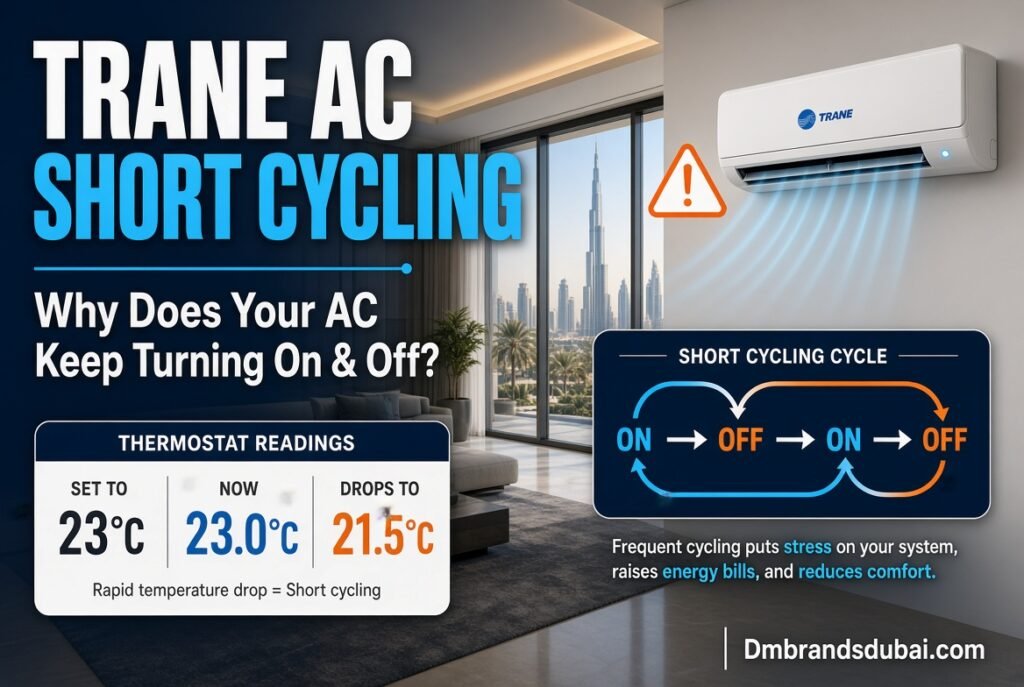
Short cycling means the system starts, runs for a few minutes, then stops, over and over. It wastes energy and wears out the compressor.
Common causes include a dirty filter, a frozen coil, an oversized system, a faulty thermostat, a refrigerant leak, or an overheating compressor.
An oversized unit cools the house too quickly and shuts off before it can remove humidity. This leaves the home cool but clammy.
A proper load calculation during replacement prevents this issue. Existing systems may need airflow corrections or control adjustments.
Trane AC Blowing Warm Air
If the indoor fan runs and the air feels warm, the outdoor unit may not be running. Go outside and check whether the fan is spinning and the compressor is humming.
If the outdoor unit is silent, suspect a tripped breaker, contactor, capacitor, or control issue. If it runs but air is warm, suspect low refrigerant, a failing compressor, or a dirty coil.
Also confirm the thermostat is set to “cool” and not “fan only.” It is a surprisingly common cause of warm air.
Trane AC Refrigerant Leaks
Refrigerant leaks are a serious repair. They reduce cooling, can freeze the coil, and harm the environment.
Common leak points include evaporator coil tubing, flare connections, service valves, and refrigerant lines. Leaks can be tiny and slow.
How Technicians Find Leaks
Professionals use electronic leak detectors, UV dye, nitrogen pressure testing, and soap bubble tests. They then repair the leak, evacuate the system, and recharge it with the correct refrigerant.
Trane’s guide lists refrigerant line repair at roughly $1,500 to $3,000 or more for significant line work, while smaller fixes cost less.
Refrigerant Type Matters
Older systems may use R-22, which was phased out of production and is costly. Many systems built after the mid-2000s use R-410A. Newer equipment is moving to lower global warming potential refrigerants such as R-454B.
Handling refrigerant legally requires EPA Section 608 certification in the United States. Never buy a DIY recharge kit for a central air system.
Trane AC Compressor Problems
The compressor is the most expensive moving part in your outdoor unit. It rarely fails alone. Dirty coils, low refrigerant, electrical faults, and poor maintenance often lead to its death.
Warning signs include loud humming, repeated breaker trips, hot outdoor unit casing, and no cooling even though the fan is running.
Trane lists compressor repairs from about $900 to $2,900. If your unit is registered and within its compressor warranty, the part may be covered, though labor usually is not.
For older systems, compressor replacement often pushes the bill close to the cost of a new outdoor unit. In that case, consider the repair-versus-replace rules later in this guide.
Trane AC Fan Motor Problems
Both the outdoor condenser fan and the indoor blower rely on motors. If either fails, heat cannot move properly.
An outdoor fan that does not spin often needs a capacitor or a new motor. An indoor blower that does not run can point to a motor, capacitor, control board, or wiring problem.
Trane’s guide lists fan motor repair at about $200 to $700. Variable-speed blower motors cost more than standard ones.
Trane AC Expansion Valve and Coil Issues
The thermostatic expansion valve, or TXV, regulates refrigerant flow into the evaporator coil. When it sticks or fails, cooling drops and the coil may freeze.
TXV repairs range from about $100 to $700 in Trane’s published tables. A coil leak is more expensive, because evaporator coils run about $1,000 to $5,000 or more.
Trane’s outdoor units use an all-aluminum Spine Fin coil design. It resists corrosion well, but a leaking coil usually needs replacement rather than patching.
Trane AC Smells and Air Quality Problems
A properly working system should not smell. Musty odors come from mold and bacteria in wet areas, such as the evaporator coil and drain pan.
Clean the drain, replace the filter, and schedule a coil cleaning. If the smell lingers, the ducts may need inspection.
A rotten egg odor can signal a natural gas leak in a gas furnace. Leave the home and call the gas utility from outside.
Trane AC High Energy Bills
When your cooling costs rise, your Trane is usually telling you something. Dirty coils, low refrigerant, a failing capacitor, and leaky ducts all force the system to work longer.
Newer SEER2 ratings measure efficiency under updated test conditions that better reflect real installations. Higher SEER2 equipment costs more upfront but can lower operating costs in hot climates.
A maintenance tune-up often finds the hidden cause. It is the first step before assuming the unit needs replacement.
Emergency Trane AC Repair
An AC failure is more than an inconvenience during a heat wave. Infants, older adults, people with medical conditions, and pets face real health risks when indoor temperatures climb.
Emergency Trane AC repair means a technician arrives outside normal hours, often the same day or night. Expect to pay more for after-hours service.
When It Counts as an Emergency
Treat these situations as urgent:
- The AC fails during extreme heat and vulnerable people are in the home
- You smell burning or see smoke or sparks
- Water is leaking near electrical equipment
- You hear loud grinding or banging from the outdoor unit
- The breaker trips immediately every time you reset it
Shut the system off first. Then call a technician and describe exactly what you see and hear.
What to Do Before the Technician Arrives
Turn the thermostat to off and cut power at the breaker if you suspect an electrical problem. Close blinds, run ceiling fans, and move to the coolest room.
Take a photo of the data plate on the outdoor unit. Note when the problem started and any sounds, smells, or error lights you noticed.
Same-Day and 24-Hour Trane AC Repair
Many HVAC companies advertise 24-hour service. Ask whether that means a live technician or only an answering service.
Ask for an arrival window and whether the company charges an emergency fee. Confirm that the technician carries common Trane parts, such as capacitors and contactors, on the truck.
Trane AC Repair Cost in 2026
Repair costs depend on the part, the labor rate in your area, the age of the system, and how hard it is to access. Trane’s own guide says HVAC repairs can range from about $75 to nearly $3,000.
Industry sources report a national average of about $350 for common AC repairs, with most jobs landing between $150 and $650.
Average Cost by Repair Type
The figures below come from Trane’s published repair guide. Your actual quote will vary.
| Repair | Typical Cost Range |
|---|---|
| Capacitor | $100 to $400 |
| Circuit board | $75 to $600 |
| Compressor | $900 to $2,900 |
| Condensate drain tube | $100 to $195 |
| Condensate pump | $100 to $165 |
| Condenser coil | $1,000 to $4,000+ |
| Drain pan | $150 to $350 |
| Evaporator coil | $1,000 to $5,000+ |
| Expansion valve | $100 to $700 |
| Fan motor | $200 to $700 |
| Fuses and relays | $75 to $290 |
| Refrigerant lines | $1,500 to $3,000+ |
| Thermostat | $90 to $600 |
Factors That Change Your Quote
Several variables push the price up or down:
- Type of repair and parts needed
- Age and model of the unit
- Single-stage, multi-speed, or variable-speed equipment
- Whether parts are in stock locally
- Local labor rates and travel distance
- Emergency, weekend, or holiday service
- Refrigerant type and the amount required
- Access to the indoor and outdoor units
Diagnostic and Service Call Fees
Most companies charge a diagnostic fee. Marketplace listings often show service calls from about $70 to $125, and some companies waive the fee if you approve the repair.
Always ask what the fee covers and whether it applies toward the final bill.
Why Trane Parts May Cost More
Trane is a premium brand, and genuine parts often cost more than universal replacements. Trane says its dealers use authentic Trane parts when repairing Trane equipment.
Universal parts can work well for items like capacitors. Proprietary electronic boards and variable-speed motors are better sourced from the manufacturer.
How to Get an Accurate Quote
Ask for a written, itemized estimate before work starts. It should list parts, labor, taxes, fees, and warranty terms.
Request a second opinion for any repair above $1,000. A reputable contractor will not mind.
Trane AC Repair vs Replacement
When a repair gets expensive, the real question is whether to keep fixing an old system or invest in a new one. The answer depends on age, cost, efficiency, and reliability.
Rules of Thumb Homeowners Use
Two common guidelines help frame the decision:
- The 50 percent rule: If the repair costs more than half the price of a new system, replacement usually makes sense.
- The $5,000 rule: Multiply the system’s age by the repair cost. If the result is over $5,000, replacement deserves serious thought.
These are guides, not laws. A 12-year-old Trane in good shape with a $400 repair is a clear repair. A 20-year-old unit with a $2,500 compressor job is not.
Signs It May Be Time to Replace
- The system is 15 years old or more and needs frequent repairs
- It uses R-22 refrigerant, which is expensive and no longer produced
- The repair requires a compressor or evaporator coil on an older unit
- Energy bills keep climbing despite maintenance
- Comfort is uneven or humidity is a constant problem
- The indoor and outdoor units are mismatched
Cost of Replacement
Trane’s 2026 pricing guide estimates air conditioner replacement from about $6,568 to $13,669, depending on the model and features. Trane notes these are estimates, not guarantees.
Variable-speed units with advanced controls sit at the top of the range. Single-stage units cost less but offer fewer comfort and efficiency benefits.
Repair vs Replace Decision Table
| Situation | Better Choice |
|---|---|
| Under 10 years old, minor part failure | Repair |
| Under warranty with a covered part | Repair |
| 10 to 15 years old, repair under $600 | Repair |
| 15+ years old, repair over $1,500 | Consider replacement |
| R-22 system with a refrigerant leak | Strongly consider replacement |
| Compressor failure on an older unit | Consider replacement |
| Repeated breakdowns in one season | Consider replacement |
Trane AC Warranty Repair
Warranty coverage can reduce your repair bill significantly. It is worth checking before you approve any work.
Trane offers a Base Limited Warranty and a Registered Limited Warranty on residential equipment. The base warranty typically covers parts for five years.
The 60-Day Registration Rule
If the equipment is registered within 60 days of installation, coverage usually extends to ten years for parts. Trane notes the length can vary by product.
Trane also advises homeowners not to assume the dealer registered the system. Confirm it and keep the certificate.
What the Warranty Usually Does Not Cover
The limited warranty generally covers replacement parts that fail because of manufacturing defects. It does not typically cover labor, refrigerant, or damage caused by poor maintenance or improper installation.
Ask the technician whether the failed part is covered and what labor charges will apply. Some dealers offer separate labor warranties.
How to Use Your Warranty
- Find your model and serial number on the outdoor unit
- Locate your warranty certificate or registration record
- Contact a Trane dealer or the installing contractor
- Ask the technician to document the failure and confirm coverage
- Keep all service records for future claims
Trane Authorized Dealer vs Independent HVAC Contractor
Both can fix your Trane. The right choice depends on your priorities, the age of the system, and what is failing.
| Factor | Authorized Trane Dealer | Independent Contractor |
|---|---|---|
| Factory training | Typically yes | Varies |
| Genuine Trane parts | Standard | Often available, may use universal parts |
| Warranty paperwork | Usually handled directly | May require extra steps |
| Labor rates | Often higher | Often lower |
| Availability | Varies by dealer | Varies by company |
| Variable-speed expertise | Strong | Depends on experience |
For a system under warranty or a complex variable-speed unit, an authorized dealer is often the safer choice. For a simple repair on an older single-stage unit, a skilled independent contractor can be a cost-effective option.
Using Trane’s Dealer Search
Trane offers an online tool to locate local dealers. It is a good starting point for finding vetted professionals who meet the brand’s standards.
Check reviews, ask about service availability, and confirm that the company can service your specific model.
How to Find the Best Trane AC Repair Near You

A strong repair experience depends on three things: a correct diagnosis, a clear written quote, and a technician with real Trane experience.
Check Licensing and Insurance
Licensing rules vary by state and city. Ask for the contractor’s license number and verify it with your state board.
Confirm that the company carries liability insurance and workers’ compensation. This protects you if something goes wrong on your property.
Look for Certifications
Technicians who handle refrigerant must hold EPA Section 608 certification in the United States. Many also hold NATE certification, an industry credential that tests real-world HVAC knowledge.
Trane-specific training is a strong plus, especially for variable-speed or communicating systems.
Read Reviews Carefully
Look for patterns across multiple platforms. Pay attention to comments about punctuality, honesty in diagnosis, cleanliness, and follow-up.
A handful of negative reviews is normal. Repeated complaints about surprise fees or unnecessary replacements are a warning.
Compare at Least Two Quotes
For repairs over a few hundred dollars, compare at least two written estimates. Make sure they describe the same work and the same parts.
The cheapest quote is not always the best. A very low price may skip the diagnostic work or use poor parts.
Questions to Ask Before Booking Trane AC Repair
A short phone call can reveal a lot about a company. Ask these questions before you schedule:
- Do you service Trane equipment regularly?
- Are your technicians licensed, insured, and EPA certified?
- What is your diagnostic fee, and is it applied to the repair?
- Do you provide written, itemized estimates?
- Do you stock common Trane parts?
- Can you handle warranty paperwork for me?
- What warranty do you offer on parts and labor?
- How soon can a technician arrive?
- Is there an extra charge for evenings, weekends, or holidays?
Red Flags to Avoid
Most HVAC contractors are honest, but a few practices should make you pause:
- Pressure to replace the whole system without a full diagnosis
- A quote that is much lower or higher than others with no explanation
- No license number or proof of insurance
- Refusal to provide a written estimate
- Adding refrigerant repeatedly without locating the leak
- Demanding full payment upfront for a routine repair
- No warranty on labor or parts
What Happens During a Trane AC Repair Visit
Knowing the process helps you spot a thorough technician. A professional visit follows a clear sequence.
Step 1: Listening to Your Description
The technician asks what you noticed, when it started, and whether anything changed recently. Details such as sounds, smells, and error lights help narrow the cause.
Step 2: Visual and Electrical Inspection
They check the thermostat settings, filter, breaker, disconnect, wiring, and visible damage. They then test the capacitor, contactor, and motor with a multimeter.
Step 3: Airflow and Temperature Testing
The technician measures the temperature drop across the evaporator coil and checks airflow. They look for ice, dirt, and blocked vents.
Step 4: Refrigerant Pressure Check
Gauges show whether the refrigerant charge is correct. A low reading triggers a leak search rather than a simple top-up.
Step 5: Written Diagnosis and Quote
The technician explains the problem in plain language and gives you options. You approve the work before parts are ordered or installed.
Step 6: Repair and Testing
After the repair, the technician runs the system through a full cooling cycle. They verify temperatures, amp draw, pressures, and drainage.
Step 7: Documentation
You should receive an invoice listing parts, labor, and warranty terms. Keep it with your equipment records.
Safe DIY Checks Before Calling for Trane AC Repair
A few simple checks can save you a service fee. They can also give the technician useful information.
Always stay on the safe side. Never open electrical panels, touch capacitors, or handle refrigerant yourself.
Checks You Can Do Safely
- Confirm the thermostat is set to cool and below the room temperature
- Replace dead thermostat batteries
- Check that the breaker for the AC and air handler is on
- Make sure the outdoor disconnect switch is in the on position
- Replace or inspect the air filter
- Open all supply vents and remove anything blocking returns
- Look for ice on the indoor coil or copper line
- Clear leaves and debris from around the outdoor unit
- Check for water in the drain pan or around the air handler
- Look for a tripped float switch on the condensate line
What Not to Do
- Do not remove access panels on the outdoor unit
- Do not touch capacitors, which can hold a dangerous electrical charge
- Do not add refrigerant or buy “recharge” kits
- Do not pour bleach into the condensate drain without guidance
- Do not run the AC with a frozen coil
- Do not keep resetting a tripping breaker
Trane AC Error Codes and Diagnostic Lights
Many Trane indoor units, furnaces, air handlers, and thermostats show status lights or codes. These give technicians a head start on diagnosis.
Codes differ by model, so the label on the service panel is the best reference. A blinking pattern often indicates a specific fault, such as a pressure switch, limit switch, or communication problem.
If you see a code, write it down or take a photo before turning the system off and on. Resetting can erase the information.
Communicating systems use a thermostat that talks digitally to the outdoor unit. Faults can show up as communication errors rather than mechanical ones.
Trane AC Maintenance to Prevent Repairs
Maintenance is the best defense against breakdowns. Most failures develop slowly, and a tune-up often catches them early.
A yearly service before cooling season is a smart standard. Homes in hot, humid, or dusty regions benefit from a second visit.
What a Professional Tune-Up Includes
- Inspect and clean evaporator and condenser coils
- Check and test capacitors, contactors, and relays
- Measure refrigerant pressures and temperature split
- Inspect electrical connections and tighten loose wiring
- Lubricate motors where applicable
- Clear and flush the condensate drain
- Test thermostat calibration and operation
- Check airflow and filter condition
- Inspect refrigerant lines and insulation
- Verify safety controls
Maintenance Schedule
| Task | Frequency | Who Does It |
|---|---|---|
| Replace or clean filter | Every 1 to 3 months | Homeowner |
| Clear debris around outdoor unit | Monthly in season | Homeowner |
| Flush condensate drain | Every few months | Homeowner or technician |
| Professional tune-up | At least once a year | Technician |
| Coil cleaning | Annually or as needed | Technician |
| Duct inspection | Every few years | Technician |
Benefits of Regular Maintenance
Maintenance lowers energy use, reduces repair costs, and extends the unit’s life. It also keeps your warranty on solid ground, since many manufacturers expect reasonable upkeep.
Many contractors offer annual maintenance plans with priority scheduling and discounts on repairs. Compare what each plan includes before signing.
Seasonal Trane AC Care Calendar
Matching your care to the season keeps your system ready when you need it most.
| Season | What to Do |
|---|---|
| Early spring | Schedule a tune-up, replace the filter, clear the outdoor unit |
| Summer | Check filters monthly, watch for weak cooling, keep vents open |
| Early fall | Clean the outdoor unit, flush the drain, inspect for damage |
| Winter | Cover only if the manufacturer allows, keep the area clear of snow and ice |
Book spring tune-ups early. Contractors get busy as soon as the first hot days arrive, and emergency calls cost more.
Trane Heat Pump Repair
Trane heat pumps provide both cooling and heating, so many repair issues overlap with air conditioners. Heat pumps add a few extra components.
Reversing Valve Problems
The reversing valve switches the system between heating and cooling. A stuck valve can leave you with heat in summer or cold air in winter.
Defrost Control Issues
In cold weather, the outdoor coil can frost over. The defrost system melts the ice. A fault can leave the coil buried in ice and cut heating output.
Auxiliary Heat Running Too Often
If your electric bills spike in winter, the backup electric heat may be running too much. A technician can check whether the heat pump is delivering its share.
Trane publishes a separate repair table for heat pumps. Costs tend to be similar to AC repairs, with extra charges for reversing valves and defrost parts.
Trane Ductless Mini Split Repair
Ductless systems have their own failure patterns. Common issues include frozen indoor coils, drain clogs, remote or control faults, and communication errors between indoor and outdoor units.
Mini splits often use inverter-driven compressors and electronic boards. A technician with ductless training is the best choice.
Cleaning the filters and indoor coil regularly prevents many problems.
Trane Commercial AC Repair
Businesses rely on rooftop units, chillers, and large split systems. Downtime can cost sales and make workplaces unbearable.
Commercial systems require technicians with commercial HVAC training and often specialized licensing. Look for contractors who handle controls, economizers, and multi-zone systems.
A preventive maintenance agreement is usually the best way to keep commercial equipment running.
AC Duct Repair and Why It Affects Trane Performance
A Trane air conditioner is only as good as the ducts that carry its air. Leaky, disconnected, or poorly insulated ducts waste cooled air and strain the system.
Signs of duct problems include uneven temperatures, weak airflow, dust around vents, high bills, and noisy ductwork.
Sealing and insulating ducts can improve comfort and efficiency without replacing the AC. Ask your technician to inspect the ducts during a repair visit.
Duct problems often get blamed on the air conditioner itself. A proper diagnosis looks at the entire system, not just the outdoor unit.
Trane vs Carrier vs Lennox: Repair Considerations
Trane, Carrier, and Lennox are often grouped as premium residential brands. All three sell reliable equipment, and all three need regular maintenance.
| Factor | Trane | Carrier | Lennox |
|---|---|---|---|
| Brand tier | Premium | Premium | Premium |
| Parts availability | Wide through dealers | Wide through dealers | Wide through dealers |
| Typical repair approach | Dealer or trained contractor | Dealer or trained contractor | Dealer or trained contractor |
| Warranty registration | Within 60 days for extended coverage | Varies by product | Varies by product |
The best brand for repairs is the one with a qualified technician nearby. Installation quality and maintenance usually matter more than the name on the unit.
If you own a Carrier system, the guide on Carrier AC repair listed below walks through costs and common problems in similar detail.
Trane AC Refrigerant Changes: What Homeowners Should Know
The HVAC industry is moving to refrigerants with lower global warming potential. In the United States, this transition follows federal rules that reduce the production of high-impact refrigerants.
R-22 has been phased out of production, so repairs on older systems can be expensive. R-410A remains common in existing equipment. Newer systems are moving toward options like R-454B.
You cannot mix or substitute refrigerants. Each system is designed for a specific type and charge.
If your older system has a major leak, the cost of refrigerant and repair can tip the decision toward replacement.
Smart Thermostats and Trane AC Repair
Smart thermostats can help you track runtime, receive alerts, and adjust schedules. Some also give technicians useful data about how the system has behaved.
Compatibility matters. Variable-speed and communicating Trane systems may need a compatible control. A wrong thermostat can cause errors or reduce performance.
Ask your technician before buying a new thermostat for a multi-stage or variable-speed system.
How to Lower Future Trane AC Repair Costs
Prevention is cheaper than repair. A few habits can reduce your risk of surprise bills:
- Change filters on schedule
- Book annual maintenance
- Keep the outdoor unit clear
- Fix small problems early
- Seal and insulate ducts
- Register new equipment within 60 days
- Keep service records and warranty paperwork
- Avoid overworking the system by setting a reasonable thermostat temperature
- Use ceiling fans and window coverings to reduce load
How to Prepare for a Trane AC Repair Appointment
A little preparation makes the visit faster and often cheaper. Technicians spend less time searching and more time fixing.
Gather the Basics
Write down the model and serial number from the outdoor unit and the indoor unit. Note the installation date if you know it.
Find your warranty certificate and any past service invoices. These records help the technician judge the system’s history.
Describe the Symptoms Clearly
Be specific about what you noticed. Instead of saying the AC is broken, explain what changed.
Useful details include when the problem began, whether it happens all the time or only at certain hours, and any sounds or smells. Mention if you recently changed the thermostat, filter, or power setup.
Clear Access to the Equipment
Move stored items away from the air handler, furnace, or attic access. Trim plants and clear debris from around the outdoor unit.
Secure pets in another room. Technicians need safe, open access to work efficiently.
Common Mistakes Homeowners Make With Trane AC Repair
Small mistakes can turn a simple repair into an expensive one. Avoiding them protects your equipment and your budget.
Ignoring Early Warning Signs
A weak capacitor can damage the compressor if it keeps struggling. A slow drain leak can ruin drywall before you notice.
Early action is almost always cheaper than waiting for a complete breakdown.
Running the System With a Frozen Coil
Many people keep the AC running because the house is hot. This can flood the drain pan and damage the compressor.
Turn the system off and let the ice melt before you try again.
Choosing the Lowest Price Only
A cheap quote can hide skipped diagnostics, poor parts, or hidden fees. A technician who rushes may fix the symptom and leave the cause.
Compare scope, parts, warranty, and reputation along with price.
Skipping Maintenance
Neglected coils, filters, and drains cause a large share of avoidable service calls. A yearly tune-up costs far less than most major repairs.
Using the Wrong Replacement Parts
Not every part fits every model. Wrong capacitors, motors, or boards can cause performance problems or shorten equipment life.
Ask the technician to confirm the part numbers match your system.
Assuming the Dealer Registered the Warranty
Trane advises homeowners not to assume the installer completed registration. If it was missed, the extended warranty window may be gone.
If your system is new, confirm registration right away.
Trane AC Repair in Hot and Humid Climates
Systems in hot, humid regions run longer and work harder. Parts wear faster, and condensate problems are more common.
High humidity increases the amount of water the coil removes. Drain lines clog faster, and mold can grow if moisture lingers.
Coastal Areas
Salt air can corrode outdoor coils and electrical parts. Rinse the outdoor unit gently as recommended and schedule more frequent inspections.
Coil corrosion is one reason coastal systems may need earlier repairs.
Desert and Dusty Areas
Dust clogs filters and coils quickly. In these places, filters may need monthly replacement during peak season.
Intense heat also stresses capacitors, contactors, and compressors. Preventive checks are especially valuable.
Storm and Power Surge Damage
Lightning and power surges can damage control boards, capacitors, and compressors. A whole-home surge protector or an HVAC-specific surge device can reduce the risk.
If a storm hits and your AC stops working, check the breaker and call a technician. Do not assume the unit is a total loss.
Humidity Control and Comfort Problems
Cooling is only part of comfort. A system that cools but leaves the home sticky is not working as well as it should.
Oversized equipment, dirty coils, low airflow, and poor fan settings can all hurt humidity control. Variable-speed systems often handle moisture better because they run longer at lower speeds.
If rooms feel cool but damp, ask your technician to check sizing, airflow, and fan settings. A repair or adjustment may be enough.
Indoor Air Quality and Your Trane System
Your air conditioner moves the air in your home many times a day. Dirty filters, coils, and ducts can spread dust and allergens.
Trane offers whole-home air cleaning options for some systems. Your technician can explain whether a better filter, a media cabinet, or an air cleaner fits your equipment.
Do not install a very dense filter without checking compatibility. A filter that restricts airflow too much can cause freezing and strain the blower.
Energy Efficiency and SEER2 Ratings
SEER2 is the current efficiency rating used for central air conditioners in the United States. It reflects updated testing conditions that better match real installations.
A higher SEER2 means the system can deliver more cooling per unit of electricity. The savings depend on climate, usage, and electricity rates.
For an older Trane, a repair can bring back lost efficiency. For a very old system, replacement with a high-efficiency model may reduce long-term operating costs.
ENERGY STAR certification can help you compare models. Ask the contractor for efficiency details and available utility rebates or incentives.
Proper Sizing and Installation Quality
Many repair problems start at installation. Incorrect sizing, poor airflow design, and weak refrigerant work can cause repeated failures.
A qualified contractor performs a load calculation. It considers square footage, insulation, windows, orientation, and local climate.
Bigger is not better. An oversized AC short cycles, wastes energy, and handles humidity poorly. An undersized system runs constantly and never catches up.
If you have chronic problems with a newer system, ask a technician to review airflow, refrigerant charge, duct design, and equipment matching.
Home Warranty Plans and Trane AC Repair
Some homeowners carry a home warranty or service plan that covers air conditioning repairs. These plans differ widely in what they cover.
Read the contract carefully. Check limits per repair, exclusions for existing conditions, and requirements for maintenance records.
Also confirm whether you can choose your own contractor. Some plans assign technicians from a network.
A manufacturer’s parts warranty and a home warranty are separate. They may work together if both apply.
Trane AC Repair for Landlords and Renters
If you rent, check your lease before calling a technician. Many leases make the landlord responsible for major equipment repairs.
Report problems in writing and keep copies. Document when the issue began and how it affects the home.
Landlords should respond quickly. An AC failure in extreme heat can become a habitability issue in many places, and local rules vary.
Real-World Examples of Trane AC Repair Scenarios
These simple examples show how typical repairs unfold. Costs and timing vary by region.
Scenario 1: The Humming Outdoor Unit
A homeowner hears humming from the outdoor unit, but the fan does not spin. The technician finds a failed run capacitor, replaces it, and tests the system.
The repair is quick and relatively affordable. Waiting could have burned out the motor.
Scenario 2: The Dripping Ceiling
Water stains appear below the attic air handler. The technician discovers a clogged drain line and a rusted secondary pan.
After clearing the line and replacing the pan, the leak stops. A maintenance plan helps prevent a repeat.
Scenario 3: The Slowly Weakening AC
A system that once cooled well now struggles on hot days. Pressure testing shows low refrigerant from a small leak at the evaporator coil.
The homeowner compares repair and replacement quotes. Because the unit is 17 years old, replacement becomes the stronger option.
Your Trane AC Repair Checklist
Use this short checklist when something goes wrong:
- Stop and note what you see, hear, and smell
- Turn off the system if you notice burning, grinding, or water near electrical parts
- Check the thermostat, filter, and breaker
- Take a photo of the data plate
- Review your warranty and registration
- Call a licensed, insured technician
- Ask for a written estimate
- Compare repair and replacement costs for major jobs
- Keep all invoices and records
- Schedule annual maintenance after the repair
DM Brands Dubai: AC Service, Repair, and Replacement
DM Brands Dubai provides home maintenance, AC servicing, and emergency AC repair across Dubai. The work is carried out by directly employed, insured technicians.
The company’s main services are AC Service and Repair, and AC Replacement and Installation. Dubai’s extreme summer heat makes fast response and reliable workmanship essential.
If you own a Trane system in Dubai, the DM Brands Dubai team can help diagnose cooling problems, water leaks, weak airflow, strange noises, and electrical faults.
AC Repair Services
Every repair starts with a full diagnostic so you receive an accurate quote and a lasting fix. Typical issues include:
- AC not cooling or weak airflow
- Water leaking from the indoor unit
- Strange noises and bad smells
- AC not turning on
- High electricity bills caused by an inefficient system
AC Maintenance and Cleaning
Routine servicing keeps equipment efficient in a dusty, humid climate. Maintenance visits can include filter cleaning, coil cleaning, drain line checks, thermostat checks, and duct inspection.
Deeper cleaning services cover ducts, coils, and filters to improve airflow and indoor air quality.
AC Replacement and Installation
When a system is beyond repair, DM Brands Dubai handles unit selection, removal of the old system, and professional installation. Correct sizing is a key part of the process.
Emergency AC Repair
Breakdowns do not wait for office hours. DM Brands Dubai offers emergency AC repair support for homes, villas, and offices across Dubai.
Annual Maintenance Contracts
An annual maintenance contract schedules regular servicing so small problems are caught early. It is a simple way to stay on a maintenance schedule year-round.
Areas Served
DM Brands Dubai serves communities including Dubai Marina, Jumeirah Village Circle, Palm Jumeirah, Downtown Dubai, Business Bay, Al Barsha, and Arabian Ranches.
If your Trane system is in the United States, use Trane’s dealer search to find a local authorized dealer. The checklist in this guide applies anywhere.
Frequently Asked Questions (FAQs)
How much does Trane AC repair cost?
Most common AC repairs cost between $150 and $650, with a national average near $350. Trane’s own guide shows individual repairs from about $75 to nearly $3,000.
Capacitors and drain repairs sit at the low end. Compressors, coils, and refrigerant lines sit at the high end.
How do I find a Trane AC repair technician near me?
Start with Trane’s online dealer search, then compare local reviews and licensing. Call two or three companies and ask whether they service your specific model.
Choose the one that offers a clear diagnostic process and a written estimate.
Do I need an authorized Trane dealer for repairs?
No, but a dealer can be the better choice for warranty work and variable-speed systems. Independent contractors can handle many repairs well if they have Trane experience.
Check licensing, insurance, and references either way.
Why is my Trane AC not cooling?
Common causes include a dirty filter, a failed capacitor, low refrigerant, a dirty condenser coil, a frozen evaporator coil, or a failing compressor. A tripped breaker or thermostat problem can also stop cooling.
Check the filter and breaker first, then call a technician if the problem continues.
Why is my Trane AC running but blowing warm air?
The indoor fan may be running while the outdoor unit is off. Check for a tripped breaker, a bad contactor, a failed capacitor, or a refrigerant problem.
Make sure the thermostat is set to cool and not fan only.
Why is my Trane AC freezing up?
Restricted airflow and low refrigerant are the usual causes. A dirty filter, blocked vents, or a weak blower can all lead to ice.
Turn the AC off and let the ice melt before calling for service.
Why is my Trane AC leaking water?
A clogged condensate drain is the most common cause. A cracked drain pan, frozen coil, or failed condensate pump can also cause leaks.
Turn off the system if water is pooling and call a technician.
Why is my Trane AC making a loud noise?
Humming often points to a weak capacitor, grinding points to worn bearings, and hissing may indicate a refrigerant leak. Banging usually means a loose or broken part.
Shut the system off if the noise is loud or sudden.
Why does my Trane AC keep tripping the breaker?
A repeated trip suggests an electrical problem such as a failing compressor, shorted motor, or damaged wiring. Do not keep resetting the breaker.
Call a licensed technician to inspect the system.
Is it worth repairing a Trane air conditioner?
For newer systems and affordable repairs, yes. Trane equipment is built for long service life, and many failures involve inexpensive parts.
For older systems with expensive failures, compare repair cost with replacement.
How long does a Trane air conditioner last?
With regular maintenance, central air conditioners commonly last 15 to 20 years. Climate, installation quality, and maintenance habits all affect lifespan.
Heavy use in hot regions can shorten that range.
How long does a Trane AC repair take?
Simple repairs such as capacitor or contactor replacement often take one to two hours. Complex repairs like coil or compressor replacement can take a full day or require ordering parts.
Ask the technician for an estimated timeline during the diagnosis.
Is emergency Trane AC repair more expensive?
Usually yes. After-hours, weekend, and holiday calls often carry higher labor rates or emergency fees.
Ask about pricing before you approve the visit.
Can I fix my Trane AC myself?
You can replace filters, clear debris, and check the thermostat and breaker. You should not handle refrigerant, open electrical panels, or touch capacitors.
Those jobs require training, tools, and certification.
Does Trane offer 24-hour AC repair?
Trane itself does not repair homes directly. Local dealers and contractors provide the service, and many offer 24-hour support.
Confirm availability and emergency rates when you call.
What is the Trane warranty on parts?
Trane’s Base Limited Warranty typically covers parts for five years. The Registered Limited Warranty typically covers parts for ten years if the equipment is registered within 60 days of installation.
Coverage varies by product, so check your certificate.
Does the Trane warranty cover labor?
The limited warranty generally covers parts, not labor. Some dealers or extended plans offer labor coverage separately.
Ask the contractor what charges apply before you approve work.
How do I register my Trane system?
You or your dealer can register the product online or by phone within 60 days of installation. Have the model and serial numbers ready.
Keep a copy of the confirmation and warranty certificate.
Where is the model number on my Trane AC?
The model and serial number are on the data plate on the outdoor unit. A similar label is on the indoor air handler or furnace.
Take a clear photo so you always have it.
What is the most common Trane AC problem?
Electrical wear parts, including capacitors and contactors, are among the most common failures. Drain clogs, refrigerant leaks, and dirty coils are also frequent.
These issues occur in most brands and are usually manageable.
How often should I service my Trane AC?
Schedule a professional tune-up at least once a year, ideally before the cooling season. Heavy-use homes may benefit from two visits.
Change filters every one to three months.
How often should I change the filter on my Trane AC?
Most filters need replacement every one to three months. Pets, allergies, dust, and construction can shorten that interval.
Check the filter monthly during peak use.
Why is my energy bill so high with my Trane AC?
Dirty coils, low refrigerant, failing motors, leaky ducts, and an aging system can all raise energy use. Thermostat settings and home insulation also matter.
A maintenance visit can often find the cause.
Can a Trane AC be repaired if it uses R-22?
Yes, but R-22 is no longer produced and is expensive. A leak repair on an older R-22 system may not be cost effective.
Ask your technician for repair and replacement quotes.
Should I replace my Trane AC or repair it?
Consider age, repair cost, efficiency, and reliability. Replacement is worth discussing when the system is over 15 years old and needs a major repair.
Repair is usually better for newer systems with minor faults.
How much does it cost to replace a Trane AC?
Trane’s pricing guide estimates air conditioner replacement at roughly $6,568 to $13,669, depending on the model and features. Other sources report different ranges.
A local dealer can provide an exact quote after assessing your home.
What does a Trane AC tune-up include?
A tune-up covers coil cleaning, electrical checks, refrigerant pressure testing, drain flushing, thermostat testing, and airflow checks. The technician also looks for early signs of wear.
It is the best way to avoid surprise breakdowns.
Can a dirty filter damage my Trane AC?
Yes. A clogged filter restricts airflow, which can freeze the coil, overheat components, and raise energy use.
Replace it regularly to protect the system.
Do I need to repair my ducts if my Trane AC is not cooling evenly?
Possibly. Leaky or poorly designed ducts are a common cause of uneven cooling.
A technician can test airflow and inspect the ductwork to confirm.
Can a Trane AC be repaired on a weekend?
Many companies offer weekend service, often at higher rates. Availability depends on the contractor and season.
Call early in the day to improve your chances of same-day service.
What should I do if my Trane AC stops working in a heat wave?
Turn off the system if you hear loud noises or smell burning. Close blinds, use fans, drink water, and move to the coolest room.
Call a technician and ask for priority service, especially if vulnerable people are at home.
How do I know if a repair quote is fair?
Compare it with typical ranges, ask for itemized pricing, and get a second opinion on large repairs. A fair quote lists parts, labor, fees, and warranty terms.
Be cautious if the price is far from others without a clear reason.
Does DM Brands Dubai offer AC repair?
Yes. DM Brands Dubai provides AC service and repair, AC replacement and installation, maintenance, and emergency AC repair across Dubai.
The work is carried out by directly employed, insured technicians.
Can DM Brands Dubai help with AC maintenance in Dubai?
Yes. Maintenance can include filter cleaning, coil cleaning, drain line checks, thermostat checks, and duct inspection. Annual maintenance contracts are also available.
Regular servicing keeps systems efficient in Dubai’s heat.
Conclusion
Finding the right Trane AC repair near me comes down to preparation. Know your symptoms, find your model number, check your warranty, and choose a licensed technician who explains the diagnosis clearly.
Most Trane problems start small. A weak capacitor, a clogged drain, or a dirty coil is inexpensive to fix when caught early. Routine maintenance, filter changes, and fast action when something feels wrong protect both your comfort and your wallet.
Compare repair costs with the age of your system, and ask for written estimates before approving major work. When the numbers point toward replacement, a properly sized and professionally installed system will serve you for many years.
If your Trane or any other AC system is in Dubai, DM Brands Dubai offers AC service and repair, AC replacement and installation, maintenance, and emergency repair across the city. Contact the team through https://dmbrandsdubai.com/ to book a diagnostic visit.