A video doorbell is one of the simplest and most useful home security upgrades you can make in Dubai.
It lets you see and speak to whoever is at your door — from your phone, from anywhere — whether you are in the living room, at work in DIFC, or travelling abroad.
For villas in Arabian Ranches, apartments in Dubai Marina, and townhouses in JVC, a video doorbell adds security, convenience, and control over deliveries and visitors.
This guide covers the types of video doorbells available, wired versus battery models, typical installation costs in AED, Wi-Fi and wiring requirements, building rules in Dubai apartments, and how to choose a professional installer.
What Is a Video Doorbell and How Does It Work?
A video doorbell combines a doorbell, a camera, a microphone, a speaker, and a motion sensor in one weatherproof unit mounted beside your front door.
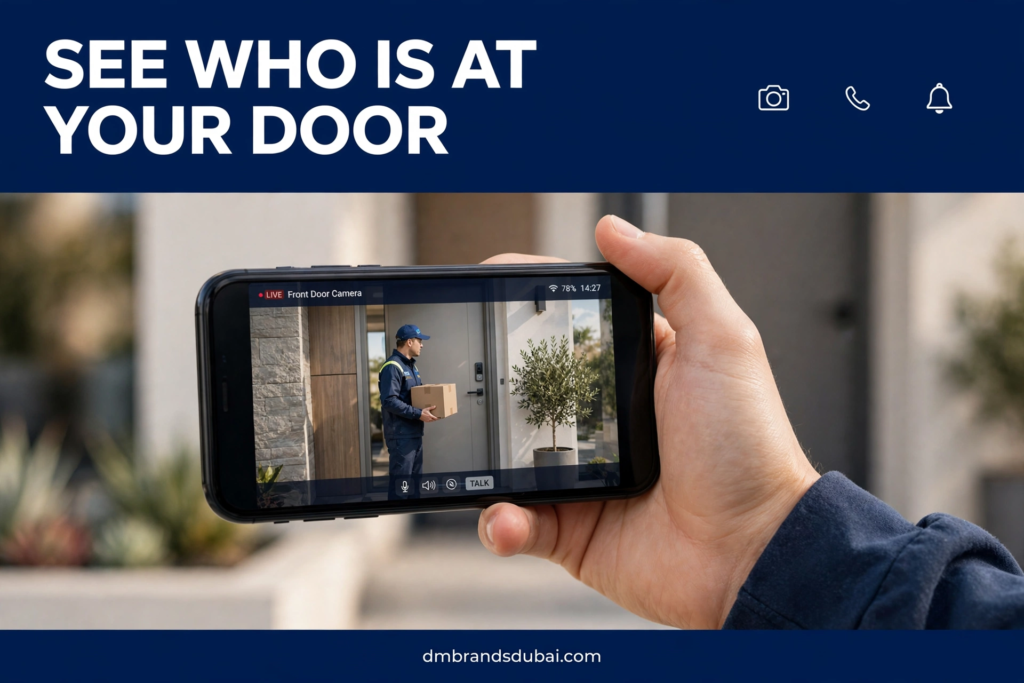
When someone presses the bell or triggers the motion sensor, your phone receives an alert. You can watch a live video feed, talk to the visitor through two-way audio, and, in many models, record the interaction.
Most video doorbells connect to your home Wi-Fi and store video clips in the cloud, on local storage, or both. Higher-end models add features such as package detection, person detection, and integration with smart locks and home assistants.
The camera typically records in 1080p or higher, with night vision for after dark. In Dubai, where summer heat and dust are constant factors, a weather-resistant rating and a heat-tolerant battery matter more than in cooler climates.
For broader home security, a video doorbell pairs well with CCTV installation in Dubai and with a full smart home installation in Dubai, so the doorbell becomes part of one connected system rather than a standalone gadget.
Why Dubai Homes Benefit Especially from Video Doorbells
Dubai’s lifestyle makes video doorbells unusually useful.
Delivery volumes are high. Food, groceries, parcels, and courier deliveries arrive daily in most households, and a video doorbell lets you confirm a delivery, give instructions to the courier, or check that a parcel was left safely — even when you are not home.
Villas have a specific security gap: the front gate or door may be far from the living areas. A video doorbell at the gate or door closes that gap, letting you screen visitors before opening anything.
Apartments benefit too. In high-rise towers, a video doorbell at the apartment door adds a layer of security beyond the building’s lobby and intercom system. It also records who knocked while you were out.
For families with children or elderly relatives at home, a video doorbell adds reassurance. You can check who is at the door remotely and speak to them, without anyone needing to open the door to a stranger.
Holiday homes and short-term rentals gain as well. Hosts can verify guest arrivals, check cleaner or maintenance visits, and monitor the property between stays — all from their phone.
Finally, video doorbells deter opportunistic crime. A visible camera at the door makes a property a less attractive target, and recorded footage is valuable evidence if an incident ever occurs.
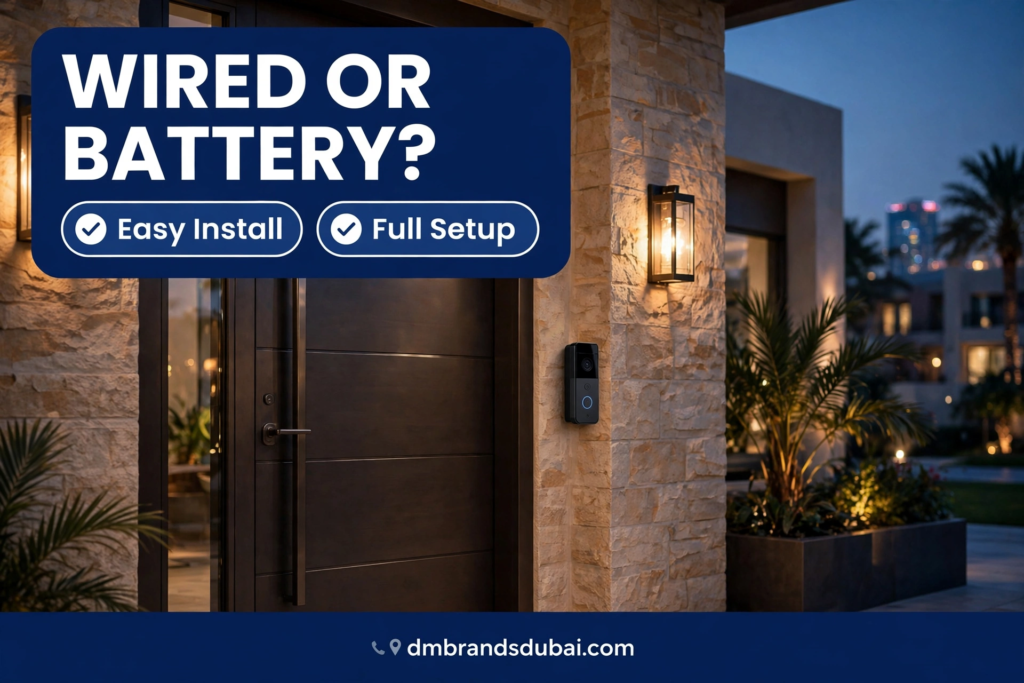
Wired vs Battery Video Doorbells: Which Suits Your Home?
Battery-powered video doorbells
Battery models are the easiest to install. They mount with screws, need no wiring, and can be fitted almost anywhere near the door.
They are ideal for rented apartments, where drilling into wiring is not an option, and for villa gates where running a cable would be expensive.
The trade-off is maintenance. Batteries need recharging every few weeks to a few months, depending on motion activity and temperature. In Dubai’s summer heat, battery life can drop, so expect more frequent charging from June to September.
Some battery models can be connected to a small solar charger, which helps in sunny Dubai — provided the charger itself is positioned in direct sunlight.
Wired video doorbells
Wired models connect to your existing doorbell wiring or a low-voltage transformer. They draw continuous power, so they never need recharging, and they often support continuous recording and a traditional indoor chime.
They suit homeowners who already have doorbell wiring, or who are renovating and can add wiring easily. Installation is more involved and usually requires an electrician or experienced installer.
If your home has no existing doorbell wiring, adding it may involve running a cable through walls or conduits, which adds cost — especially in finished villas.
Wired with battery backup
Some models combine both: wired for everyday power, with a battery that keeps the doorbell running during a power cut. This is a strong choice for villas and for anyone who wants reliability during DEWA outages or maintenance.
For most Dubai apartments, a battery model is the practical starting point. For villas and long-term homes, a wired model usually pays off in convenience and features.
Popular Video Doorbell Options in Dubai
Several major brands are widely available in Dubai, through electronics retailers and online stores.
Ring doorbells are the most common, with battery and wired models, a well-developed app, and optional cloud recording subscriptions. Ring’s support pages, such as Ring’s installation help, cover mounting, wiring, and Wi-Fi troubleshooting in detail.
Google Nest doorbells integrate with Google Home and offer intelligent alerts, including person and package detection. They suit households already using Google Assistant or Nest cameras.
Eufy doorbells appeal to buyers who prefer local storage over a monthly subscription. Video is stored on the device or a home base station, which avoids ongoing cloud fees.
Arlo doorbells offer high video quality and integrate with Arlo’s wider camera ecosystem, making them a good choice if you already use Arlo cameras.
When choosing, check three things before the brand: whether your Wi-Fi reaches the door reliably, whether your door position gives a useful camera angle, and whether you want a subscription or local storage. The brand decision follows from those answers.
Also confirm the operating temperature range. Dubai summer heat at a sun-exposed door can exceed 50°C, and some models handle heat better than others. A shaded mounting position helps every model last longer.
Video Doorbell Installation Cost in Dubai (Typical Ranges)
Costs split into the device itself and the installation labour. These are typical market ranges in AED, not a quote.
| Item | Typical range (AED) |
|---|---|
| Battery video doorbell (device only) | 350 – 900 |
| Wired video doorbell (device only) | 450 – 1,200 |
| Premium doorbell with advanced features | 900 – 1,800 |
| Battery model installation (labour) | 150 – 350 |
| Wired model installation (labour) | 300 – 700 |
| New wiring / transformer installation | 200 – 600 |
| Wi-Fi extender or chime setup | 100 – 300 |
| Solar charger add-on | 150 – 350 |
| Cloud subscription (per month, if chosen) | 10 – 40 |
A straightforward battery installation in an apartment usually totals AED 500–1,200 including the device. A wired villa installation with new wiring typically runs AED 1,000–2,500 including the device.
Always confirm what installation includes: mounting, Wi-Fi setup, app configuration, motion-zone setup, and a test of live view, two-way audio, and notifications. A proper handover should leave you able to use every feature, not just the doorbell button.
If the installer also fits a smart lock, intercom, or cameras in the same visit, ask about a bundle price. Combining work is often cheaper than separate callouts, and it ensures the devices work together properly. See intercom installation in Dubai for a related upgrade that pairs naturally with a video doorbell.
What Happens During a Professional Installation
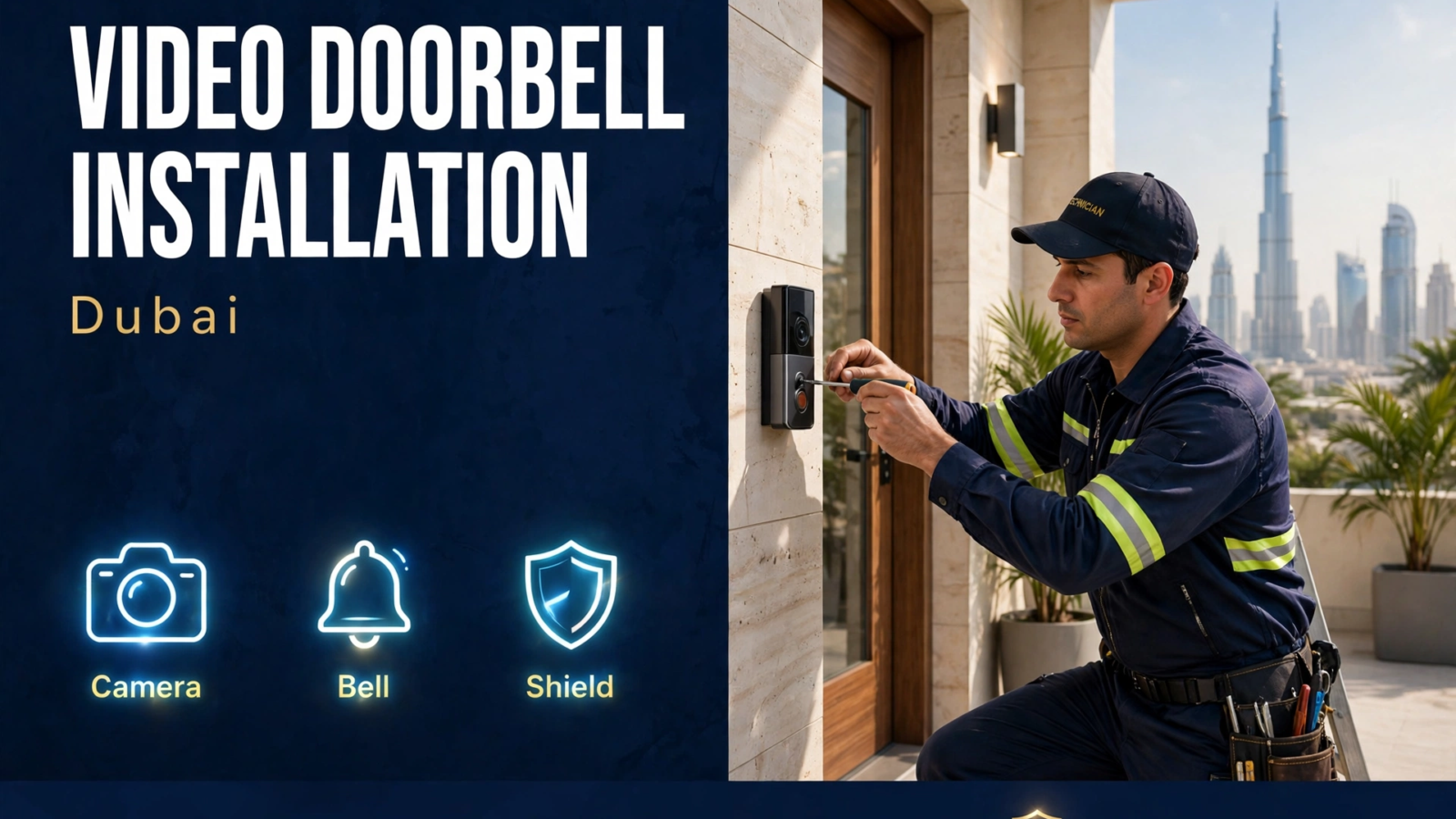
A professional installation usually takes 1–2 hours for a battery model and 2–4 hours for a wired model with new wiring.
First, the installer assesses the door, the mounting surface, the camera angle, and the Wi-Fi signal at the door. A weak signal is the most common cause of a doorbell that works poorly, so this check matters.
Next, they mount the bracket at the right height — usually around 120 cm from the ground, so faces are captured clearly rather than the tops of heads.
For wired models, they connect to the existing doorbell wiring or install a transformer, testing voltage before connecting the doorbell. Electrical work should be done safely and neatly, with cables routed through conduit where exposed.
Then they connect the doorbell to your Wi-Fi, configure the app on your phone, and set up motion zones, sensitivity, and notification preferences. Motion zones matter in Dubai: a doorbell facing a busy corridor or street will generate constant alerts unless zones are tuned to your doorway only.
Finally, they test everything with you: live view, two-way talk, motion alerts, night vision, and, for wired models, the indoor chime. They should also show you how to recharge or replace the battery, adjust settings, and share access with family members.
Before the installer leaves, check the camera view yourself on your phone. Make sure faces at the door are clear, the angle covers the approach, and the image is not washed out by sunlight or blocked by a door frame.
Wi-Fi, Power, and Positioning: Getting the Setup Right
Three factors decide whether a video doorbell works well or frustrates you daily.
Wi-Fi signal is first. Video doorbells need a stable 2.4 GHz Wi-Fi connection at the door. Many Dubai apartments have the router far from the front door, behind thick walls. If the signal is weak, a Wi-Fi extender or mesh node near the door solves it — and it is far cheaper than replacing the doorbell later.
Positioning is second. The doorbell should face the approach to the door, not a blank wall or a bright light source. Avoid mounting it where direct afternoon sun hits the lens, which causes glare and overheating. A small shade or a slightly angled mount can fix both problems.
Power is third. For battery models, plan a charging routine — every month or two in normal use, more often in summer. For wired models, confirm the transformer voltage matches the doorbell’s requirements; an incorrect transformer is a common cause of doorbells that buzz, overheat, or fail early.
Also consider your door material. Metal doors and gates can interfere with Wi-Fi and require a wedge or angle mount to get a clear view. UPVC and wooden doors are simpler.
If you are unsure about any of these, a pre-installation survey is worth it. A good installer will check signal, angle, and power before drilling anything.
Building Rules, Landlord Permission, and Privacy in Dubai
Before installing, check the rules that apply to your home.
In rented apartments, ask your landlord or property manager first. Most landlords allow a battery doorbell, which causes minimal alteration, but written permission avoids disputes at move-out. Wired installations that alter electrical systems almost always need approval.
In apartment towers, building management may have rules about devices in common corridors. A doorbell mounted on your own door frame is usually acceptable, but a camera pointing down a shared corridor can raise privacy concerns with neighbours. Angle the camera at your doorway, not at neighbours’ doors.
In villa communities, community management may regulate gate-mounted devices. Check community guidelines before mounting a doorbell on a shared or community-facing gate.
Privacy is a real consideration. A video doorbell records visitors, delivery riders, and passers-by. Use it for your own doorway security, keep recordings private, and avoid sharing footage publicly. Motion zones and privacy zones in the app help limit recording to your own entrance.
For tenants, a battery doorbell has a further advantage: it can be removed at move-out with minimal marks, and it moves with you to your next home.
If your building already has an intercom system, a video doorbell complements it rather than replacing it. The intercom controls building access; the doorbell secures your individual front door.
Video Doorbell Installation Across Dubai’s Neighbourhoods
Different property types across Dubai present different installation challenges.
In Dubai Marina, JLT, and Downtown Dubai, apartments dominate. Battery doorbells are the norm, Wi-Fi extenders are often needed because routers sit deep inside the apartment, and building rules about corridor cameras must be respected.
In Palm Jumeirah, Emirates Hills, and Arabian Ranches, villas dominate. Wired doorbells at gates are common, but long cable runs and gate pillars make professional installation worthwhile. Heat and sun exposure at gates also demand careful positioning.
In JVC, Dubai Hills, and Town Square, townhouses and villas mix. These homes often suit a wired doorbell at the front door plus a battery unit at a side gate, giving coverage of both entrances.
In older areas such as Deira, Bur Dubai, and Al Barsha, older wiring and thicker walls are common. A pre-installation check of wiring and Wi-Fi is especially important here, and battery models are often the simpler choice.
For landlords and short-term rental hosts, a video doorbell is a practical investment. It verifies arrivals, monitors cleaner and maintenance visits, and adds a security feature that guests value. Hosts should inform guests that a doorbell camera is present at the entrance — transparency avoids complaints.
Choosing a Video Doorbell Installer in Dubai
The installer matters as much as the device. A poor mount, bad angle, or weak Wi-Fi setup will make even the best doorbell perform badly.
Look for:
- A pre-installation check. Signal, angle, and power should be assessed before drilling.
- Experience with your property type. Villa gate installations differ from apartment door installations.
- Electrical competence. Wired work should be done by someone qualified, with the correct transformer and safe cable routing.
- Full app setup. The installer should configure your phone, motion zones, and notifications — not just mount the hardware.
- Written pricing. Device, labour, wiring, and any subscription should be itemised before work starts.
- Aftercare. Ask who to call if the doorbell goes offline, and whether the installer offers a follow-up visit.
- Integration knowledge. If you have cameras, a smart lock, or a home assistant, the installer should connect the doorbell into that system. A related upgrade, door lock repair and smart lock fitting in Dubai, pairs naturally with a video doorbell for keyless entry.
Avoid installers who skip the Wi-Fi check, mount the doorbell without testing the camera angle, or leave you without app access. Those shortcuts cause most post-installation complaints.
Also confirm whether the installer supplies the device or fits one you have bought. Supply-and-fit is simpler for warranty purposes, because one company is responsible for both the hardware and the installation.
Maintaining Your Video Doorbell in Dubai’s Climate
Dubai’s heat, dust, and humidity demand a little regular care.
Clean the camera lens monthly with a soft, dry cloth. Dust on the lens causes blurry video and false motion alerts, and it builds up quickly in Dubai.
Check the mount and screws every few months. Heat expansion and contraction can loosen fittings, especially on sun-exposed gates.
For battery models, set a charging reminder. Do not wait for the battery to die completely — a doorbell that goes offline leaves your door unmonitored, and a fully drained battery degrades faster.
Keep the app and firmware updated. Manufacturers release updates that improve motion detection, fix bugs, and patch security vulnerabilities. Enable automatic updates where the app offers them.
Protect your account. Use a strong, unique password for the doorbell app and enable two-factor authentication. A video doorbell is a security device, and its account deserves the same care as your email or banking login.
Review motion settings seasonally. Longer daylight hours, Ramadan timings, and changes in foot traffic around your home can all change how often the doorbell alerts you. Tuning zones and sensitivity twice a year keeps alerts useful rather than annoying.
If your doorbell is exposed to direct sun, consider a small shade or a silicone cover designed for your model. It reduces overheating and extends battery and component life.
Common Installation Mistakes to Avoid
Mounting too high is the most common mistake. A doorbell mounted above head height captures the tops of heads, not faces. Around 120 cm is the right height for most doors.
Ignoring Wi-Fi is the second. A doorbell installed where the signal is weak will miss alerts, drop video, and drain its battery faster as it struggles to stay connected. Always test signal at the door before mounting.
Using the wrong transformer for a wired model causes buzzing, overheating, or premature failure. Check the doorbell’s voltage requirements and match the transformer exactly.
Forgetting motion zones leads to alert fatigue. A doorbell facing a busy street or corridor will notify you constantly unless zones are restricted to your doorway and approach.
Skipping the night-vision test is another error. Check the camera view after dark before the installer leaves — infrared reflection from a nearby wall or gate can wash out the image.
Finally, not sharing access properly causes frustration. Set up family access in the app during installation, so everyone who needs it can answer the door, not just the person who was home on installation day.
Video Doorbells and Smart Locks: A Natural Pairing
A video doorbell plus a smart lock is one of the most practical combinations for a Dubai home.
The doorbell shows you who is at the door; the smart lock lets you open it remotely. Together, they allow you to admit a cleaner, a family member, or a delivery into a secure porch area without being home.
Integration varies by brand. Ring pairs with selected smart locks, Google Nest works with compatible locks through Google Home, and other brands use general smart-home platforms. If this pairing matters to you, choose the doorbell and lock as a system, not as separate purchases.
For villas, the combination is especially useful at gates: verify a visitor on video, then release the gate remotely. For apartments, it means never needing to leave a key with a visitor or rush home for a delivery.
If you already have a smart lock, tell the installer before they arrive so they can confirm compatibility and configure the integration during the same visit.
Features Worth Paying For — and Ones You Can Skip
Video doorbells range from basic to feature-packed, and the price gap is large. These are the features that genuinely matter in Dubai homes.
Person detection is worth it. It distinguishes people from passing cars, swaying trees, or cats, which dramatically reduces false alerts — especially for villa gates facing a street.
Package detection is useful if you receive frequent deliveries. It alerts you when a parcel is left and, on some models, when it is picked up. For households that order groceries and parcels daily, this is a real convenience.
Two-way talk with noise reduction matters more than it sounds. Dubai streets are noisy, and a doorbell microphone that cannot cut traffic noise makes conversations frustrating.
Colour night vision, available on some premium models, gives clearer identification after dark than standard infrared. If your entrance is poorly lit, it is worth considering.
Local storage is worth weighing against subscriptions. If you dislike monthly fees, a model with onboard or base-station storage saves money over time, though you should still back up important clips.
Features you can usually skip include ultra-high 4K resolution on a small doorbell lens, which adds cost and bandwidth without much practical benefit, and advanced facial recognition, which raises privacy questions and is unnecessary for most homes.
The best approach is to list what you actually need — visitor screening, delivery monitoring, or full security coverage — and choose the cheapest model that does those things well.
Troubleshooting Common Video Doorbell Problems
Most video doorbell problems have simple fixes, and knowing them saves a callout.
If alerts stop arriving, check the app notification permissions on your phone first. Phone software updates sometimes reset permissions silently. Also confirm the doorbell is online in the app.
If live view is slow or pixelated, the cause is usually Wi-Fi. Move a mesh node or extender closer to the door, or switch the doorbell to a less congested Wi-Fi channel. A doorbell on a weak signal will always underperform, no matter how good the hardware is.
If the battery drains quickly, check motion sensitivity and zones. A doorbell facing a busy corridor that records hundreds of events a day will drain far faster than one tuned to a quiet doorway. Summer heat also shortens battery life, so expect faster drain from June to September.
If night vision looks washed out, check for reflective surfaces near the lens — a white wall, a glass panel, or a shiny gate can bounce infrared back into the camera. Angling the doorbell slightly or adding a wedge mount usually fixes it.
If two-way talk sounds muffled, clean the speaker and microphone openings. Dust buildup in Dubai clogs these small openings faster than most owners expect.
If the doorbell goes offline repeatedly, restart your router and check for firmware updates. Persistent offline problems usually point to Wi-Fi coverage, and an extender near the door is the fix.
For problems that persist after these checks, contact the installer or the manufacturer’s support. Note the model, the app version, and when the problem started — that information speeds up any support call considerably.
Frequently Asked Questions
How much does video doorbell installation cost in Dubai?
A battery model installation typically costs AED 150–350 in labour, plus AED 350–900 for the device. A wired installation costs AED 300–700 in labour, plus wiring costs if new cabling is needed. Total installed cost usually ranges from AED 500 to AED 2,500 depending on model and wiring.
Do I need Wi-Fi for a video doorbell?
Yes, for live view, alerts, and remote talk. Most doorbells need a stable 2.4 GHz Wi-Fi signal at the door. If your router is far from the door, a Wi-Fi extender or mesh node near the entrance usually solves it.
Can a video doorbell be installed in a rented apartment?
Usually yes, especially battery models that need only screws and cause minimal alteration. Ask your landlord for permission first, and keep the original doorbell hardware so you can restore it at move-out.
How long does installation take?
Battery models take 1–2 hours including app setup. Wired models take 2–4 hours, longer if new wiring or a transformer must be installed.
Will a video doorbell work in Dubai’s summer heat?
Most major brands are rated for high temperatures, but direct sun on a dark doorbell can exceed those ratings. Mount in shade where possible, and expect battery models to need more frequent charging in summer.
Do I need a monthly subscription?
Not necessarily. All major doorbells offer live view and alerts without a subscription. Subscriptions typically add cloud video history, person or package detection, and extended storage. Eufy and some other brands offer local storage as a subscription-free alternative.
Can a video doorbell record at night?
Yes. Most models have infrared night vision that records clearly in darkness up to several metres. Check the night view during installation, as nearby walls can cause infrared glare.
What happens if the Wi-Fi or power goes out?
Battery models keep recording on battery during a power cut, but they cannot send alerts without Wi-Fi. Wired models with battery backup keep running briefly. Once Wi-Fi returns, stored clips usually sync, depending on the model.
Conclusion
A video doorbell is a small device that changes how you manage your front door.
It gives you eyes and a voice at the entrance, whether you are at home, at work, or abroad. It helps with deliveries, deters unwanted visitors, reassures family members, and records what happens at your door.
Choose the right type for your home — battery for apartments and rentals, wired for villas and long-term homes — and make sure the Wi-Fi, angle, and power are right before the installer drills anything.
Use a professional installer who checks signal and angle, configures the app properly, and tests everything with you before leaving.
Then maintain it: clean the lens, charge the battery on schedule, update the firmware, and protect the account.
In a city where deliveries arrive daily and homes range from Marina apartments to Palm villas, a well-installed video doorbell is one of the most practical security upgrades you can make — and one of the easiest to live with every day.