An intercom is the first line of security and convenience for any Dubai home. It lets you see and speak to a visitor before opening a gate or door, grant access to deliveries and guests without walking to the entrance, and keep a record of who came and when. In villas, where the gate may be 30 metres from the front door, a good intercom is not a luxury — it is daily practicality.
Dubai’s market has changed fast. Traditional audio handsets still serve apartments well, but video intercoms with smartphone apps now dominate villa installations, and smart systems integrate with door locks, gates, CCTV and home automation. This guide explains intercom installation in Dubai: system types, costs, wiring, building approvals, and how to choose a system that suits your villa or apartment.
What Is an Intercom System?
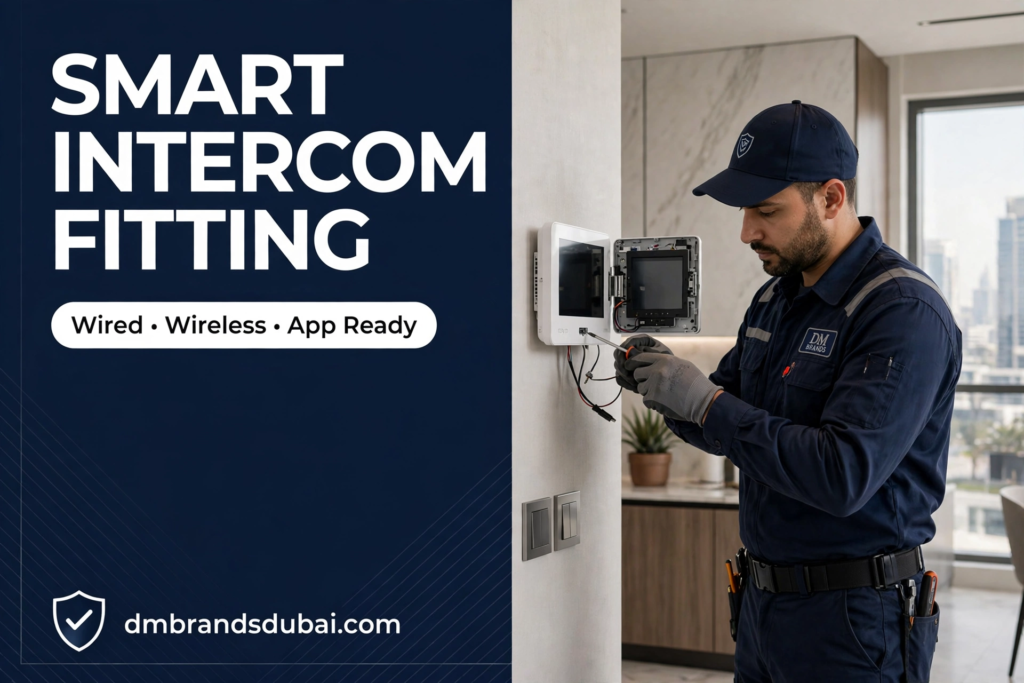
An intercom system connects an outdoor station at a gate or entrance door to indoor stations inside the home. The outdoor unit typically includes a call button, microphone, speaker and, in video systems, a camera. Indoor units range from a simple wall handset to a touchscreen monitor or a smartphone app.
When a visitor presses the call button, the indoor station rings and, in video systems, shows the visitor’s image. You speak to the visitor, verify who they are, and press a button to release an electric gate or door lock. More advanced systems add multiple outdoor stations, multiple indoor monitors, mobile app access, video recording, and integration with smart locks and CCTV.
In Dubai apartments, the building usually provides a communal intercom from the main entrance to each unit, and the homeowner’s choice is limited to replacing or upgrading the indoor handset. In villas, the homeowner chooses the entire system, from the gate station to the indoor monitors and the lock release.
Intercom Installation Dubai Cost
Intercom costs divide into equipment and installation labour. Equipment prices vary enormously by brand, features and number of stations, while labour depends on wiring complexity and whether the property is new or existing.
| System type | Equipment typical range (AED) | Installation typical range (AED) |
|---|---|---|
| Basic audio intercom, 1 door + 1 handset | 500–1,500 | 400–900 |
| Video intercom, 1 gate + 1 monitor | 1,500–4,500 | 800–2,000 |
| Video intercom, 1 gate + 2–3 monitors | 3,000–8,000 | 1,500–3,500 |
| Smart video intercom with app + smart lock | 4,000–12,000 | 1,500–4,000 |
| Multi-unit / multi-villa system | 8,000–25,000+ | 3,000–8,000 |
| Wireless video intercom kit | 1,200–3,500 | 300–800 |
For a typical Dubai villa, a quality video intercom with one gate station, two indoor monitors and electric gate release usually costs AED 3,500 to AED 8,000 fully installed. A premium smart system with app access, recording and smart lock integration ranges from AED 7,000 to AED 15,000. A simple apartment handset replacement typically costs AED 500 to AED 1,500 including labour, provided the existing wiring and building system are compatible.
These are typical market ranges for planning purposes. Final pricing depends on cable runs, gate and lock types, number of stations, and whether new wiring must be chased through finished walls.
Audio vs Video vs Smart Intercoms Compared
Audio intercoms
Audio systems carry voice only. They are simple, reliable, affordable and adequate where visual verification is less critical — for example, an apartment where the building entrance is already staffed or covered by CCTV. Their weakness is obvious: you cannot see who is calling, so they suit low-risk entrances better than villa gates.
Video intercoms
Video systems add a camera at the outdoor station and a screen indoors. You see the visitor before answering, which is a major security improvement and the reason video dominates new villa installations. Modern video intercoms offer colour cameras, night vision, wide-angle lenses and clear two-way audio, and most record snapshots or short clips of calls.
Smart intercoms
Smart intercoms connect to your home Wi-Fi and a smartphone app, so you can answer the gate from anywhere — the office, the mall, or abroad. They typically include cloud recording, visitor logs, integration with smart locks and gates, and sometimes facial recognition or package-delivery PIN codes. They cost more and depend on reliable Wi-Fi at the gate, but for frequent travellers and busy families, remote answering is transformative.
Wired vs wireless
Wired systems are more reliable, support longer distances and better video quality, and do not depend on batteries or Wi-Fi. They are best installed during construction or renovation, when cables can be run cleanly. Wireless systems install quickly in finished homes with minimal disruption, but they depend on Wi-Fi strength and battery life, and video quality can suffer at long range or through thick villa walls. For a villa gate 20 to 40 metres from the house, a wired system or a professionally planned wireless system with a dedicated access point is strongly preferred over a basic consumer wireless kit.

Choosing the Right System for Your Home
Villas
Villas need a weatherproof outdoor station rated for Dubai’s heat, dust and occasional rain, with a wide-angle camera covering the gate approach, not just the person standing at the button. Two indoor monitors — one near the entrance hall and one in the family living area or master bedroom — are the practical minimum for larger villas. Gate release integration is essential, and app access is highly recommended for villas where the gate is far from living areas.
In communities such as Arabian Ranches, Jumeirah Park, The Meadows and Palm Jumeirah, villa gates vary from simple pedestrian gates to large automated driveway gates. Confirm that the intercom’s lock release is compatible with your gate motor and lock type before purchase; mismatched voltages and lock types are a common cause of failed installations.
Apartments
Apartment owners usually work within the building’s existing system. Replacing a faulty handset or upgrading to a video monitor requires a unit compatible with the building’s brand and wiring — a generic unit rarely works. Ask building management or the building’s maintenance contractor which models are approved, and confirm whether the work needs management permission or must be done by an approved technician.
In newer Dubai Marina, Business Bay and Downtown towers, many buildings already provide video intercoms with app access through the building management system. In older buildings, the system may be audio-only, and upgrading a single unit to video may not be possible without a building-wide upgrade. Check before buying equipment.
Offices and small commercial premises
Offices, clinics and small shops need a system that handles multiple staff, delivery access and after-hours visitors. A video intercom with two or three indoor stations, a door release, and a visitor log suits most small premises. For larger offices, an access-control system with intercom integration is usually more appropriate than a residential kit.
The Installation Process Step by Step
Step 1: Site survey
The installer visits, checks the gate and entrance layout, measures cable distances, tests Wi-Fi strength at the gate for smart systems, inspects the existing lock and gate motor, and discusses indoor monitor positions. This survey should end with a written system specification, not just a brand name.
Step 2: Equipment selection
Choose the outdoor station, indoor monitors, power supply, lock release and any smart integration together, confirming compatibility between all parts. Mixing brands across outdoor and indoor units usually fails, so buy a matched system from one manufacturer family.
Step 3: Approvals
In apartments, confirm building management requirements. In villas within managed communities, check whether gate modifications need community approval, especially if the outdoor station changes the gate’s appearance or requires new fixings. Most villa intercom installations need no formal permit, but community rules vary.
Step 4: Cabling
Cables are run from the outdoor station to indoor monitors and to the lock release, ideally through conduits and protected routes. In new builds and renovations, cables are chased into walls and plastered over. In finished homes, installers use surface trunking, existing conduits or wireless links to minimise disruption. Cable quality matters: use the manufacturer’s specified cable type, because video and power over long runs are sensitive to voltage drop.
Step 5: Mounting and fixing
The outdoor station is mounted at a comfortable height — typically 1.4 to 1.6 metres — sheltered from direct rain where possible, with the camera angled to capture faces and the approach. Indoor monitors are mounted near entrances and living areas at eye level, with power and cable access concealed.
Step 6: Lock and gate integration
The electric lock release or gate motor interface is wired and tested. The installer should demonstrate gate release from every indoor station and from the app, and confirm that the gate still operates manually and from existing remotes after integration.
Step 7: Configuration and testing
The system is configured: ringtones, volumes, camera settings, night vision, app pairing, user codes and recording settings. Every station is tested for audio clarity, video quality, night vision, gate release and app answering, including a test call from a mobile network rather than just home Wi-Fi.
Step 8: Handover and training
The installer demonstrates the system to all household members, leaves manuals and warranty documents, and notes the system model, passwords and installer contact details. Change default admin passwords immediately — a surprising number of intercoms ship with defaults that anyone can guess.
Wiring, Power and Wi-Fi: The Hidden Essentials
Intercom reliability lives or dies on infrastructure. Wired systems need a dedicated power supply, usually a transformer or Power over Ethernet, sized for the number of stations and the lock release load. Undersized power supplies cause the classic symptom of an intercom that works for voice but fails to release the lock, or video that drops when the lock operates.
Cable distance matters. Video signals and lock power degrade over long runs, so villa installations with 30 to 50 metre runs need correct cable gauge and sometimes local power at the gate. Ask your installer how they have allowed for voltage drop on your specific distances.
For smart intercoms, Wi-Fi at the gate is critical. Test signal strength at the gate itself, not inside the house. If the signal is weak, a weatherproof outdoor access point or a wired connection to the gate station solves the problem far more reliably than hoping the house router reaches. In large villas, a proper Wi-Fi design for the garden and gate area is part of the intercom project, not an afterthought.
Dubai-Specific Guidance: Heat, Dust and Building Rules
Heat and weatherproofing
Dubai summer temperatures exceed 45 degrees, and gate stations sit in direct sun. Choose an outdoor station with a high operating temperature rating and an IP65 or better weatherproof rating, and mount it with some shade where possible. Cheap outdoor units fade, crack and fail in their first summer; reputable brands design for Gulf conditions.
Dust and sand
Dust coats camera lenses and speaker grilles, degrading video and audio. Choose a station with a recessed or hooded camera, and clean the lens and grille monthly with a soft cloth. In communities near open desert or construction, more frequent cleaning is needed.
Building and community rules
Apartment intercom work must respect building systems and management rules. Never disconnect a communal intercom to fit an independent system without management approval — it can affect building security and fire systems. In villa communities, gate appearance rules may restrict the size and colour of outdoor stations, so check community guidelines before ordering.
Privacy and recording
Video intercoms record visitors, and Dubai’s privacy expectations and community rules apply. Position cameras to cover your own entrance, not neighbours’ properties or public areas beyond what is necessary, and inform household staff and regular visitors that calls may be recorded. For commercial premises, signage about video recording is good practice.
Integration With Locks, Gates and CCTV
The best intercom installations work as part of a wider security system. Electric strikes release pedestrian gates, magnetic locks suit glass doors, and gate motor interfaces release driveway gates. Each lock type has different power, fail-safe and manual-override behaviour, and the intercom must be matched to it.
CCTV integration lets you view gate cameras on the same app or monitor as the intercom, and some systems record intercom calls alongside CCTV footage. Smart lock integration goes further: a verified visitor can be granted a one-time PIN or a time-limited app credential instead of a physical key. For villas with domestic staff, cleaners and regular deliveries, this level of control is genuinely useful.
If you are planning wider security upgrades, our guides to CCTV installation, door lock repair and replacement, smart home installation and electrical repair services explain how those systems are priced and integrated.
Mistakes to Avoid
Buying equipment before a survey is the most common mistake. A system that works in a compact apartment may fail over a villa’s long cable runs or weak gate Wi-Fi, and an incompatible handset will not work with a building’s communal system at any price.
Mounting the camera too high or too low produces video of the top of heads or of chests, not faces. Mount at face height, angle for the approach path, and test with real visitors of different heights before final fixing.
Ignoring power requirements causes intermittent failures that are hard to diagnose later. Confirm the power supply rating covers all stations plus the lock release simultaneously, and ask what happens during a power cut — battery backup, manual gate operation and system behaviour should all be explained.
Leaving default passwords unchanged is a security risk for any smart intercom. Change admin and user passwords during handover, enable two-factor authentication on the app account where available, and keep firmware updated.
Maintenance and Troubleshooting
Monthly, wipe the outdoor camera lens and speaker grille, test the call button and gate release, and check that night vision works after dark. Quarterly, check cable entry points for water ingress, test app answering from outside the home network, and review recording storage.
Common faults have simple causes. No audio usually means a loose connection, a muted handset, or a failed power supply. Poor video usually means a dirty lens, weak Wi-Fi, or voltage drop on a long cable run. Gate release failure usually means a power supply or lock compatibility issue, not a faulty intercom. A systematic check of power, connections and settings resolves most faults without replacing equipment.
Keep the system model, installer details and passwords recorded safely. When a fault occurs years later, this information saves diagnostic time and prevents unnecessary replacement of a system that only needs a power supply or a settings reset.
How Long Does Intercom Installation Take?
| Scope | Typical duration |
|---|---|
| Apartment handset replacement | 1–2 hours |
| Wireless video kit in a finished home | Half a day |
| Wired villa video intercom, 1 gate + 2 monitors | 1–2 days |
| Smart system with lock, gate and app integration | 2–3 days |
| Multi-station or multi-building system | 3–5 days |
Timelines extend when new cables must be chased through finished walls, when gate motors need modification, or when building approvals are required. A survey that identifies these issues upfront prevents the one-day job that stretches to a week.
Choosing an Intercom Installer in Dubai
Ask for a trade licence, insurance, and examples of similar installations — villa systems if you live in a villa, building-compatible handsets if you live in an apartment. Ask which brands the installer is authorised for, because warranty support depends on authorised supply and installation.
The quotation should list every component by brand and model, cable and power specifications, number of stations, lock and gate integration scope, app and recording inclusions, programme, warranty periods and payment schedule. It should state who handles building or community approvals and whether Wi-Fi improvements at the gate are included or excluded.
Be wary of quotes that specify equipment only by generic description — “video intercom, 1 gate, 2 monitors” — without brand or model. Two systems with that description can differ by AED 5,000 in quality, camera performance and app reliability. Compare matched specifications, not just headline prices.
Intercom Costs by Property Type in Dubai
In Dubai Marina, JLT and Business Bay apartments, most intercom work is handset replacement or indoor monitor upgrades within the building system, typically AED 500 to AED 2,500. Full independent systems are rare in apartments because the building system governs the main entrance.
In JVC, Town Square and Dubai Silicon Oasis villas and townhouses, standard video intercom installations dominate, typically AED 3,500 to AED 8,000 fully installed. Townhouses with shorter gate distances and simpler gates sit at the lower end, while larger villas with two gates or multiple monitors sit higher.
In Arabian Ranches, Palm Jumeirah, Emirates Hills and Jumeirah Golf Estates, premium smart systems with app access, recording and smart lock integration are common, typically AED 7,000 to AED 15,000. Large plots, long cable runs, dual gates and integration with existing CCTV and automation push costs toward the upper end, but the convenience and security return is proportionally higher.
Frequently Asked Questions
How much does intercom installation cost in Dubai?
A villa video intercom typically costs AED 3,500 to AED 8,000 fully installed. Smart systems with app access and smart lock integration cost AED 7,000 to AED 15,000. Apartment handset replacements typically cost AED 500 to AED 1,500.
What is the best intercom system for a Dubai villa?
A wired video intercom with a weatherproof gate station, two indoor monitors, gate release and smartphone app access suits most villas. Choose a brand rated for Gulf heat and dust, and confirm gate motor and lock compatibility before purchase.
Can I answer my villa intercom from my phone?
Yes, with a smart video intercom connected to home Wi-Fi and its app. You can see, speak to and admit visitors from anywhere with mobile data, and review visitor logs and recordings later.
Do I need building approval to install an intercom?
In apartments, yes — the work must be compatible with the building system and usually needs management approval. In villas, community rules may govern gate appearance, but most installations need no formal permit. Confirm requirements before ordering equipment.
Is a wired or wireless intercom better?
Wired systems are more reliable and better for long villa gate distances and high-quality video. Wireless systems install faster in finished homes but depend on Wi-Fi strength and batteries. For villa gates, wired or professionally planned wireless with a dedicated access point is preferred.
Can an intercom open my electric gate?
Yes, most video and smart intercoms integrate with electric gate motors and pedestrian gate locks. Compatibility must be confirmed during survey, because lock voltages and motor interfaces vary.
How weatherproof are outdoor intercom stations?
Quality outdoor stations carry IP65 or better ratings and high temperature tolerances for Gulf conditions. Cheap units without proper ratings fade and fail in Dubai summers, so check specifications rather than price alone.
Does a video intercom record visitors?
Many video and smart intercoms record snapshots or short clips of calls, and smart systems offer cloud recording and visitor logs. Check storage limits, retention periods and subscription costs before purchase, as some smart features require ongoing subscriptions.
Can I keep my existing apartment intercom handset and add video?
Usually only if the building system supports video and the new unit is compatible with the building’s brand and wiring. A generic video monitor will not work on an audio-only building system. Ask building management which models are approved.
What happens to my intercom during a power cut?
Wired systems stop working unless they have battery backup or UPS support. Ask your installer about backup options and confirm that gates can still be operated manually during an outage. Smart systems also need home internet and router power for app answering.
How many indoor monitors do I need?
Most villas need at least two: one near the main entrance hall and one in the main living area or master bedroom. Larger villas benefit from three, including a kitchen or family room station. Each additional monitor adds equipment and cabling cost.
Can intercoms integrate with CCTV and smart locks?
Yes, many modern systems integrate with CCTV cameras, smart locks and home automation, allowing one app to handle gate calls, cameras and door credentials. Integration must be planned during survey, as it affects wiring, power and app selection.
How do I maintain an intercom system?
Monthly, clean the camera lens and speaker grille and test calls and gate release. Quarterly, check cable entries for water, test app answering from outside the home network, and review recording storage. Update firmware and change passwords periodically.
Why is my intercom video poor quality?
Common causes are a dirty lens, weak Wi-Fi at the gate, voltage drop on long cable runs, or a low-resolution camera. Clean the lens first, test Wi-Fi at the gate, and ask your installer to check power and cable specifications if the problem persists.
Can I install an intercom myself?
Simple wireless kits can be DIY-installed by capable homeowners, but wired villa systems, gate integration and building-system handsets are best left to professionals. Incorrect wiring can damage equipment, void warranties and create security weaknesses.
Is a video intercom worth it over audio only?
For villa gates, yes — seeing a visitor before admitting them is a major security improvement and avoids opening gates to strangers. For apartments with staffed entrances and CCTV, audio may suffice, but video still adds confidence and a record of calls.
What should an intercom quotation include?
It should list every component by brand and model, cable and power specifications, station count, lock and gate integration scope, app and subscription details, approvals responsibility, programme, warranty and payment schedule.
Do smart intercoms need a subscription?
Some smart intercom features, such as cloud recording and extended visitor history, require subscriptions, while basic app answering is often free. Confirm subscription costs before purchase so running costs hold no surprises.
Intercom Installation for New Builds vs Existing Homes
New-build villas offer the cleanest intercom installations. Cables run in conduits before plastering, outdoor stations mount on prepared gate pillars with power already provisioned, and indoor monitors sit on pre-wired points. If you are building or extensively renovating, specify the intercom system during the electrical design stage, not after plastering — retrofitting cables into finished walls is the single biggest cost driver in existing-home installations.
Existing homes need a different approach. The installer should first check for usable existing conduits, such as spare conduits from the gate to the house or old doorbell wiring routes. Where no conduit exists, options include surface trunking painted to match, wireless links between gate and house, or carefully chased cables with plaster repair and repainting limited to the chase lines. Each option trades cost against appearance, and the right choice depends on your home’s finishes and your tolerance for visible trunking.
For older villas in Jumeirah, Umm Suqeim and Al Barsha, where gates and boundary walls may predate modern intercom wiring, a site survey is especially important. Gate pillars may need core drilling for cables, power may need to be extended from the house or the gate motor supply, and heritage or community appearance rules may limit modifications. A good installer identifies these issues during survey, not halfway through installation day.
Intercoms and Deliveries: Managing Couriers and Guests
Dubai homes receive frequent deliveries — groceries, parcels, food orders — and a good intercom turns delivery management from a daily interruption into a smooth routine. With a video intercom, you verify the courier, release the pedestrian gate, and direct them to leave parcels in an agreed spot, all without walking to the gate. Smart intercoms add one-time PIN codes for regular couriers or a delivery box integration, so parcels can be accepted even when you are out.
For households with domestic staff, intercoms also simplify access control. Staff can answer the gate from indoors, verify visitors, and admit only expected guests, while the homeowner retains app visibility and a visitor log. Agree household rules in advance: who may admit visitors, which deliveries go where, and what to do with unexpected callers. Technology helps, but clear household procedures make it work consistently.
In apartment buildings, delivery management usually follows building rules: couriers may be held at reception or the main entrance rather than admitted to floors. Your indoor intercom station is still useful for verifying building reception calls and for communicating with the concierge, but it does not replace building security procedures. Check with management how deliveries are handled in your tower before promising couriers direct access.
Future-Proofing Your Intercom Investment
Intercom technology evolves, but the infrastructure lasts. Invest in good cabling, adequate power, and a reputable brand with a track record of firmware support, and your system will serve for a decade or more even as apps and features change. Choose a system with standard interfaces — SIP compatibility, ONVIF camera support, or relay outputs for locks and gates — so future upgrades do not require replacing everything.
Avoid closed systems that lock you into a single supplier’s expensive accessories, and avoid no-name brands with no local support or spare parts. A slightly higher upfront cost for a supported brand pays back in warranty service, available parts and installer familiarity. Ask how long the manufacturer has supported previous models with firmware updates, and whether indoor monitors can be added later without replacing the outdoor station — expandability is the practical test of future-proofing.
Finally, keep your intercom’s software updated and review its settings annually: user codes, app users, recording retention and notification preferences. Remove access for former staff or tenants promptly, just as you would change locks. An intercom is a security device, and its settings deserve the same attention as its hardware.
A Final Checklist Before Installation Day
Run through this checklist with your installer before work begins. Is the system brand and model confirmed in writing, with all stations, power supply and lock hardware listed? Are cable routes, gate power arrangements and Wi-Fi provisions agreed, including who provides any outdoor access point? Have building or community approvals been confirmed, and is the work scheduled within permitted hours? Are indoor monitor positions marked on the wall and tested for viewing height and glare?
Confirm the programme, the payment schedule, and what happens if the gate motor or lock needs modification beyond the quoted scope. Agree the handover standard: every station tested, app paired on your phone, passwords changed, manuals left, and a walk-through demonstration completed. A ten-minute checklist conversation before installation prevents most of the disputes, delays and disappointments that follow intercom projects — and it costs nothing.
Conclusion: See, Speak, Then Open
A good intercom does one simple thing brilliantly: it lets you verify a visitor before you open your gate or door. Video adds the confidence that audio alone cannot, smart access adds convenience for busy households and frequent travellers, and proper installation ensures the system works in Dubai’s heat, dust and long villa distances.
Choose your system after a proper survey, not before it. Confirm compatibility with your gate, lock and — in apartments — your building system. Insist on matched equipment, adequate power, tested Wi-Fi at the gate, and a handover that leaves you confident using every feature. Done well, an intercom is a quiet daily upgrade: fewer trips to the gate, safer admissions, and a home that greets visitors properly.
Contact DM Brands Dubai for an intercom survey and itemised quotation. Prices in this guide are typical market ranges for planning purposes and are not a fixed quote for your home.