Dubai's tap water is safe to drink, but it is hard. It carries high levels of calcium and magnesium. Those minerals leave white scale on taps, stiffen laundry, dry out skin, and slowly choke water heaters and pipes. A water softener removes that hardness before the water reaches your taps.
This guide covers water softener installation in Dubai in full. You will learn how softeners work, which type suits a villa or an apartment, what installation typically costs in AED, and how to choose a licensed installer. Prices are typical market ranges, not fixed quotes. Your final price depends on your home size, your water hardness, and where the unit can be fitted.
Quick answer: A water softener is a treatment unit that removes calcium and magnesium from your home's water supply. In Dubai, a whole-house softener installation typically costs AED 2,500 to AED 8,000 including the unit, fittings, and labour. Small apartment units start from around AED 1,500. Installation usually takes 3 to 6 hours for a villa.
What Is Hard Water, and Why Is Dubai Water Hard?
Hard water is water with a high concentration of dissolved calcium and magnesium. These minerals come from the ground and from the desalination process. Dubai's water comes mainly from desalination plants. Desalinated water is then remineralised, which adds calcium and magnesium back in. The result is water that is safe but noticeably hard.
You can see hard water every day. White crust forms around taps and shower heads. Kettles scale up within weeks. Soap does not lather well. Clothes feel stiff after washing. Glass shower screens go cloudy. These are all signs of hardness.
The hidden damage is worse. Scale builds up inside water heaters, washing machines, dishwashers, and pipes. A scaled water heater uses more electricity and fails earlier. Scale narrows pipes over time and reduces water pressure. In a villa with a water tank and a pump, hard water adds wear to every part of the system.
Hardness is measured in milligrams per litre (mg/L) or grains per gallon (gpg). Dubai tap water is generally classed as hard to very hard. A simple test strip or a digital tester will tell you the hardness at your own taps. A professional installer tests the water before recommending a system size.
Signs You Need a Water Softener
Not every home needs a softener, but most Dubai villas benefit from one. Look for these signs.
- White scale on taps, shower heads, and tiles. The most obvious sign. Scale returns within days of cleaning.
- Soap scum in showers and baths. Hard water reacts with soap to form a sticky film on skin, tiles, and glass.
- Dry skin and dull hair. Hard water leaves mineral deposits on skin and hair. Many residents notice softer skin within a week of fitting a softener.
- Stiff laundry and faded colours. Minerals bind to fabric fibres. Towels feel rough and colours fade faster.
- Cloudy glassware. Dishwashers leave spots and a white film on glasses.
- Frequent appliance repairs. Water heaters, washing machines, and kettles fail early when scale builds up inside them.
- Low water pressure. Scale narrows pipes and shower heads over time.
If you recognise three or more of these signs, a softener is worth a proper assessment. If you only have light scale on one tap, a point-of-use filter may be enough.
How Does a Water Softener Work?
Most whole-house softeners use a process called ion exchange. It sounds technical, but the idea is simple.
Water flows through a tank filled with tiny resin beads. The beads carry sodium ions. As hard water passes over them, the beads attract calcium and magnesium ions and swap them for sodium ions. The water leaving the tank is soft. The calcium and magnesium stay on the beads.
Over time, the beads fill up with hardness minerals. The system then runs a cleaning cycle called regeneration. It flushes the beads with a salty brine solution. The salt washes the calcium and magnesium away and recharges the beads with sodium. The system is ready to soften again.
A modern softener regenerates automatically, usually at night when nobody uses water. A metered system regenerates only when needed, based on how much water you have used. A timer system regenerates on a fixed schedule. Metered systems use less salt and less water, and they suit most Dubai homes.
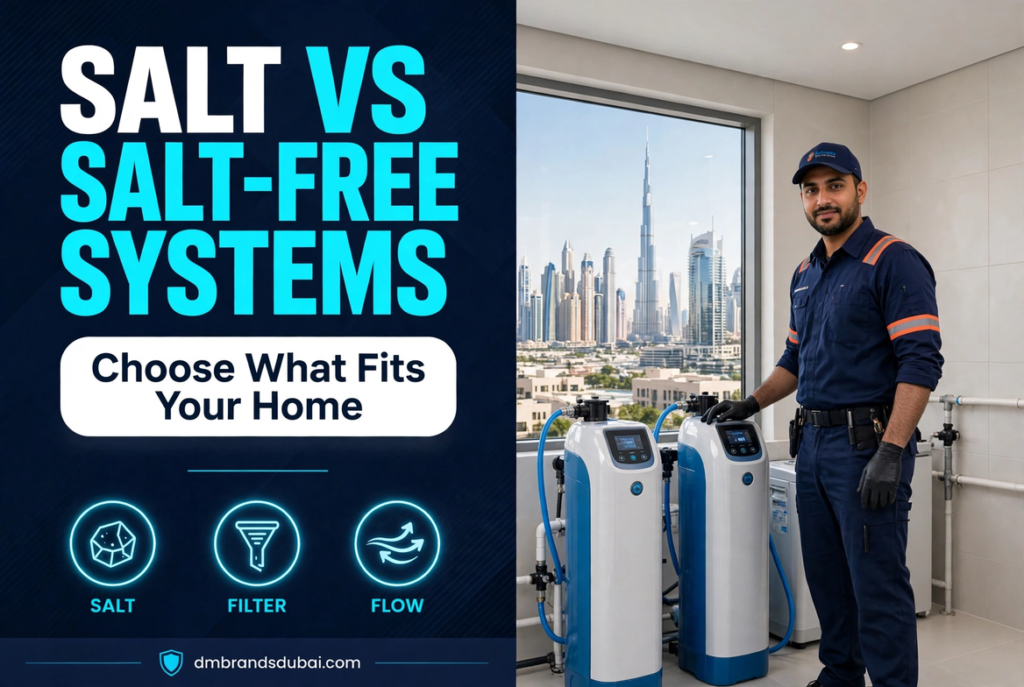
Salt-free systems work differently. They do not remove calcium and magnesium. Instead, they change the crystal structure of the minerals so they do not stick to surfaces. This is called template-assisted crystallisation. Salt-free systems reduce scale but do not truly soften the water. Soap will still lather poorly, and the water will still test hard.
Types of Water Softeners Available in Dubai
Choosing the right type matters more than choosing a brand. The four main options suit different homes and budgets.
| System type | How it works | Removes hardness? | Best for | Typical price range (installed) |
|---|---|---|---|---|
| Salt-based ion exchange | Resin beads swap calcium for sodium | Yes | Villas, whole-house softening | AED 2,500–8,000 |
| Salt-free conditioner | Changes mineral crystals so scale does not stick | No, conditions only | Light scale, low maintenance | AED 2,000–5,000 |
| Dual-tank softener | Two resin tanks alternate so soft water never stops | Yes | Large villas, high water use | AED 6,000–12,000 |
| Point-of-use softener | Small unit for one tap or one appliance | Yes, at one point | Apartments, single shower | AED 1,500–3,000 |
Salt-Based Ion Exchange Softeners
This is the standard choice for a Dubai villa. It genuinely removes hardness. The water feels different, soap lathers properly, and scale stops forming.
A salt-based system needs a drain connection for regeneration water, a power point, and space for a salt refill. Salt costs around AED 50 to AED 100 per bag, and a family villa uses roughly one bag a month. That is a small running cost for the benefit.
The main drawback is size. A whole-house unit with a brine tank needs about a square metre of floor space. Most villas have a utility room, a pump room, or a garage corner that works well.
Salt-Free Water Conditioners
Salt-free systems need no salt, no drain, and no electricity. They are compact and almost maintenance-free. They suit homeowners who want less scale without the running costs of a salt system.
The limit is honest: they do not soften water. Your water will still test hard. Soap scum and stiff laundry may improve slightly, but they will not disappear. If your main problem is scale in the water heater and pipes, a salt-free system helps. If you want truly soft water, choose ion exchange.
Dual-Tank Softeners
A dual-tank system has two resin tanks. While one regenerates, the other keeps supplying soft water. There is never a gap.
This suits large villas with high water use, homes with a swimming pool top-up on the same line, and families where someone always seems to be showering at 2 a.m. The cost is higher, but the supply is uninterrupted.
Point-of-Use Softeners
A small softener fits under a kitchen sink or before a single shower. It protects one tap or one appliance. It costs less and fits in an apartment where a whole-house unit is impossible.
The limit is obvious: only that tap is soft. The rest of the house still gets hard water. For apartment residents, a shower filter plus a point-of-use unit is often the practical compromise. Check with your building management before fitting anything to the main supply line.
Benefits of Soft Water in a Dubai Home
The benefits show up in the first week and grow over months.
Cleaner fixtures and tiles. Scale stops forming. Taps stay shiny. Shower glass stays clear. Cleaning takes less time and less descaler.
Softer skin and hair. Many residents notice the difference within days. Skin feels less dry after showering. Hair feels softer and easier to manage. This matters in Dubai, where the dry air already stresses skin.
Better laundry. Soft water lets detergent work properly. Clothes come out softer and colours last longer. Towels regain their fluff. You also use less detergent, which saves money over time.
Longer appliance life. Water heaters, washing machines, dishwashers, and kettles last longer without scale. A scaled water heater can use noticeably more electricity. Removing scale protects your investment in appliances. If your heater is already struggling, our water heater repair service in Dubai can assess whether scale is the cause.
Better water pressure. Scale narrows pipes and shower heads. Soft water stops that narrowing. Pressure stays steady year after year.
Lower cleaning costs. You buy less descaler, less detergent, and less shampoo. The savings are small per bottle but add up over a year.
Protected plumbing. Scale and corrosion damage pipes from the inside. Soft water slows that damage. For villas with older plumbing, this protection alone can justify the system.
How Much Does Water Softener Installation Cost in Dubai?
Prices depend on the system type, the size of your home, and the plumbing work needed. The ranges below are typical Dubai market rates in 2026, including the unit and standard installation.
| Item | Typical range (AED) |
|---|---|
| Point-of-use softener + installation | 1,500–3,000 |
| Salt-based softener, small villa (2–3 bedrooms) | 2,500–4,500 |
| Salt-based softener, large villa (4–6 bedrooms) | 4,000–8,000 |
| Salt-free conditioner + installation | 2,000–5,000 |
| Dual-tank softener + installation | 6,000–12,000 |
| Water hardness test (often free with a quote) | 0–100 |
| Salt, per bag (monthly use for a family villa) | 50–100 |
| Annual service and resin check | 300–600 |
| Extra plumbing work (long pipe runs, new drain) | 300–1,500 |
What Affects the Final Price
Home size and water use. A 2-bedroom apartment needs a smaller unit than a 6-bedroom villa with a maid's room and a garden tap. The installer should ask how many bathrooms you have and how many people live in the home.
Water hardness level. Very hard water needs a larger resin bed or more frequent regeneration. A water test before the quote is essential.
Installation location. The ideal spot is near the main water inlet, after the water tank and pump, with a drain nearby. If the pipes need rerouting or a new drain must be added, the cost rises.
Existing plumbing. Older villas may have galvanised pipes or unusual layouts. A good installer inspects before quoting. If your plumbing has other issues, our plumbing services in Dubai team can fix them during the same visit.
Brand and warranty. Established brands cost more but offer real warranties and local spare parts. A cheap unit with no local support is a risk. Ask for the warranty in writing.
Always get a written quote that names the brand, model, capacity, salt type, installation work included, and the warranty period. If a quote is vague, ask for the detail before you agree.
The Installation Process Step by Step
A professional water softener installation follows a clear sequence. Knowing the steps helps you judge the quality of the work.
Step 1: Water Testing
The technician tests your tap water for hardness, total dissolved solids, and sometimes chlorine. This test decides the system size. A home with very hard water needs a larger resin bed than a home with moderately hard water.
Step 2: Choosing the Location
The softener fits on the main water line, after the water tank and pump, so every tap gets soft water. The location needs a power point, a drain for regeneration water, and enough space for the unit and the salt tank. Common spots are the pump room, the utility room, or a sheltered corner of the garage.
Step 3: Plumbing the Bypass
A bypass valve is fitted first. This lets you switch the softener out of the line for maintenance without cutting off the water to the house. It also lets you use hard water for the garden if you prefer. Garden plants do not need soft water, and bypassing the garden tap saves salt.
Step 4: Connecting the Unit
The inlet and outlet pipes connect to the softener head. The drain line runs to a suitable drain. The overflow pipe from the brine tank runs to the same drain. All joints are checked for leaks under pressure.
Step 5: Adding Salt and Setting Up
The brine tank is filled with softener salt. The control head is programmed with the water hardness, the time of day, and the regeneration schedule. A metered system is set to regenerate based on water use.
Step 6: Regeneration and Testing
The technician runs a manual regeneration cycle. This flushes the resin bed and confirms the drain works. They then test the water at a tap. Soft water should test at a low hardness level. They also check every joint again for leaks.
Step 7: Handover and Demonstration
You are shown how to add salt, how to read the control panel, how to use the bypass valve, and what the warning lights mean. You should get the manual and the warranty papers before the technician leaves.
Most villa installations take 3 to 6 hours. Apartments with a point-of-use unit take 1 to 2 hours. Add time if new pipework or a new drain is needed.
Dubai-Specific Notes: Tanks, Pumps, and Apartments
Dubai homes have water systems that differ from homes in Europe or North America. The advice below reflects how water actually works here.
Water tanks are standard. Most villas store water in a rooftop or ground tank, then pump it to the taps. The softener should sit after the tank and the pump, on the line that feeds the house. Fitting it before the tank wastes capacity softening water that sits in storage. If your tank needs cleaning, arrange it before the installation so the softener starts with clean water. Our water tank cleaning service in Dubai can handle this first.
Pumps and pressure matter. A softener adds slight resistance to the water flow. If your pump is weak or your pressure is already low, the installer should check the pump first. A softener on a low-pressure system will make showers worse. In some homes, a pump service or a pressure adjustment is needed alongside the installation.
Villas versus apartments. Villas are ideal for whole-house softeners because you control the main inlet. Apartments are harder. The main supply usually belongs to the building. You need building management approval to fit anything on the common line, and most buildings will not allow it. Apartment residents should choose a point-of-use unit for the kitchen or the main shower, or a shower filter. Always check your building rules first.
Heat and the brine tank. Salt absorbs moisture in humid conditions. Keep the brine tank lid closed and store spare salt bags in a dry place. In summer, check the salt level monthly. A salt bridge can form, where a hard crust sits above an empty space. Break it up gently with a broom handle if it forms.
Drinking water. Softened water contains a small amount of sodium from the ion exchange process. The amount is low, but some households prefer a separate drinking water tap. A common setup is a softener for the whole house plus a reverse-osmosis unit or a filter at the kitchen sink for drinking water. If you are on a low-sodium diet, discuss this with your doctor and your installer.
DEWA and regulations. A domestic water softener does not need a DEWA permit. What matters is that the installation follows good plumbing practice. The drain must go to a proper drain, not to the garden or the street. Guidance on water use and home safety is available from DEWA and Dubai Municipality.
How to Choose a Water Softener Installer in Dubai
The installer matters as much as the unit. A wrongly sized or badly plumbed softener wastes salt, wastes water, and still leaves scale behind. Use this checklist.
- Water test before quoting. A reputable installer tests your water first. A quote without a test is a guess.
- Correct sizing. The installer should ask about bathrooms, occupants, and water use. A unit that is too small regenerates constantly. A unit that is too large wastes salt and water.
- Licensed and insured. Ask for the trade licence. A licensed company stands behind its work.
- Written quote. The quote should name the brand, model, capacity, salt type, pipework included, and the warranty.
- Local spare parts. Resin, control heads, and seals should be available in the UAE. Ask what happens if the control head fails in year three.
- Aftercare and salt supply. Will they return for the first service? Can they supply salt? A company with an annual maintenance contract in Dubai can keep the system serviced without you chasing them.
- Bypass valve included. Every installation should include a bypass. If the quote does not mention one, ask why.
Get two quotes for a whole-house system. Compare the capacity, not just the price. A cheaper quote for a smaller unit is not a saving.
Mistakes to Avoid
Buying a unit without a water test. Hardness varies across Dubai. A unit sized for one area may be wrong for another. Always test first.
Choosing salt-free when you need true softening. Salt-free systems condition water. They do not remove hardness. If you want soft water for skin, laundry, and soap, you need ion exchange.
Fitting the softener in the wrong place. A softener before the tank or on the wrong branch line leaves some taps hard. The unit must sit on the main feed to the house, after the tank and pump.
Forgetting the drain. Regeneration produces wastewater. It needs a proper drain. A unit with no drain connection cannot regenerate and will stop softening.
Using the wrong salt. Use proper water softener salt, not table salt or rock salt with impurities. The wrong salt clogs the brine system and damages the resin.
Never checking the salt level. An empty brine tank means no regeneration. The water goes hard again without any warning. Check the salt monthly and top it up before it runs out.
Ignoring leaks. A slow drip at a joint wastes water and can damage walls or floors. Check the connections weekly for the first month after installation.
Maintenance: Keeping Your Softener Working for Years
A salt-based softener needs regular but simple care. A 10-minute check each month prevents most problems.
- Check the salt level monthly. Keep the brine tank at least a quarter full. Top it up before it runs out. Use only proper softener salt.
- Watch for a salt bridge. Tap the side of the brine tank. If it sounds hollow at the top and solid below, a crust has formed. Break it up gently.
- Clean the brine tank yearly. Empty it, rinse out any sludge, and refill with fresh salt. This is usually part of an annual service.
- Check the drain line. Make sure the drain hose is not kinked or blocked. A blocked drain stops regeneration.
- Test the water every few months. Use a test strip at a bathroom tap. If the hardness rises, the system may need a manual regeneration or a service.
- Service the control head yearly. Seals and injectors wear over time. An annual service keeps the regeneration cycle efficient.
- Sanitise the system yearly. A professional service includes sanitising the resin bed. This matters in warm climates where bacteria can grow in standing water.
- Keep the area dry and ventilated. Do not store chemicals or paint next to the softener. Keep the unit out of direct sun.
Resin beads last 10 to 15 years with proper care. The control head usually lasts 8 to 12 years. A well-maintained softener is a long-term appliance, not a disposable gadget.
Water Softener Installation in Dubai: FAQs
How much does water softener installation cost in Dubai?
A small villa system typically costs AED 2,500 to AED 4,500 installed. A large villa system costs AED 4,000 to AED 8,000. Point-of-use units cost AED 1,500 to AED 3,000. Salt-free systems cost AED 2,000 to AED 5,000. These are typical ranges. A water test and a site inspection give you an exact quote.
Is Dubai tap water hard?
Yes. Dubai tap water is generally classed as hard to very hard. It comes mainly from desalination and is remineralised before supply. The hardness causes scale on fixtures and reduces the life of appliances.
Will a water softener make my water safe to drink?
Dubai tap water is already safe to drink. A softener changes the hardness, not the safety. Softened water contains a small amount of sodium. Most households drink it without issue, but some prefer a separate filtered tap for drinking water.
What is the difference between a salt-based and a salt-free softener?
A salt-based softener removes calcium and magnesium through ion exchange. The water becomes truly soft. A salt-free conditioner changes the mineral crystals so scale sticks less, but the water still tests hard. Salt-free systems need less maintenance but do not soften water.
How much salt does a water softener use?
A family villa typically uses one bag of salt per month, costing around AED 50 to AED 100. Use depends on water hardness and how much water your household uses. A metered system uses less salt than a timer system.
How long does installation take?
A whole-house villa installation takes 3 to 6 hours. A point-of-use unit takes 1 to 2 hours. Add time if new pipework, a new drain, or a pump adjustment is needed.
Can I install a water softener in an apartment?
A whole-house softener is usually not possible in an apartment because the main supply belongs to the building. A point-of-use unit for the kitchen or shower is the practical option. Check with your building management first.
Where should a water softener be installed in a villa?
On the main water line, after the water tank and pump, where it feeds the whole house. The spot needs a power point, a drain, and space for the unit and the salt tank. Pump rooms and utility rooms are the usual locations.
Does a water softener reduce water pressure?
A correctly sized softener causes only a small pressure drop. An undersized unit on a high-demand home can reduce pressure noticeably. Correct sizing and a healthy pump prevent this problem.
How often does a water softener regenerate?
A metered system regenerates when it has softened a set volume of water, usually every few days for a family. It normally runs at night. You may hear a quiet flushing sound. A timer system regenerates on a fixed schedule whether it needs to or not.
What maintenance does a water softener need?
Check the salt monthly and top it up. Clean the brine tank yearly. Service the control head yearly. Test the water hardness every few months. A professional annual service covers the deeper checks.
How long does a water softener last?
The resin bed lasts 10 to 15 years. The control head lasts 8 to 12 years. The tanks last longer. Regular service and correct salt use give the longest life.
Will soft water help my skin and hair?
Most residents notice softer skin and hair within a week. Hard water leaves mineral deposits that dry out skin and dull hair. Soft water rinses soap away fully, which helps both.
Does a softener help with laundry?
Yes. Soft water lets detergent work properly. Clothes feel softer, colours last longer, and towels stay fluffy. You can also use less detergent per wash.
Can a water softener protect my water heater?
Yes. Scale is a major cause of water heater failure. Soft water stops scale forming inside the heater. The heater runs more efficiently and lasts longer. If your heater already has scale, ask a technician to check it before fitting the softener.
What is a bypass valve, and do I need one?
A bypass valve lets you take the softener out of the water line without cutting off the house supply. It is essential for maintenance and for watering the garden with unsoftened water. Every installation should include one.
Is softened water bad for plants?
Softened water contains sodium, which most plants do not like in large amounts. Use the bypass valve for garden taps, or run a separate hard water line to the garden. Indoor plants should also get unsoftened water where possible.
Do I need a permit to install a water softener in Dubai?
No permit is needed for a domestic water softener. The installation must follow good plumbing practice, and the regeneration drain must connect to a proper drain. If you live in a managed community, check whether any internal plumbing change needs to be notified.
What should I do if my water still feels hard after installation?
Check the salt level first. Then run a manual regeneration cycle. Test the water again after the cycle. If the water is still hard, the resin may need cleaning or the control settings may be wrong. Call your installer for a service visit.
Can a water softener remove chlorine or bad taste?
A standard softener does not remove chlorine. If taste or smell is a problem, add a carbon filter before or after the softener. Many installers fit a combined softener and carbon filter system for villas.
Conclusion
Hard water is a fact of life in Dubai, but it does not have to damage your home. A properly sized water softener stops scale, protects your appliances, softens your skin and laundry, and keeps your water pressure steady. The key is choosing the right system for your home: a salt-based ion exchange unit for true softening, correctly sized after a water test, and fitted on the main line after your tank and pump.
Do not buy on price alone. A cheap unit with no local parts and no aftercare will cost more in the long run. Get a water test, get a written quote, and choose a licensed installer who services what they fit.
Ready to soften the water in your Dubai villa or apartment? DM Brands Dubai installs and services whole-house and point-of-use water softeners across Dubai Hills Estate, Arabian Ranches, Jumeirah Village Circle, Al Barsha, Mirdif, The Springs, and all Dubai communities. Our licensed technicians test your water, recommend the right system, and fit it in a single visit in most cases.
Message us on WhatsApp or call DM Brands Dubai today for a free water test and a written quote. Tell us how many bathrooms you have and whether you want a whole-house system or a single-tap unit, and we will give you a clear price before any work starts.
Book your water softener installation in Dubai today — softer water, cleaner fixtures, and appliances that last longer.