Dubai's power supply is reliable. Outages are rare and usually short. Yet when the power does go out in August, a villa without cooling becomes uncomfortable within an hour. Fridges warm up. Wi-Fi dies. Medical equipment stops. A home generator turns a blackout from a crisis into a minor inconvenience.
This guide covers home generator installation in Dubai in full. You will learn how standby and portable generators work, how to size one for your villa, what installation typically costs in AED, and how to choose a licensed installer. Prices are typical market ranges, not fixed quotes. Your final price depends on the generator size, the fuel type, and the electrical work needed.
Quick answer: A home generator is a backup power unit that starts automatically or manually when the mains supply fails. In Dubai, a standby generator installation for a villa typically costs AED 12,000 to AED 45,000 including the unit, automatic transfer switch, and labour. Portable generators cost far less but power only a few essentials. Sizing starts with a load calculation, never a guess.
What Is a Home Generator?
A home generator is an engine-driven machine that produces electricity when the mains supply fails. A fuel engine, usually petrol, diesel, or natural gas, spins an alternator. The alternator produces electrical power. That power feeds your home through a transfer switch.
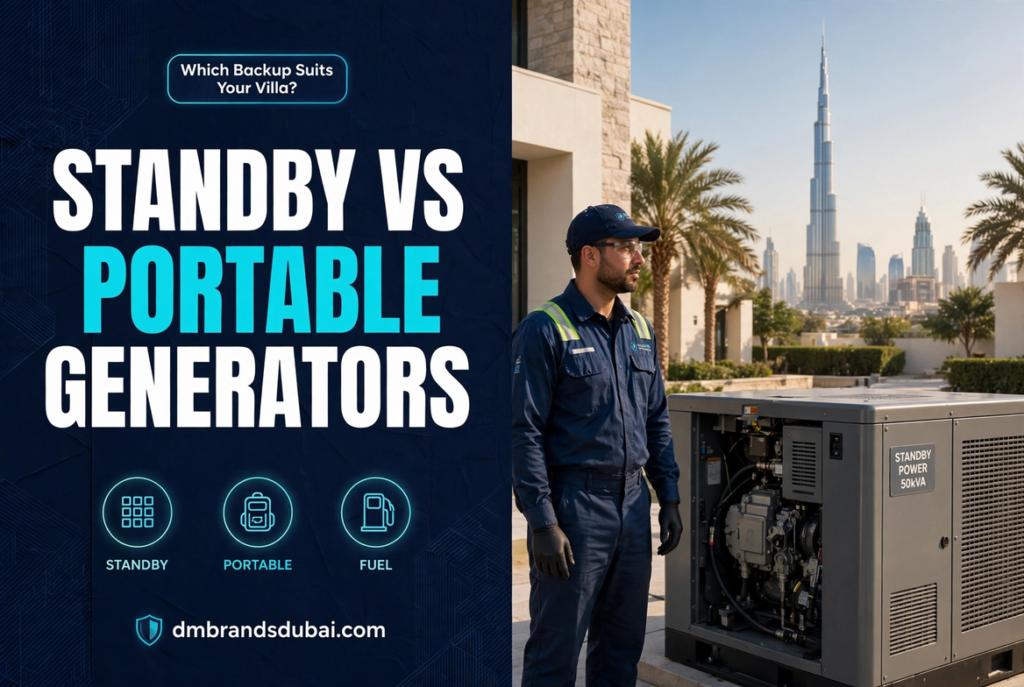
There are two main kinds. A standby generator is permanently installed outside your home. It starts automatically within seconds of an outage. A portable generator is a smaller unit you wheel out, fill with fuel, and start by hand. It powers a few appliances through extension leads.
For a Dubai villa, the standby generator is the serious option. It powers the air conditioning, the fridge, the lights, and the Wi-Fi without anyone touching it. A portable generator is a budget backup for a few essentials.
Why Dubai Villas Need Backup Power
Power cuts are uncommon in Dubai. DEWA runs a modern grid with high reliability. So why fit a generator at all?
First, the consequences of an outage are higher here than in a mild climate. Indoor temperatures rise fast in summer. A villa can reach 35°C within two hours of the air conditioning stopping. Elderly residents, babies, and pets suffer first.
Second, many villas depend on electric pumps for water. No power means no water pressure. Toilets, showers, and the kitchen all stop together.
Third, home offices are now normal. A two-hour outage during a work call or an exam is more than an inconvenience. A generator keeps the Wi-Fi and the laptop running.
Fourth, some homes have medical equipment that cannot stop. An oxygen concentrator, a powered bed, or refrigerated medicine needs guaranteed power. For those homes, a generator is not a luxury. It is essential.
Finally, a generator protects your food. A full villa fridge and freezer hold thousands of dirhams of food. A long outage in summer can spoil it all in a day.
Types of Home Generators Available in Dubai
The right generator depends on what you need to power, how automatically it must start, and your budget. Here is how the options compare.
| Generator type | Power range | Starts | Best for | Typical price range (installed) |
|---|---|---|---|---|
| Portable petrol generator | 2–7 kW | Manual | A few essentials, short outages | AED 2,000–7,000 |
| Inverter generator | 2–4 kW | Manual | Sensitive electronics, quiet use | AED 3,000–9,000 |
| Standby diesel generator | 10–30 kW | Automatic | Whole villa, AC, long outages | AED 15,000–45,000 |
| Standby gas generator | 10–25 kW | Automatic | Whole villa, cleaner running | AED 12,000–40,000 |
| Solar + battery backup | 5–15 kW | Automatic | Short outages, lower running cost | AED 25,000–60,000 |
Portable Generators
A portable generator is a small engine on wheels. You store it in the garage, wheel it outside during an outage, add fuel, and pull the starter cord. It powers a few appliances through extension leads or a manual changeover switch.
Portable units suit small budgets and short outages. They run a fridge, a few lights, a fan, and a phone charger. They will not run a villa's central air conditioning. They are also noisy and need you to be home to start them.
Safety matters. Never run a portable generator inside a garage or a closed room. Exhaust fumes contain carbon monoxide, which is colourless and deadly. Always run it outdoors, at least 6 metres from windows and doors.
Inverter Generators
An inverter generator produces cleaner, more stable power than a standard portable unit. The output is safe for laptops, televisions, and other sensitive electronics. Inverter units are also quieter and more fuel-efficient.
They suit home offices and small apartments. The power range is limited, usually 2 to 4 kW. That covers a fridge, lights, Wi-Fi, and a laptop, but not air conditioning.
Standby Diesel Generators
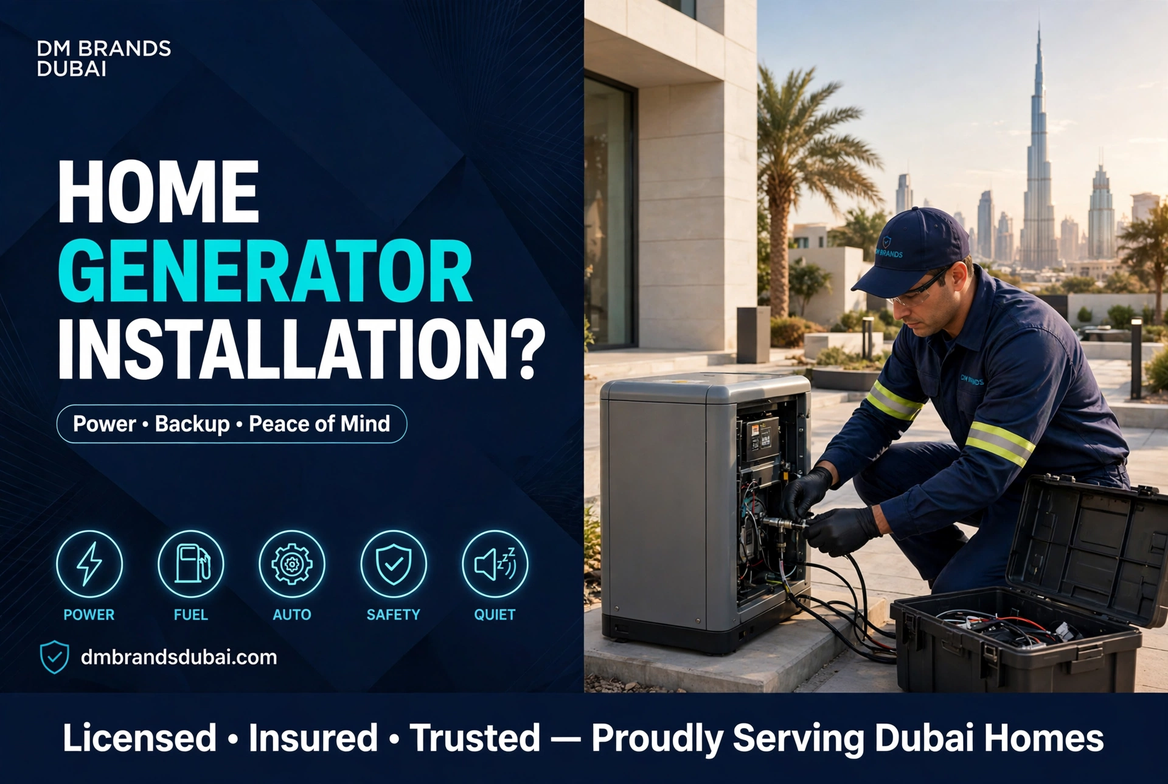
A standby diesel generator is the workhorse of villa backup power. It sits permanently outside on a concrete pad, connected to the house wiring through an automatic transfer switch. When the mains fails, it starts itself within seconds. When the mains returns, it switches back and shuts down.
Diesel units are powerful, durable, and widely supported in the UAE. Fuel is available everywhere. A 15 to 20 kW diesel unit powers a typical 4-bedroom villa, including one or two air conditioning units. Larger villas need 25 to 30 kW.
The drawbacks are noise, size, and exhaust. A diesel generator needs a soundproof enclosure and a proper exhaust route. It also needs regular servicing. Diesel is the most common choice for whole-villa backup in Dubai.
Standby Gas Generators
Gas generators run on natural gas or LPG. They start automatically like diesel units. They run more quietly, produce less smell, and need less maintenance. There is no diesel to store and no fuel to go stale.
The limit is fuel supply. A gas generator needs a gas line or a large LPG tank. Many Dubai villas have no gas connection. If your villa has piped gas, a gas standby unit is an excellent option. If not, the cost of a large LPG tank may cancel the benefit.
Solar Panels and Battery Backup
Solar panels with a battery can cover short outages. During the day, the panels charge the battery. At night, the battery powers essential circuits. This suits homes that already have solar panels fitted.
The limit is capacity. A battery system that covers a villa's air conditioning through a summer night is very expensive. Most solar backup systems cover lights, fridge, Wi-Fi, and fans, not full cooling. For whole-villa backup, a generator remains the practical choice. See our guide to solar panel installation in Dubai if you are considering solar for your villa.
How to Size a Generator for Your Villa
Sizing is the most important decision in the whole project. An undersized generator trips out when the air conditioning starts. An oversized generator wastes money and fuel. Never guess the size.
Step 1: List What Must Keep Running
Walk through your villa and list the essential loads. A typical list includes air conditioning, fridge and freezer, water pump, lights, Wi-Fi router, and a few sockets. Add medical equipment if relevant.
Step 2: Add Up the Watts
Each appliance has a running wattage and a starting wattage. Motors need extra power to start. An air conditioner that runs at 2,500 watts may need 7,500 watts to start. The generator must handle the starting surge, not just the running load.
Typical running watts for common villa loads:
| Appliance | Running watts (typical) | Starting watts (typical) |
|---|---|---|
| Split AC, 1.5 ton | 1,500–2,000 | 4,500–6,000 |
| Central AC, 5 ton | 4,000–6,000 | 12,000–18,000 |
| Fridge-freezer | 150–300 | 800–1,200 |
| Water pump | 500–1,000 | 1,500–3,000 |
| LED lights, whole villa | 200–400 | 200–400 |
| Wi-Fi router and laptop | 100–200 | 100–200 |
| Washing machine | 500–1,000 | 1,500–2,000 |
| Electric water heater | 1,500–3,000 | 1,500–3,000 |
| Television | 150–300 | 150–300 |
Step 3: Choose a Sizing Strategy
There are two strategies. Whole-house sizing powers everything, including all air conditioning. This needs a large generator, usually 20 to 30 kW for a villa.
Essential-load sizing powers only what matters: one or two air conditioners, the fridge, the pump, lights, and Wi-Fi. This needs 10 to 15 kW for most villas. It costs far less and still keeps the home comfortable.
Most Dubai homeowners choose essential-load sizing. The installer fits a separate essential-loads panel. Non-essential circuits, such as the pool pump and the water heater, stay off during an outage.
Step 4: Get a Professional Load Calculation
A licensed electrician should do the final calculation. They measure your actual loads, check the starting currents, and account for the Dubai heat, which reduces generator output. A generator rated at 20 kW in a cool climate may deliver less in a 45°C villa garden. This derating is real and must be included in the sizing.
How Much Does Home Generator Installation Cost in Dubai?
Prices depend on the generator size, fuel type, and the electrical work needed. The ranges below are typical Dubai market rates in 2026, including the unit, the transfer switch, and standard installation.
| Item | Typical range (AED) |
|---|---|
| Portable generator, 3–5 kW | 2,000–5,000 |
| Inverter generator, 2–4 kW | 3,000–9,000 |
| Standby gas generator, 10–15 kW, installed | 12,000–25,000 |
| Standby diesel generator, 15–20 kW, installed | 18,000–35,000 |
| Standby diesel generator, 25–30 kW, installed | 30,000–45,000 |
| Automatic transfer switch (ATS) | 2,000–6,000 |
| Concrete pad and enclosure | 1,500–5,000 |
| Fuel tank and fuel lines | 1,000–4,000 |
| Electrical panel work and wiring | 1,500–5,000 |
| Annual service contract | 1,000–3,000 |
What Affects the Final Price
Generator size. This is the biggest factor. Every extra kilowatt costs money. Correct sizing saves more than any discount.
Fuel type. Diesel units cost more than gas units of the same size, but diesel is easier to store and widely available. Gas units need a gas supply, which may add cost.
Automatic transfer switch. A good ATS costs AED 2,000 to AED 6,000. It is the part that makes the system automatic. Do not accept a cheap manual changeover switch for a standby system. It defeats the purpose.
Location and access. The generator needs a ventilated outdoor spot with a concrete pad. If the location is far from the electrical panel, the cable run adds cost. If the garden needs excavation for cables, add more.
Noise enclosure. A soundproof canopy adds cost but matters in a villa community. Your neighbours will notice a bare diesel engine at 2 a.m. Check your community rules on noise before you buy.
Electrical panel work. Older villas may need a panel upgrade to accept the transfer switch safely. Our electrical panel upgrade service in Dubai can be done as part of the installation.
Always get a written quote that names the generator brand and model, the kW rating, the transfer switch type, the fuel system, the pad and enclosure, labour, and the warranty. If a quote is vague, ask for the detail in writing.
The Installation Process Step by Step
A standby generator installation is a multi-trade job. It involves electrical work, plumbing for fuel, and a concrete base. Knowing the steps helps you judge the quality of the work.
Step 1: Site Survey and Load Calculation
The technician visits your villa, measures the electrical loads, and checks the main panel. They choose a location for the generator. It must be outdoors, ventilated, away from bedroom windows, and reachable for fuel delivery and service. They check the cable route from the generator to the panel.
Step 2: Choosing the Generator and Transfer Switch
Based on the load calculation, the technician recommends a generator size and fuel type. The automatic transfer switch is sized to match the main breaker. A switch that is too small will overheat. The enclosure and exhaust route are planned at this stage.
Step 3: Preparing the Base
A concrete pad is poured or precast slabs are laid. The pad must be level and strong enough for the generator's weight. A diesel unit with a full fuel tank can weigh over 500 kg. The pad should sit slightly above ground level so rainwater does not pool under the unit.
Step 4: Fitting the Generator and Fuel System
The generator is placed on the pad and bolted down. The fuel tank is connected, or the gas line is run by a licensed gas fitter. The exhaust is routed away from windows and air conditioning intakes. The soundproof canopy is fitted.
Step 5: Electrical Connection
A licensed electrician installs the automatic transfer switch next to the main panel. The essential-loads panel is wired. Cables run from the generator to the transfer switch in proper conduit. All connections are torqued and labelled. The system is earthed correctly.
Step 6: Testing and Commissioning
The mains supply is switched off to simulate an outage. The generator should start within seconds. The transfer switch moves the load to the generator. The technician checks the voltage and frequency under load, then restores the mains and confirms the system switches back and shuts down. The auto-start, the battery charger, and the alarms are all tested.
Step 7: Handover and Demonstration
You are shown how to start the generator manually, how to check the fuel and oil, what the warning lights mean, and when to call for service. You should get the manual, the warranty papers, and the service schedule before the team leaves.
A standby installation usually takes 2 to 4 days, including the concrete pad curing time. A portable generator needs no installation, but a manual changeover switch still needs a licensed electrician.
Dubai-Specific Notes: Heat, Communities, and Approvals
Dubai conditions shape every generator decision. The advice below reflects what actually matters here.
Heat reduces output. Generators lose power in extreme heat. A unit rated at 20 kW at 25°C may deliver 17 to 18 kW at 45°C. Your installer must size for Dubai summer conditions, not for the brochure rating. Ask them to confirm the derated output in writing.
Ventilation is critical. A generator needs a constant supply of cool air and a clear path for hot exhaust. Never enclose a generator in a sealed room. Never place it under a window. The enclosure must be designed for airflow, not just for looks.
Community rules apply. Many villa communities have rules about external equipment, noise, and fuel storage. Check with your community management before buying. Some communities require the generator to be screened from view. Some restrict diesel storage quantities. Get the approval in writing before work starts.
DEWA and electrical safety. A standby generator connects to your home wiring. The work must be done by a licensed electrician. The transfer switch must prevent back-feeding, where generator power flows back into the grid. Back-feeding can kill a linesman working on the supply. This is why the automatic transfer switch is not optional. Guidance on home electrical safety is available from DEWA.
Fuel storage. Diesel must be stored safely, away from heat and ignition sources. Keep the tank shaded. Diesel goes stale after 6 to 12 months, so use a fuel stabiliser if the generator rarely runs. Check the fuel level monthly. A generator with an empty tank is just a garden ornament.
Dust and sand. Fine sand clogs air filters faster in Dubai than in cooler climates. Check the air filter monthly during summer. A clogged filter makes the engine run hot and reduces output.
Summer travel. If you travel for weeks in summer, a standby generator protects the villa while you are away. Test it before you travel. Make sure the fuel tank is full, the battery is charged, and the auto-start is switched on. Ask a neighbour or your maintenance company to check it weekly.
How to Choose a Generator Installer in Dubai
A generator installation is a serious electrical job. The installer matters as much as the machine. Use this checklist.
- Licensed electricians. Ask for the trade licence and the electrician's credentials. Generator wiring is not a handyman job.
- Load calculation in writing. The installer should show you the load calculation, not just name a size. Ask which circuits are on the essential panel.
- Written quote. The quote should name the brand, model, kW rating, transfer switch type, fuel system, pad and enclosure, labour, and warranty.
- Brand support in the UAE. Ask which brands they install and whether spare parts and service are available locally. A generator with no local support is a liability.
- Noise rating. Ask for the noise level in decibels at 7 metres. Compare it with your community's rules.
- Service contract. A generator needs an annual service at minimum. Ask about a service contract and the response time for a breakdown. A company with a villa maintenance service or an annual maintenance contract in Dubai can keep the unit ready.
- References. Ask for photos of recent villa installations in your area. A genuine installer will have them.
Get two or three quotes for a standby system. Compare the kW rating, the transfer switch, and the warranty, not just the headline price. A cheap quote that omits the enclosure, the pad, or the panel work is not a saving.
Mistakes to Avoid
Guessing the size. An undersized generator trips out when the air conditioning starts. An oversized one wastes fuel and money. Always get a professional load calculation.
Skipping the transfer switch. A manual changeover switch on a standby generator defeats the purpose. Worse, a wrongly wired switch can back-feed the grid. Always fit a proper automatic transfer switch.
Running a portable generator indoors. Never run any generator inside a garage, a room, or a tent. Carbon monoxide kills silently. Always run it outdoors, away from windows.
Buying a cheap unbranded unit. A cheap generator may have no local parts, no warranty, and a poor voltage output that damages electronics. Buy a recognised brand with UAE support.
Forgetting the fuel. Diesel goes stale. Petrol goes stale faster. A generator that has not run for a year may not start when you need it. Run it monthly and keep the fuel fresh.
Ignoring the noise. A bare diesel engine at night will upset neighbours and may break community rules. Budget for a soundproof canopy from the start.
No maintenance plan. A generator is an engine. It needs oil changes, filter changes, and battery checks. Without maintenance, it will fail in the outage you bought it for.
Maintenance: Keeping Your Generator Ready
A generator that is never tested is a gamble. A simple routine keeps it ready for the day you need it.
- Run it monthly. Start the generator under load for 20 to 30 minutes every month. This keeps the engine lubricated, charges the battery, and reveals problems early. Many standby units do this automatically. Check that the exercise timer is set.
- Check the fuel monthly. Top up the tank. Add stabiliser if the fuel will sit for months. Drain and replace stale fuel.
- Check the oil and coolant. Low oil damages the engine. Check the levels monthly and change the oil after the first 20 hours of use, then at the intervals in the manual.
- Check the battery. The starter battery is the most common cause of failure. Keep the terminals clean. Replace the battery every 2 to 3 years, before it fails.
- Clean the air filter. Check it monthly in summer. Tap out the dust or replace it. A clean filter keeps the engine cool and efficient.
- Test the transfer switch. Simulate an outage every few months. Switch off the mains and confirm the generator starts and the essential circuits power up.
- Book an annual service. A professional service covers the oil, filters, spark plugs or injectors, belts, coolant, battery test, and a full load test. This is the single most important habit for a standby generator.
Keep a log of every run, service, and fuel fill. It helps the technician diagnose faults and proves the service history if you sell the villa.
Home Generator Installation in Dubai: FAQs
How much does a home generator cost in Dubai?
A portable generator costs AED 2,000 to AED 7,000. A standby gas generator for a villa costs AED 12,000 to AED 25,000 installed. A standby diesel generator costs AED 18,000 to AED 45,000 installed, depending on size. These are typical ranges. A load calculation and a site survey give you an exact quote.
What size generator do I need for a villa in Dubai?
Most 3 to 4-bedroom villas need 10 to 15 kW for essential loads, including one or two air conditioners, the fridge, the water pump, and lights. Whole-house coverage needs 20 to 30 kW. A professional load calculation gives the exact size.
How long will a standby generator run?
It runs as long as it has fuel. A diesel unit with a full tank typically runs 8 to 24 hours, depending on the tank size and the load. Larger tanks extend the run time. Gas units run as long as the gas supply lasts.
Does a home generator start automatically?
A standby generator with an automatic transfer switch starts within seconds of an outage. A portable generator must be started by hand. If you want automatic backup, you need a standby system.
Is a generator noisy?
Portable and open-frame generators are noisy, often 70 decibels or more. A standby unit in a soundproof canopy runs at 60 to 65 decibels at 7 metres, about the level of normal conversation. Ask for the noise rating before you buy.
Do I need approval to install a generator in Dubai?
You do not need a DEWA permit for a domestic generator, but you must check your community management rules. Many communities have rules about noise, fuel storage, and external equipment. The electrical work must be done by a licensed electrician.
Can a generator power my air conditioning?
Yes, if it is sized correctly. Air conditioners need a large starting surge. The generator must handle that surge. Essential-load sizing usually covers one or two air conditioners. Whole-house sizing covers all of them.
What fuel is best for a home generator in Dubai?
Diesel is the most common choice for standby villas because it is widely available and stores well. Gas is quieter and cleaner but needs a gas supply. Petrol suits small portable units but goes stale quickly. Choose based on your fuel access and the generator size.
How often should I service my generator?
Service a standby generator at least once a year, plus a monthly test run. Change the oil and filters at the intervals in the manual. Replace the starter battery every 2 to 3 years. A service contract makes this automatic.
Will a generator damage my electronics?
A quality standby or inverter generator produces stable power that is safe for electronics. A cheap portable generator can produce unstable voltage that harms laptops and televisions. If you power sensitive equipment, choose an inverter or a quality standby unit.
Can I install a generator myself?
A portable generator needs no installation, but any connection to your home wiring must be done by a licensed electrician. A standby installation involves a transfer switch, a concrete pad, and fuel lines. Do not attempt it yourself.
What is an automatic transfer switch?
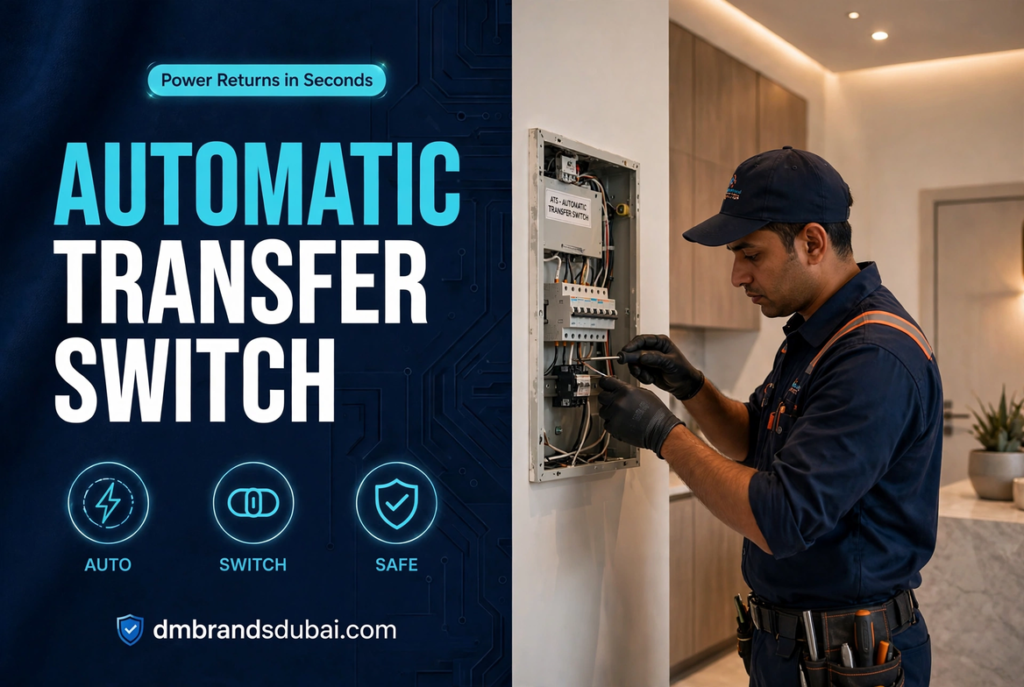
An automatic transfer switch monitors the mains supply. When the power fails, it starts the generator and switches your home to generator power. When the mains returns, it switches back and shuts the generator down. It also prevents dangerous back-feeding into the grid.
How much fuel does a home generator use?
A 15 kW diesel generator uses roughly 3 to 5 litres per hour at half load. Use rises with the load. A 20 kW unit at full load can use 6 to 8 litres per hour. Your installer can estimate the fuel use for your specific load.
Can a generator run on solar power?
A generator and solar panels can work together. Solar panels with a battery cover short outages and lower your bills. A generator covers long outages and heavy loads such as air conditioning. Many villas use both.
What happens if the generator fails to start?
The most common causes are a flat battery, stale fuel, or a tripped breaker. Check the battery, the fuel, and the control panel. If it still will not start, call your installer. This is why a monthly test run matters.
Is a home generator worth it in Dubai?
It depends on your needs. If you work from home, have medical equipment, or travel in summer, a standby generator is worth the investment. If outages rarely affect you, a small portable unit may be enough. Weigh the cost against the cost of a long summer outage.
How long does a home generator last?
A quality standby generator lasts 15 to 25 years with regular service. Portable units last 5 to 10 years depending on use. The engine hours matter more than the calendar age.
Can a generator be fitted in an apartment?
A standby generator is not practical for an apartment because it needs outdoor space, a fuel supply, and a connection to the flat's wiring. Apartment residents should use a small inverter generator on a balcony only if the building allows it, or a battery backup system. Check building rules first.
What should I do before a generator installation?
Clear the chosen location. Confirm the cable route to the electrical panel. Check community approval. Make sure the installer has access to the main panel and the garden. Agree the essential-loads list in writing before work starts.
Does home insurance cover a generator?
Many home insurance policies cover a permanently installed generator as part of the building or contents. Check with your insurer before installation and update the policy after the work is done.
Conclusion
A home generator is insurance you can hear running. In Dubai, where summer heat makes power more than a convenience, a standby generator keeps your villa cool, your fridge cold, and your Wi-Fi alive through any outage. The key is correct sizing: a professional load calculation, a quality generator from a brand with UAE support, and a proper automatic transfer switch fitted by a licensed electrician.
Do not buy on price alone. A cheap generator that will not start, or that trips when the air conditioning kicks in, is worse than no generator at all. Get a written quote, confirm the derated output for Dubai heat, and agree a service plan from day one.
Ready to fit a home generator in your Dubai villa? DM Brands Dubai installs standby diesel and gas generators, automatic transfer switches, and essential-load panels across Dubai Hills Estate, Arabian Ranches, Jumeirah Village Circle, Al Barsha, Mirdif, The Springs, and all Dubai villa communities. Our licensed electricians calculate your load, recommend the right size, and commission the system with a full outage test.
Message us on WhatsApp or call DM Brands Dubai today for a free site survey and a written quote. Tell us how many bedrooms you have and which air conditioners must keep running, and we will give you a clear price before any work starts.
Book your home generator installation in Dubai today — automatic backup power, fitted and tested by licensed professionals.