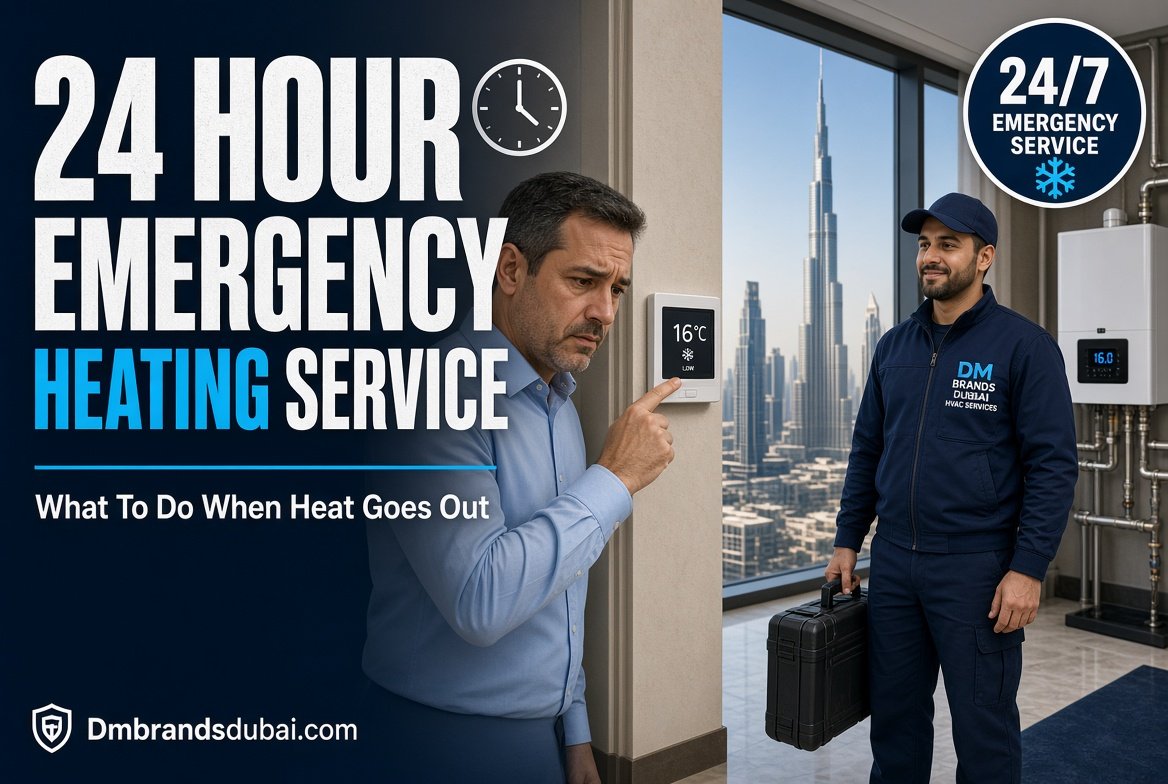
A 24 hour emergency heating service sends a trained technician to your home or business at any hour when your heating system fails. It covers nights, weekends, and holidays, the exact times when most breakdowns seem to happen.
A heating failure is more than an inconvenience. Cold rooms can harm babies, older adults, and anyone with a health condition, and a faulty system can create real safety risks like carbon monoxide or gas leaks.
Knowing what counts as a true heating emergency helps you act fast and stay safe. It also helps you avoid paying after-hours rates for a problem that could wait until morning.
Whether you live in a villa, an apartment, or run an office, the same rules apply to split, ducted, central, and heat pump systems.
Table of Contents
What Is a 24 Hour Emergency Heating Service?
A 24 hour emergency heating service is round-the-clock repair for furnaces, heat pumps, boilers, and other heating systems. Call right away if you have no heat in cold weather, smell gas, hear loud banging, see smoke, or your carbon monoxide alarm sounds.
Most providers answer calls at any hour and dispatch a technician with common parts on the truck. The goal is to restore safe heat in a single visit when possible.
If the problem is a safety hazard, such as a gas smell or a carbon monoxide alarm, leave the building first and call for help from outside.
Key Takeaways
- Call an emergency service when there is no heat in cold weather, a gas smell, or a safety alarm.
- Leave your home immediately if a carbon monoxide alarm sounds, then call emergency services.
- Check the thermostat, power, filter, and fuel supply before you call. These are quick, safe checks.
- Ask about the service call fee, after-hours rates, and arrival time before you book.
- Choose licensed, insured technicians who carry common parts.
- Yearly maintenance by a qualified technician prevents most winter breakdowns.
- Heat pumps, furnaces, and boilers each fail in different ways, so describe your system clearly on the phone.
What Counts as a Heating Emergency?
Not every heating problem needs a midnight visit. Some issues are dangerous, and others can wait for a regular appointment.
Use the table below as a quick guide.
| Situation | Emergency? | What to Do |
|---|---|---|
| Smell of gas | Yes, critical | Leave the building, call your gas supplier or emergency services from outside |
| Carbon monoxide alarm sounding | Yes, critical | Get everyone outside, call emergency services |
| Smoke or burning smell from the unit | Yes | Turn off the system, leave if smoke is heavy, call for help |
| No heat during freezing weather | Yes | Call an emergency heating service |
| No heat with infants, elderly, or ill people at home | Yes | Call right away and use safe temporary warmth |
| Loud banging, grinding, or screeching | Likely | Turn off the system and call |
| Water leaking from a boiler | Likely | Shut off the system if safe and call |
| Heat works but is weak in mild weather | No | Book a standard appointment |
| Thermostat display blank | Often no | Check batteries and power first |
| Slightly uneven room temperatures | No | Schedule a routine inspection |
If you are unsure, treat safety signs as urgent. A short call to a dispatcher can help you decide.
Signs You Need Emergency Heating Repair
Watch for these warning signs.
- The system will not turn on at all.
- The unit runs but only blows cold air.
- You hear banging, rattling, or screeching sounds.
- You notice a strong, unusual smell.
- Water pools around the furnace or boiler.
- The system shuts off again and again.
- Your carbon monoxide detector beeps or sounds an alarm.
- The pilot light goes out and will not stay lit.
Any of these can point to a failing part or a safety problem. Early action prevents bigger damage.
Heating Problems That Can Usually Wait
Some problems are annoying but not urgent. A noisy blower on a mild day, a dirty filter, or small temperature differences between rooms are good examples.
You can schedule these for the next available daytime slot. That is usually cheaper than an after-hours visit.
Still, do not ignore them. Small issues often turn into winter breakdowns.
Safety First: Carbon Monoxide and Gas Leak Warnings
Heating systems that burn fuel can create dangerous gases. Safety must come before repairs.
The CDC explains that carbon monoxide (CO) is an odorless, colorless gas produced by furnaces and other fuel-burning appliances. It can make you sick or even be life threatening.
Symptoms of Carbon Monoxide Poisoning
According to the CDC, common symptoms include headache, dizziness, weakness, nausea, vomiting, chest pain, and confusion.
Symptoms can feel like the flu. If several people in the home feel sick at once, or symptoms improve when you leave the house, suspect CO.
Pets can also show signs of illness.
What to Do if Your CO Alarm Sounds
Follow the CDC advice. Leave your home immediately and call emergency services if your carbon monoxide detector alarm sounds.
Do not stop to open windows or investigate the heater. Get everyone outside into fresh air first.
Do not go back inside until emergency responders say it is safe.
What to Do if You Smell Gas
A gas smell is a serious hazard. Do not use light switches, phones, or lighters inside the home.
Leave the building right away. Call your gas supplier or emergency services from outside.
Only a qualified technician or the gas company should repair a gas leak.
Install and Maintain CO Alarms
Place carbon monoxide alarms outside each sleeping area and on every floor of your home. Test them monthly and replace batteries as needed.
CO alarms wear out over time. Follow the manufacturer’s replacement date on the label.
Alarms are an important backup, but the CDC stresses that yearly maintenance of fuel-burning appliances is the main way to prevent poisoning.
Never Use Unsafe Heat Sources
The CDC warns against heating your home with a gas oven. It also warns against burning anything in an unvented stove or fireplace.
During a power outage, never run a generator, charcoal grill, or camp stove inside your home, basement, or garage. Keep generators at least 20 feet from windows, doors, and vents.
These shortcuts can cause deadly CO buildup in minutes.
What to Do Immediately When Your Heating Fails
Stay calm and follow a simple order of steps. This protects your family and speeds up the repair.
Step 1: Check for Danger
Look for smoke, a gas smell, or an alarm. If you find any, leave the building and call for emergency help.
If there is no danger, move to the next step.
Step 2: Keep Your Household Warm
Close doors to rooms you are not using. Gather in one room and keep curtains closed to hold in heat.
Layer clothing and blankets. Warm drinks and movement also help.
Pay special attention to babies, older adults, and people with medical conditions.
Step 3: Run Quick, Safe Checks
Before you call, try the basic checks in the next section. Many “no heat” calls turn out to be simple issues like a tripped breaker or a dead thermostat battery.
Do not open the furnace cabinet or touch gas lines. Leave internal parts to professionals.
Step 4: Call a 24 Hour Emergency Heating Service
Describe your system, symptoms, and any safety concerns. Share your address and a good phone number.
Ask for an arrival window, the call-out fee, and what the technician will check first.
Keep your phone nearby for updates.
Step 5: Prepare Your Home for the Technician
Clear a path to the heating unit. Move stored items, pets, and clutter away.
Turn on outdoor lights if it is dark. Have your system’s age, brand, and any recent repair notes ready.
This saves time and helps the technician diagnose the problem faster.
Quick Troubleshooting Checklist Before You Call
These checks are safe for most homeowners. They fix a surprising number of heating problems.
Check the Thermostat
Make sure it is set to “heat” and the temperature is higher than the current room temperature. Replace the batteries if the screen is blank.
If your thermostat is programmable, confirm the schedule did not change after a power blip.
Check Power and Breakers
Look at your electrical panel for a tripped breaker. Reset it once if it tripped.
If it trips again, stop and call a technician. Repeated tripping points to an electrical fault.
Also check the furnace switch near the unit, which can be turned off by accident.
Check the Air Filter
A clogged filter restricts airflow and can cause the system to overheat and shut down. Replace it if it looks dirty.
Filters should be checked regularly during heavy-use months. A clean filter also improves efficiency.
Check the Fuel Supply
For gas furnaces, confirm the gas valve is open and other gas appliances work. For oil systems, check the tank level.
For propane, check the tank gauge. An empty tank is a common cause of no heat.
If you smell gas at any point, stop and follow the gas leak steps above.
Check Vents and Registers
Make sure supply vents and return grilles are open and not blocked by furniture or rugs.
Blocked airflow can create uneven heating and strain the blower motor.
Check the Condensate Line and Float Switch
High-efficiency furnaces produce condensation. A clogged drain line can trip a safety switch and shut the system down.
If you see water near the unit and are not sure how to handle it, leave it for the technician.
Know When to Stop
If your checks do not restore heat, stop. Do not remove panels, bypass safety switches, or relight burners without proper training.
Heating systems combine electricity, gas, and moving parts. Mistakes can cause injury or damage.
Types of Heating Systems an Emergency Technician May Repair
Different systems fail in different ways. Telling the dispatcher what you have speeds up the visit.
| System | How It Heats | Common Emergency Problems |
|---|---|---|
| Gas furnace | Burns natural gas or propane, blows warm air through ducts | Ignition failure, dirty flame sensor, cracked heat exchanger, blower failure |
| Electric furnace | Uses electric heating elements | Failed elements, tripped breakers, bad sequencer |
| Heat pump | Moves heat using refrigerant | Frozen outdoor coil, refrigerant leak, failed reversing valve, compressor trouble |
| Boiler | Heats water for radiators or baseboards | Low pressure, leaks, failed circulator pump, pilot or ignition issues |
| Ducted split system | Air handler plus outdoor unit | Blower failure, thermostat faults, duct leaks, control board issues |
| Oil furnace | Burns heating oil | Clogged nozzle, empty tank, failed ignition |
| Ductless mini split | Wall units with outdoor compressor | Sensor errors, drain blockage, refrigerant issues |
Many technicians who work on cooling equipment also handle ducted and heat pump systems. These share blowers, ductwork, and controls with air conditioners.
Always confirm that the company services your exact system type before you book.
24/7 Emergency Heating Repair: What the Service Includes
A good emergency service does more than show up. It diagnoses the cause, fixes it safely, and checks that the whole system runs correctly.
Here is what you can usually expect.
Phone Triage and Dispatch
A dispatcher asks about your system, symptoms, and safety concerns. They decide how urgent the call is and send the closest available technician.
Many companies run a call centre around the clock. This means a real person answers at 3 a.m., not just a voicemail.
On-Site Diagnosis
The technician inspects the thermostat, power supply, ignition system, blower, filters, and safety switches. They also check for leaks and carbon monoxide risks.
Testing tools help them find electrical faults and airflow problems quickly.
Emergency Repair
Many repairs finish in one visit when the truck carries common parts. Typical fixes include replacing igniters, flame sensors, capacitors, thermostats, and blower components.
Some jobs need special parts. In that case, the technician may offer a temporary solution and return with the part.
Safety Check
After the repair, a responsible technician tests the system and checks for gas leaks, exhaust problems, and CO risks. They confirm that the unit cycles properly.
Ask for a short explanation of what failed and what was done.
Written Estimate and Documentation
You should receive a clear estimate before major work starts. After the job, ask for an invoice that lists parts, labor, and any warranty.
Keep this paperwork for future service and warranty claims.
Emergency Furnace Repair
Furnaces are one of the most common home heating systems in colder regions. When one fails, the cause is often a small, fixable part.
Here are the issues technicians see most.
Furnace Will Not Turn On
Common causes include a tripped breaker, dead thermostat, blown fuse, closed gas valve, or failed control board.
A door switch that does not close fully can also keep the furnace from starting.
Furnace Blowing Cold Air
This often means the burners are not lighting. Possible causes include a dirty flame sensor, bad igniter, clogged filter, or gas supply issue.
It can also happen if the fan is set to “on” and the burners have shut off for safety.
Furnace Short Cycling
Short cycling means the system turns on and off in quick bursts. Dirty filters, overheating, a faulty thermostat, or an oversized unit can cause it.
Short cycling wears out parts and wastes energy. It needs a professional diagnosis.
Furnace Making Loud Noises
Banging, squealing, and grinding each point to different problems. Delayed ignition can cause a bang.
Squealing may come from a worn belt or motor bearing. Grinding can mean a failing blower motor.
Turn the system off and call for help if the noise is loud or sudden.
Pilot Light or Ignition Problems
Older furnaces use a standing pilot light. Newer models use electronic ignition.
If the pilot keeps going out, a thermocouple or gas supply issue may be the cause. Do not keep relighting it if it fails repeatedly.
Cracked Heat Exchanger
The heat exchanger separates combustion gases from the air you breathe. A crack can allow carbon monoxide into your home.
This is a serious safety issue. A technician may shut down the furnace until it is repaired or replaced.
Emergency Heat Pump Repair
Heat pumps heat and cool your home by moving heat. They are common in milder climates and growing in cold ones.
When they fail in winter, you need fast help.
Heat Pump Not Heating
Possible causes include low refrigerant, a faulty reversing valve, a failing compressor, a frozen outdoor coil, or thermostat settings.
A technician can test refrigerant pressure and electrical components to find the fault.
Frozen Outdoor Unit
Heat pumps normally run a defrost cycle. If ice builds up and does not clear, the unit may have a defrost control or sensor problem.
Do not chip ice off the coil. This can damage delicate fins.
What Is “Emergency Heat” on a Thermostat?
Many heat pump thermostats have an “EM Heat” or “Emergency Heat” setting. It switches your system to backup heating, often electric resistance heat, and bypasses the heat pump.
Backup heat can keep you warm if the outdoor unit fails. But it usually costs more to run.
Use it only as a short-term fix until a technician repairs the heat pump.
Emergency Boiler Repair
Boilers heat water or produce steam to warm radiators, baseboards, or in-floor systems. They are common in older homes and some apartment buildings.
Boiler problems can cause both heat loss and water damage.
Common Boiler Emergencies
- No heat or hot water
- Low or high pressure readings
- Leaks around the boiler or pipes
- Strange banging or kettling noises
- Pilot light or ignition failures
- A failed circulator pump
Turn the boiler off if you see a leak or smell gas. Call a technician who is qualified to work on boilers.
Why Boiler Repair Needs Special Skills
Boilers operate under pressure and at high temperatures. Incorrect repairs can cause scalding, leaks, or even system failure.
Always hire a professional with boiler experience.
Emergency HVAC Service: 24 Hour Heating and Cooling
Many companies handle both heating and cooling. This is useful because the two systems share ducts, blowers, thermostats, and electrical controls.
A single call can cover problems that involve both.
Why One Company for Heating and Cooling Helps
A team that works on air conditioning knows how airflow, controls, and refrigerant circuits behave. That experience applies to ducted systems and heat pumps.
You also build a relationship with one provider. They learn your system and keep records of past repairs.
Round-the-Clock Support Matters
Heating and cooling breakdowns do not follow business hours. A provider with 24-hour support can respond to a winter heating loss or a summer cooling failure.
Look for clear information about emergency availability, service areas, and technician qualifications.
DM Brands Dubai: 24/7 Emergency HVAC and AC Service
DM Brands Dubai provides home maintenance, AC servicing, and emergency repair across Dubai. Its licensed technicians are directly employed and insured, and its call centre is open 24 hours.
If your split, ducted, or central unit stops working properly, including units that offer a heating mode on cooler nights, the team can diagnose the fault and restore comfort. Everything below reflects the services DM Brands Dubai offers.
Why Homeowners and Businesses Choose DM Brands Dubai
- Expert technicians. The team is licensed and experienced across split units, ducted systems, and central air conditioning.
- 24/7 emergency service. The emergency line is staffed around the clock for urgent breakdowns, including nights, weekends, and public holidays.
- Transparent, affordable pricing. You receive a clear, itemized quote before work begins, with no hidden fees.
- Same-day service. In most cases, appointments are prioritized so comfort returns the same day you call.
- Complete solutions. Repair, maintenance, installation, and cleaning are handled under one roof.
- Citywide coverage. The team serves homes, villas, and offices across Dubai, seven days a week.
Common Problems the Team Fixes
Most HVAC and AC faults follow a few patterns. Here is how each one is handled.
AC not cooling or weak airflow. Low refrigerant, a failing compressor, or a blocked filter are the usual suspects. Technicians run a full diagnostic to find the root cause, not just the symptom.
Water leaking from the unit. A blocked condensate drain line or damaged evaporator coil is the most common cause. The team clears blockages, repairs or replaces damaged coils, and tests the system to confirm the leak is gone.
Strange noises or bad smells. Noise often means a mechanical fault such as loose fan blades or worn bearings. Smells often point to mold or bacteria buildup, which calls for cleaning and sanitization.
Unit will not turn on. The cause is usually electrical, such as a tripped breaker, faulty thermostat, or blown capacitor. Technicians trace the electrical path end to end so you do not pay for a replacement you did not need.
High DEWA bills. Dirty coils, low refrigerant, and a struggling compressor force the system to work harder. Regular servicing keeps efficiency up and bills in check.
AC Repair Services
Every repair starts with a full diagnostic. This gives you an accurate quote and a lasting fix.
Repairs cover all major brands and system types, including split, ducted, and central units.
AC Maintenance Services
Regular servicing is the most effective way to prevent breakdowns. A typical maintenance visit includes the following.
- Filter cleaning
- Coil cleaning
- Refrigerant (gas) top-up
- Thermostat checks
- Duct inspection
AC Installation and Replacement
If your system is beyond repair, the team handles the full replacement. That includes choosing the right unit size for your space, professional installation, and safe removal of the old system.
Correct sizing matters because an oversized or undersized unit cycles badly and wastes energy.
AC Cleaning Services
A clean system improves both air quality and efficiency. Deep cleaning includes three services.
- Duct cleaning: Removes dust, allergens, and buildup from ductwork.
- Coil cleaning: Restores heat-exchange efficiency.
- Filter cleaning: Improves airflow and indoor air quality.
Annual Maintenance Contracts (AMC)
An annual maintenance contract locks in regular, planned servicing for your home or office. It catches small issues before they become expensive breakdowns.
Contracts suit apartments, villas, offices, and commercial properties alike.
Which Service Do You Need: Repair, Maintenance, Installation, or Deep Cleaning?
Use this table to match your situation to the right service.
| Service | When You Need It | What Is Included | Typical Turnaround |
|---|---|---|---|
| Emergency repair | Unit not working, leaking, noisy, or not turning on | Diagnostic, part repair or replacement, system testing | Same-day in most cases |
| Maintenance and servicing | Preventive, seasonal, or under an AMC | Filter, coil, and duct cleaning, gas check, thermostat check | Scheduled visit |
| Installation and replacement | New unit, old system beyond repair, renovation | Sizing consultation, removal of old unit, professional install | About one day per unit |
| Deep cleaning | Bad smells, allergy symptoms, visible dust or mold | Duct, coil, and filter deep clean, sanitization | Half a day to a full day |
Not sure which category fits? Contact DM Brands Dubai and the team will point you in the right direction.
Typical HVAC Maintenance and AMC Costs in Dubai
Prices depend on the type and number of units and whether the property is residential or commercial. The ranges below are typical Dubai market figures from DM Brands Dubai’s maintenance guide.
Always request a written quote after a technician has assessed your property.
Pay-Per-Visit Maintenance Costs
| Unit Type | Typical Cost Per Visit (AED) |
|---|---|
| Window AC unit | 80 to 200 |
| Split AC unit | 100 to 250 |
| Ducted or central AC (per system) | 300 to 800 and up |
| Commercial or VRF systems | Custom quote based on scope |
Annual Maintenance Contract Costs
| AMC Tier | Typical Annual Cost (AED) | Best For |
|---|---|---|
| Basic (2 to 3 units) | 500 to 1,200 | Apartments and small villas |
| Comprehensive (labor and minor parts) | 1,500 to 2,500 | Larger villas and families wanting fewer surprises |
| Commercial or full cover | 5,000 to 30,000 and up | Offices, retail, hospitality, and larger buildings |
Emergency repair costs vary with the fault. A simple filter or thermostat fix costs far less than a compressor replacement or refrigerant recharge.
Service Areas Across Dubai
DM Brands Dubai covers all major communities, so help is never far away. Coverage includes the following areas.
- Dubai Marina
- Jumeirah Village Circle (JVC)
- Palm Jumeirah
- Downtown Dubai
- Business Bay
- Al Barsha
- Arabian Ranches
- Jumeirah
- JBR
- Al Quoz
Whether you live in a high-rise apartment in Downtown or a villa in Arabian Ranches, technicians are equipped to handle homes, villas, and offices across the city.
Why Professional HVAC Care Matters in Dubai’s Climate
Dubai’s heat and humidity push systems harder than milder climates do. Units run near-constantly for much of the year, which speeds up wear on compressors, coils, and seals.
Fine desert dust also clogs filters and coils year-round. That is why servicing every few months and a pre-summer inspection are so valuable.
Better Indoor Air Quality
A poorly maintained system recirculates dust, allergens, and bacteria. Regular cleaning and filter changes matter most for households with children, older adults, or anyone with respiratory sensitivities.
Longer System Life and Lower Bills
Routine professional care helps protect your unit and keeps energy use, and your DEWA bill, under control.
Fewer Costly Emergencies
Preventive maintenance is usually cheaper than emergency repair. Catching a refrigerant leak or worn part during a routine visit costs a fraction of a full compressor failure.
How to Get Emergency Help From DM Brands Dubai
Getting started is simple. Follow these steps.
- Contact the team. Reach out by phone, WhatsApp, or the online form. The call centre is open 24 hours.
- Describe the problem. Share your system type, symptoms, and location.
- Receive your quote. You get a clear, itemized quote before any work begins.
- Meet the technician. A licensed, insured technician arrives, and in most cases the repair is completed the same day.
- Confirm the fix. The system is tested to make sure the problem is fully resolved.
A free, no-obligation quote is available. Visit DM Brands Dubai to request one.
How to Choose a Reliable 24 Hour Emergency Heating Service
When your home is freezing, it is tempting to call the first number you find. A short check protects you from poor service and surprise bills.
Use this checklist.
Confirm True 24/7 Availability
Some companies advertise 24-hour service but only answer an answering machine. Call and see whether a person responds.
Ask whether weekends and holidays are included.
Check Licensing and Insurance
Ask for the company’s license or registration details, as required where you live. Confirm that they carry liability insurance.
Technicians who handle refrigerants should hold proper certification. A useful benchmark is the U.S. EPA Section 608 framework, which reflects proper training in safe refrigerant handling.
Look at Technician Qualifications
Manufacturer authorization is also valuable. Brands such as Daikin, LG, Mitsubishi Electric, and Carrier often have authorized service partners. Ongoing training matters too.
Ask how experienced the dispatched technician is with your system type.
Ask About Response Time
Request a realistic arrival window. Be cautious of companies that promise an exact minute without knowing their workload.
A good dispatcher explains delays honestly.
Ask About Pricing Up Front
Request the call-out fee, hourly rate, and after-hours surcharge. Ask whether the diagnostic fee is applied to the repair.
Get a written estimate before any major work begins.
Read Reviews and Check References
Look at recent reviews on several platforms. Pay attention to comments about punctuality, honesty, and cleanup.
A few negative reviews are normal. Patterns of upselling or missed appointments are a warning sign.
Ask About Warranties
Reputable companies back their parts and labor. Ask how long the warranty lasts and what it covers.
Keep your receipt and warranty details in a safe place.
Questions to Ask Before You Book
Use these questions during the call.
| Question | Why It Matters |
|---|---|
| Are you available 24 hours, including holidays? | Confirms real after-hours support |
| What is your call-out fee? | Prevents surprise charges |
| Is there an after-hours surcharge? | Helps you compare providers |
| How soon can a technician arrive? | Sets expectations |
| Do your technicians carry common parts? | Raises the chance of a one-visit fix |
| Are your technicians licensed and insured? | Protects you and your property |
| Do you offer a warranty on repairs? | Shows confidence in workmanship |
| Will I get a written estimate? | Avoids disputes later |
Red Flags to Avoid
Most companies are honest, but a few use pressure tactics. Watch for these warning signs.
- A price quote given before anyone has seen the system
- Pressure to replace the whole unit immediately
- Refusal to give a written estimate
- Technicians who cannot show identification
- Demands for full cash payment up front
- Vague answers about licensing or insurance
- A company that only lists a mobile number and no business address
Take a moment to step back. You can always ask for a second opinion, unless there is a safety hazard.
What to Expect During an Emergency Heating Service Visit
Knowing the process makes the visit less stressful. Here is a typical timeline.
Arrival and Introduction
The technician introduces themselves and confirms the problem. They may ask when the issue began and whether anything unusual happened.
Share any details about noises, smells, or recent repairs.
Inspection and Testing
The technician checks the thermostat, power, ignition, burners, blower, and safety controls. They may use meters and gauges to test parts.
They also look at filters, vents, and ducts for blockages.
Explanation and Estimate
Once the cause is found, the technician explains the problem in plain language. They give you repair options and a price.
Ask questions. A good technician welcomes them.
Repair and Testing
After you approve the work, the technician repairs or replaces the faulty part. They then run the system to confirm it heats properly.
They also check for safety issues before leaving.
Final Walkthrough
You should receive a summary of the repair, advice on preventing a repeat, and any recommended follow-up work.
Ask for an invoice and warranty details.
How Long Does an Emergency Heating Repair Take?
Many repairs take one to a few hours. Simple fixes like a thermostat or filter swap are faster.
Complex repairs, such as a compressor or heat exchanger replacement, can take longer. They may require ordering parts.
The technician should explain realistic timing after diagnosing the problem.
What If Parts Are Not Available?
Sometimes a needed part is out of stock overnight. Ask about temporary measures, such as safe supplemental heating, while you wait.
A professional will not leave you in an unsafe situation.
Emergency Heating Repair Cost: What Affects the Price
Emergency repairs usually cost more than scheduled visits. Technicians work outside normal hours and must keep staff on call.
Prices vary widely by region, system, and problem, so exact numbers are hard to give. These factors shape the bill.
Time of Day and Day of Week
Nights, weekends, and holidays often carry higher rates. Some companies charge a flat after-hours fee, while others charge a higher hourly rate.
Ask which model applies before you book.
Type and Age of the System
Older systems may need hard-to-find parts. High-efficiency or specialty systems can cost more to repair than basic units.
Brand matters too. Some manufacturers use proprietary parts.
The Part That Failed
A thermostat or igniter is usually far cheaper than a compressor, blower motor, or heat exchanger. The cause of the failure is the biggest cost driver.
An honest technician explains why a part failed, not just that it did.
Call-Out and Diagnostic Fees
Many companies charge a fee for the visit and diagnosis. Some credit it toward the repair if you proceed.
Ask whether the fee is waived or applied to the final bill.
Warranty Coverage
If your system or part is still under manufacturer warranty, parts may be covered. Labor often is not.
Have your model number and purchase date ready.
Is Emergency Repair More Expensive Than Regular Repair?
Usually, yes. You are paying for immediate availability.
If heat loss is not dangerous, waiting for a regular appointment can save money. Use safe temporary measures in the meantime.
Repair or Replace: How to Decide
An emergency repair is a good moment to ask whether the system is worth saving. The answer depends on age, repair cost, and efficiency.
Use this decision table as a starting point.
| Factor | Lean Toward Repair | Lean Toward Replacement |
|---|---|---|
| System age | Under about 10 years | Past typical lifespan |
| Repair cost | Small part, low labor | Major component, high cost |
| Breakdown history | First problem in years | Repeated breakdowns |
| Safety | No safety concerns | Cracked heat exchanger or CO risk |
| Efficiency | System still efficient | Rising energy bills |
| Parts | Readily available | Discontinued or scarce |
| Comfort | Heats evenly | Uneven heating, noise |
Furnaces and heat pumps often last many years with good care. But lifespan varies by brand, climate, and maintenance.
Questions to Ask Your Technician
- How old is my system, and what is its expected lifespan?
- Is this repair likely to fix the problem for good?
- What other parts are showing wear?
- What would a replacement cost compared to this repair?
Do not feel pressured to decide on the spot, unless the system is unsafe. A temporary repair can buy you time to compare quotes.
Energy Efficiency Considerations
Newer systems can be more efficient than older ones. Ask a technician whether upgrading could lower your energy use and your electricity bill.
Keeping Warm Safely While You Wait for the Technician
You may have to wait an hour or more. Use safe methods to stay warm.
Safe Ways to Stay Warm
- Gather in one small room and close the door.
- Wear layers, hats, and warm socks.
- Use blankets and sleeping bags.
- Cover windows with curtains or blankets to reduce drafts.
- Drink warm fluids and eat regular meals.
- Stay active with light movement.
Body heat adds up in a small space. Keep children and pets close.
Space Heater Safety
Electric space heaters can help for short periods if used correctly. Follow these rules.
- Plug directly into a wall outlet, not an extension cord.
- Keep heaters at least three feet from anything flammable.
- Never leave a heater running while you sleep or leave the room.
- Choose a model with tip-over and overheat protection.
- Do not use fuel-burning heaters indoors unless designed for it and properly vented.
Fire safety groups like the NFPA and your local civil defence authority offer detailed space heater safety guidance.
Never Use These Heat Sources
Do not use a gas oven or stovetop to heat your home. Do not bring a charcoal grill or camp stove indoors.
These can produce carbon monoxide and cause fires. The CDC specifically warns against these practices.
Protecting Vulnerable Household Members
Cold exposure is riskier for some people. Take extra care if anyone in your home falls into these groups.
Babies and Young Children
Infants lose body heat quickly. Dress them in warm layers and keep them close to you.
Contact your pediatrician if you worry about a baby’s temperature or feeding.
Older Adults
Older adults may feel cold less and be more at risk of health problems from cold. Check on elderly family members and neighbors during outages.
If a loved one lives alone and has no heat, help them find a warm place.
People With Medical Conditions
Heart, lung, and circulation conditions can worsen in the cold. Some medical devices need power.
Talk to your doctor about a plan for outages and heating failures.
When to Move to a Warmer Location
If you cannot restore heat soon and the home is very cold, consider moving to a relative’s home, a hotel, or a warming center. Safety is more important than staying put.
Local authorities often open warming shelters during severe cold.
Protecting Your Pipes During a Heating Failure
A long heating outage in freezing weather can freeze and burst pipes. Burst pipes cause costly water damage.
Take these steps if the heat will be off for hours.
Steps to Prevent Frozen Pipes
- Open cabinet doors under sinks to let warm air reach pipes.
- Let faucets drip slightly, especially on exterior walls.
- Keep garage doors closed.
- Seal obvious drafts near pipes.
- Know where your main water shut-off valve is.
Moving water is less likely to freeze. A slow drip can help protect vulnerable lines.
If a Pipe Freezes or Bursts
Shut off the main water supply right away. Call a plumber.
If the heating system is a boiler, a freeze can damage it as well. Let your technician know about any water issues.
Seasonal and Weather-Related Heating Emergencies
Heating failures cluster during cold snaps. Systems run hard, and weak parts finally give out.
Understanding why helps you prepare.
Cold Snaps and Heavy Demand
When temperatures drop suddenly, many homes call for service at once. Wait times can grow.
Book maintenance before winter so you are not competing with emergency calls.
Power Outages and Winter Storms
Storms can cut power to furnaces, heat pumps, and boilers. Even gas furnaces need electricity for blowers and controls.
Never use a generator indoors. CDC guidance says to keep generators at least 20 feet from windows, doors, and vents.
Holiday Breakdowns
Holidays are a common time for breakdowns, partly because systems run more when families gather. They are also when regular offices are closed.
Having a trusted 24-hour provider’s number saved in your phone is smart.
Nighttime Temperature Drops
Many failures occur overnight when temperatures are lowest and the system runs longest.
If you wake up cold, check the thermostat and power first, then call for help if needed.
Emergency Heating for Landlords, Tenants, and Businesses
Heating emergencies affect more than single-family homes. Rentals and businesses face special concerns.
Tenants
Tell your landlord or property manager right away if you lose heat. Put the request in writing, such as email or text, to keep a record.
Many places have rules about landlords’ duties to provide heat. Check local housing regulations.
Landlords and Property Managers
Have an emergency contact plan for after-hours calls. A trusted 24-hour provider reduces tenant risk and liability.
Keep service records for each unit. Annual inspections reduce emergencies.
Commercial Properties
Offices, shops, and restaurants lose business and may face safety problems when heating fails. Ask about commercial system experience, including rooftop units and larger ducted systems.
Maintenance contracts can give priority service for businesses.
Multi-Unit Buildings
Shared boilers or central systems affect many residents at once. Building managers should communicate quickly with tenants and the service provider.
Document the outage and the repair for insurance and compliance.
Preventing the Next Heating Emergency
Most emergency calls trace back to missed maintenance. Prevention is cheaper and less stressful.
Build these habits into your year.
Schedule Yearly Professional Maintenance
The CDC recommends having your heating system, water heater, and other fuel-burning appliances serviced by a qualified technician every year. A tune-up before the cold season is ideal.
Technicians clean components, test safety controls, and catch worn parts early.
What a Heating Tune-Up Includes
- Inspecting and cleaning burners and the heat exchanger
- Testing ignition and flame sensors
- Checking gas pressure and connections
- Inspecting the blower motor and belts
- Testing the thermostat and controls
- Checking the flue and vent for blockages
- Replacing or checking the air filter
- Testing for carbon monoxide leaks
Change Filters on Schedule
Check filters monthly in heavy-use seasons. Replace them when dirty.
A clean filter protects the blower, improves airflow, and lowers energy use.
Keep Vents and Outdoor Units Clear
Keep furniture and rugs off vents. Clear snow, leaves, and debris from outdoor heat pump units and exhaust vents.
The CDC notes that blocked vents and flues can cause dangerous gas buildup.
Test Smoke and CO Alarms
Test alarms monthly. Replace batteries on a regular schedule, such as when you change your clocks.
Replace alarms at the end of their rated life.
Consider a Maintenance Plan
Many companies offer yearly service plans. These often include priority scheduling and discounts.
Compare what each plan covers before you sign up.
Watch for Early Warning Signs
Notice changes in noise, smell, airflow, or energy bills. Early repairs cost less than emergency ones.
If something feels off, schedule a check before winter hits.
Winter Heating Preparedness Checklist
Use this list each fall.
- Book a professional heating inspection.
- Replace the air filter.
- Test CO and smoke alarms.
- Stock extra batteries.
- Keep a flashlight and blankets handy.
- Save your 24-hour heating service number in your phone.
- Know where your gas shut-off and water main are.
- Clear vents, flues, and outdoor units.
- Insulate exposed pipes.
- Make a plan for vulnerable family members.
Common Heating Parts That Fail and What They Do
Understanding the parts helps you follow the technician’s explanation. It also makes estimates easier to judge.
| Part | What It Does | Typical Failure Signs |
|---|---|---|
| Thermostat | Tells the system when to heat | Blank screen, wrong temperature, no response |
| Igniter | Lights the burners | Furnace tries to start but no flame |
| Flame sensor | Confirms the flame is lit | Burners light then shut off after a few seconds |
| Thermocouple | Senses the pilot light on older units | Pilot will not stay lit |
| Blower motor | Pushes warm air through ducts | Weak airflow, grinding or squealing |
| Capacitor | Helps motors start | Humming without starting |
| Control board | Directs system operations | Random shutdowns, error codes |
| Heat exchanger | Transfers heat safely from flame to air | Cracks, soot, CO risk |
| Limit switch | Shuts system off if it overheats | Frequent shutoffs, hot unit |
| Reversing valve | Switches heat pump between heating and cooling | Blows cool air in heating mode |
| Circulator pump | Moves hot water in a boiler | No heat to radiators, noise |
| Air filter | Traps dust and protects the system | Poor airflow, overheating |
Parts differ by system type and brand. Common manufacturers include Carrier, Trane, Lennox, Rheem, Goodman, and Bryant.
Ask the technician to show you the failed part when possible.
Understanding Error Codes and Warning Lights
Many modern furnaces and heat pumps display codes on a control board or thermostat. These codes point to the problem area.
Do not ignore them.
How to Use Error Codes
Note the code or flash pattern before you call. Check your manual to see what it means.
Share the code with the dispatcher. It helps them bring the right parts.
Reset Cautions
Some systems allow a simple reset. Try it once if your manual says it is safe.
If the problem returns, do not keep resetting. Repeated resets can hide a serious fault.
Thermostat Problems: A Common Cause of “No Heat” Calls
A bad thermostat setting or failure can mimic a broken furnace. Always check it first.
Thermostat Troubleshooting Steps
- Confirm the mode is set to heat.
- Raise the temperature setting above the room temperature.
- Replace batteries.
- Check that the display is lit.
- Confirm that the Wi-Fi or smart features are not blocking operation.
- Make sure the schedule is not overriding your setting.
When to Upgrade the Thermostat
A smart or programmable thermostat can improve comfort and help control energy use. But compatibility matters.
Ask a technician before you buy one, especially for heat pumps or multi-stage systems.
Ductwork and Airflow Issues That Affect Heating
Even a perfect furnace cannot heat well if ducts leak or collapse. Duct problems can look like system failure.
Signs of Duct Trouble
- Some rooms stay cold while others are hot
- Weak airflow from vents
- Whistling or rattling in the walls
- Dusty vents and rising energy bills
- Visible gaps, tears, or disconnected duct sections
Why Duct Repair Matters
Leaky ducts waste heat and make the system work harder. Sealing and repairing ducts can restore airflow and comfort.
A provider that handles AC duct repair can usually spot and fix these issues in a heating system as well, since the same ductwork carries both warm and cool air.
Maintenance Contracts vs. Pay-Per-Visit Emergency Service
You can pay only when something breaks or sign up for a plan. Each approach has pros and cons.
| Option | Pros | Cons |
|---|---|---|
| Pay-per-visit | No upfront cost, flexible | Higher cost in emergencies, may wait longer |
| Annual maintenance plan | Priority scheduling, regular tune-ups, possible discounts | Yearly fee, may not cover all repairs |
| Extended warranty | Covers certain repairs | Exclusions and deductibles apply |
| Home warranty | Covers multiple systems | Coverage limits, provider choice rules |
Read the fine print on any plan. Look for what is excluded, such as pre-existing conditions.
Plans make the most sense for older systems, rental properties, and families with vulnerable members.
Environmental and Energy Considerations
Heating accounts for a large share of home energy use. Efficient operation saves money and reduces emissions.
Efficiency Tips During Repairs
Ask your technician whether the system is running efficiently. Small adjustments can improve performance.
Sealing ducts and replacing filters help too.
Refrigerant Handling
Heat pumps and AC systems use refrigerants. Handling them is regulated and requires proper training.
Only certified technicians should add, remove, or recover refrigerant.
Upgrading to Efficient Equipment
If you replace a system, compare efficiency ratings on the unit label.
Ask about rebates and incentives that may be available in your area.
Heating Safety Standards and Industry Organizations
Several organizations set standards and offer guidance. Knowing them helps you judge a provider’s claims.
- CDC (Centers for Disease Control and Prevention): Carbon monoxide prevention and symptoms.
- NFPA (National Fire Protection Association): Fire safety codes and heating safety tips.
- EPA: Refrigerant handling and technician certification benchmarks.
- ACCA (Air Conditioning Contractors of America): HVAC contractor standards.
- AHRI (Air-Conditioning, Heating, and Refrigeration Institute): Equipment performance standards.
- Equipment manufacturers: Daikin, LG, Mitsubishi Electric, Carrier, and others publish service and safety instructions for their units.
- UL: Product safety testing.
A provider who follows these standards and guidelines is more likely to deliver safe, quality work.
Sample Scenarios: What to Do in Real Situations
Real examples help you decide quickly.
Scenario 1: No Heat at Midnight in Freezing Weather
The furnace will not start and the house is dropping in temperature. You check the thermostat, breaker, and filter with no change.
Call a 24 hour emergency heating service. Gather your family in one room, close doors, and use blankets until the technician arrives.
Scenario 2: Furnace Smell Plus a Headache
You notice a strange smell and feel dizzy. Your carbon monoxide alarm is quiet.
Treat this seriously. Get everyone outside and call emergency services, since alarms can fail and symptoms matter. Do not go back in until responders clear the home.
Scenario 3: Heat Pump Blowing Cool Air
Your heat pump runs but the air feels cool. The outdoor unit is covered in ice.
Switch the thermostat to emergency heat if you have it, and call for service. Do not chip the ice.
Scenario 4: Boiler Pressure Dropping and Water on the Floor
The boiler shows low pressure and a puddle forms beneath it. Radiators are cold.
Shut off the system if safe and call a qualified boiler technician. Mop up water to avoid slipping.
Scenario 5: Rental Apartment With No Heat
Your apartment heat stops during a cold weekend. You email and call the landlord.
Keep records of your messages. If no response, check local tenant rules and contact local authorities if needed.
Common Mistakes People Make During a Heating Emergency
Avoid these errors.
Ignoring a Safety Warning
Never ignore a gas smell, CO alarm, or smoke. Leave first and get help.
Trying Risky DIY Repairs
Opening gas valves, bypassing safety switches, or relighting burners without training can cause injuries or fires.
Stay with basic checks and leave the rest to professionals.
Using Unsafe Heat Sources
Do not use ovens, grills, or generators indoors. These create CO hazards.
Calling Only One Company
If the first company cannot arrive soon, call another. Do not wait hours without a plan.
Skipping the Estimate
Always ask for pricing before work begins. A written estimate prevents disputes.
Delaying Annual Maintenance
Skipping tune-ups invites winter breakdowns. Book service before the cold arrives.
Forgetting About Pipes
A long outage can freeze pipes. Protect your plumbing early.
Pros and Cons of Using a 24 Hour Emergency Heating Service
Weigh the trade-offs so you can decide calmly.
| Pros | Cons |
|---|---|
| Fast help when you need it most | Higher rates than regular hours |
| Protects health and safety | Possible wait during peak demand |
| Reduces risk of frozen pipes | Limited parts may mean temporary fixes |
| Peace of mind on nights and holidays | Quality varies between providers |
| Often one-visit repairs | Some may upsell unnecessary work |
If safety is at risk, the benefits outweigh the costs. If the issue is minor, waiting for a regular appointment may be wiser.
Why Fast Response Matters
A heating failure can escalate fast. Cold air spreads, pipes can freeze, and health risks grow.
A quick response helps in several ways.
- It limits damage to pipes, floors, and belongings.
- It protects vulnerable people from cold stress.
- It reduces the chance of a minor fault becoming a major repair.
- It lets technicians catch safety hazards early.
Choose a provider whose call centre is open around the clock and who can dispatch trained, insured technicians quickly.
Building a Relationship With a Trusted HVAC Provider
The best time to find a reliable provider is before an emergency. A known provider already understands your home and your system.
Steps to Build the Relationship
- Research providers and read recent reviews.
- Call and ask the key questions from this guide.
- Schedule a routine tune-up.
- Save the 24-hour number in your phone.
- Keep a folder with model numbers, service notes, and warranties.
Benefits of Having a Go-To Provider
Technicians can look up past visits and spot recurring issues. You may also receive priority scheduling.
You avoid scrambling through search results at 2 a.m.
Documentation to Keep for Your Heating System
Good records make every service visit smoother. Keep these items together.
| Item | Why Keep It |
|---|---|
| Model and serial numbers | Needed for parts and warranty |
| Installation date | Shows system age |
| Warranty papers | Proves coverage |
| Service invoices | Tracks repairs |
| Filter size | Makes replacement quick |
| Technician’s notes | Highlights ongoing issues |
| Emergency contacts | Speeds up calls |
Take photos of the unit’s label and store them on your phone. This saves time when you call for help.
How to Describe Your Heating Problem on the Phone
Clear details help the dispatcher send the right technician with the right parts. A few minutes of preparation pays off.
Information to Have Ready
- Your address and the best phone number
- The type of heating system, such as furnace, heat pump, or boiler
- The brand and approximate age
- The fuel type, such as gas, electric, oil, or propane
- What you see, hear, or smell
- When the problem started
- What you already checked
- Any health concerns in the household
Helpful Ways to Describe Symptoms
Say “the furnace clicks but never lights” instead of “it’s broken.” Say “the outdoor unit is covered in ice” instead of “it’s not working.”
Specific details lead to faster diagnosis. Mention any error codes as well.
Heating Emergency vs. Cooling Emergency: Key Differences
Both can disrupt your home, but the risks differ. Heating failures often add safety hazards that cooling failures do not.
| Factor | Heating Emergency | Cooling Emergency |
|---|---|---|
| Main risk | Cold exposure, CO, gas leaks, frozen pipes | Heat stress, humidity, mold |
| Safety hazards | Combustion gases, fire | Electrical faults, refrigerant leaks |
| Vulnerable groups | Infants, older adults | Infants, older adults |
| Common causes | Ignition, airflow, heat exchanger, boiler pressure | Refrigerant, compressor, drain, airflow |
| Shared parts | Blower, ducts, thermostat | Blower, ducts, thermostat |
Because the two systems share so many components, a skilled HVAC team can often address both. That is why many homeowners prefer one provider for heating and cooling.
Trusted Sources for Heating Safety and Maintenance
Use these official resources to learn more and verify advice.
- The CDC offers carbon monoxide prevention guidance, symptoms, and winter safety tips.
- The NFPA shares home heating fire safety guidance.
- The EPA explains refrigerant rules and technician certification.
- Your equipment manufacturer provides model-specific safety and maintenance instructions.
- Your local civil defence and utility authorities provide regional safety rules.
Guidance may change over time. Check these sources for updates before cold weather arrives.
Also Read:
- AC Repair Dubai: Fast, Trusted and 24/7 Service for Homes and Offices
- AC Maintenance Dubai: The Complete Guide to Keeping Your Cooling System Running
- Carrier AC Repair Near Me: Costs and Common Problems
- Local Air Conditioning Repair: Complete Guide for Dubai Homes
- AC Duct Repair: Signs, Causes, and What to Expect
- Local AC Repair Near Me: Fast and Reliable Service
- Emergency AC Repair Dubai: What to Do When Your AC Stops Working
Frequently Asked Questions (FAQs)
What is a 24 hour emergency heating service?
It is round-the-clock repair for furnaces, heat pumps, boilers, and other heating systems. A technician comes to your property at any hour, including nights, weekends, and holidays.
The goal is to restore safe heat as quickly as possible.
When should I call an emergency heating service?
Call right away if you have no heat in cold weather, smell gas, see smoke, hear loud banging, or your carbon monoxide alarm sounds. Call sooner if babies, elderly people, or ill family members are at home.
For gas smells and CO alarms, leave the building first.
What should I do first if my heat stops working?
Check for danger signs like gas smell, smoke, or alarms. Then check the thermostat, breaker, filter, and fuel supply.
If heat does not return, call an emergency service and keep everyone warm in one room.
What should I do if my carbon monoxide alarm goes off?
Get everyone outside and call emergency services, as the CDC advises. Do not go back in until responders say it is safe.
Do not try to find the source yourself.
What are the symptoms of carbon monoxide poisoning?
The CDC lists headache, dizziness, weakness, nausea, vomiting, chest pain, and confusion. Symptoms can resemble the flu.
If several people feel sick at once, suspect CO and get to fresh air.
What should I do if I smell gas?
Do not use switches, phones, or flames inside. Leave the building immediately.
Call your gas supplier or emergency services from a safe place outside.
Why is my furnace blowing cold air?
Common causes include ignition failure, a dirty flame sensor, a clogged filter, a closed gas valve, or a thermostat fan setting. Check the thermostat and filter first.
If the problem remains, call a technician.
Why won’t my furnace turn on?
Possible causes include a tripped breaker, dead thermostat batteries, a closed gas valve, a failed control board, or a door switch problem.
Do basic checks and call a professional if they do not help.
Why is my heat pump not heating?
Causes include a frozen outdoor coil, low refrigerant, a faulty reversing valve, a compressor problem, or thermostat settings.
Do not chip ice off the unit. Call a technician.
What does “emergency heat” mean on my thermostat?
It switches a heat pump system to backup heating, usually electric resistance heat. It can keep you warm if the heat pump fails.
It usually costs more to run, so use it only until repairs are made.
How fast can a technician arrive?
Arrival time depends on distance, weather, and demand. Many companies give a window when you call.
Ask for a realistic estimate and a number to call for updates.
How much does emergency heating repair cost?
Cost depends on the time of day, system type, part that failed, and call-out fees. Emergency visits usually cost more than regular appointments.
Ask for the call-out fee and after-hours charges before booking.
Is emergency heating repair more expensive than regular repair?
Usually yes. You pay for immediate availability outside normal hours.
If there is no safety risk, waiting for a standard appointment may save money.
Do emergency heating services work on weekends and holidays?
True 24-hour providers do. Confirm this when you call, since some advertise round-the-clock help but only answer messages.
Can a technician fix my heating in one visit?
Often, yes. Technicians who carry common parts can complete many repairs on the first visit.
Specialty parts may require a second trip.
How do I choose a reliable emergency heating service?
Check that they are licensed and insured, answer the phone around the clock, and explain pricing up front. Read recent reviews and ask about warranties.
Ask whether technicians are directly employed and trained on your system type.
Are your technicians insured and directly employed?
Ask every provider this question. DM Brands Dubai states that its home maintenance, AC servicing, and emergency repair work is carried out by licensed, directly employed, insured technicians.
Insurance protects your property during repairs.
Does the same company handle heating and air conditioning?
Many HVAC companies do. Ducted systems and heat pumps share blowers, ducts, and controls with air conditioners.
Confirm that the company services your specific heating system before booking.
Is it safe to use a space heater during a heating outage?
Electric space heaters can help short term if used safely. Plug them into a wall outlet, keep them away from flammable items, and never leave them running unattended.
Never use gas ovens, grills, or camp stoves indoors.
How can I keep my home warm until the technician arrives?
Gather in one room, close doors, and cover windows. Wear layers and use blankets.
Eat regular meals and drink warm fluids.
How do I prevent frozen pipes during a heating failure?
Open cabinet doors under sinks and let faucets drip slightly. Keep garage doors closed and know where your main water shut-off is.
If a pipe bursts, turn off the water and call a plumber.
How often should I service my heating system?
The CDC recommends yearly service by a qualified technician for heating systems and other fuel-burning appliances. Fall is the best time.
Regular tune-ups prevent many winter breakdowns.
Should I repair or replace my heating system?
Consider age, repair cost, breakdown history, efficiency, and safety. A cracked heat exchanger or repeated failures often point toward replacement.
Ask your technician for both options and compare quotes.
What should I tell the dispatcher when I call?
Share your address, system type, brand, age, symptoms, and what you already checked. Mention any smells, sounds, or error codes.
Also say if infants, older adults, or ill people are at home.
Can tenants request emergency heating repair?
Yes. Notify your landlord or property manager right away and keep a written record.
Check local housing rules for heating requirements and your rights.
What documents should I keep for my heating system?
Keep model and serial numbers, installation date, warranty papers, service invoices, and filter size. Photos of the unit label are helpful.
These speed up future repairs.
Does DM Brands Dubai offer 24/7 emergency service?
Yes. The call centre is open 24 hours, and the emergency line is staffed around the clock, including nights, weekends, and public holidays.
Does DM Brands Dubai offer same-day service?
In most cases, yes. Appointments are prioritized so comfort is restored the same day you call.
Which AC and HVAC systems does DM Brands Dubai service?
The team works on split, ducted, and central air conditioning systems across all major brands sold and installed in the UAE. Confirm your exact system when you call so the right technician is sent.
What services does DM Brands Dubai provide besides emergency repair?
It offers AC maintenance and servicing, AC installation and replacement, and deep cleaning, including duct, coil, and filter cleaning. Annual maintenance contracts are also available for homes and businesses.
Which areas of Dubai does DM Brands Dubai cover?
Coverage includes Dubai Marina, JVC, Palm Jumeirah, Downtown Dubai, Business Bay, Al Barsha, Arabian Ranches, Jumeirah, JBR, Al Quoz, and other communities across the city.
How do I get a quote from DM Brands Dubai?
Contact the team by phone, WhatsApp, or the online form. You receive a clear, itemized quote before any work starts, and quotes are free with no obligation.
How often should I service my HVAC system in Dubai?
Given Dubai’s heat and near year-round usage, most homes and offices benefit from servicing every three to four months, plus a full deep clean at least once a year. An annual maintenance contract keeps you on schedule automatically.
Conclusion
A 24 hour emergency heating service gives you fast help when your furnace, heat pump, boiler, or ducted system fails at the worst time. Knowing when to call, what to check, and how to stay safe makes a stressful night much easier.
Put safety first. Leave the building for a gas smell or a carbon monoxide alarm, call emergency services, and never use ovens, grills, or generators indoors for heat.
When it is safe, check the thermostat, power, filter, and fuel supply. Then call a provider that is licensed, insured, and available around the clock, and ask about pricing before work begins.
Prevention is your best protection. Book regular servicing, clean or change filters, test alarms, and keep your provider’s number handy.
DM Brands Dubai offers 24/7 emergency service, same-day repairs, maintenance, installation, deep cleaning, and annual maintenance contracts for homes, villas, and offices across Dubai. Contact the team by phone, WhatsApp, or the online form for a free, no-obligation quote.