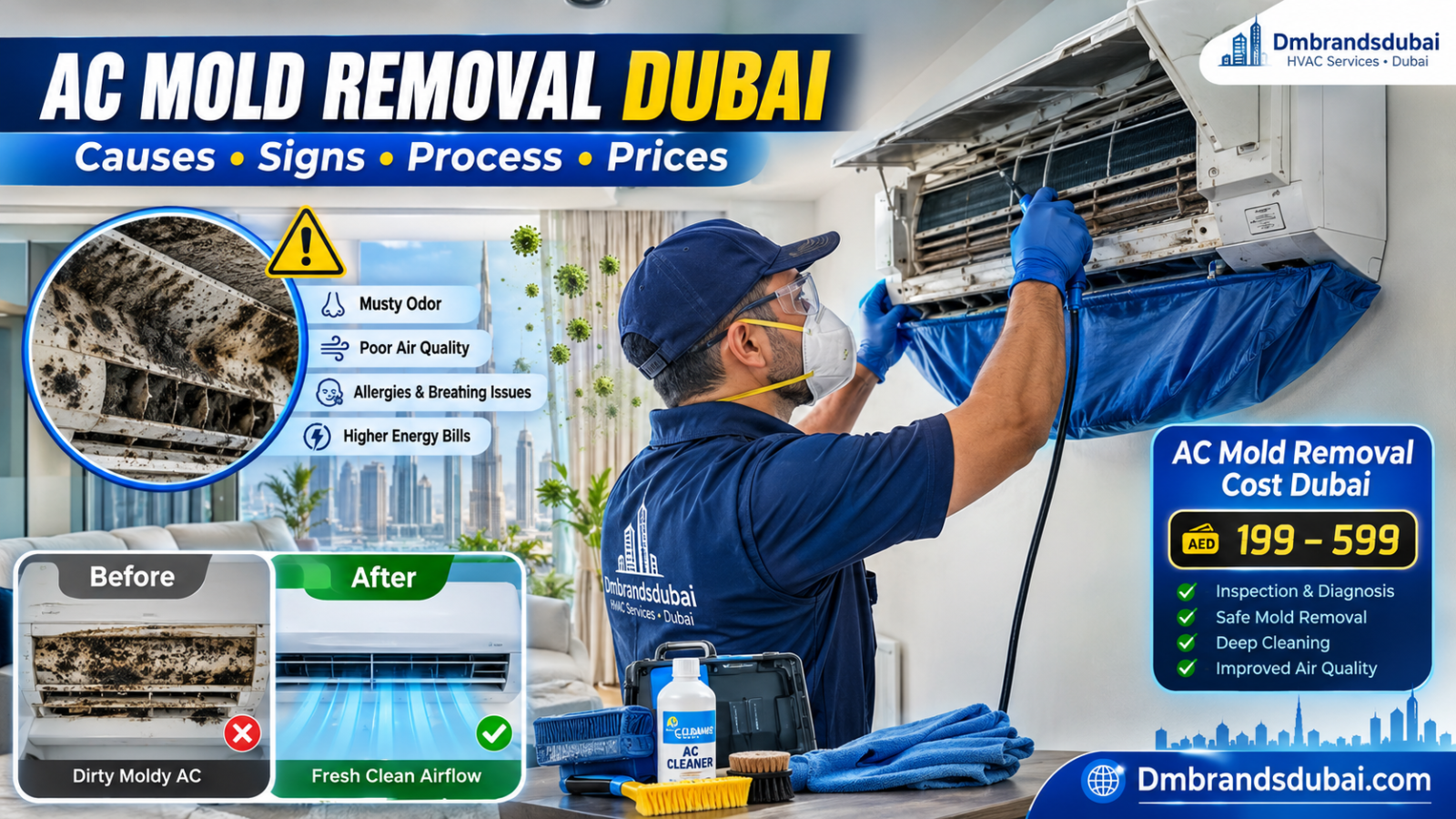
AC mold removal Dubai searches spike every year for the same reason: a sealed home, a humid climate and a system that runs almost non-stop is a near-perfect recipe for mold.
If your unit smells musty the moment it switches on, or you have noticed dark spots around a vent, this guide walks through why it happens, how to confirm it, what a proper clean-out involves, and what it takes to stop it coming back.
Table of Contents
Quick Facts: Mold in AC Units
| Question | Short Answer |
|---|---|
| What causes it | Condensation, high humidity and dust sitting on damp coils or in ducts |
| Most common sign | A musty or sour smell when the AC starts blowing |
| Where it grows | Evaporator coil, drain pan, drain line and duct interior |
| Is it dangerous | It can trigger allergies, coughing and irritation, especially for children, the elderly and asthma sufferers |
| Can it be wiped away | Surface wiping helps briefly, but mold inside the coil or ducts needs proper cleaning to stop it returning |
| How it is fixed | Coil cleaning, duct cleaning and drain line clearing, done together, not one in isolation |
| How often to prevent it | Filter checks monthly in summer, full servicing every 3 to 4 months |
Why AC Units Grow Mold So Easily in Dubai
The climate does most of the damage
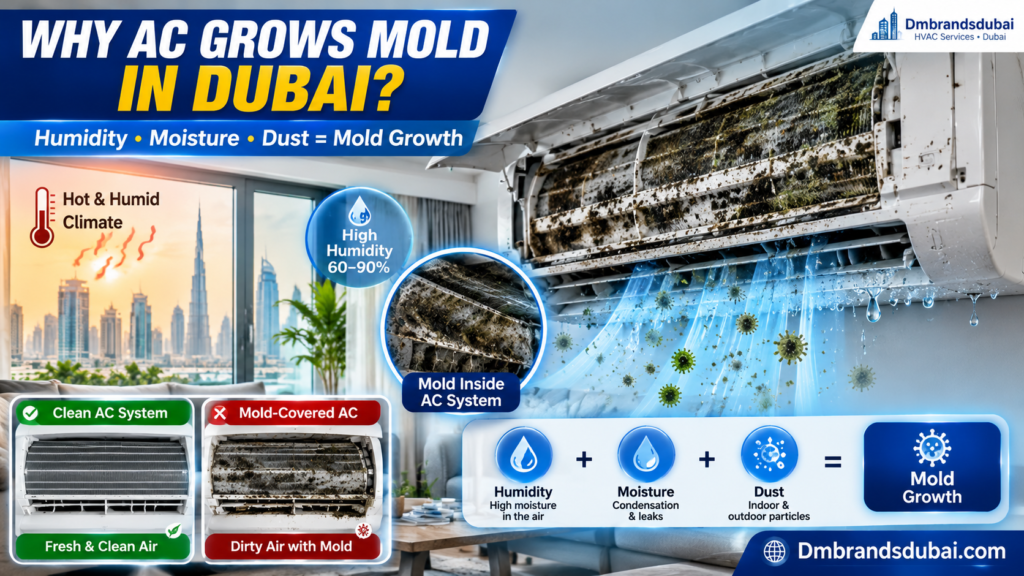
Dubai summers push humidity well above 80 percent for long stretches, and homes stay sealed and air-conditioned almost around the clock to cope with it. Every time warm, humid air passes over a cold evaporator coil, moisture condenses on that coil. That water is supposed to drain away cleanly through the condensate line. When dust, dirt or a partial blockage slows that drainage, water sits, and standing water on a dark, dusty surface is exactly what mold needs to establish itself.
Sealed homes trap the problem
Older window units and villas with limited natural ventilation trap moisture rather than letting it disperse. Combined with dust from Dubai’s outdoor air being drawn through the filter, the coil and drain pan become a food source and a water source in one place. Once mold colonizes the coil, every cooling cycle pushes a small amount of spore-laden air back into the room.
Irregular servicing lets it take hold
An AC that goes a year or more without a proper coil and duct clean gives mold months of undisturbed growth. By the time a musty smell is noticeable, the colony is usually well established rather than just starting out.
Signs Your AC Has Mold
A musty or sour smell on start-up
This is the single most common early warning sign. The smell is often strongest in the first minute after the system switches on, then fades slightly as it circulates. If it comes back every time you restart the unit, that points to a source inside the system rather than a one-off smell in the room.
Visible spots on vents, filters or the indoor unit
Black, green, grey or white patches around the vent grille, on the return air filter, or on the visible edge of the indoor coil are a direct sign of active growth. Mold on the filter is usually easier to spot early, since filters are removed and checked more often than the coil itself.
Physical symptoms when the AC is running
Sneezing, a scratchy throat, coughing, itchy or watery eyes, or headaches that ease when you leave the house and return when the AC is on again are a strong indicator. These symptoms are worth taking seriously, particularly for children, older family members, or anyone with asthma or a mold allergy.
Reduced airflow or the system working harder
Mold and the dust it collects can restrict airflow across the coil and through vents, so the system runs longer to reach the same temperature and cooling bills creep up without an obvious cause.
Water marks or staining near the indoor unit
Staining on the ceiling or wall around an indoor unit often means the drain line or drain pan has been backing up, which is the same condition that encourages mold growth in the first place.
Health Risks of a Moldy AC
| Exposure Level | Typical Effects |
|---|---|
| Mild, short-term | Sneezing, a stuffy or runny nose, mild throat irritation |
| Ongoing, everyday exposure | Persistent coughing, itchy or burning eyes, skin irritation, fatigue |
| Sensitive individuals (asthma, allergies, young children, elderly) | More frequent asthma flare-ups, stronger allergic reactions, respiratory discomfort that does not resolve until the source is treated |
Health authorities including the CDC note that mold exposure affects people differently, and reactions can range from none at all to significant respiratory symptoms in sensitive individuals. If anyone in the home has unexplained, recurring symptoms that improve away from the property, it is worth treating the AC as a likely contributor and arranging an inspection.
Where Mold Actually Hides Inside an AC System
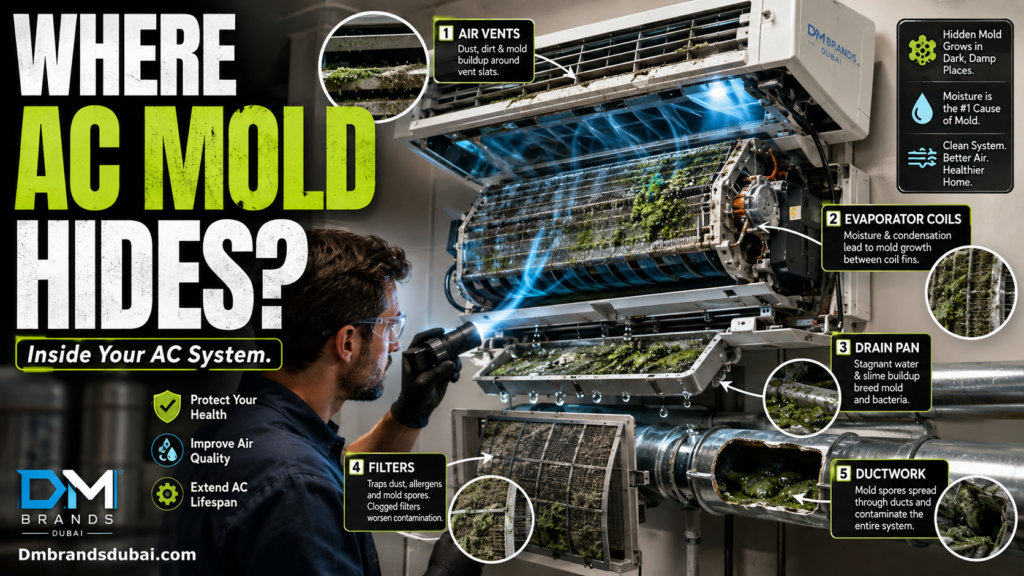
Evaporator coil
The coldest, wettest surface in the system and the most common starting point for mold. Dust sticks to the condensation on the fins and stays damp for hours after the unit shuts off.
Drain pan and drain line
Standing water here, caused by dust or a partial clog, creates a still, dark, damp pocket that mold thrives in even if the coil itself is clean.
Air ducts
Once spores are airborne, they settle on duct walls, particularly at bends and joints where airflow slows. Ducts are harder to inspect than a coil, which is why mold here often goes unnoticed the longest.
Air filters and vent grilles
The most visible location and usually the first place a patch of mold is actually seen, even though it is rarely the only place growth is happening.
How Professional AC Mold Removal Works
A proper clean-out is not a single spray-and-wipe job. It typically follows this sequence:
- Inspection. A technician checks the filter, visible coil surface, drain pan and, where accessible, the duct interior to confirm where mold is present and how far it has spread.
- Isolating the system. The unit is switched off before any chemical treatment or physical cleaning begins, so spores are not pushed further into the ductwork while work is underway.
- Coil cleaning. The evaporator and, where relevant, the condenser coil are treated with an appropriate cleaning solution and rinsed, removing dust, biofilm and mold from the fins rather than just the surface.
- Drain line clearing. The condensate line is flushed to remove the blockage or buildup that is usually the root cause of standing water.
- Duct cleaning. Ductwork is cleaned to remove settled dust and mold spores from the passages air actually travels through, rather than leaving a clean coil feeding air through a contaminated duct.
- Filter replacement. A moldy or heavily soiled filter is replaced rather than cleaned, since a contaminated filter can reseed the system almost immediately.
- Final check and airflow test. The technician confirms drainage is clear, airflow is restored and there is no residual odor before finishing the job.
AC Mold Removal vs a DIY Wipe-Down
| Factor | DIY Surface Wipe | Professional AC Mold Removal |
|---|---|---|
| Reaches the coil interior | No | Yes |
| Clears the drain line | No | Yes |
| Cleans duct interior | No | Yes, where accessible |
| Addresses the root cause | Rarely | Yes, drainage and airflow are corrected |
| Result lasts | Days to a few weeks | Months, with normal servicing |
| Risk of spreading spores during cleaning | Higher, no containment | Lower, system is isolated first |
Wiping visible mold from a vent grille is a reasonable first step and will not do any harm, but it treats the symptom rather than the source. If the smell returns within a week or two, the growth is almost certainly still active inside the coil, drain pan or ducts.
Duct Cleaning and Coil Cleaning: The Two Jobs That Actually Remove AC Mold
At DM Brands Dubai, mold problems in an AC system are handled through two services working together rather than a single generic “mold spray.”
Coil cleaning is a deep chemical clean of the evaporator and condenser coil to remove the dust, biofilm and mold sitting on the fins, restoring both airflow and cooling capacity in the process. Duct cleaning then clears the ductwork itself of dust, damp and microbial growth, so a clean coil is not simply feeding air through a contaminated duct system.
Both are carried out as part of a wider AC service and repair visit, so drainage, airflow and the general condition of the unit are checked at the same time, not treated as separate, disconnected jobs. If the smell or symptoms have appeared suddenly and you need it looked at quickly, that falls under emergency call-out, with same or next-day response depending on how busy the day is.
Every job is priced before work starts, using directly employed, licensed and insured technicians rather than subcontracted labor, so there is one team accountable for the coil, the ducts and the drainage, instead of three different contractors pointing at each other if the smell comes back.
What Affects the Cost of AC Mold Removal
There is no single fixed price for AC mold removal in Dubai, because the right price depends on:
- How many indoor units are affected, since a villa with several split units costs more to treat than a single apartment unit
- How far the mold has spread, a coil-only job is quicker than one that also needs full duct cleaning
- System type, split, ducted and central systems all have different access points and cleaning times
- Whether the drain line needs clearing or repairing, not just flushing
The most reliable way to know what it will actually cost is a written quote based on your specific system, rather than a generic figure that may not reflect your setup. Get a free quote and a technician will confirm pricing before any work begins.
How to Stop AC Mold Coming Back
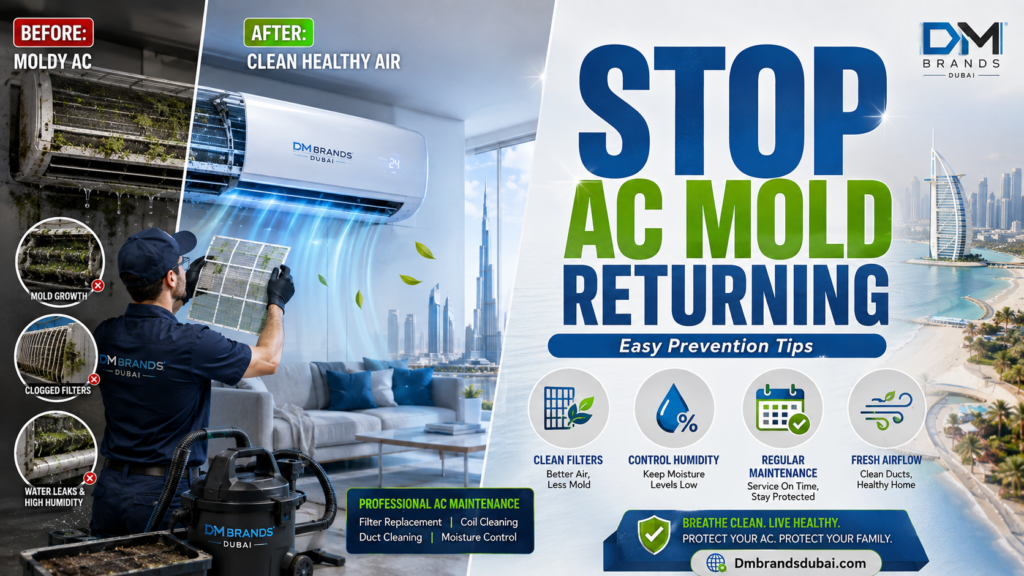
Replace or clean filters on schedule
Check filters monthly during peak summer months and replace or clean them as needed. A dirty filter both restricts airflow and gives mold spores something to cling to.
Keep indoor humidity in a reasonable range
Where possible, keep indoor humidity roughly between 40 and 50 percent. In particularly humid rooms such as bathrooms or laundry areas, a dehumidifier reduces the moisture load the AC has to deal with.
Book servicing every 3 to 4 months
Regular servicing catches a slow drain line or an early buildup before it turns into a full mold problem, which is far cheaper and faster to fix than letting it establish itself.
Do not ignore a musty smell
A smell that appears and does not clear within a day or two is worth booking an inspection for, rather than waiting for visible mold or symptoms to confirm it.
Consider an annual maintenance contract
For homes with several AC units, an annual maintenance contract covers scheduled servicing plus priority booking, which is a more predictable way to prevent mold than reacting to it after the fact.
When to Call a Professional vs Handle It Yourself
Cleaning a visible speck of mold off a vent grille with a damp cloth is low-risk and reasonable to do yourself. Anything beyond that, coil mold, a persistent smell, staining around the indoor unit, or symptoms that clear up away from home, is worth a professional inspection. Attempting to open and clean a coil or duct without the right equipment risks spreading spores further through the system rather than removing them.
Choosing an AC Mold Removal Company in Dubai
- Confirm they clean coils and ducts, not just a surface spray. A quick wipe is not the same as a real remediation job.
- Ask whether technicians are directly employed or subcontracted. Directly employed teams are generally easier to hold accountable if a problem recurs.
- Get a written price before work starts, so there are no surprise extras once the technician is on site.
- Check licensing and insurance. This protects you if something goes wrong during the visit.
- Ask about the warranty on the work. A reputable company stands behind the job in writing.
Related Guides from DM Brands Dubai
- AC Duct Cleaning Dubai: What It Costs, and When You Need It
- AC Coil Cleaning Service Dubai: Costs, Signs & What’s Involved
- How to Improve Indoor Air Quality Dubai: A Practical Home Guide
- AC Maintenance Dubai: The Complete Guide to Keeping Your Cooling System Running
- Split AC Repair Dubai, Priced Before We Start
- Emergency AC Repair Near Me in Dubai 2026
- How to Choose the Right AC Servicing Companies in Dubai
Frequently Asked Questions (FAQs)
What causes mold to grow inside an AC unit?
Mold grows when condensation on the evaporator coil combines with dust and cannot drain properly. Dubai’s high humidity and near-constant AC use make this especially common.
How do I know if my AC has mold and not just dust?
Dust is usually grey and dry. Mold tends to appear as black, green or white patches with a texture, and comes with a musty smell rather than just visible dirt.
Is mold in an AC dangerous to my health?
It can be. Reactions range from mild sneezing and irritation to more noticeable respiratory symptoms, particularly for children, the elderly and anyone with asthma or allergies.
Can I just spray a store-bought cleaner into the vents myself?
You can, but it usually only reaches the surface. Mold sitting deeper in the coil, drain pan or ducts is likely to remain and the smell often returns within days.
How long does professional AC mold removal take?
A single split unit typically takes under an hour for coil cleaning. Adding duct cleaning or treating multiple units extends the visit, and a technician can confirm timing before starting.
Will the mold come back after cleaning?
It can, if the underlying drainage or humidity issue is not addressed. Regular servicing and keeping the drain line clear significantly reduce the chance of it returning.
Does duct cleaning alone remove AC mold?
Not on its own. If the coil is still contaminated, cleaned ducts will be recontaminated fairly quickly, which is why both are usually done together.
What is the musty smell actually coming from?
It is caused by microbial volatile organic compounds released by mold and mildew as they grow, which is the same chemical process behind a damp basement smell.
Can mold in the AC damage the system itself?
Yes. Mold and the dust it collects can restrict airflow across the coil, forcing the system to work harder, which increases energy use and wear over time.
Is black mold in an AC more dangerous than other types?
Black mold gets the most attention, but any type of mold circulating through your air supply can cause symptoms in sensitive individuals, so the color is less important than removing it.
How often should AC coils be cleaned to prevent mold?
Every 3 to 4 months during heavy use is a reasonable interval for most homes, though villas with several units or higher dust exposure may need more frequent checks.
Should I turn off my AC if I suspect mold?
If the smell or symptoms are strong, switching off the affected unit until it is inspected is a sensible precaution, since running it continues to circulate spores.
Can mold grow in a brand-new AC unit?
Yes, if drainage is not working correctly or the unit sits unused with residual moisture for long periods, even a newer system can develop mold.
Do window and split units get moldy the same way as central systems?
The mechanism is the same, condensation and dust on a cold surface, though central and ducted systems have more hidden surface area for mold to establish itself unnoticed.
What is the difference between mold and mildew in an AC?
Both are fungi and both can grow in similar conditions inside a system. In practical terms, they are treated the same way during cleaning.
Can a dirty filter alone cause a musty smell?
Yes. A filter loaded with dust and moisture can develop odor-causing growth even before mold has spread to the coil, which is why replacing it is part of every proper clean-out.
Is an annual maintenance contract worth it just to prevent mold?
If you have multiple AC units or have dealt with recurring mold, a contract that includes scheduled servicing is usually cheaper over a year than repeat call-outs for the same problem.
Will professional AC mold removal fix reduced cooling too?
Often, yes. Since mold buildup restricts airflow across the coil, removing it typically improves cooling performance alongside clearing the odor and health concern.
How much does AC mold removal cost in Dubai?
It depends on the number of units, how far the mold has spread and whether duct cleaning is needed. A written quote based on your system is the most accurate way to know.
Who should I call for AC mold removal in Dubai?
A licensed, insured provider that cleans coils, clears the drain line and cleans ducts as one job, rather than a surface-only service, and that gives you a price in writing before starting.
Conclusion
Mold in an AC unit is a Dubai-specific problem with a straightforward fix once it is diagnosed correctly.
The smell, the visible spots and the symptoms all trace back to the same root cause: moisture sitting somewhere it should not be, usually on the coil or in the drain line.
A proper job clears the coil, the drain line and the ducts together, rather than masking the smell for a week or two.
If your AC has started smelling musty on start-up, or a family member’s allergies flare up whenever the unit is running, get a free quote from DM Brands Dubai and have it inspected before it becomes a bigger problem.