Searching for aircon installation near me usually happens at a stressful moment. The old unit has died, the new apartment has no cooling, or the villa extension needs a proper system before summer arrives.
The good news is that a well-planned installation is not complicated. It just needs the right unit, the right size, and a technician who does the job properly the first time.
At DM Brands Dubai, we install, repair, clean and maintain air conditioning systems for homes, villas and offices. We see the same pattern every year. Most cooling complaints do not start with a bad unit. They start with a bad installation.
A unit that is too small never cools the room. A unit that is too big switches on and off all day and wastes power. A unit with poor piping or a weak drain line leaks, whistles, or fails early.
That is why choosing who installs your AC matters as much as choosing what you install.
Table of Contents
What “Aircon Installation Near Me” Really Means
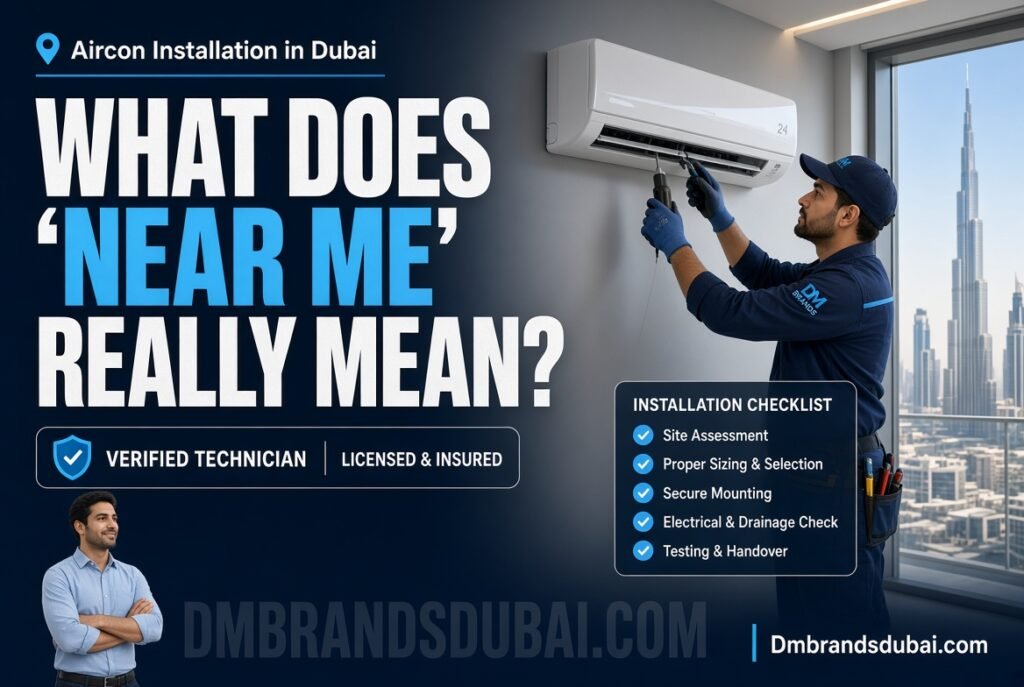
When someone types “aircon installation near me,” they want more than a name and a phone number. They want a nearby team that can inspect the space, recommend a system, and finish the job quickly.
Search engines read this as a local, high-intent request. The person is ready to book, not just browse.
The Search Behind the Words
Most people searching this phrase fall into one of a few groups.
- A homeowner replacing a failed unit
- A tenant moving into a property with no AC
- A villa owner adding cooling to a new room or extension
- An office manager fitting out a workspace
- A landlord preparing a unit for handover
Each of these needs a slightly different answer. What they share is urgency and a need for trust.
Why “Near Me” Matters for AC Work
Installation is a physical job. A technician has to visit, measure, drill, mount, connect and test.
A nearby team means faster site surveys, quicker installation slots, and easier follow-up if something needs adjusting. It also means the installer understands local conditions such as building rules, heat load and typical property layouts.
What a Complete Installation Service Includes
A proper aircon installation is more than hanging a unit on a wall. It covers the whole chain from advice to handover.
- Site survey and heat load assessment
- Help choosing the right system and size
- Removal of the old unit, where needed
- Mounting of indoor and outdoor units
- Copper piping, insulation and drain routing
- Electrical connection and safety checks
- Vacuum, refrigerant charge and leak testing
- Performance testing and thermostat setup
- Handover, warranty details and care advice
If a quote skips several of these steps, ask why.
Why Professional AC Installation Matters
An air conditioner can be a premium model and still perform badly. Installation quality decides how well the machine works in real life.
Manufacturers design their systems to run under specific conditions. When the installer ignores those conditions, the system pays for it.
Performance Depends on the Installer
Even a small mistake changes how the system behaves. A piping run that is too long, a poorly insulated line, or a slightly wrong refrigerant charge can reduce cooling output noticeably.
The unit may still switch on and blow air. But it will work harder, cool less, and cost more to run.
Efficiency and Your Electricity Bill
Air conditioning is often the biggest part of a household electricity bill in hot climates. In Dubai, cooling load lands heavily on the monthly DEWA bill, especially in summer.
A correctly installed system reaches the set temperature faster and cycles less. That directly reduces energy use.
Safety and Compliance
AC installation involves electrical work, refrigerant handling, working at height and heavy outdoor units. Mistakes here are not just expensive. They can be dangerous.
Licensed technicians follow safe wiring practice, use the right breakers and cable sizes, and handle refrigerant according to the rules for the region.
Warranty Protection
Many manufacturer warranties expect installation by a qualified technician. If the unit fails and the installation was done incorrectly, the claim can be rejected.
A professional installer also gives you written documentation of the work. That paperwork can matter later, during a warranty claim or when handing a property back.
Comfort and Noise
A well-installed system runs quietly. Poorly fixed brackets, loose panels and pipes touching walls create vibration and rattling.
Bad airflow direction also causes uneven cooling, cold spots and warm corners. Good placement solves both problems from day one.
Types of AC Systems You Can Install
Before you book anything, it helps to know what you are choosing between. The right type depends on your property, your budget and how you use the space.
Split AC
A split AC has an indoor unit on the wall and an outdoor unit connected by refrigerant piping. It is the most common choice for apartments and single rooms.
Split units are quiet, efficient and easy to install. Most modern models use inverter technology to save energy.
Multi-Split AC
A multi-split system connects several indoor units to one outdoor unit. It suits homes where several rooms need cooling but outdoor space is limited.
It reduces the number of outdoor units on the facade. That helps in buildings with strict appearance rules.
Ducted and Central AC
A ducted system cools multiple rooms through a network of ducts. Cool air travels from a central unit to supply grilles in each space.
It gives an even, discreet finish because most components are hidden in the ceiling. It also needs well-designed and well-sealed ductwork to perform properly.
VRF and VRV Systems
Variable refrigerant flow systems are designed for large villas, offices and commercial buildings. One outdoor unit supplies many indoor units, each controlled separately.
They offer precise zoning and strong efficiency at partial loads. They also need careful design and a skilled installation team.
Cassette AC
A ceiling cassette sits flush in the ceiling and blows air in several directions. It is popular in offices, shops and open-plan spaces.
It frees up wall space and spreads air evenly across a room. Ceiling void depth and drain routing need to be checked first.
Window AC
A window unit sits in a wall opening or window frame. It is simple and lower in cost, but it is louder and less efficient than modern split systems.
It still makes sense for small rooms, temporary use, or older buildings where a split cannot be fitted.
Portable AC
Portable units stand on the floor and vent hot air through a hose. They need no permanent installation.
They are a short-term fix. They are noisier and less efficient, so they rarely suit long-term cooling.
Ductless Mini-Split and Heat Pump Options
Ductless mini-splits work the same way as split systems and are widely used in homes without ducts. Some models also offer heating, which is useful in regions with cool winters.
For hot-climate properties, cooling performance and efficiency at high outdoor temperatures matter most.
Comparison Table: Which System Fits Which Space
| System | Best For | Main Advantage | Main Limitation |
|---|---|---|---|
| Split AC | Apartments, bedrooms, small offices | Quiet and efficient | One indoor unit per outdoor unit |
| Multi-split AC | Homes with limited outdoor space | Several rooms, one outdoor unit | Rooms share one outdoor unit |
| Ducted / central AC | Villas, large homes | Even cooling, hidden components | Needs sealed, well-designed ducts |
| VRF / VRV | Large villas, offices, commercial | Precise zone control | Higher design and install cost |
| Cassette AC | Offices, shops, open plans | Even air distribution | Needs ceiling void space |
| Window AC | Small rooms, budget setups | Low upfront cost | Louder, less efficient |
| Portable AC | Temporary cooling | No permanent install | Least efficient option |
How to Size Your AC Correctly
Sizing is where many installations go wrong. Size decides comfort, efficiency and equipment life.
An AC’s capacity is measured in BTU per hour or in tons. One ton of cooling equals 12,000 BTU per hour.
Why Bigger Is Not Better
Many people assume a bigger unit cools faster and is therefore safer. In practice, an oversized unit reaches the target temperature too quickly and switches off.
This short cycling hurts comfort and efficiency. It also removes less humidity, so the room feels cool but clammy.
Why Smaller Also Fails
An undersized unit runs nonstop and still cannot reach the set temperature on hot days. The compressor works constantly and wears out faster.
Your bills rise while comfort falls. It is one of the most common reasons people call us for repairs shortly after a new installation elsewhere.
What Affects the Right Size
Floor area is only the starting point. A proper heat load assessment looks at several factors.
- Room size and ceiling height
- Sun exposure and window area
- Glass type and shading
- Wall and roof insulation
- Number of people using the room
- Heat from lighting and equipment
- Kitchen or server heat sources
- Local climate
Manual J and Heat Load Calculation
Manual J is the North American industry method for calculating residential heating and cooling loads. It comes from ACCA and is widely used to size systems accurately.
Professional installers in any region use a similar heat load approach. Guessing from square footage alone is a shortcut that often ends in the wrong unit.
Rough Room-to-Capacity Guide
The table below shows a common starting point for room air conditioners based on floor area. It assumes normal ceiling height and moderate conditions.
Hot climates, sunny rooms and heavy occupancy push the number up. Treat this as a first estimate, not a final answer.
| Room Area (sq ft) | Approximate Capacity (BTU/h) |
|---|---|
| 100 to 150 | 5,000 |
| 150 to 250 | 6,000 |
| 250 to 300 | 7,000 |
| 300 to 350 | 8,000 |
| 350 to 400 | 9,000 |
| 400 to 450 | 10,000 |
| 450 to 550 | 12,000 |
| 550 to 700 | 14,000 |
| 700 to 1,000 | 18,000 |
Special Cases That Change the Size
Some rooms need extra capacity. A top-floor room under a roof gets far more heat than a middle-floor room.
Open kitchens, glass-heavy living rooms and rooms with west-facing windows all raise the load. A technician who visits the site will spot these; a phone quote will not.
Efficiency Ratings Explained
Efficiency labels look confusing at first. They are simply a way to compare how much cooling a unit delivers for each unit of electricity.
Higher efficiency usually costs more upfront and less to run. In a hot climate where the AC works for most of the year, that trade-off often pays back.
SEER and SEER2
SEER stands for Seasonal Energy Efficiency Ratio. It measures cooling output over a whole season divided by the electricity used.
SEER2 is the updated US test standard that replaced SEER in 2023. It tests units under more realistic airflow conditions, so numbers are not directly comparable to older SEER ratings.
EER and EER2
EER measures efficiency at a single, hot outdoor temperature. It shows how well a unit performs when conditions are tough.
For very hot regions, EER is a useful number to check because it reflects peak-heat performance.
US Minimums in Simple Terms
US federal rules set minimum SEER2 levels by region. Northern states use a lower minimum, while southern and southwestern states use a higher one.
Current published minimums for split-system central air conditioners are around 13.4 SEER2 in the north and 14.3 SEER2 in the south and southwest. Always confirm the current rule for your state before you buy.
ENERGY STAR
ENERGY STAR is a US program that labels products meeting stricter efficiency targets. It helps buyers spot better-than-minimum models without reading technical sheets.
Many rebate programs use ENERGY STAR or similar tiers to decide who qualifies.
Efficiency Labels in the UAE
In the UAE, air conditioners carry an energy efficiency label that helps buyers compare models. Look for the rating on the unit, and ask your installer to explain it in plain terms.
DEWA also runs programs that encourage efficient cooling and lower consumption. Check current offers before you buy.
Inverter vs Non-Inverter
A non-inverter compressor runs at full power and then switches off. An inverter compressor adjusts its speed to match the load.
Inverter units hold temperature more steadily, use less electricity and are usually quieter. For most homes, they are the better long-term choice.
Refrigerants and Why They Matter
Refrigerant is the fluid that carries heat out of your room. Its type affects safety, environmental impact and service needs.
The industry has been moving away from older refrigerants because of their global warming potential.
From R-410A to Lower-GWP Options
For years, R-410A was the standard in residential systems. Newer systems increasingly use R-32 or R-454B, which have lower global warming potential.
Some of these newer refrigerants are mildly flammable, classified as A2L. That changes handling and installation requirements.
What This Means for You
Ask your installer which refrigerant your new unit uses. Make sure the technician is trained to handle it.
Mixing incompatible refrigerants or using the wrong tools can damage the system and create safety risks. It is a good reason to avoid unlicensed, low-cost installers.
Charging and Leak Testing
The system must hold exactly the right amount of refrigerant. Too little and it will not cool. Too much and the compressor is at risk.
A careful installer pressure tests the lines, pulls a deep vacuum to remove air and moisture, and then charges the system by manufacturer guidance.
Aircon Installation Cost and What Affects It
Cost is often the first question and the hardest to answer without a visit. The final price depends on the system, the property and the work involved.
Instead of chasing the lowest number, look for a clear written quote that lists what is included.
Main Factors That Change the Price
- Type of system, such as split, ducted or VRF
- Capacity and number of indoor units
- Brand and efficiency level
- Length of piping between indoor and outdoor units
- Access, such as high floors or difficult wall types
- Electrical upgrades, if needed
- Ductwork, new or repaired
- Removal and disposal of the old unit
- Building approvals and documentation
- Warranty and after-sales terms
Published US Price Ranges
Published US guides put central air conditioner installation at roughly $3,000 to $15,000 or more, depending on size, efficiency and ductwork. Many typical replacement jobs land somewhere in the middle of that range.
Ductless mini-split systems are often quoted at about $2,000 to $10,500, depending on the number of indoor units. These ranges come from national averages and vary by region, so they are only a rough guide.
How Efficiency Changes the Price
Higher SEER2 ratings generally add several hundred to a few thousand dollars to the installed price. Variable-speed and smart-control features add more.
In hot climates, this extra cost can be offset by lower running costs over several cooling seasons.
What Affects Cost in Dubai
In Dubai, prices vary a lot between suppliers because of brand choice, building rules and the amount of piping or ducting needed. Published local figures differ widely, which is a sign that generic online prices are unreliable.
The only accurate figure is the one that comes after a site visit. DM Brands Dubai provides a clear, itemized quote before work begins.
Hidden Costs to Ask About
Some quotes look cheap because they leave things out. Ask directly whether these are included.
- Extra piping beyond a basic length
- Wall drilling and making good
- Outdoor unit brackets or stands
- Drain pump, where gravity drainage is not possible
- Electrical isolator or breaker
- Removal of the old unit
- Building management fees or approvals
- Commissioning and testing
- Warranty terms for the installation itself
Why the Cheapest Quote Often Costs More
A low price can hide low-grade copper, thin insulation, weak brackets or rushed testing. Those shortcuts show up months later as leaks, noise and poor cooling.
The cost of fixing a bad installation often exceeds the saving. Value comes from doing the job properly once.
Sample Quote Comparison
| Item | Basic Quote | Complete Quote |
|---|---|---|
| Site survey | Not included | Included |
| Heat load check | Not included | Included |
| Piping and insulation | Basic length only | Length and quality stated |
| Drain routing | Assumed | Planned and tested |
| Vacuum and leak test | Not mentioned | Included |
| Commissioning report | No | Yes |
| Installation warranty | Unclear | Written |
The AC Installation Process, Step by Step
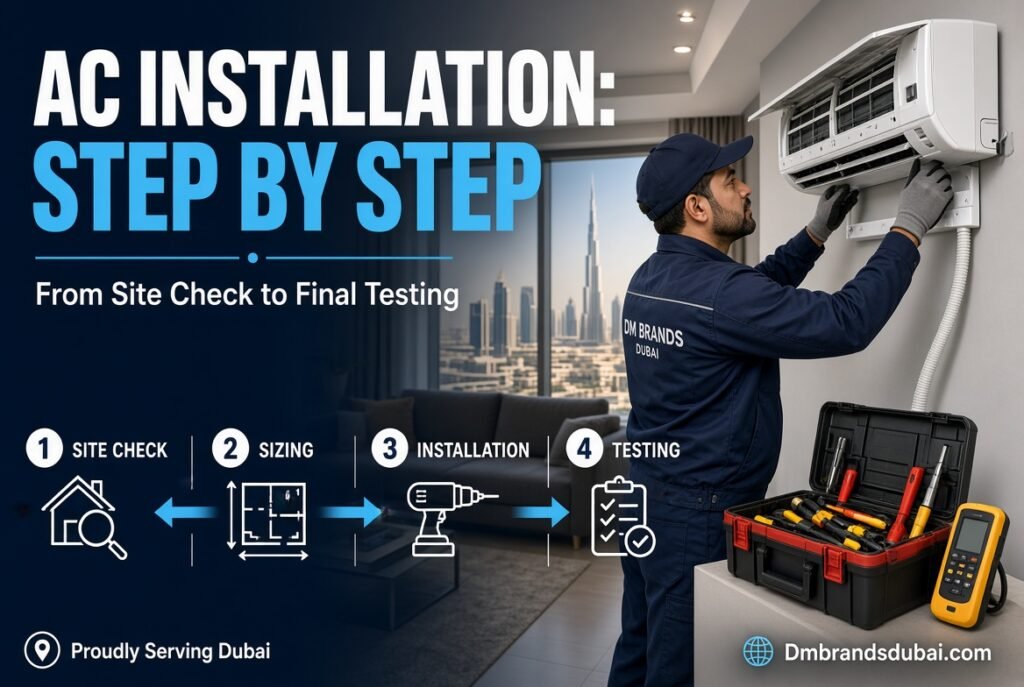
Knowing the process helps you judge whether a technician is doing things properly. A good installer will happily explain each stage.
Here is how a professional installation normally runs.
Step 1: Site Survey and Consultation
The technician visits the property and looks at the space. They check room size, sun exposure, wall structure, electrical supply and outdoor unit location.
They also ask how you use the room. A bedroom used at night has different needs from a busy home office.
Step 2: Sizing and System Selection
Using the survey, the technician calculates the cooling load and recommends a capacity. They suggest one or two suitable options at different price levels.
You should understand why each option is recommended. If the explanation is vague, keep asking.
Step 3: Written Quote and Approval
You receive a clear quote that lists the equipment, the work included and the warranty. No work should start until you approve it.
This is also the moment to ask about building rules and any approvals needed.
Step 4: Removal of the Old Unit
If you are replacing an existing system, the old unit is disconnected safely. Refrigerant is recovered rather than released into the air.
The old indoor and outdoor units are removed, and the mounting area is cleaned up.
Step 5: Mounting the Indoor Unit
The indoor unit goes on a solid, level bracket. Position matters. It should not blow directly on beds or desks, and it needs clear space around it for airflow.
The technician marks the wall, drills the pipe hole with a slight downward slope and fixes the mounting plate securely.
Step 6: Installing the Outdoor Unit
The outdoor unit needs a stable, level base and enough space for air to enter and leave freely. Blocked airflow reduces performance and raises running temperatures.
Brackets must carry the weight of the unit and resist vibration. On high floors, safe access and secure fixing are essential.
Step 7: Piping, Insulation and Drainage
Copper pipes connect the two units. They are cut, flared or brazed and insulated to prevent heat gain and condensation.
The drain line carries condensate away from the indoor unit. It must slope correctly and be tested so that water never drips inside the wall or onto the floor.
Step 8: Electrical Connection
The unit needs a suitable power supply, a correctly rated breaker and, where required, an isolator. Cable size follows the manufacturer’s data.
Loose or undersized wiring is a fire risk and a common cause of early failure.
Step 9: Vacuum, Leak Test and Refrigerant Charge
Before opening the refrigerant, the technician removes air and moisture from the lines with a vacuum pump. This step protects the compressor and oil.
They then test for leaks and release or add refrigerant as the manufacturer specifies.
Step 10: Commissioning and Testing
The system runs through cooling mode. The technician checks temperatures, airflow, pressures, noise and drainage.
They confirm that the thermostat works and that the remote control is set up.
Step 11: Handover and Care Advice
A good technician shows you how to use the system, how to clean the filters and what warning signs to look for. You receive warranty details and contact information.
Ask for this in writing. It saves confusion later.
Typical Timing
A single split unit is often installed in a few hours. Multiple units or ducted systems take longer, sometimes several days.
Large villa or office projects need proper scheduling, especially where ceilings or walls must be opened.
What to Prepare Before the Technician Arrives
A little preparation makes the visit smoother and the result better. It also shortens the time the team spends in your home.
Clear the Work Area
Move furniture, curtains and valuables away from the installation wall. Clear access to the outdoor location as well.
This protects your belongings from dust from drilling and gives the team room to work safely.
Confirm Access and Permissions
If you live in an apartment or managed community, check what approvals the building requires. Some buildings have rules on outdoor unit position, drain routes and working hours.
Sorting this early avoids delays and possible penalties.
Know Your Electrical Setup
Tell the technician if you have had electrical problems before. Ask them to check that the circuit can handle the new load.
Older properties sometimes need a breaker upgrade or a dedicated circuit for the AC.
Keep Your Questions Ready
Write down your priorities. They might be low noise, low running cost, smart control or a particular brand.
The more the installer knows, the better the recommendation.
Permits, Approvals and Regulations
Rules differ by country, city and building. A professional installer knows what applies and helps you with the paperwork.
Ignoring the rules can lead to fines, forced removal or problems when you hand back a rental.
Licensed Technicians
In many regions, refrigerant handling and electrical work must be done by licensed professionals. In Dubai, installation work is expected to follow DEWA and local authority requirements.
Ask to see proof of licensing and insurance before work starts.
Building Management Approval
Apartment towers and villa communities usually have rules on where outdoor units go and how drains connect. Some require written approval before any installation begins.
Your installer should know these rules and help you comply.
Drainage and Neighbour Considerations
Improper drainage can drip onto balconies, walkways and neighbours’ property. Authorities can issue penalties for it.
A proper drain route is part of a good installation, not an optional extra.
Refrigerant and Environmental Rules
Refrigerant must be handled, recovered and disposed of according to regional rules. Venting it into the air is not acceptable.
Professional installers carry the right recovery equipment and dispose of old systems responsibly.
Documents to Keep
Keep the quote, invoice, warranty card, commissioning notes and any building approval. They help with future servicing, claims and property handover.
AC Installation for Apartments, Villas and Offices
Every property type brings different challenges. The right plan matches the building and the way it is used.
Apartments
Apartments often have limited outdoor space and strict building rules. Split and multi-split systems are usually the best fit.
Planning pipe routes and drain paths early avoids awkward surprises after the walls are already marked.
Villas and Large Homes
Villas offer more flexibility but higher cooling loads. Multiple splits, ducted systems or VRF may all be options.
A whole-home plan helps avoid mismatched units and wasted energy. It also makes future servicing easier.
Extensions, Majlis and Extra Rooms
Added rooms, majlis spaces and converted garages often have different insulation and glass than the rest of the home. Their loads need separate calculation.
Connecting them to an existing system without checking capacity is a common mistake.
Offices and Small Businesses
Offices need reliable cooling during working hours and quiet operation. Cassette and ducted systems are popular.
Equipment heat, meeting rooms and glass frontages all change the requirement. Scheduling installation outside business hours can reduce disruption.
Retail and Commercial Spaces
Shops and commercial units have high foot traffic and variable loads. VRF systems and well-zoned splits give control without overcooling.
Downtime is costly here, so planning and fast execution matter.
Repair or Replace: When a New Installation Makes Sense
Not every struggling AC needs replacing. Sometimes a repair, gas top-up or deep clean brings the system back to life.
Other times, spending more on an old unit is throwing good money after bad.
Signs Your AC May Be Beyond Repair
- The unit is well past ten years old
- Repairs are becoming frequent
- The compressor has failed
- Cooling is weak even after servicing
- Energy bills keep climbing
- The unit uses an outdated refrigerant that is hard to source
- Parts are no longer available
A Simple Rule of Thumb
A popular rule multiplies the age of the unit by the repair quote. If the result is higher than the cost of a new system, replacement usually makes better sense.
It is not a law, just a useful check. A technician’s honest assessment matters more.
Age and Lifespan
A well-maintained central air conditioner often lasts around 12 to 17 years in normal conditions. In very hot climates where units run almost constantly, real-world life can be shorter.
Regular servicing is the biggest factor in reaching the top of that range.
When Repair Is the Better Choice
If the unit is fairly young and the fault is minor, repair wins. Examples include a blocked drain, a dirty coil, a faulty capacitor or low refrigerant from a small leak.
DM Brands Dubai diagnoses first and advises honestly. If a repair is enough, we tell you.
Repair vs Replace at a Glance
| Situation | Better Option |
|---|---|
| Unit under 8 years, minor fault | Repair |
| Blocked drain or dirty coils | Cleaning and repair |
| Compressor failure on an old unit | Replace |
| Frequent breakdowns | Replace |
| Unit too small after home extension | Replace or add a unit |
| Very high bills with old equipment | Replace |
Upgrading for Better Efficiency
Sometimes the old system still works but costs too much to run. A new inverter model can cut energy use noticeably.
If your bills are high and your unit is old, ask for a comparison of running costs before deciding.
How to Choose the Right Installer Near You
Searching for aircon installation near me will show many options. The challenge is telling the good ones from the rest.
Focus on evidence, not promises.
Check Licensing and Experience
Ask whether the company and its technicians are licensed. Ask how long they have worked on the system type you need.
Experience with split, ducted and central systems matters, because each behaves differently.
Look at Reviews and Real Jobs
Read recent customer reviews from more than one source. Look for comments about punctuality, cleanliness, communication and follow-up.
Photos of completed work show how tidy the pipework and finishing are.
Ask for a Site Visit Before a Quote
Phone quotes are estimates at best. A responsible installer wants to see the space first.
If someone gives a fixed price without asking a single question about your rooms, treat it with caution.
Get a Written, Itemized Quote
The quote should list the equipment model, capacity, materials, work included and warranty. Compare quotes line by line, not just by total.
Anything unclear should be clarified before you sign.
Ask About Warranty and After-Sales Service
There are two warranties to understand. One is the manufacturer’s warranty on the equipment, and the other is the installer’s warranty on the workmanship.
Ask how long each lasts and what it covers. Also ask how to reach the team if something goes wrong.
Check Availability and Response Time
A good installer can offer clear dates and sticks to them. For emergencies, ask whether they provide urgent service and how quickly they respond.
DM Brands Dubai provides same-day service in most cases and 24/7 coverage for urgent needs.
Questions to Ask Every Installer
- Are your technicians licensed and insured?
- How do you calculate the right AC size?
- Which brands do you install and support?
- What is included in the quoted price?
- What warranty do you give on the installation?
- Do you handle building approvals?
- How do you test the system before handover?
- What happens if there is a problem after installation?
Red Flags to Avoid
- No site visit and a suspiciously low price
- Pressure to decide immediately
- Refusal to provide a written quote
- No proof of licensing
- Vague answers about sizing
- No mention of testing or warranty
- Cash-only deals with no paperwork
Common AC Installation Mistakes
Most installation problems are avoidable. Knowing them helps you spot trouble early.
Guessing the Size
Choosing capacity from room size alone ignores sun, glass, insulation and use. Wrong sizing is the number one cause of complaints.
A heat load check takes a little time and saves years of frustration.
Poor Indoor Unit Placement
Placing the unit behind furniture, directly above a bed or too near a corner blocks airflow. It creates drafts and warm zones.
Good placement spreads air across the room without blowing straight at people.
Weak Outdoor Unit Location
Outdoor units squeezed into tight spaces or placed in direct heat and against walls struggle to release heat. Performance drops and parts wear faster.
Leave enough clearance and protect the unit from debris.
Skipping the Vacuum Step
Skipping or rushing the vacuum leaves moisture and air inside the system. That can cause corrosion, ice and compressor failure over time.
You cannot see this mistake, which is why trust in the installer matters.
Long, Unplanned Pipe Runs
Extra pipe length adds pressure drop and needs extra refrigerant. Manufacturers give limits for length and height difference.
Choosing the outdoor location carefully keeps runs short and efficient.
Poor Drain Slope
A drain line without proper slope holds water, which then leaks or grows mold. It is a very common cause of “AC leaking” calls after installation.
The drain should be tested with water before the technician leaves.
Thin or Missing Insulation
Uninsulated or poorly wrapped pipes sweat, waste cooling and leave marks on walls. In hot, humid places this shows up quickly.
Quality insulation should cover the full length of the lines and be sealed at joints.
Ignoring Electrical Requirements
Undersized cables, missing isolators and shared circuits create risks. A unit that trips the breaker constantly is often a sign of a poor electrical setup.
Ask your installer to confirm the load and the breaker rating.
DIY Installation
Some people try to install units themselves to save money. Refrigerant handling, brazing, electrical work and working at height all need skill and equipment.
Mistakes can void your warranty, damage the unit or cause injury. Professional installation is the safer and cheaper choice in the long run.
Caring for Your New AC After Installation
Installation is the beginning of the system’s life, not the end. Regular care decides how long and how well it performs.
Simple habits go a long way.
Clean the Filters Regularly
Dirty filters restrict airflow and reduce cooling. They also let dust into the coil.
Check them every few weeks during heavy use. Wash or replace them as needed.
Schedule Professional Servicing
Professional servicing catches problems before they become breakdowns. It typically includes filter and coil cleaning, refrigerant checks, drain checks and thermostat testing.
In hot regions with near-constant use, servicing every three to four months is a sensible target for many homes and offices.
Consider an Annual Maintenance Contract
An Annual Maintenance Contract locks in regular visits at a planned cost. It removes the need to remember and keeps your system under steady professional care.
DM Brands Dubai offers AMC options for homes, villas and offices.
Deep Cleaning for Air Quality
Over time, coils, ducts and drain pans collect dust, allergens and biological growth. That affects both efficiency and the air you breathe.
Deep cleaning, including duct, coil and filter cleaning, keeps the system healthy. It is especially valuable for families with children, elderly members or anyone with respiratory sensitivities.
Keep the Outdoor Unit Clear
Leaves, dust, bags and stored items around the outdoor unit block airflow. Keep the area free and wipe away surface dirt when safe.
Never spray high-pressure water at the fins without guidance, as they bend easily.
Watch for Early Warning Signs
- Warm or weak airflow
- Water leaking from the indoor unit
- Strange noises or smells
- Ice on the pipes or coil
- The unit turning off unexpectedly
- Sudden rises in electricity bills
If you notice any of these, book a check-up rather than waiting.
Energy-Saving Tips for Your New AC
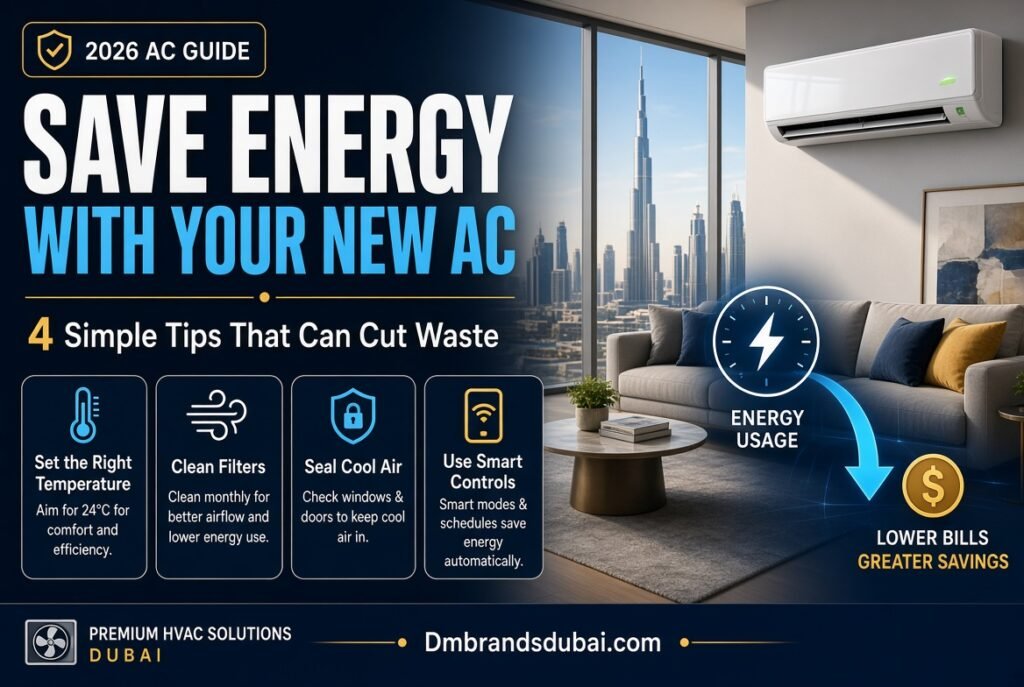
A well-installed AC is only half of the story. How you use it decides the other half.
These habits reduce running costs without sacrificing comfort.
Set a Sensible Temperature
Every degree lower increases energy use. Many utilities suggest around 24°C as a comfortable and efficient setting for homes.
Small changes add up over a long cooling season.
Use a Timer or Smart Thermostat
Scheduling helps the system cool the space before you arrive and ease off when it is empty. Smart controls give even better management.
Avoid switching off and on repeatedly, since the unit works hardest at start-up.
Reduce Heat Coming In
Curtains, blinds and window film limit solar heat. Good door seals and insulation keep cool air in.
A well-shaded room needs less cooling and gives the AC an easier life.
Keep Doors and Windows Closed
Open doors let cooled air escape and bring warm, humid air in. Close off the cooled zone when the AC runs.
Use extractor fans sparingly in cooled rooms.
Clean Filters and Coils
Clean components transfer heat more effectively. Dirty ones force the compressor to work harder for the same result.
This single habit often gives the best return on effort.
Use Fan Mode Wisely
Ceiling fans help distribute cool air so you can raise the thermostat slightly. They cool people, not rooms, so switch them off when nobody is there.
The Best Time to Install an AC
Timing affects price, availability and convenience. Installing before peak demand gives you the most choice.
Before the Summer Rush
In hot regions, the weeks before summer are the busiest for installers. Booking early gives better scheduling and avoids waiting for parts.
Installing outside peak demand often means more flexible time slots.
Off-Season Advantages
Autumn and winter installations are easier to schedule and less rushed. Your technician has more time for careful work.
Some suppliers also run promotions outside peak season.
When You Cannot Wait
If your AC fails during a heatwave, waiting is not an option. That is when a fast, reliable local team matters most.
Our 24/7 line covers urgent breakdowns, including nights, weekends and public holidays.
Choosing Brands and Features
Brand choice affects price, warranty and spare parts. It also affects how easy the unit is to service in your area.
The best brand is the one that suits your budget and has strong local support.
Popular Brands
Many well-known brands are used across homes and offices, including Daikin, Carrier, LG, Samsung, Mitsubishi Electric, Gree, Midea, Hitachi, Panasonic, Trane, York, Haier and O General. Each has different strengths in price, features and range.
Our technicians work on all major brands sold and installed in the region.
Features Worth Paying For
- Inverter compressor for lower bills
- High efficiency rating for heavy use
- Low-noise operation for bedrooms
- Wi-Fi control for scheduling and remote use
- Air filters that help with dust
- Corrosion-resistant coating for outdoor coils
- Good warranty terms
Features You May Not Need
Extra modes and gadgets add cost without adding much value in every home. Focus on cooling performance, reliability and service support first.
Availability of Parts and Service
A great-looking unit is a problem if parts take weeks to arrive. Ask whether the brand has local stock and authorised support.
Your installer should be able to tell you this before you buy.
Understanding Ducts and Airflow
Ducted systems depend on the quality of their air distribution. Even a top-tier unit cannot compensate for poor ducts.
Why Ductwork Matters
Leaky, poorly insulated or badly designed ducts waste a lot of cooled air. ENERGY STAR guidance notes that a poorly sealed duct system can lose a substantial share of the air moving through it.
That means you pay for cooling that never reaches the room.
Signs of Duct Problems
- Some rooms are much hotter than others
- Weak airflow at certain vents
- Dust blowing from the vents
- Higher bills without a clear reason
- Musty smells
Duct Repair and Cleaning
Sealing gaps and cleaning built-up dust restore airflow and efficiency. Duct cleaning also improves indoor air quality.
If you have a ducted system, ask about a duct inspection when you plan a new installation or replacement.
What to Check Right After Installation
Before the technician leaves, take ten minutes to check the work together. It is the easiest time to fix any small issue.
Handover Checklist
| Check | What to Look For |
|---|---|
| Cooling | Cold air within a few minutes of starting |
| Airflow | Even flow, no rattling or whistling |
| Noise | Smooth sound from indoor and outdoor units |
| Drainage | Water flowing out cleanly, no drips |
| Piping | Neat, insulated, no visible damage |
| Mounting | Units level and firmly fixed |
| Remote and thermostat | Working and explained |
| Paperwork | Warranty, invoice and contact details |
Problems That Need Fast Attention
Call the installer straight away if you notice water dripping inside, a burning smell, ice on the lines or a breaker that keeps tripping. These issues rarely fix themselves.
A good installation team answers these calls without argument.
Normal Sounds vs Real Problems
A soft hum, light airflow noise and a gentle click when the unit starts are normal. Loud rattling, grinding or hissing is not.
If you are unsure, ask the technician what normal sounds like before they leave.
Why Choose DM Brands Dubai for Aircon Installation
Dubai is full of AC companies. Few combine speed, clear pricing and technical depth the way DM Brands Dubai does.
Here is what sets our team apart.
Licensed, Experienced Technicians
Our team is skilled across split units, ducted systems and central air conditioning. If it cools a building in Dubai, we have worked on it.
Every installation follows a clear process from survey to handover.
Transparent, Upfront Pricing
You receive a clear quote before we start. It explains what is included so there are no surprises on the final bill.
We would rather earn your trust with honest numbers than win a job with a low price that grows later.
Site Survey and Correct Sizing
We check your space before recommending a unit. That means heat load, sun exposure, layout and electrical supply are all considered.
The result is a system that cools properly and does not waste energy.
Same-Day Service in Most Cases
When you contact us, we aim to respond quickly. For repairs and many installation requests, we prioritise same-day appointments.
Speed matters when the weather is hot and the home is uncomfortable.
24/7 Emergency Support
AC problems do not follow office hours. Our emergency line is available around the clock for urgent breakdowns.
Whether it is late at night or during a public holiday, help is a call away.
One Team for the Whole AC Lifecycle
We handle installation, replacement, repair, maintenance and cleaning under one roof. That means the team that installs your unit also understands its history when it needs servicing.
You avoid chasing several companies for a single system.
Service Across Dubai
We serve homes, villas and offices across Dubai, seven days a week. That is what people mean when they search for aircon installation near me and want a team that actually reaches their area.
Our AC Services at a Glance
Installation is only one part of what we do. Here is how our services fit together.
AC Installation and Replacement
We help you select the right unit size, install it correctly and remove the old system safely. Every job is warranty-backed and tested before handover.
AC Repair
Our technicians diagnose the fault first and explain the options. Typical issues include an AC not cooling, water leaking, strange noises, bad smells and units that will not turn on.
AC Maintenance and Servicing
Regular servicing keeps your system efficient and prevents surprise breakdowns. Visits typically include filter cleaning, coil cleaning, refrigerant checks, thermostat checks and duct inspection.
AC Cleaning
Our cleaning services improve air quality and efficiency. They include duct cleaning, coil cleaning and filter cleaning.
Annual Maintenance Contracts
Our AMC plans give homes and businesses planned servicing throughout the year. They help catch small issues early and keep costs predictable.
Service Summary Table
| Service | When You Need It | Typical Result |
|---|---|---|
| Installation | New unit or new space | Correctly sized, tested system |
| Replacement | Old unit beyond repair | Better efficiency and reliability |
| Repair | Weak cooling, leaks, noise | Fault fixed at the root |
| Maintenance | Prevention and upkeep | Fewer breakdowns |
| Deep cleaning | Smells, dust, allergies | Cleaner air and airflow |
| AMC | Ongoing care | Planned servicing year-round |
Related Problems We See After Poor Installations
We are often called to fix work done elsewhere. The problems repeat, and most trace back to the same causes.
- Units that are too small or too large
- Leaking drains from poor slope
- Iced coils from low or overcharged refrigerant
- Noisy units from loose brackets
- Tripping breakers from poor electrical work
Fixing these correctly often costs more than doing the installation right the first time.
Areas We Serve
DM Brands Dubai provides AC services across Dubai’s main communities. Our team is used to working in high-rise apartments, low-rise buildings, villas and offices.
We regularly work in areas such as Dubai Marina, Jumeirah Village Circle (JVC), Palm Jumeirah, Downtown Dubai, Business Bay, Al Barsha, Arabian Ranches, Jumeirah, JBR and Al Quoz, and in many other neighbourhoods.
If your area is not listed, contact us. We will tell you honestly whether we can reach you quickly.
Installing an AC in Extreme Heat and Humidity
Hot, humid regions test cooling equipment harder than mild ones. Units run longer, outdoor temperatures climb and dust settles quickly.
Installation choices should reflect this from the start.
Choose Equipment Built for High Ambient Temperatures
Some units keep their cooling output better than others when outdoor air is very hot. Check the manufacturer’s stated operating range and ask which models perform well in your conditions.
Coastal properties may also need corrosion-resistant coatings on the outdoor coil.
Shade and Airflow for the Outdoor Unit
Outdoor units in direct afternoon sun run hotter and less efficiently. Where possible, place them in shade with good airflow.
Never enclose the unit in a tight box or cover it in a way that blocks air movement. Recirculating hot air is a common cause of poor performance.
Humidity and Comfort
In humid climates, comfort depends on humidity removal as much as temperature. A correctly sized unit that runs in longer cycles removes more moisture than an oversized one.
Some models include a dry mode, but sizing remains the foundation.
Dust and Sand
Dusty environments clog filters and coils quickly. Plan for more frequent cleaning than the manufacturer’s standard schedule.
Good filters and regular servicing protect both efficiency and air quality.
Indoor Unit Placement: Getting Comfort Right
Where the indoor unit goes shapes how the room feels every day. A few sensible rules make a big difference.
Place It High and Clear
Wall-mounted indoor units work best high on the wall with open space around them. Blocked air paths cause uneven cooling.
Keep curtains, shelves and furniture away from the airflow.
Avoid Direct Airflow on People
Cold air blowing straight onto a bed, sofa or desk is uncomfortable and can cause stiffness or headaches for some people. Aim the airflow along the room or along the ceiling.
Louvre settings help, but position does most of the work.
Keep It Away From Heat Sources
Do not mount the unit above a heater, near a cooker or in direct sun. The thermostat sensor reads the wrong temperature and the unit behaves oddly.
Think About Noise
Bedrooms and study rooms need quiet units and careful placement. Avoid mounting on thin partition walls that carry vibration.
Ask the installer about the sound level of the indoor and outdoor units.
Smart Controls and Modern Features
Modern systems offer more than a basic remote. Some features are genuinely useful, while others are nice extras.
Wi-Fi and App Control
App control lets you switch the AC on before you arrive home and adjust settings remotely. It also helps you monitor usage and schedule cooling.
For busy households, it is one of the most practical upgrades.
Smart Thermostats
Smart thermostats learn your routine and adjust temperatures automatically. They work best with systems that support them.
Ask your installer whether your chosen unit is compatible.
Zoning
Zoning lets different areas run at different temperatures. Multi-split, ducted and VRF systems can include zoning.
It saves energy by cooling only the spaces you use.
Air Quality Features
Some units include filters or purification functions. They can help with dust, but they do not replace regular cleaning and servicing.
Understanding Your Warranty
Warranties protect you only if you understand them. Two warranties usually apply to an installation.
Manufacturer Warranty
This covers defects in the equipment for a stated period, often with longer cover on the compressor. It usually requires proper installation and regular servicing.
Keep your invoice and warranty card in a safe place.
Installation Warranty
This covers the workmanship. That includes piping, drainage, electrical connections and mounting.
A reliable installer states the period in writing and honours it. DM Brands Dubai backs its installations and explains the terms before work starts.
What Can Void a Warranty
- Installation by unlicensed technicians
- Use of unapproved parts
- Missing servicing records where required
- Damage from poor electrical supply
- Unauthorised modifications
Following the maintenance schedule keeps your warranty intact.
Understanding Running Costs
Buying price is only part of the story. Over ten years, electricity often costs more than the unit itself in hot regions.
What Drives Running Costs
- Unit efficiency
- Hours of use
- Thermostat setting
- Insulation and heat gain
- Servicing and cleanliness
- Correct sizing and installation
How to Compare Options
Ask the installer for the efficiency rating and estimated power consumption of each option. Then compare the extra upfront cost with the expected saving.
In hot climates with long cooling seasons, mid-to-high efficiency models often pay back sooner than expected.
Incentives and Rebates
Some regions offer rebates or incentives for efficient equipment. In the US, federal tax credit rules have changed recently, and many benefits now come from state and utility programs.
In Dubai, DEWA has run efficiency programs. Always check the current terms before you buy, because programs change.
Real-World Installation Scenarios
Examples make the decisions easier. Here are three situations we see often.
Scenario 1: The Failed Unit in a Rented Apartment
A tenant’s old split unit stops cooling in peak summer. The technician finds a failed compressor on a unit over ten years old.
Replacing it with a correctly sized inverter split solves the problem and cuts the running cost. The tenant also checks the landlord’s approval before work begins.
Scenario 2: The Villa Extension
A family adds a large glass-fronted majlis to their villa. The existing system was not designed for the extra load, so the room never cools properly.
A separate heat load calculation shows it needs its own dedicated unit. Adding one, rather than stretching the old system, restores comfort in the whole house.
Scenario 3: The New Office Fit-Out
A small business moves into a new unit with no cooling. Meeting rooms, an open-plan area and a server cabinet each have different needs.
A mix of ceiling cassettes and a dedicated split for the server room gives even cooling and reliable temperature control. Installation is scheduled outside working hours to avoid downtime.
Professional Installation vs DIY
Some people consider installing an AC themselves to save money. It is worth seeing the trade-offs clearly.
| Factor | Professional Installation | DIY Installation |
|---|---|---|
| Sizing accuracy | Heat load checked | Often guessed |
| Refrigerant handling | Trained and equipped | Risky and often illegal |
| Electrical safety | Correct cable and breaker | Higher risk |
| Vacuum and leak testing | Standard practice | Often skipped |
| Warranty | Protected | Often voided |
| Long-term cost | Lower | Often higher after repairs |
| Compliance | Handled | Easily missed |
The Bottom Line on DIY
The saving on labour rarely covers the cost of a single repair caused by a mistake. A professional installation protects your equipment, your safety and your warranty.
A Practical Buying Checklist
Use this list before you confirm any installation.
- Measure the room and note sun exposure
- Decide your priorities: price, noise, efficiency or smart features
- Ask for a site survey and heat load assessment
- Compare at least two written quotes line by line
- Check installer licensing and reviews
- Confirm building approval requirements
- Ask about the refrigerant type
- Clarify warranty on equipment and workmanship
- Agree on timing and cleanup
- Keep all documents after handover
Also Read:
- Carrier AC Repair Near Me: Costs and Common Problems 2026
- Local Air Conditioning Repair in Dubai
- AC Duct Repair: Signs, Causes and Fixes
- Local AC Repair Near Me: What to Know Before You Call
- AC Maintenance in Dubai
- AC Cleaning and Deep Cleaning Services
- DM Brands Dubai: All AC Services
Frequently Asked Questions (FAQs)
What does aircon installation near me include?
It covers the full job from site survey to handover. That means sizing, mounting the units, piping, drainage, electrical connection, vacuuming, refrigerant charging, testing and a walkthrough.
A proper service also includes removal of the old unit and clear warranty details.
How long does AC installation take?
A single split unit usually takes a few hours. Multiple units, ducted systems and VRF projects can take several days depending on complexity.
Your installer should give you a clear time estimate after the site survey.
How much does aircon installation cost?
The price depends on system type, capacity, brand, piping length, electrical needs and building requirements. Published US figures range from roughly $2,000 for simple ductless setups to $15,000 or more for large central systems.
In Dubai, the only reliable number is a written quote after a site visit. DM Brands Dubai provides itemized quotes before any work begins.
Can I install an AC myself?
It is not recommended. Installation involves electrical work, refrigerant handling and working at height.
DIY installation can void your warranty, damage the unit and create safety risks. In many regions, licensed technicians are required.
What size AC do I need?
It depends on room area, ceiling height, sun exposure, insulation, glass and how many people use the space. One ton equals 12,000 BTU per hour.
A heat load assessment gives the most accurate answer, so avoid choosing by floor area alone.
Is a bigger AC better?
No. An oversized unit cools too quickly, switches off early and does not remove enough humidity.
It also wears parts faster and wastes energy. Correct sizing gives better comfort and lower bills.
What is SEER2?
SEER2 is the US efficiency rating that measures seasonal cooling output per unit of electricity, using a more realistic test than the older SEER. Higher numbers mean better efficiency.
It replaced SEER in 2023 for new US equipment.
What is the difference between SEER and EER?
SEER measures efficiency across a whole cooling season with varying temperatures. EER measures efficiency at one hot outdoor temperature.
In very hot regions, EER shows how well a unit performs at peak heat.
Are inverter ACs worth it?
For most homes, yes. Inverter units adjust compressor speed to match the load, which saves power and keeps temperature stable.
They cost more upfront but usually pay back over time, especially where AC runs for long hours.
Which is better, split AC or central AC?
Split AC suits single rooms and apartments. Central or ducted systems suit larger homes that need whole-house cooling.
The right choice depends on layout, budget and whether ducts already exist.
What is a multi-split system?
A multi-split connects several indoor units to one outdoor unit. It works well when outdoor space is limited.
Each indoor unit can be controlled separately, though they share one outdoor unit.
What refrigerant will my new AC use?
Newer systems increasingly use lower-GWP refrigerants such as R-32 or R-454B instead of older R-410A. The exact type depends on the model.
Ask your installer to confirm the refrigerant and make sure they are trained to handle it.
Do I need permission to install an AC in an apartment?
Often yes. Many buildings and communities require approval for outdoor unit position, drain routes and work timing.
Check with building management first, and ask your installer to help with the paperwork.
Do you install all AC brands?
Our technicians work with all major brands sold and installed in the region, including split, ducted and central systems.
If you already have a preferred brand, tell us and we will advise on suitability.
Should I replace or repair my old AC?
If the unit is young and the fault is minor, repair usually makes sense. If it is old, breaks down often or has a failed compressor, replacement is usually better value.
A technician’s diagnosis and a quote for both options will help you decide.
How long does an air conditioner last?
A well-maintained central air conditioner often lasts around 12 to 17 years in typical conditions. Heavy use in hot climates can shorten that.
Regular servicing is the best way to reach the upper end.
How often should I service my AC?
In hot climates with near-constant use, servicing every three to four months suits many homes and offices. A deep clean at least once a year is also sensible.
An Annual Maintenance Contract keeps this on schedule automatically.
Why is my new AC not cooling properly?
Common causes are wrong sizing, poor refrigerant charge, a dirty filter, blocked airflow around the outdoor unit or installation faults.
Contact the installer first. A quick diagnostic usually finds the cause.
Why is my new AC leaking water?
The most common cause is a poorly sloped or blocked drain line. Loose connections and uninsulated pipes can also cause dripping.
Switch the unit off and call for a check rather than letting water damage the wall or ceiling.
Does installation quality affect my electricity bill?
Yes. Correct sizing, sealed piping, proper refrigerant charge and good placement all improve efficiency.
A poor installation can force the unit to run longer and use more power.
Do you offer emergency AC service?
Yes. Our 24/7 line is available for urgent breakdowns, including nights, weekends and public holidays.
Contact us and describe the fault, and we will arrange the fastest visit we can.
Can DM Brands Dubai clean and maintain my AC after installation?
Yes. We offer maintenance, filter cleaning, coil cleaning, duct cleaning and Annual Maintenance Contracts.
Having the installer also handle servicing means one team knows your system from day one.
What should I do before the installation team arrives?
Clear the work area, confirm building approvals and check that the electrical supply is suitable. Write down your priorities, such as noise, cost or smart control.
A little preparation makes the visit faster and the result better.
How do I know if an installer is trustworthy?
Look for licensing, recent reviews, a site visit before quoting, a written itemized quote and a clear warranty. A trustworthy team explains the work in plain language.
Be careful with very low prices, vague answers and pressure to decide on the spot.
Can old AC units be removed during installation?
Yes. A professional team disconnects and removes the old unit, recovers the refrigerant properly and leaves the area clean.
Ask for this to be included in the quote.
Conclusion
Finding the right aircon installation near me comes down to three things: correct sizing, careful workmanship and a team that stands behind its work. Get those right and the system will cool quietly, cost less to run and last for years.
Get them wrong, and you will pay for it in bills, noise and repeat repairs. That is why we treat every installation as a complete project, from the first survey to the final walkthrough.
DM Brands Dubai brings licensed technicians, transparent pricing, same-day response in most cases and 24/7 support to homes, villas and offices across Dubai. We handle installation, replacement, repair, maintenance and deep cleaning, so one team looks after your system for its whole life.
Ready to get your cooling sorted? 📞 Contact us via phone, WhatsApp, or our online form for a free, no-obligation quote.
👉 Get Your Free Quote at DM Brands Dubai
DM Brands Dubai — licensed AC technicians serving homes, villas, and offices across Dubai Marina, JVC, Palm Jumeirah, Downtown Dubai, Business Bay, Al Barsha, Arabian Ranches, and beyond.