A false ceiling transforms a room more than almost any other single upgrade. It hides wiring, air-conditioning ducts and uneven concrete slabs, improves acoustics, and gives a home the clean, finished look that Dubai buyers and tenants expect. With layered gypsum designs, cove lighting and integrated AC vents, a well-built false ceiling turns a plain apartment into a polished, modern space.
Yet false ceilings fail more often than most homeowners realise. Sagging boards, visible joints, cracked corners and stained patches usually trace back to rushed framing, wrong board choice, or poor coordination with air-conditioning and electrical work. This guide explains false ceiling installation in Dubai from first survey to final paint: costs, materials, design options, the installation process, and how to choose a contractor whose ceilings stay perfect for years.
What Is a False Ceiling?
A false ceiling, also called a suspended or dropped ceiling, is a secondary ceiling hung below the structural concrete slab. A metal framework of channels and hangers is fixed to the slab, gypsum or other boards are screwed to the frame, joints are taped and filled, and the surface is painted. The void between the slab and the false ceiling — typically 10 to 30 centimetres — hides ducts, pipes, cables and light fittings.
In Dubai, false ceilings are standard in apartments and villas alike. They conceal the building’s services, allow recessed downlights and cove lighting, improve thermal and acoustic insulation, and make it possible to redesign lighting without chasing concrete. They also protect against minor slab imperfections: a level false ceiling hides a slab that is anything but level.
False Ceiling Installation Dubai Cost
False ceiling pricing in Dubai is usually quoted per square metre for straightforward flat ceilings, and per square foot or as a lump sum for decorative designs with bulkheads, curves and cove lighting.
| Ceiling type | Typical price (AED per sqm) | Best for |
|---|---|---|
| Plain gypsum board ceiling | 60–110 | Bedrooms, corridors, offices |
| Gypsum with simple bulkhead / cove | 90–160 | Living rooms, master bedrooms |
| Decorative layered / curved design | 140–250+ | Feature living areas, majlis |
| POP (plaster of Paris) decorative | 100–200 | Ornate designs, cornices |
| Metal / aluminium panel ceiling | 120–220 | Kitchens, bathrooms, commercial |
| Acoustic mineral fibre tiles | 90–180 | Offices, studios, commercial |
| Wood / wooden finish ceiling | 200–400+ | Luxury villas, feature rooms |
For a typical apartment living room of 25 square metres, a plain gypsum ceiling with painting usually costs AED 1,500 to AED 2,750, while a layered design with cove lighting and bulkheads ranges from AED 2,500 to AED 4,500. A full 3-bedroom apartment of 100 to 130 square metres typically costs AED 8,000 to AED 18,000 depending on design complexity, and a villa living area with feature ceilings can reach AED 20,000 to AED 40,000 or more.
These are typical market ranges for planning purposes. Final pricing depends on design, ceiling height, access, and whether lighting, AC modifications and painting are included.
What Is Included in a Quotation — and What Often Is Not
A complete false ceiling quotation should include the metal framework, boards, joint tape and compound, screws and hangers, labour, and at least one coat of primer plus two coats of paint. It should also state who handles protection of floors and furniture, debris removal, and final cleaning.
Items frequently excluded — and charged as extras later — include recessed light fittings and their wiring, LED strip lighting and drivers, AC vent relocation or new grilles, cornice and decorative moulding, and painting in colours other than standard white. If your design includes cove lighting, confirm whether the LED strips, aluminium channels and drivers are included, because these can add AED 50 to AED 120 per linear metre.
Ask whether the quotation includes a site visit and measurement. Ceilings should be measured room by room, with bulkheads, curves and level changes priced separately. A single per-square-metre rate applied blindly to a complex design is a sign the contractor has not thought through the job.
False Ceiling Materials Compared
Gypsum board
Gypsum board is the workhorse of Dubai false ceilings. It is light, fire-resistant, easy to cut into curves and layers, and takes paint beautifully. Standard boards suit living areas and bedrooms; moisture-resistant green boards suit kitchens and bathrooms; fire-rated boards suit corridors and commercial spaces. Gypsum is the default choice for most homes and the easiest to repair later.
Plaster of Paris (POP)
POP is applied as a plaster over a framework or as pre-cast decorative elements such as cornices, medallions and mouldings. It allows ornate, flowing designs that gypsum boards cannot easily achieve, and it is popular for traditional and luxury interiors. POP work is more labour-intensive, takes longer to dry, and needs skilled craftsmen for a flawless finish.
Metal panels
Aluminium and galvanised steel panels suit kitchens, bathrooms and commercial spaces because they resist moisture, are easy to remove for access to services, and clean simply. They look more utilitarian than gypsum, but modern perforated and coloured panels can look smart in contemporary kitchens and offices.
Mineral fibre tiles
Suspended mineral fibre tile ceilings are standard in offices and commercial spaces. Tiles lift out for access to ducts and wiring, and acoustic tiles reduce echo in large rooms. They are less common in homes, where a seamless gypsum finish is usually preferred.
Wood and wood-look finishes
Real wood battens, veneer panels and wood-look aluminium slats add warmth and luxury to villas, majlis areas and feature ceilings. They cost significantly more, need careful detailing around lights and AC, and should be specified with fire and moisture considerations in mind.
Design Options for Dubai Homes
Flat ceiling with recessed lights
The simplest and most reliable design: a level ceiling with evenly spaced recessed downlights. It suits bedrooms, corridors and rental apartments, hides services cleanly, and costs least. Good lighting layout matters more than decoration here — plan light positions around furniture, not just in a grid.
Cove lighting ceiling
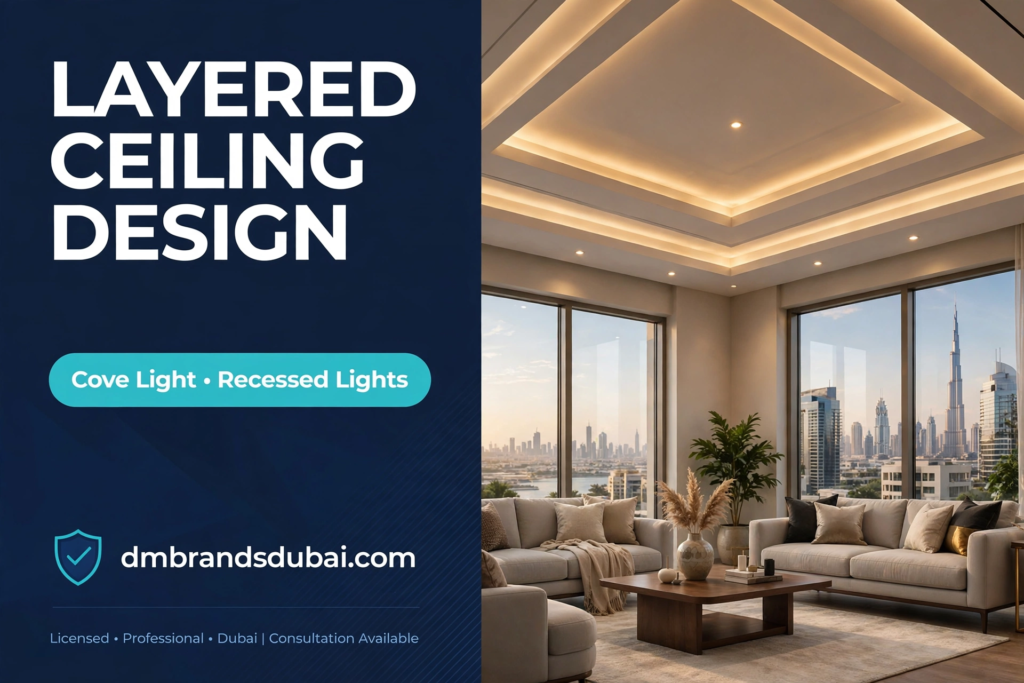
A recessed ledge around the room perimeter hides an LED strip that washes light up the wall and across the ceiling. Cove lighting creates a soft, luxurious ambience in living rooms and master bedrooms and is one of the most popular Dubai designs. It needs a well-built ledge, accessible drivers, and dimmable LEDs to be genuinely useful rather than merely decorative.
Layered and tray ceilings
A tray design drops the ceiling perimeter and leaves a raised central panel, often with cove lighting inside the tray. Layered ceilings add depth and suit large living rooms and dining areas. They cost more because of extra framing and finishing, but they define zones in open-plan villas without walls.
Bulkheads and beams
Bulkheads box in AC ducts, beams and structural drops, turning awkward projections into deliberate design features. A bulkhead around a room’s perimeter can hide curtain tracks, AC grilles and cove lighting in one clean line. Plan bulkhead depths around duct sizes and curtain clearances, not just appearance.
Curved and feature ceilings
Curves, waves, circular drops over dining tables, and geometric patterns suit feature rooms and luxury villas. They need experienced framing and finishing teams, and they cost most per square metre. If you want a feature ceiling, view the contractor’s previous curved work before committing — poor curves show every flaw.
The Installation Process Step by Step
Step 1: Survey and design
The contractor measures each room, checks slab height and level, notes AC duct positions, beam locations, and existing light and fan points, and discusses your design and lighting plan. This survey should end with drawings or at least a written design description, not just a price.
Step 2: Approvals and protection
In apartments, building management approval may be needed, especially if AC ducts or electrical circuits change. Floors, furniture and joinery are protected before work starts, and the work area is sealed to contain dust.
Step 3: Marking and framework
Ceiling levels are marked on walls with a laser level, and hangers are fixed to the slab. Main and cross channels form the framework, spaced to suit board sizes and load. This stage determines whether the finished ceiling is level and sag-free: hanger spacing, channel gauge and fixing quality matter enormously and are invisible once boards go up.
Step 4: Board fixing
Gypsum boards are screwed to the framework with joints staggered, not aligned in continuous lines. Screw spacing and depth are controlled so boards sit flat without dimpling. Cut-outs for downlights, AC grilles, speakers and access panels are made at this stage, coordinated with the electrician and AC technician.
Step 5: Joint treatment
Joints are taped with fibre mesh or paper tape and filled with joint compound in two to three coats, each sanded after drying. This is the most skill-dependent stage: rushed jointing shows as visible lines and cracks within months. Corners are reinforced with metal or paper-faced beads.
Step 6: Services coordination
Electricians install downlight wiring and drivers, AC technicians fit or relocate grilles and check airflow, and any speakers, smoke detectors or CCTV points are fixed. Coordination here prevents the familiar problem of a downlight clashing with a duct or a grille landing off-centre in a panel.
Step 7: Priming and painting
The ceiling is primed, defects are spotted and filled, and two coats of ceiling paint are applied. In kitchens and bathrooms, moisture-resistant paint is used. Final inspection under raking light reveals defects that flat light hides, so check the ceiling from several angles before sign-off.
Step 8: Snagging and handover
Walk each room with the contractor, list defects — visible joints, uneven paint, misaligned lights or grilles — and require rectification before final payment. Keep access panel locations noted for future AC and electrical maintenance.
False Ceilings and Air Conditioning in Dubai
No false ceiling project in Dubai is complete without AC coordination. The ceiling void carries ducts, and grille positions, duct sizes and return-air paths all affect cooling performance. If a new ceiling lowers the void too far, ducts may need resizing or rerouting, and airflow can suffer.
Discuss AC early, not after boards are fixed. Confirm whether existing grilles stay, move or are replaced, whether duct insulation is intact, and whether the new ceiling leaves access panels over fan coil units, dampers and valves. A ceiling without access to the fan coil unit turns routine AC servicing into a demolition job — a costly mistake that is entirely avoidable.
For related services, our guides to AC installation costs, AC maintenance, AC servicing before summer and split AC installation explain how cooling work is priced and sequenced alongside ceiling projects.
Lighting Design With False Ceilings
Lighting is where a false ceiling earns its cost. Recessed downlights provide general light, cove LEDs provide ambience, and pendant or track lights over dining tables and kitchen islands provide focus. Plan all three layers, not just a grid of downlights.
Choose warm white (2700K to 3000K) for living areas and bedrooms, and neutral white (4000K) for kitchens and workspaces. Dimmers on cove and main lights transform evening use, and they cost little when planned during first fix. Check that LED drivers are accessible through access panels or removable light fittings, because drivers fail before LEDs do.
Avoid over-lighting. Too many downlights create glare, waste energy and make a ceiling look like an office. A lighting designer or an experienced contractor will space lights by room function and furniture layout, typically 1.2 to 1.8 metres apart for standard downlights, adjusted for ceiling height.
False Ceilings in Villas vs Apartments
Apartment ceilings face fixed slab heights, typically 2.7 to 3.2 metres, so every centimetre of drop matters. A standard drop of 12 to 15 centimetres leaves comfortable headroom, but layered designs and deep bulkheads can make a low apartment feel cramped. In Dubai Marina and Downtown apartments, keep drops modest and use cove lighting to add perceived height.
Villa ceilings offer more freedom. Double-height living areas, majlis rooms and master bedrooms suit layered, tray and feature designs, and the larger void simplifies duct and lighting coordination. The trade-off is scale and cost: villa ceilings cover more area, and feature designs need more framing and finishing time.
In both cases, check ceiling height room by room before designing. A design that works in a 3.4-metre villa living room may overwhelm a 2.7-metre apartment bedroom. Good contractors measure heights and adjust designs accordingly rather than applying one design everywhere.
Dubai-Specific Guidance: Approvals, Moisture and Maintenance
Building approvals
Most apartment buildings allow internal ceiling work without a full renovation permit, but any change to AC ducts, fire systems, sprinklers or smoke detectors needs management approval and sometimes a specialist contractor. Never cover or relocate a smoke detector or sprinkler head without approval — it is a life-safety issue and a management violation.
Moisture and bathrooms
Standard gypsum boards fail in persistently damp conditions. Bathrooms, kitchens and laundry areas need moisture-resistant boards, proper ventilation and moisture-resistant paint. If a bathroom ceiling shows staining, find the leak above before replacing the ceiling, or the new ceiling will stain again.
Thermal and acoustic benefits
A false ceiling with insulation above it reduces heat transfer from the slab and dampens sound between floors — a real benefit in Dubai apartments where upstairs noise travels through concrete. Rockwool or glasswool insulation in the void improves both, at modest extra cost, and is worth specifying for bedrooms and home offices.
Access for future maintenance
Every ceiling should include access panels over fan coil units, valves, junction boxes and duct dampers. Note their positions and keep them unobstructed by joinery. A ceiling that looks seamless but hides its services is a maintenance trap.
Mistakes to Avoid
Skipping laser levelling is the root of many sagging and wavy ceilings. A framework set by eye or by string alone will show its errors once painted and lit. Insist on laser-set levels and check them yourself with a spirit level on the finished framework if you can.
Using thin channels or widely spaced hangers saves money upfront and causes sagging within a year, especially under the weight of layered designs and heavy light fittings. Ask what channel gauge and hanger spacing the contractor uses, and compare it across quotes.
Rushing joint compound drying is another classic error. Each coat must dry fully before sanding and recoating. In Dubai’s air-conditioned interiors, drying takes longer than expected, and a contractor who paints over damp joints guarantees cracks later.
Ignoring AC and electrical coordination leads to grilles and lights landing in the wrong places, ducts crushed by framing, and drivers buried without access. Hold a coordination meeting — even a brief one — between ceiling, electrical and AC teams before boards go up.
How Long Does False Ceiling Installation Take?
| Scope | Typical duration |
|---|---|
| Single room, flat ceiling | 2–4 days |
| 2–3 bedroom apartment, flat ceilings | 1–2 weeks |
| Apartment with cove and layered designs | 2–3 weeks |
| Villa, multiple feature ceilings | 3–6 weeks |
Timelines extend when AC modifications, custom joinery or imported light fittings are involved. Painting and drying add days that optimistic quotes often omit. A realistic programme with drying time built in beats a rushed job that cracks within months.
Choosing a False Ceiling Contractor in Dubai
Ask for a trade licence, insurance, and photographs of completed ceilings similar to your design — especially if you want curves, coves or layered features. Ask what board brand, channel gauge and joint compound the contractor uses, and whether painting is included.
The quotation should list rooms, areas, design descriptions, materials, lighting and AC inclusions and exclusions, programme and payment schedule. Stage payments tied to milestones — framework complete, boards fixed, jointing complete, painting complete — protect both sides and encourage quality at each stage.
Be wary of quotes far below market rates. They usually mean thin framing, unbranded boards, rushed jointing or excluded painting. A ceiling is overhead, permanent and hard to fix once furnished — it is the wrong place to save money by cutting quality.
If your ceiling project is part of a wider renovation, plan the sequence with other trades. Our guides to villa painting costs, TV wall mounting, smart home installation and handyman services help coordinate ceiling work with painting, mounting and automation.
Frequently Asked Questions
How much does a false ceiling cost in Dubai?
A plain gypsum ceiling typically costs AED 60 to AED 110 per square metre including painting. Cove and layered designs cost AED 90 to AED 250+ per square metre depending on complexity. A full apartment usually ranges from AED 8,000 to AED 18,000.
What is the best false ceiling material for Dubai homes?
Gypsum board is the best all-round choice for living areas and bedrooms. Moisture-resistant gypsum suits kitchens and bathrooms, metal panels suit commercial and wet areas, and POP suits ornate decorative designs.
How much does a false ceiling lower the room height?
A standard false ceiling drops 10 to 15 centimetres below the slab. Layered designs and bulkheads drop further locally, typically 20 to 30 centimetres at the perimeter or feature areas. Check finished headroom room by room before approving a design.
Do I need approval to install a false ceiling in my apartment?
Internal ceiling work alone usually needs only management notification, but changes to AC ducts, sprinklers or smoke detectors need formal approval. Confirm requirements with your building management before work starts.
How long does false ceiling installation take?
A single room takes two to four days. A full apartment takes one to three weeks depending on design, and a villa with feature ceilings takes three to six weeks including painting and drying.
Can a false ceiling hide AC ducts and wiring?
Yes, that is one of its main purposes. The void hides ducts, pipes and cables, while grilles, lights and access panels are integrated into the finished surface. Plan duct and access positions before boards are fixed.
Is a false ceiling good for insulation?
Yes, especially with insulation in the void. It reduces heat transfer from the slab and dampens sound between floors, improving comfort and energy efficiency in Dubai apartments and villas.
What lighting works best with a false ceiling?
Combine recessed downlights for general light, cove LED strips for ambience, and pendants or task lights for focus areas. Use warm white in living areas, neutral white in kitchens, and dimmers for flexibility.
Can false ceilings be installed in bathrooms?
Yes, using moisture-resistant gypsum boards, proper ventilation and moisture-resistant paint. Standard boards will fail in damp bathrooms, so material choice matters. Ensure access to any plumbing or AC above the ceiling.
Do false ceilings sag over time?
A properly framed ceiling with correct channel gauge, hanger spacing and board fixing should not sag. Sagging usually indicates thin framing, water damage, or excessive load from heavy fittings fixed without support.
How do I maintain a false ceiling?
Keep it dry, fix leaks promptly, dust cove ledges periodically, and repaint every five to seven years or when marked. Replace failed LED drivers through access panels or light cut-outs rather than cutting new holes.
Can I install a false ceiling in a rented property?
With landlord permission, yes. Flat gypsum ceilings are a popular tenant improvement, but agree in writing who pays, whether the work stays at lease end, and whether lighting and AC changes are included.
What is the difference between gypsum and POP ceilings?
Gypsum uses factory-made boards fixed to a metal frame, giving a fast, clean, predictable finish. POP is site-applied plaster that allows ornate decorative shapes but takes longer, needs more skill, and is harder to repair seamlessly.
Are false ceilings fire safe?
Gypsum boards are inherently fire-resistant and slow fire spread. Fire-rated boards are available for corridors and commercial spaces. Never bury smoke detectors, sprinklers or electrical junctions without proper access and approval.
Can a false ceiling reduce noise from upstairs?
Yes, a gypsum ceiling with insulation in the void noticeably reduces impact and airborne noise from the floor above, though it cannot eliminate all sound through concrete structures. Acoustic insulation specification matters.
How much does cove lighting add to the cost?
Cove lighting typically adds AED 50 to AED 120 per linear metre for LED strips, channels and drivers, plus the cost of the cove ledge framing itself. Dimmable, high-quality LEDs cost more upfront but last longer and look better.
What should a false ceiling quotation include?
It should list rooms and areas, design descriptions, board and frame specifications, jointing and painting inclusions, lighting and AC inclusions and exclusions, programme, and payment schedule. Single lump-sum quotes should be itemised on request.
Can existing ceilings be repaired instead of replaced?
Yes, minor cracks, stains and joint failures can often be repaired by re-taping, filling and repainting the affected area. Widespread sagging, water damage or a failed framework usually requires partial or full replacement.
False Ceiling Costs by Room in Dubai
Room-by-room pricing helps homeowners prioritise. A bedroom flat ceiling of 12 to 16 square metres typically costs AED 720 to AED 1,760 including painting, while a master bedroom with a simple tray or cove design ranges from AED 1,500 to AED 3,500. Living and dining areas are larger and more design-led: a 25 to 40 square metre living room with cove lighting and bulkheads usually costs AED 3,000 to AED 7,000.
Kitchens and bathrooms use smaller areas but moisture-resistant boards and more cut-outs for lights and vents, so per-square-metre rates run higher even though totals are lower — typically AED 800 to AED 2,000 per room. Corridors and entrance halls are often priced as part of an apartment package, but a feature entrance ceiling with cove lighting can add AED 1,000 to AED 2,500 on its own.
Majlis rooms and villa family rooms are where budgets rise most, because feature designs, wood finishes and layered lighting combine. A 30 square metre majlis with a decorative ceiling, cove lighting and cornice detailing can cost AED 6,000 to AED 15,000. Always price feature rooms separately from plain rooms so you can see exactly where the design premium sits.
False Ceilings and Smart Homes
Modern Dubai homes increasingly combine false ceilings with smart lighting, speakers, and climate control, and the ceiling is the natural home for all three. Plan smart devices during the ceiling design stage, not after painting. Recessed speakers need cut-outs and backing boxes, smart light controllers need accessible drivers and neutral wiring, and motorised curtain tracks need bulkhead space and power.
Voice-controlled lighting works best when circuits are grouped logically — cove lights on one circuit, downlights on another, pendants on a third — so scenes can be set room by room. If you plan a smart home system, tell your ceiling contractor before framing begins, and share the lighting and device layout with the electrician and the smart home installer together. Retrofitting smart devices into a finished ceiling means cutting holes, patching joints and repainting — work that is free when planned early and expensive when done late.
Our guide to smart home installation in Dubai covers device selection, wiring and integration in more detail, and it is worth reading before you finalise a ceiling design that will carry smart lighting and audio.
Repairing and Repainting an Existing False Ceiling
Not every tired ceiling needs replacement. Hairline joint cracks, minor stains and scuffed paint can often be repaired by re-taping the affected joint, filling, sanding and repainting the area. Water stains need the source fixed first — usually a leak from above or condensation on a duct — then stain-blocking primer and repainting.
Sagging sections, swollen boards and widespread joint failure indicate deeper problems: water damage, failed fixings, or a framework that was never adequate. In those cases, replacing the affected area, and sometimes the whole ceiling, is more economical than repeated patch repairs that fail again within months.
Repainting a false ceiling every five to seven years refreshes a home dramatically, especially when combined with new LED lamps and cleaned cove ledges. Use ceiling-specific matte paint to hide minor imperfections, and repaint cove interiors at the same time so reflected light stays even. If your ceiling predates LED lighting, a repaint is also the right moment to upgrade old halogen downlights to efficient LEDs, provided the fittings and drivers are compatible.
False Ceiling Safety: What Homeowners Should Check
Safety in false ceilings is mostly about what is hidden: electrical junctions must sit in proper boxes, not buried loose in the void; heavy fittings such as chandeliers and large pendants need independent support from the slab, not just from gypsum boards; and fire-rated penetrations around ducts and pipes must be sealed. Ask your contractor how heavy fittings will be supported, and never hang a heavy chandelier from gypsum board alone.
In apartments, never cover smoke detectors, sprinklers or fire alarm sounders with ceiling boards or paint. If a detector must move, it must be moved by an approved specialist and tested afterwards. Similarly, AC fire dampers and access panels must remain accessible and unobstructed. These rules are not bureaucracy — they protect everyone in the building, and management will require rectification at your cost if they are breached.
Finally, confirm that all waste — offcuts, packaging, old boards — is removed from the property and not left in the ceiling void. Debris in the void attracts pests, blocks airflow and can hide leaks. A clean void is part of a professional job, even though no one sees it after handover.
Getting the Most From Your Ceiling Budget
If your budget is tight, spend it on the rooms you live in most and keep secondary rooms simple. A feature cove ceiling in the living room and master bedroom, with plain flat ceilings in secondary bedrooms, corridors and storage areas, delivers the luxury impression where it counts for roughly half the cost of feature ceilings everywhere. You can always upgrade a secondary room later, and a plain ceiling is easy to enhance with a bulkhead or cove addition.
Similarly, prioritise framework quality and joint finishing over decorative extras. A perfectly flat, well-lit plain ceiling looks better and lasts longer than an ambitious layered design built on thin framing and rushed joints. Ask your contractor to show you a finished plain ceiling under raking light — if that is flawless, their feature work will be too. A ceiling you never notice, because it is perfectly level, evenly lit and free of cracks, is the quiet signature of a job done properly. The best ceiling budget is one that buys craftsmanship first and decoration second.
Conclusion: A Ceiling That Works as Good as It Looks
A false ceiling is structure, services and design in one package. When the framework is level, the joints are properly finished, the AC and lighting are coordinated, and access is preserved, the result looks effortless and lasts for years. When any of those steps are rushed, the ceiling tells the story within months.
Plan your design around your rooms’ heights, your AC layout and your lighting needs — not just a photograph of someone else’s ceiling. Choose gypsum for reliability, moisture-resistant boards where needed, and a contractor who can show you similar completed work. Done well, a false ceiling does not just finish a room; it elevates the whole home.
Contact DM Brands Dubai for a false ceiling survey and itemised quotation. Prices in this guide are typical market ranges for planning purposes and are not a fixed quote for your home.