When your air conditioner stops cooling in the middle of a Dubai summer, the compressor is often the part to blame.
The compressor is the heart of your AC system. It pumps refrigerant through the coils, and without it, no cooling happens at all.
In Dubai, where temperatures regularly cross 45°C and air conditioners run for most of the year, compressors work harder than almost anywhere else on earth.
That heavy workload means wear, overheating, and eventual failure are common — especially in older units, poorly maintained systems, and villas with long refrigerant lines.
This guide explains everything you need to know about AC compressor repair in Dubai: the warning signs, the likely causes, typical costs in AED, whether repair or replacement makes more sense, and how to choose a technician you can trust.
If you live in Dubai Marina, JLT, Downtown Dubai, Palm Jumeirah, JVC, Arabian Ranches, or anywhere else in the city, the advice here applies to your home.
What Does an AC Compressor Actually Do?
Think of your air conditioner as a loop. Refrigerant absorbs heat from inside your home, carries it outside, releases it, and returns to absorb more heat.
The compressor drives that loop. It squeezes the refrigerant gas, raising its pressure and temperature so the outdoor coil can dump heat into the already-hot Dubai air.
Without a working compressor, the refrigerant cannot circulate. The indoor fan may still blow, but the air will feel warm or barely cool.
Most Dubai homes use one of three compressor types. Reciprocating compressors are common in older window and split units. Rotary compressors appear in many modern splits. Scroll compressors are found in larger ducted systems and villas.
Each type fails differently, but the warning signs overlap heavily. A technician should always confirm the diagnosis with pressure gauges and electrical tests before quoting a repair.
For general upkeep, regular AC maintenance in Dubai keeps the compressor cleaner, cooler, and far less likely to fail early.
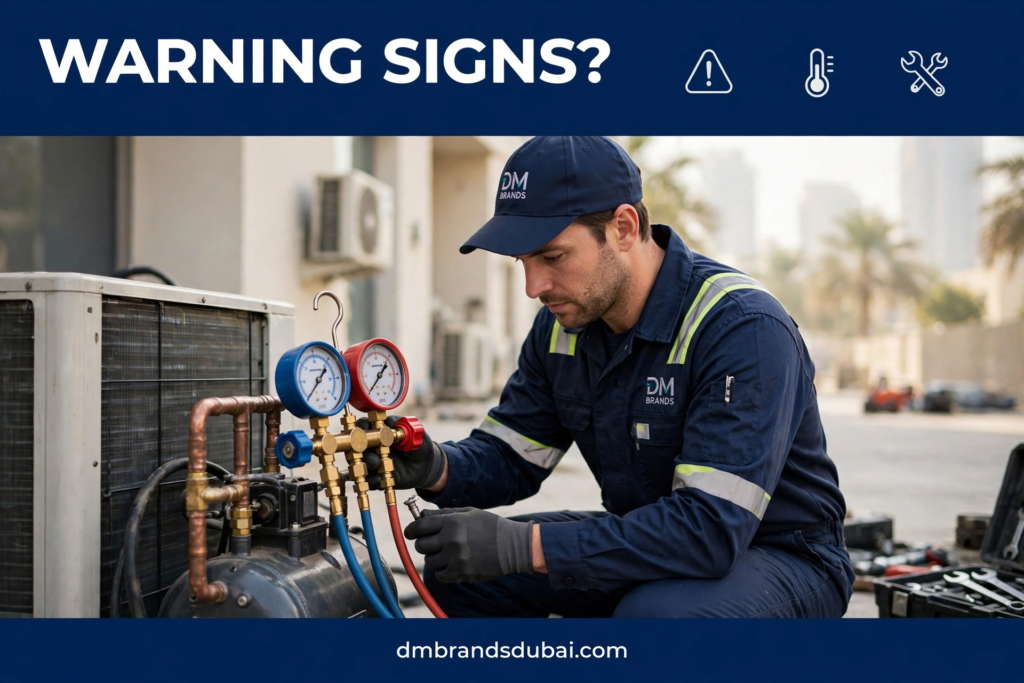
7 Warning Signs Your AC Compressor Needs Repair
1. The AC blows warm or room-temperature air
This is the most common complaint. If the indoor unit runs but the air never gets cold, the compressor may not be starting, or it may be running without enough refrigerant to move heat.
Before calling a technician, check the thermostat is set to “cool” and below room temperature. If the setting is right and the air is still warm, the compressor or refrigerant circuit needs inspection.
2. The outdoor unit is silent while the indoor unit runs
Walk outside and listen. The outdoor condenser unit should hum and its fan should spin when cooling is demanded.
If the indoor unit blows air but the outdoor unit is dead silent, the compressor may not be receiving power, its capacitor may have failed, or the compressor itself may be seized.
3. Loud, unusual noises from the outdoor unit
A healthy compressor hums quietly. Grinding, rattling, screeching, or loud clanking are warning signs of internal wear, loose mounts, or failing bearings.
Do not ignore a sudden new noise. Running a damaged compressor can turn a repairable fault into a full replacement.
4. The AC trips the breaker repeatedly
Compressors draw a large starting current. When windings short or the compressor struggles to start, it can trip the circuit breaker again and again.
Resetting the breaker repeatedly is not a fix. It risks damage to your home’s wiring and to the compressor itself. Switch the unit off and call a technician.
5. The unit starts and stops constantly
Short cycling — where the AC switches on and off every few minutes — strains the compressor badly.
Causes include an oversized unit, a faulty thermostat, low refrigerant, or a compressor that overheats and cuts out on its safety switch.
6. Higher DEWA bills with weaker cooling
A struggling compressor runs longer and draws more power to deliver less cooling. If your electricity bill climbs while comfort drops, the compressor may be losing efficiency.
Dubai’s official energy guidance encourages efficient cooling habits, and the DEWA energy-saving tips are a useful starting point for reducing load on your system.
7. Refrigerant leaks or ice on the coils
Low refrigerant forces the compressor to work harder and can cause ice to form on indoor coils or copper lines.
Refrigerant is not “used up” in normal operation. If levels are low, there is a leak that must be found and fixed — simply topping up the gas only delays the failure. A related service, AC gas refill in Dubai, should always include a leak check first.
Why Compressors Fail in Dubai
Dubai’s climate is uniquely hard on air conditioning. Outdoor units sit in direct sun, in dust, and in air that can exceed 50°C on a rooftop or balcony.
The most common causes of compressor failure here include:
- Overheating. Blocked condenser coils, poor airflow, or a failed outdoor fan make the compressor run hotter than designed.
- Low refrigerant. Leaks reduce cooling and lubrication, causing the compressor to overheat internally.
- Electrical problems. Voltage fluctuations, faulty capacitors, and worn contactors can burn out compressor windings.
- Dirty coils and filters. Dust buildup is relentless in Dubai. Dirty coils trap heat, and dirty filters starve the system of airflow.
- Lack of servicing. Units that go years without cleaning and inspection fail far earlier than maintained ones.
- Wrong refrigerant charge. Overcharging is just as harmful as undercharging, which is why a qualified technician should always weigh the charge rather than guess.
- Age. Most compressors last 10–15 years with good care. Beyond that, failures become increasingly likely.
Villas in Arabian Ranches, Palm Jumeirah, and Emirates Hills often have larger ducted systems, where a single compressor failure can shut down cooling for an entire floor. Apartments in Dubai Marina and JLT usually rely on split or ducted units per room, so one failure affects one zone — but the urgency is the same in August heat.
AC Compressor Repair vs Replacement: How to Decide
Not every compressor fault means a new compressor. Capacitors, contactors, relays, and fan motors are cheaper fixes that can restore cooling completely.
A technician should test the electrical components first. In many cases, what looks like a dead compressor is actually a failed capacitor — a repair that typically costs a fraction of compressor replacement.
Replacement becomes the smarter choice when:
- The compressor windings are burnt out or shorted to ground.
- The compressor is mechanically seized and will not turn.
- The unit is more than 12–15 years old and uses phased-out refrigerant.
- The cost of replacement approaches half the price of a new AC unit.
- The system has suffered repeated compressor failures, suggesting a deeper problem.
For newer units under warranty, always check the manufacturer’s warranty terms before authorising work. Compressor warranties on some brands run for five years or more, and using an unauthorised repairer can void coverage.
Manufacturer guidance, such as Daikin’s air conditioning maintenance advice, stresses regular servicing and prompt attention to faults — both of which protect the compressor.
If your system needs a full change, compare with AC installation costs in Dubai before committing to a compressor replacement on a very old unit.
AC Compressor Repair Cost in Dubai (Typical Ranges)
Prices vary by unit type, brand, refrigerant, and whether the work is done in an apartment or a villa. The figures below are typical market ranges in AED, not a quote. A proper diagnosis is needed for an exact price.
| Service | Typical range (AED) |
|---|---|
| Diagnosis / call-out | 150–300 |
| Capacitor / contactor replacement | 250–600 |
| Refrigerant leak repair and recharge | 400–1,200 |
| Compressor repair (minor, e.g. electrical) | 600–1,500 |
| Compressor replacement, small split AC | 1,800–3,500 |
| Compressor replacement, large split or ducted | 3,500–7,000+ |
| Outdoor fan motor replacement | 500–1,200 |
| Full condenser unit replacement | 4,000–9,000+ |
Several factors push the price up or down. Branded compressors for Daikin, Mitsubishi, LG, Samsung, or Carrier cost more than generic equivalents, but they usually last longer and fit properly.
Villa ducted systems take longer to access and test, so labour is higher. Emergency or same-day callouts in peak summer may carry a callout fee.
Always ask for a written breakdown before work starts: parts, labour, refrigerant, and warranty. A reputable company will explain whether the quoted compressor is original, OEM-equivalent, or reconditioned, because the difference matters for lifespan.
Be cautious of quotes that seem far below the market. A suspiciously cheap compressor replacement often means a reconditioned unit, an incorrect refrigerant charge, or skipped steps like vacuuming the system — all of which shorten the repair’s life.
What to Expect During a Compressor Repair Visit
A professional visit usually follows a clear sequence, and it should take between one and four hours depending on the fault.
First, the technician inspects the indoor and outdoor units, checks the thermostat, and listens for abnormal sounds.
Next, they test electrical components: capacitor, contactor, wiring, and the compressor windings with a multimeter. This step separates a simple electrical fix from a true compressor failure.
Then they attach gauges to measure refrigerant pressures. Low suction pressure points to a leak or restriction; very high pressure suggests blocked coils or a failed fan.
If a leak is suspected, they will search joints, valves, and coils with a detector or soapy solution. Repairing the leak comes before any refrigerant is added.
For a compressor replacement, the technician recovers the old refrigerant safely, removes the failed compressor, fits the new one, pressure-tests the system with nitrogen, vacuums it to remove moisture, and then charges it with the correct refrigerant weight.
Finally, they run the system, check cooling performance, measure the temperature drop across the indoor coil, and confirm the outdoor unit runs quietly.
You should receive a short report: what failed, what was replaced, the refrigerant used, and the warranty on parts and labour. Keep this record — it helps with future servicing and warranty claims.
If the fault turns out to be urgent, such as a complete cooling failure in summer, emergency AC repair in Dubai services can usually attend the same day.
Compressor Repair Across Dubai’s Neighbourhoods
Cooling needs differ across the city, and so do the common faults technicians see.
In Dubai Marina and JLT, high-rise apartments often have balcony-mounted condensers exposed to reflected heat from glass towers. Poor airflow around these units is a frequent cause of overheating.
In Downtown Dubai and Business Bay, many apartments use ducted systems with ceiling-concealed units. Access can be tight, and a compressor fault may require coordination with building maintenance for rooftop access.
On Palm Jumeirah, villas face salty, humid air that corrodes outdoor components faster. Regular coil cleaning matters more here than almost anywhere else in the city.
In JVC, Dubai Hills, and Arabian Ranches, villas run large ducted systems for long hours. These compressors benefit enormously from an annual service contract, which spreads the cost of maintenance across the year.
In older areas such as Deira, Bur Dubai, and Al Barsha, ageing split units are common. Compressors in these units are often near the end of their life, so the repair-versus-replace decision needs honest advice rather than a quick sale.
Wherever you live, choose a provider that genuinely covers your area. A technician travelling from the opposite end of the city will be slower to arrive and may charge more for the visit.
How to Choose a Compressor Repair Provider in Dubai
The quality of the technician matters more than the brand of the compressor. A poor installation can destroy a brand-new compressor within months.
Look for these signs of a trustworthy provider:
- Clear diagnosis before pricing. A good technician tests before quoting, not the other way around.
- Written, itemised quotes. Parts, labour, refrigerant, and warranty should all be listed.
- Refrigerant handled properly. The system should be vacuumed and charged by weight, not guessed by pressure alone.
- Genuine parts. Ask whether the compressor is new and original or equivalent, and get it in writing.
- Warranty. Expect at least 3–6 months on labour and 6–12 months on a replacement compressor.
- Reviews and track record. Look for consistent feedback from customers in your area, not just a star rating.
- No pressure tactics. Be wary of anyone who insists on an immediate full-system replacement without testing the compressor first.
Also confirm the company is licensed and insured. If a technician is injured on your property or damages your system, insurance protects you.
An annual maintenance contract in Dubai can be good value if you have multiple units or a villa system, because it usually includes priority callouts and discounted repairs.
Maintenance Tips to Protect Your Compressor
Most compressor failures are preventable. These habits add years to your compressor’s life:
- Service twice a year. In Dubai, once before summer and once after is ideal. Servicing includes coil cleaning, filter cleaning, refrigerant checks, and electrical inspection.
- Keep the outdoor unit clear. Leave at least 30 cm of space around the condenser. Remove plants, boxes, and covers that block airflow.
- Clean or replace filters monthly. In dusty months, check filters every two to three weeks. Restricted airflow strains the whole system.
- Do not set the thermostat too low. Setting 18°C when it is 48°C outside forces the compressor to run non-stop. A setting of 22°C–24°C is cooler, cheaper, and kinder to the equipment.
- Shade the outdoor unit if possible. A simple shade that does not block airflow can reduce operating temperatures noticeably.
- Fix small problems early. A weak capacitor or a slow refrigerant leak is cheap to fix today and expensive to ignore for a season.
- Clean the coils. Dirty condenser coils are the single most common cause of compressor overheating in Dubai. Professional coil cleaning is part of any proper service.
- Use the timer and fan wisely. Letting the system rest during cooler hours reduces total running time without sacrificing comfort.
For the full system, AC duct cleaning in Dubai also helps, because clean ducts improve airflow and reduce the load on the compressor.
Common Mistakes Homeowners Make
One mistake is running the AC with a known fault “until it dies completely.” A compressor that is struggling today may seize tomorrow, and a seized compressor can contaminate the whole refrigerant circuit, making the eventual repair far more expensive.
Another is hiring the cheapest available technician without checking what parts they use. A mismatched or reconditioned compressor may cool for a few weeks and then fail again.
A third is ignoring the outdoor unit entirely. Many homeowners never look at their condenser. Dust, leaves, and even bird nests can block it, and the compressor pays the price.
Finally, some people top up refrigerant every summer without fixing the leak. Each top-up costs money, harms the environment, and leaves the compressor running under stress. A leak should be found and repaired once, properly.
Compressor Types Explained: Which One Is in Your Home?
Knowing your compressor type helps you understand the repair quote and the expected lifespan.
Reciprocating compressors use a piston, much like a car engine. They are durable and common in older units, but they are noisier and less efficient than modern designs. Repairs often involve valves or piston rings, and parts can be harder to find for very old models.
Rotary compressors use a rotating roller inside a cylinder. They are compact, quieter, and widely used in split ACs across Dubai apartments. They are generally reliable, but once internal wear sets in, replacement is usually more practical than an internal rebuild.
Scroll compressors use two spiral scrolls that compress the gas smoothly. They are efficient, quiet, and common in ducted villa systems and larger commercial units. They tolerate liquid refrigerant better than other types, but they are more expensive to replace.
Inverter compressors are a variation rather than a separate mechanical type. An inverter drive varies the compressor speed instead of switching it fully on and off. This saves energy, reduces wear from constant starting, and keeps temperatures steadier. If your home has an inverter AC, a fault may lie in the drive board rather than the compressor itself, so diagnosis should cover the electronics too.
Your technician can identify the type from the unit’s model plate, usually found on the outdoor unit. Take a photo of that plate before the visit — it speeds up parts sourcing considerably.
What Happens If You Ignore a Failing Compressor?
Delaying a repair rarely saves money. Here is how a small fault typically escalates over a Dubai summer.
First, efficiency drops. The system runs longer to reach the same temperature, and your DEWA bill rises. Rooms furthest from the indoor unit feel warm first.
Next, the compressor overheats more often and its internal safety switch trips. Cooling becomes intermittent — cold for an hour, warm for an hour — which is frustrating and hard on the equipment.
Then the compressor may seize or burn out. At that point, debris and burnt oil can contaminate the refrigerant lines and coils. Cleaning a contaminated circuit adds labour and cost to the repair.
Finally, the outdoor unit may fail completely during the hottest week of the year, when every repair company in Dubai is fully booked. Emergency callouts at peak times cost more and take longer to arrange.
The lesson is simple: a strange noise or a small drop in cooling is worth a same-week inspection. It is the cheapest moment to fix the problem.
Dubai Summer Checklist for Compressor Health
Use this checklist at the start of summer, ideally in April or May, before the extreme heat arrives.
- Book a full service, including coil cleaning and refrigerant pressure checks.
- Clean or replace indoor filters and check that all vents are open and unblocked.
- Inspect the outdoor unit for dust, debris, and clearance on all sides.
- Listen to the outdoor unit for a full cooling cycle and note any new noises.
- Check that the condensate drain is clear and water flows freely.
- Confirm the thermostat reads accurately by comparing it with a room thermometer.
- Note your DEWA bill as a baseline, so you can spot efficiency drops early.
- If your unit is over 10 years old, ask the technician for an honest assessment of the compressor’s remaining life.
Homes that follow this routine rarely face surprise compressor failures. The cost of a service is small compared with a mid-summer replacement, and the comfort difference is immediate.
Compressor Repair for Villas vs Apartments
Villa systems and apartment systems present different challenges, and a good provider will adapt to both.
In villas, ducted systems often serve multiple rooms from one outdoor unit. A compressor failure can affect the whole floor, so speed matters. Access is usually easier, but the units are larger and the refrigerant charge is bigger, which raises parts and labour costs.
In apartments, split units are more common, and each room has its own system. A failure is less disruptive to the whole home, but balcony space is tight and building rules may restrict working hours or rooftop access. Technicians should confirm access arrangements with building security before the visit.
For landlords and property managers, compressor failures in tenanted properties need fast, documented action. Keep records of every service and repair, because they demonstrate proper maintenance and protect both parties if a dispute arises.
Short-term rental hosts in Dubai Marina, Downtown, and Palm Jumeirah should be especially proactive. A failed AC during a guest’s stay leads to complaints, refunds, and bad reviews that cost far more than a service visit.
Is It Really the Compressor? Other Faults That Look Similar
Not every cooling failure is a compressor failure, and a careful diagnosis saves many homeowners from an unnecessary replacement.
A failed capacitor is the most common lookalike. The capacitor gives the compressor the jolt it needs to start. When it fails, the outdoor unit hums or clicks but never starts. Capacitors are cheap, quick to replace, and fail often in Dubai’s heat — so a good technician always tests them first.
A faulty contactor can also mimic compressor failure. The contactor is an electrical switch that sends power to the compressor. Pitted or burnt contacts can stop the compressor from receiving power at all, even though the compressor itself is healthy.
Thermostat faults cause confusion too. A thermostat that misreads room temperature may never call for cooling, leaving the outdoor unit idle. Before assuming the worst, check the thermostat batteries, settings, and placement — a thermostat in direct sunlight or near a heat source will misbehave.
Refrigerant restrictions, such as a blocked filter drier or a kinked line, can produce symptoms similar to a weak compressor: poor cooling, ice on lines, and unusual pressures. These are diagnosed with gauges and temperature readings, not guesswork.
Finally, a tripped breaker or a blown fuse in the outdoor disconnect box can make the whole outdoor unit appear dead. Checking the electrical supply is always step one, and it costs nothing.
This is why a proper diagnosis matters. A company that quotes a compressor replacement over the phone, without testing, is guessing with your money.
Frequently Asked Questions
How long does an AC compressor repair take?
Minor electrical repairs usually take under an hour. A full compressor replacement typically takes 2–4 hours, including pressure testing, vacuuming, and recharging. Villa ducted systems may take longer if access is difficult.
Can I run my AC if the compressor is faulty?
It is not advisable. Running a damaged compressor can cause it to seize, burn out its windings, or contaminate the refrigerant circuit. Switch the unit off and book a technician, especially if you hear grinding noises or the breaker keeps tripping.
How much does it cost to replace an AC compressor in Dubai?
Typical ranges are AED 1,800–3,500 for a small split AC and AED 3,500–7,000 or more for a large split or ducted system. The exact price depends on brand, size, refrigerant type, and labour. Always get a written quote after diagnosis.
Is it better to repair or replace the whole AC?
If the unit is under 10 years old and the rest of the system is healthy, compressor replacement usually makes sense. If the unit is over 12–15 years old, uses old refrigerant, or has had repeated failures, replacing the whole system is often more economical in the long run.
Why does my AC compressor keep failing?
Repeated failures usually point to an underlying cause: incorrect refrigerant charge, blocked coils, poor airflow, voltage problems, or a contaminated circuit from a previous repair. A good technician will investigate the cause rather than just swapping the part again.
Does a compressor repair come with a warranty?
Reputable companies typically offer 3–6 months on labour and 6–12 months on a replacement compressor. Ask for the warranty in writing, including what it covers and what would void it.
How often should I service my AC in Dubai?
Twice a year is ideal: once before summer and once afterwards. At minimum, arrange one full service per year, with filter cleaning every month during heavy use.
Will a new compressor lower my electricity bill?
Often, yes. A worn compressor draws more power for less cooling. A new, correctly charged compressor restores efficiency, and the saving is most noticeable in villas and large apartments that run cooling for long hours.
Conclusion
Your AC compressor works harder in Dubai than in almost any other city, and it deserves attention before it fails — not after.
Learn the warning signs: warm air, strange noises, tripped breakers, and rising bills. Act on them early, because a small electrical fix today is far cheaper than a full compressor replacement tomorrow.
Choose a technician who diagnoses before quoting, uses genuine parts, charges refrigerant by weight, and backs the work with a written warranty.
And protect your investment with regular servicing, clean filters, and clear airflow around the outdoor unit.
If your AC has stopped cooling or your compressor sounds wrong, do not wait for the next heatwave to force the issue. Book a proper inspection, get a clear written quote, and get your home cool again — comfortably, efficiently, and with confidence that the repair will last.