A thermostat is the brain of your air conditioning system. It decides when your AC runs, how hard it works, and how much electricity it consumes. In Dubai, where air conditioning runs for most of the year, a modern thermostat is not a luxury. It is one of the fastest ways to cut cooling bills, fix uneven temperatures, and take real control of comfort in your villa or apartment.
This guide covers everything you need to know about AC thermostat installation in Dubai. You will learn how thermostats work, which types suit Dubai homes, what installation involves, what it typically costs, and which mistakes to avoid. Whether you live in Dubai Marina, JVC, Arabian Ranches, Downtown Dubai, or Palm Jumeirah, the advice here applies to your home.
DM Brands Dubai installs, replaces, and configures thermostats across the city. Our technicians work with all major brands, including Nest, Honeywell, Ecobee, and Siemens, and with the split, ducted, and VRF systems common in Dubai properties.
What Is an AC Thermostat and Why Does It Matter in Dubai?
A thermostat is a control device that senses the temperature in your home and switches your air conditioning on or off to hold your chosen setting. Older thermostats use a simple dial or a basic digital display. Modern smart thermostats add Wi-Fi, learning schedules, room sensors, and app control.
Dubai’s climate makes thermostat quality unusually important. Summer temperatures regularly exceed 40°C, and humidity adds to the load on your system. A poorly placed or outdated thermostat can leave bedrooms warm while the living room freezes. It can also force your compressor to cycle too often, which wastes energy and shortens equipment life.
A well-chosen, correctly installed thermostat solves both problems. It reads temperature accurately, runs the system only when needed, and keeps every room closer to your target. Many Dubai households see noticeably lower DEWA bills after upgrading, especially when a smart schedule replaces a thermostat left at one temperature all day.
Signs You Need a New Thermostat
Your thermostat may be failing long before it stops working completely. Watch for these warning signs in your Dubai home.
First, uneven cooling is the most common symptom. One room feels cold while another stays warm, even though vents are open and filters are clean. A faulty sensor or a thermostat in a bad location often causes this pattern.
Second, short cycling wastes energy and wears out your compressor. If your AC switches on and off every few minutes, the thermostat may be misreading temperature or losing calibration. This fault deserves prompt attention, because compressor damage is far more expensive than a thermostat replacement.
Third, unresponsive controls signal trouble. Buttons that need several presses, a blank or flickering display, or settings that reset themselves all point to a failing unit. Batteries can cause some of these symptoms, so try fresh batteries first on a battery-powered model.
Fourth, rising electricity bills without a change in usage suggest your system is running longer than necessary. An old mechanical thermostat can drift several degrees from its set point, silently overcooling your home around the clock.
Finally, if your thermostat is more than ten years old, it probably lacks the features that make modern cooling efficient. Upgrading during a routine service visit is often the simplest time to do it. Pairing the upgrade with AC servicing before summer keeps your whole system in top shape.
Types of Thermostats Available in Dubai
Non-Programmable Digital Thermostats
These are the simplest modern option. You set a temperature manually, and the unit holds it until you change it. They are accurate, reliable, and inexpensive, making them a good choice for rental apartments, guest rooms, and smaller studios.
Their weakness is convenience. Nothing adjusts automatically when you leave for work or go to sleep. If you forget to raise the temperature before leaving, the system cools an empty home all day.
Programmable Thermostats
Programmable models let you set different temperatures for different times of day. A typical Dubai schedule cools bedrooms at night, eases off during working hours, and pre-cools the living room before you return home. This alone can trim a meaningful share of cooling costs.
These thermostats suit households with predictable routines. They need no Wi-Fi and no app, which appeals to residents who prefer simple, dependable controls.
Smart Wi-Fi Thermostats
Smart thermostats connect to your home Wi-Fi and are controlled from a phone app. Leading models learn from your habits, adjust automatically, and show energy reports. Some use room sensors to balance temperatures across larger villas.
For Dubai homes, the standout benefits are remote control and scheduling flexibility. You can cool the villa on your way home from the office, check the temperature while travelling, and receive alerts if the system behaves unusually. If you are building a connected home, a smart thermostat pairs naturally with smart home installation in Dubai.
Thermostats for Ducted and VRF Systems
Many Dubai villas and larger apartments use ducted or VRF/VRV systems with wired wall controllers. These are not always interchangeable with standard smart thermostats. Compatibility depends on the brand, the control protocol, and the wiring at the wall.
Brands such as Daikin, Mitsubishi, LG, and Samsung each use their own controllers. In these cases, the right upgrade is often a
manufacturer-approved smart controller or a compatible gateway. A technician should confirm compatibility before you buy any unit.

Thermostat Comparison Table
| Thermostat type | Best for | App control | Typical install complexity | Energy-saving potential |
|---|---|---|---|---|
| Non-programmable digital | Studios, rentals, guest rooms | No | Low | Low to moderate |
| Programmable | Homes with fixed routines | No | Low to moderate | Moderate |
| Smart Wi-Fi | Villas, tech-friendly homes | Yes | Moderate | High |
| Ducted/VRF controller | Villas with ducted or VRF systems | Varies by brand | Moderate to high | Moderate to high |
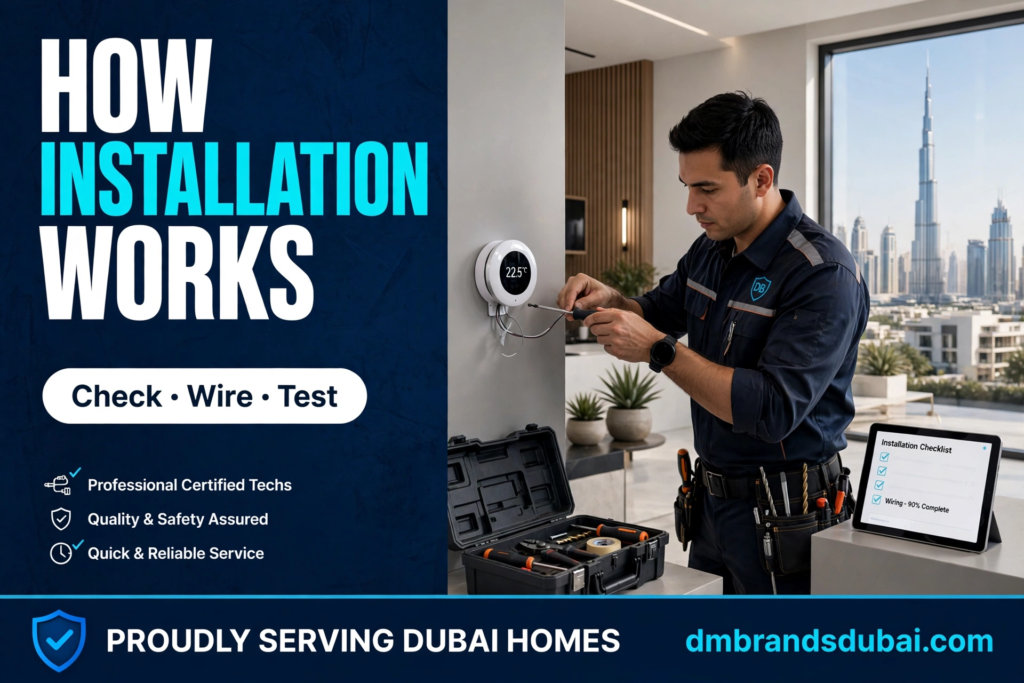
How AC Thermostat Installation Works
Professional installation follows a clear sequence. Knowing the steps helps you judge the quality of the work and avoid shortcuts.
Step 1: System and Compatibility Check
The technician first identifies your AC type, brand, and control wiring. They check voltage, the number of control wires, and whether a common wire (C-wire) is present. Many smart thermostats need a C-wire for continuous power, and older Dubai apartments sometimes lack one.
Step 2: Power Isolation and Old Unit Removal
Power to the AC system is switched off at the breaker before any wiring is touched. The old thermostat is removed carefully, and each wire is labelled so nothing is crossed during reconnection.
Step 3: Mounting and Wiring
The new thermostat’s wall plate is fixed level on the wall, ideally in the location chosen during the survey. Wires are connected to the matching terminals, and any C-wire adapter is fitted if required. Loose or corroded connections are cleaned or replaced.
Step 4: Configuration and Testing
The technician powers the system back on and configures the thermostat for your equipment type. They test cooling, fan modes, and temperature accuracy against a separate thermometer. For smart models, they connect the unit to your Wi-Fi and walk you through the app.
Step 5: Handover and Scheduling Setup
A good installer does not leave you with a blinking screen and a manual. They set your first schedule, explain the main features, and show you how to change temperature, modes, and holiday settings. This handover usually takes ten minutes and prevents most follow-up calls.
Most standard installations take between one and two hours. Ducted or VRF controller replacements can take longer, especially when a gateway or adapter is involved.
Where Should a Thermostat Be Installed?
Placement matters as much as the device itself. A thermostat in the wrong spot will misread your home’s temperature and run the system badly.
The ideal location is an interior wall in a room you use often, roughly at chest height, away from direct sunlight. It should sit clear of supply vents, which blow cold air directly onto the sensor and cause short cycling. Kitchens are poor locations because cooking heat skews readings.
Hallways can work well in apartments, provided they are not near the front door or a sunlit window. In villas, the main living area or master bedroom is usually the best choice. Large villas may benefit from zoning or additional sensors, which your technician can advise on during the survey.
If your current thermostat sits in a bad spot, installation is the right moment to move it. Relocating a thermostat involves extending control wiring, which is straightforward during a planned visit but messy as an afterthought.
AC Thermostat Installation Cost in Dubai
Costs vary with the thermostat type, your system, and any extra wiring work. The figures below are typical market ranges in Dubai, not fixed quotes. Your final price depends on the unit you choose and the condition of your existing wiring.
| Item | Typical range in Dubai |
|---|---|
| Basic digital thermostat (supply only) | AED 150 – 400 |
| Programmable thermostat (supply only) | AED 300 – 700 |
| Smart Wi-Fi thermostat (supply only) | AED 700 – 1,500 |
| Standard installation labour | AED 150 – 350 |
| C-wire adapter or extra wiring | AED 100 – 300 |
| Ducted/VRF controller replacement | AED 500 – 1,500+ |
Several factors move the price within these ranges. Premium brands cost more than generic units. Villas with multiple zones need more hardware. Apartments in older buildings sometimes need wiring upgrades. If your AC itself needs attention, combining thermostat installation with a full service visit saves a second call-out fee.
Be cautious of quotes far below these ranges. Very cheap installation often means no testing, no configuration, and no support when the unit misbehaves. A proper job includes compatibility checks, calibration, and a handover.
Thermostat Brands That Work Well in Dubai
Google Nest
Nest thermostats are popular in Dubai villas for their learning schedules and clean design. They suit standard split systems well, but ducted-system compatibility must be checked. Google’s official support pages offer wiring guides for common configurations.
Honeywell Home
Honeywell makes a wide range, from simple digital models to advanced smart thermostats. Their reliability and broad compatibility make them a safe choice for apartments and villas alike. Many Dubai technicians know Honeywell wiring by heart.
Ecobee
Ecobee stands out for room sensors, which help larger villas balance temperatures between floors and wings. Its energy reports are detailed, and it integrates with major smart-home platforms.
Siemens and Manufacturer Controllers
For ducted and VRF systems, Siemens controllers and the AC manufacturer’s own smart controllers are often the correct choice. They speak the system’s native protocol, which generic smart thermostats cannot always do.
Your installer should recommend based on your system, not on brand preference alone. The best thermostat is the one that communicates correctly with your equipment.
Energy Savings: What Is Realistic?
Manufacturers often advertise savings of 10 to 15 percent on cooling costs. Real results depend on your habits, your home, and your previous thermostat. Households upgrading from an old mechanical unit with no schedule tend to save the most.
The biggest savings come from scheduling, not from the device alone. Cooling an empty home all day is the single largest waste in Dubai households. A smart schedule that eases off during work hours and pre-cools before your return captures most of the benefit.
Room sensors add further savings in villas by preventing the system from overcooling the hallway while bedrooms stay warm. Regular maintenance multiplies these gains. A dirty filter or low refrigerant forces longer run times no matter how good the thermostat is, which is why an AC maintenance service in Dubai pairs so well with an upgrade.
Dubai’s electricity tariff structure also matters. DEWA bills combine consumption charges with a fuel surcharge, so every kilowatt-hour saved shows up directly on your bill. Over a year of near-constant cooling, even modest percentage savings add up to real money.
Smart Thermostat Features Worth Using
Many owners install a smart thermostat and then use only the temperature buttons. These features are worth learning.
Scheduling and learning. Let the thermostat learn your routine for a week, then review the schedule it builds. Adjust the pre-cooling time so the house is comfortable when you arrive, not an hour early.
Away and holiday modes. Set an energy-saving temperature for holidays rather than switching the AC off entirely. In Dubai’s humidity, a completely idle home can develop damp and musty smells. A moderate holding temperature protects furniture and finishes.
Energy history. Check the monthly report to spot unusual run times. A sudden increase often points to a filter, refrigerant, or sensor issue worth investigating early.
Room sensors. If your model supports them, place sensors in the rooms that matter most, such as bedrooms. Prioritise comfort where you sleep, not in the hallway where the thermostat sits.
Filter reminders. Enable maintenance reminders so filter changes are not forgotten. A clogged filter is the most common cause of weak cooling in Dubai apartments.
Common Thermostat Installation Mistakes to Avoid
Buying before checking compatibility. Not every smart thermostat works with every AC system. Ducted and VRF systems are the most common source of expensive mistakes. Confirm compatibility first, ideally with a technician’s survey.
Installing in direct sunlight. A thermostat on a sunlit wall reads several degrees high and overcools the home all afternoon. This single error can erase all energy savings.
Skipping the C-wire check. Smart thermostats without a proper power supply may reboot, lose Wi-Fi, or drain batteries quickly. A C-wire adapter solves this, but only if the installer checks for the problem.
Leaving default settings untouched. Default schedules rarely match Dubai routines. A thermostat left on factory settings behaves little better than the unit it replaced.
DIY wiring without labelling wires. Swapping wires by guesswork can damage the control board. If you install it yourself, photograph the old wiring before disconnecting anything, and switch power off at the breaker first.
Ignoring calibration. A thermostat that reads two degrees off will keep your home permanently uncomfortable. Testing against a separate thermometer takes minutes and should be part of every installation.
Thermostat Installation Across Dubai’s Neighbourhoods
Dubai’s housing stock varies enormously, and thermostat needs vary with it. Marina and Downtown apartments usually have split or fan-coil systems with standard wall controllers, making smart upgrades straightforward. JVC and Dubai Silicon Oasis apartments are similar, though some older towers have limited control wiring.
Villas in Arabian Ranches, Palm Jumeirah, Emirates Hills, and Jumeirah Golf Estates often use ducted or VRF systems. These homes benefit most from zoning advice and room sensors, because a single thermostat rarely serves a large villa well. Townhouses in Town Square, DAMAC Hills, and Mudon sit between the two, with a mix of split and ducted systems.
Landlord and tenant situations also differ. Tenants should confirm with their landlord before replacing a fixed controller, and keep the original unit for reinstallation at move-out. Owners can treat the upgrade as a lasting improvement that also appeals to future tenants.
DM Brands Dubai serves all of these areas daily. Our technicians carry the common thermostat models and adapters, so most jobs finish in a single visit without a return trip for parts.
Maintaining Your Thermostat After Installation
A thermostat needs little maintenance, but a few habits keep it accurate. Dust the unit gently every few months, since dust on the sensor affects readings. Replace batteries promptly on battery-powered models, and keep the firmware updated on smart models so security and features stay current.
Check the temperature reading against a simple room thermometer once or twice a year. A drift of more than one degree suggests recalibration or relocation is needed. If you repaint a room, keep paint off the sensor vents, and avoid covering the unit with curtains or furniture.
Finally, revisit your schedule seasonally. Dubai’s cooler months from December to February need far less cooling, and a schedule tuned for August wastes energy in January. A quick seasonal review takes five minutes and keeps savings intact.
Pre-Installation Checklist
Use this checklist before your technician arrives, so the visit goes smoothly:
- [ ] Note your AC brand, model, and type (split, ducted, or VRF)
- [ ] Photograph your current thermostat and its wiring
- [ ] Confirm whether your home has stable Wi-Fi at the thermostat location
- [ ] Decide which rooms matter most for comfort
- [ ] Check with your landlord if you rent
- [ ] Clear access to the thermostat wall and the indoor AC unit
- [ ] List any problems: uneven cooling, short cycling, high bills
- [ ] Ask the technician to test calibration before leaving
Thermostat Installation and Your Wider AC System
A thermostat upgrade is most effective when the rest of the system is healthy. If your AC has weak airflow, warm spots, or strange noises, those faults will persist regardless of the controller. In that case, ask for a full system check during the same visit.
Related upgrades worth considering include a fresh split AC installation in Dubai if your unit is very old, and an annual maintenance contract in Dubai if you want scheduled servicing without remembering dates. For urgent faults, emergency AC repair in Dubai is available when cooling fails at the worst moment.
Think of the thermostat as the control layer, not a cure for mechanical problems. Pairing a smart controller with clean filters, correct refrigerant levels, and healthy airflow gives the best comfort and the lowest bills.
Thermostat Wiring and Safety Basics
Thermostat wiring looks simple, but it carries the control signals for your entire AC system. Most residential systems use low-voltage wiring, typically 24 volts, which is safer than mains power but still capable of damaging a control board if wires are crossed. That is why power isolation matters: switching off the breaker protects both the technician and your equipment.
Each wire has a standard colour and role, though older Dubai installations do not always follow the convention. Red usually carries power, white controls heating, yellow controls cooling, green runs the fan, and blue or black serves as the common wire. A careful installer labels every wire before disconnecting the old unit, rather than trusting colours alone.
If your home has only two or three wires, options narrow. Some smart thermostats can work with limited wiring using a power extender kit, while others need a new wire run. Running a new wire through finished walls is sometimes possible via existing conduits, but in concrete Dubai apartment walls it can be disruptive. Your technician should explain the trade-off before drilling anything.
Safety also covers the AC unit itself. A thermostat fault can keep a compressor running without a break, which risks overheating. If your AC ever runs non-stop and ignores the thermostat, switch it off at the breaker and call a technician. Continued running can turn a small control fault into a compressor replacement.
Renters and owners in shared buildings should also note that some Dubai towers restrict electrical work to approved contractors or require management approval. Checking with building management before the visit avoids a wasted appointment.
Repair or Replace: Making the Call
Not every thermostat problem needs a new unit. A blank display may need only fresh batteries. A loose wire can cause erratic behaviour that a service visit fixes in minutes. If your thermostat is under five years old and the fault is minor, repair is usually the sensible first step.
Replacement makes sense when several signs appear together. An old unit with a drifting sensor, unresponsive buttons, and no scheduling is rarely worth repairing. The same applies when you want smart features your current model cannot offer, such as app control or room sensors.
Consider the age of your AC system too. Fitting a premium smart thermostat to an air conditioner nearing the end of its life may not pay back before the system itself is replaced. In that case, a reliable mid-range programmable model is the smarter spend, with the premium upgrade saved for the new system.
A good technician will tell you honestly when repair beats replacement. At DM Brands Dubai, we check the existing unit first and only recommend replacement when the fault, age, or missing features justify it.
Frequently Asked Questions
How long does AC thermostat installation take in Dubai?
Most standard installations take one to two hours, including compatibility checks, wiring, configuration, and testing. Ducted or VRF controller replacements can take longer, especially when a gateway or adapter is needed. Your technician should confirm the expected time before starting.
Can I install a smart thermostat myself?
You can, if your system uses standard low-voltage wiring and you are comfortable working with labelled wires. Switch power off at the breaker first, photograph the old wiring, and follow the manufacturer’s guide. For ducted or VRF systems, or if your wiring lacks a C-wire, professional installation is safer and usually faster.
Do smart thermostats work with Dubai’s ducted AC systems?
Sometimes, but not always. Many ducted and VRF systems use manufacturer-specific protocols that generic smart thermostats cannot speak. In those cases, a manufacturer-approved controller or a compatible gateway is the right solution. Always confirm compatibility before buying.
Will a new thermostat really lower my DEWA bill?
It can, mainly through scheduling and accurate temperature control. Households that previously cooled an empty home all day usually see the clearest savings. Results vary with your usage, home size, and previous thermostat, but a well-configured smart schedule is one of the most reliable ways to cut cooling costs.
What is a C-wire and why does it matter?
A C-wire, or common wire, supplies continuous power to a smart thermostat. Without one, the thermostat may reboot, lose its Wi-Fi connection, or drain its battery quickly. Many older Dubai apartments lack a C-wire, but an adapter usually solves the problem without rewiring the whole home.
Where is the best place to install a thermostat?
On an interior wall in a frequently used room, at about chest height, away from direct sunlight, supply vents, and heat sources such as kitchens. A hallway can work in apartments if it is not near the front door or a sunlit window.
Can a thermostat be moved to a better location?
Yes. Relocation involves extending the control wiring to the new spot, which is straightforward during a planned installation visit. Moving a badly placed thermostat often improves comfort more than upgrading the unit itself.
Do I need Wi-Fi for a smart thermostat?
Wi-Fi is needed for app control, remote access, and energy reports. Without Wi-Fi, most smart thermostats still work as programmable thermostats, holding schedules you set on the device itself. If your home has weak Wi-Fi at the thermostat location, a range extender may be needed.
Which thermostat brand is best for Dubai homes?
There is no single best brand. Nest suits tech-friendly households with standard split systems. Honeywell offers broad compatibility and reliability. Ecobee excels in larger villas thanks to room sensors. For ducted or VRF systems, the manufacturer’s own controller is often the correct choice.
How much does thermostat installation cost in Dubai?
Typical labour costs range from AED 150 to AED 350 for a standard installation, plus the cost of the thermostat itself. Basic digital units start around AED 150, while premium smart models can reach AED 1,500. Extra wiring or C-wire adapters add roughly AED 100 to AED 300.
Will a new thermostat fix uneven cooling in my villa?
It can help, especially with room sensors or zoning, but it cannot fix blocked ducts, dirty filters, or undersized equipment. If uneven cooling persists after a thermostat upgrade, ask a technician to check airflow and duct balance.
Should tenants install their own thermostat?
Tenants should get landlord permission first and keep the original controller for reinstallation when moving out. A simple programmable or smart thermostat is usually acceptable, since it improves the property, but written approval avoids deposit disputes.
How often should a thermostat be replaced?
Most thermostats last ten years or more, but technology moves faster than hardware failure. If your unit is over ten years old, lacks scheduling, or misreads temperature, replacement is worth considering even if it still switches the AC on and off.
Does a smart thermostat work during a power cut?
Like all thermostats, it stops controlling the AC during a power cut, since the AC itself has no power. Most smart models remember their settings and reconnect to Wi-Fi automatically when power returns. Battery backup preserves the clock and schedule on some models.
Can one thermostat control multiple AC units?
Standard thermostats control one zone or system. Multi-zone homes need either multiple thermostats, a zoning system with dampers, or a VRF controller designed for several indoor units. Your technician can advise on the right approach for your villa’s layout.
Is thermostat installation covered by a maintenance contract?
It depends on the contract. Many annual maintenance contracts cover servicing and minor adjustments but charge separately for new hardware and installation. Ask your provider what is included before booking, and consider bundling the upgrade with a scheduled service visit.
What should I do if my new thermostat shows the wrong temperature?
First, check for sunlight, nearby vents, or heat sources affecting the sensor. Compare the reading with a separate thermometer placed nearby. If the difference exceeds one degree and placement is fine, the unit may need recalibration or replacement, and your installer should revisit under warranty.
Conclusion: Smarter Control for a Cooler, Cheaper Dubai Home
A thermostat upgrade is a small job with an outsized effect on comfort and cost. The right unit, placed correctly and configured properly, keeps your Dubai home comfortable without cooling empty rooms or cycling your compressor to death. Smart models add remote control and learning schedules that suit busy households and frequent travellers.
The key steps are simple: confirm compatibility with your AC system, choose a location away from sunlight and vents, insist on calibration testing, and set a schedule that matches your real routine. Skip those steps and even the best thermostat will disappoint.
DM Brands Dubai installs thermostats across Dubai Marina, JVC, Arabian Ranches, Downtown, Palm Jumeirah, and every neighbourhood in between. Our licensed and insured technicians check compatibility before they start, configure your schedule with you, and test calibration before they leave. Book your AC thermostat installation in Dubai today, and take control of your cooling, your comfort, and your DEWA bill.