
Air duct replacement is the removal of worn, damaged or poorly designed ductwork and the installation of new ducts that carry cooled air through your home properly. In Dubai, where a ducted AC system may run for most of the year, the ducts decide how well that cooling actually reaches your rooms.
Most people never see their ducts. They sit above false ceilings, behind walls and in roof voids, quietly leaking air, collecting dust and sweating in the heat until something goes wrong.
DM Brands Dubai installs, repairs and cleans ducted air conditioning for villas, apartments and townhouses across the city. We inspect first, quote in writing before any work starts, and tell you honestly when cleaning or sealing is enough and when replacement is the better spend.
A good duct system gives you even temperatures, lower DEWA bills and cleaner air. A bad one makes a brand new air conditioner look faulty.
Air duct replacement makes sense when ducts are old, crushed, torn, badly insulated, mouldy beyond cleaning or leaking so much that rooms cool unevenly. In Dubai, costs depend on the home size, duct material and access, so always ask for a written quote after an inspection.
Table of Contents
What Is Air Duct Replacement?
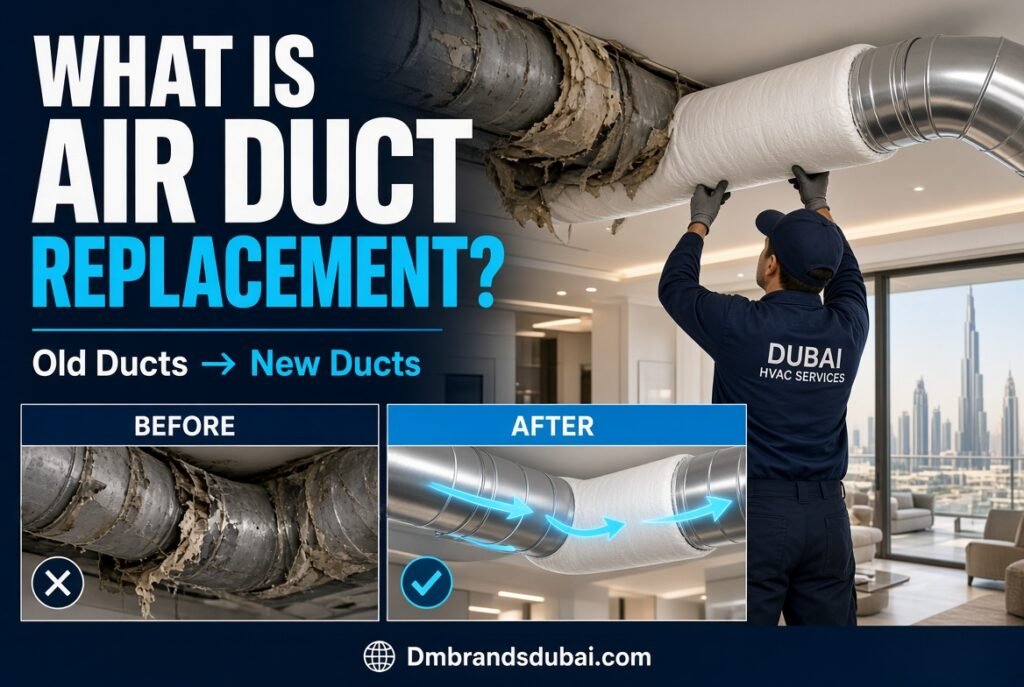
Ductwork is the network of channels that moves cooled air from the air handler to each room, and moves return air back again. Air duct replacement swaps all or part of that network for new, correctly sized and insulated ducts.
It is different from cleaning, which removes dust and debris from ducts you keep. It is also different from sealing and repair, which fixes leaks and loose joints without replacing the duct itself.
What Ducts Actually Do
Supply ducts deliver cold air to grilles and diffusers in each room. Return ducts or return grilles bring warm air back to the air handler to be cooled again.
The system only works as designed when the duct sizes, routes and sealing match the equipment. A great air handler connected to a poor duct network still performs badly.
What Air Duct Replacement Includes
A complete job usually covers:
- Inspection and measurement of the existing ductwork
- Removal and disposal of the old ducts
- New ducts in a suitable material and size
- Insulation and sealing of every joint
- New grilles, diffusers and dampers where needed
- Airflow testing and balancing
- Access panels and ceiling making good
- Handover with a written warranty
Full Replacement vs Partial Replacement
A full replacement changes the entire duct network. A partial replacement changes only the damaged runs, such as a crushed section above one bedroom.
Partial work costs less and often solves a local problem. Full replacement suits older systems where the whole network is worn, undersized or contaminated.
Who Needs Air Duct Replacement?
Villa owners with older ducted systems are the most common customers. Owners of renovated homes whose layout has changed also need new ducts to match the new rooms.
Tenants should involve the landlord, because ducts are part of the building and usually belong to the property owner.
Signs You Need Air Duct Replacement
Duct problems develop slowly and hide well. The signs below, especially when several appear together, suggest it is time to look at replacement rather than another patch.
Uneven Cooling From Room to Room
If one room freezes while another stays warm, air is not being delivered where it should be. Leaks, crushed sections, wrong sizing or poor balancing are the usual causes.
Repair and balancing can fix some cases, but widespread damage points to replacement.
Weak Airflow From the Vents
Vents that barely move air suggest restricted or leaking ducts. A torn or collapsed duct can lose much of the air before it ever reaches the room.
Always rule out a dirty filter and a weak blower first, because those are cheaper fixes.
Rising DEWA Bills With No Change in Use
Leaky ducts push cold air into the roof void instead of your rooms. The AC runs longer to compensate, and your DEWA bill climbs.
Cooling is the largest line on most Dubai electricity bills, so duct losses become expensive quickly.
Water Stains and Dripping From Ceilings
Cold ducts in hot, humid roof voids sweat when insulation is damaged or missing. The condensation drips onto ceilings and leaves brown stains.
Ongoing dampness also feeds mould, so this sign should never be ignored.
Musty Smells and Visible Mould
A musty smell when the AC starts suggests mould or bacteria in the ducts. Black or green growth around grilles and diffusers is a clear warning.
Light contamination can be cleaned. Porous or heavily contaminated duct material, especially old flexible duct, often needs replacement.
Excess Dust Around Grilles
Dust streaks around vents and a film of dust on furniture soon after cleaning suggest leaks or dirty ducts. Poor sealing lets dusty roof void air get drawn into the system.
Our duct cleaning service deals with contamination, and an inspection shows whether cleaning is enough.
Visible Damage in the Roof Void
Torn flexible duct, crushed sections, disconnected joints, sagging runs and peeling insulation are signs of failure. Rodent or insect damage also shows up as chewed insulation and droppings.
If a technician can see these problems, replacement of the affected runs is usually justified.
Banging, Rattling or Whistling Noises
Loose sections, undersized ducts and high air velocity create noise. Whistling grilles and rumbling runs suggest the duct design or condition is wrong.
Old Age
Ducts in older villas may be decades old. Metal ducts can corrode, insulation breaks down and flexible ducts become brittle.
There is no fixed lifespan, but age combined with any other sign tilts the decision towards replacement.
A New AC System Does Not Perform
If you recently replaced your air conditioner and cooling is still poor, the old ducts may be the problem. New equipment cannot overcome leaking, undersized or badly routed ducts.
This is one of the most common reasons for a combined duct and equipment upgrade.
Changes to the Home Layout
Extensions, new partitions, converted rooms and finished lofts all change airflow needs. Ducts designed for the old layout rarely suit the new one.
Replacement or modification brings the duct design back in line with how you actually use the home.
Air Duct Repair, Sealing, Cleaning or Replacement: Which Do You Need?
Not every duct problem needs replacement. A good company compares the options honestly and explains the trade-offs.
| Option | Best For | What It Fixes | Limitation |
|---|---|---|---|
| Duct cleaning | Dust, light contamination, odours | Removes debris and microbial growth | Does not fix leaks or damage |
| Duct sealing | Leaking joints and seams | Stops air escaping into the roof void | Cannot fix crushed or undersized ducts |
| Duct repair | Local damage such as a torn section | Restores one run or joint | Does not fix wider age or design issues |
| Insulation repair | Sweating and heat gain | Stops condensation and losses | Does not fix leaks or airflow problems |
| Partial replacement | Damaged runs in an otherwise sound system | Replaces failed sections | Mixed ages and materials remain |
| Full replacement | Old, damaged, contaminated or badly designed ducts | Renews the whole network | Highest cost and most disruption |
When Cleaning Is Enough
Cleaning is enough when ducts are structurally sound, well insulated and only dusty or lightly contaminated. It is usually the first step for smells and dust complaints.
A camera inspection shows whether cleaning will do the job.
When Sealing and Repair Are Enough
If ducts are sound but leaking at joints, resealing with the right materials can recover much of the lost airflow. Local damage can often be repaired without touching the rest of the network.
When Replacement Is the Better Choice
Replacement wins when ducts are crushed, torn, corroded, badly undersized or contaminated through porous materials. It also wins when repeated repairs add up to a large share of the cost of new ducts.
Think in Cost Per Year of Life
A cheap patch that buys one summer can cost more per year than a new duct system that lasts many years. Ask for a written repair option and a written replacement option side by side.
Our residential AC repair guide explains other faults that mimic duct problems, such as weak blowers and dirty coils.
Air Duct Replacement Cost in Dubai
Air duct replacement cost in Dubai depends mainly on the size of the home, the length of ductwork, the material and how hard the ducts are to reach. A single damaged run costs far less than a whole-villa network.
The figures below are general Dubai market ranges to help you plan. They are not fixed prices, and your quote will depend on the layout, materials and site conditions.
Indicative Air Duct Replacement Costs
| Job | Indicative Cost (AED) |
|---|---|
| Duct inspection or camera survey | 150 to 500 |
| Duct sealing and minor repair | 500 to 3,000 |
| Replacing a single flexible duct run | 300 to 900 |
| Replacing a damaged rigid duct section | 500 to 2,000 |
| Small apartment ducted system | 3,000 to 9,000 |
| Medium villa full duct replacement | 8,000 to 20,000 |
| Large villa full duct replacement | 15,000 to 35,000 |
| Grille or diffuser replacement (each) | 50 to 250 |
Quotes usually cover materials, labour, insulation and testing. Ceiling opening, making good, painting, electrical work and permits are often priced separately.
Cost Per Metre of Ductwork
Many installers price by the length of duct. A general guide for rigid insulated duct is AED 100 to AED 350 per metre, depending on size, material and access.
Flexible duct costs less per metre but is not suitable everywhere. Ask your installer to explain why they chose each material.
How Duct Replacement Compares With Duct Cleaning
Cleaning costs a fraction of replacement and solves dust and smell problems in sound ducts. Replacement costs more but fixes damage, leaks and design faults that cleaning cannot touch.
Read our guide to AC replacement and installation if you are also considering new equipment.
Get a Written Quote After Inspection
Never accept a price for full duct replacement over the phone. A technician needs to see the roof void, measure runs and check condition.
DM Brands Dubai quotes in writing before work begins, and our cost guide gives a feel for the numbers before an inspection.
Factors That Affect Air Duct Replacement Cost
Two homes of similar size can receive very different quotes. These factors explain why.
Size of the Home and Length of Ducts
Bigger homes need more duct, more grilles and more labour. Long runs through multiple floors cost more than short ones in a compact apartment.
Duct Material
Galvanised steel, pre-insulated panels, flexible duct and fabric duct all have different costs. Premium materials last longer but cost more upfront.
Duct Size and Capacity
Larger ducts for bigger airflows cost more. Correct sizing matters more than saving a little on material.
Insulation Quality
Thicker, better insulation costs more but prevents condensation and heat gain. In Dubai’s hot roof voids, skimping on insulation is a false economy.
Access and Working Conditions
Tight roof voids, low ceilings, hot working conditions and difficult routes slow the work. Higher access difficulty adds labour time.
Ceiling Work and Making Good
Opening false ceilings and repairing them afterwards adds cost. Painting and finishing add more. Our painting and decorating service can handle the finishing so one team manages the whole project.
Grilles, Diffusers and Dampers
Replacing every outlet improves appearance and airflow. Adding balancing dampers improves control but adds cost.
Return Air Arrangements
Poor return paths cause noise and weak performance. Fixing or adding return air routes can add work and cost, but it often solves hidden problems.
Contamination and Mould
Heavily contaminated ducts need careful removal and disposal. Mould found in the roof void may need separate treatment.
Timing and Demand
Installers are busiest in summer. Winter and early spring offer more choice and calmer scheduling.
Duct Materials for Dubai Homes
Choosing the right material affects durability, noise, insulation and cost. Each option suits different situations.
| Material | Main Advantage | Main Limitation | Typical Use |
|---|---|---|---|
| Galvanised steel (insulated) | Strong, long lasting, smooth airflow | Needs separate insulation and skilled fabrication | Main trunks and long runs |
| Pre-insulated duct panels | Built-in insulation, quick to install | Needs careful sealing at joints | Villa and apartment ducting |
| Flexible insulated duct | Easy to route around obstacles | Can sag, crush or restrict airflow if badly installed | Short final connections |
| Aluminium duct | Light and corrosion resistant | Less rigid, needs insulation | Short runs and risers |
| Fabric duct | Even air distribution | Specific to certain layouts and fit-outs | Open spaces and commercial areas |
Galvanised Steel Ducts
Galvanised steel is a durable, widely used choice. Smooth interior walls give good airflow, and rigid construction resists damage.
It needs external insulation and careful sealing, and fabrication takes skill.
Pre-Insulated Duct Panels
These panels combine a rigid insulated core with a foil facing. They are quick to install and give good thermal performance.
Joints must be sealed correctly and supported properly to last in a hot roof void.
Flexible Insulated Duct
Flexible duct bends around obstacles, which makes it handy for short connections. Poor installation causes sagging, kinks and sharp bends that choke airflow.
Many problem installations are long runs of flexible duct that should have been rigid.
Aluminium and Fabric Ducts
Aluminium suits specific short runs. Fabric ducts suit particular fit-outs and commercial spaces.
They are less common in typical Dubai villas but worth knowing about.
Why Material Choice Matters
The right material resists heat, humidity, dust and mechanical damage. A cheap material in the wrong place can fail within a few summers.
Ask your installer to explain material choices run by run.
Duct Insulation and Condensation in Dubai
Insulation is where many Dubai duct systems fail. Cold ducts run through hot, humid roof voids, and any weakness shows up as sweating.
Why Ducts Sweat
When cold ducts meet warm, humid air, moisture condenses on the surface. If insulation is missing, thin or damaged, water collects and drips onto ceilings.
Signs of Insulation Failure
Water stains, damp ceiling boards, peeling insulation and a musty smell all point to failing insulation. Cold spots on ceilings are another clue.
Insulation Quality Matters
Good insulation keeps cold air cold and prevents condensation. It also reduces energy loss, which helps your DEWA bill.
Vapour barriers and sealed joints are as important as the insulation thickness.
Repair or Replace Insulation?
Small damaged areas can be repaired. If insulation is widely degraded, wet or contaminated, replacing the duct section is often the better answer.
Wet insulation can hold moisture and grow mould, so it should not be left in place.
Duct Design, Sizing and Airflow

Good ducts are designed, not just installed. Size, route and layout all affect how well each room cools.
A properly designed network delivers the right amount of air to each space, quietly and efficiently.
Why Sizing Matters
Ducts that are too small restrict airflow, raise air speed and create noise. Ducts that are too large waste material and can reduce air velocity too much.
The right size follows the airflow each room needs, which comes from a cooling load assessment.
Airflow, Velocity and Noise
Air moving too fast creates whistling, rushing and rumbling sounds. Sharp bends, sudden size changes and undersized runs all increase noise.
Smooth, gradual bends and sensible sizing keep the system quiet.
Supply and Return Air
Cooled air must have a path back to the air handler. Without a proper return route, rooms become pressurised, doors slam and airflow drops.
Return grilles, transfer ducts and return plenums are part of the design, not afterthoughts.
Balancing the System
Balancing adjusts dampers so each room gets the right share of air. A system that is never balanced can leave bedrooms warm and living rooms cold.
A good installer measures airflow at each outlet and adjusts it before handover.
Grille and Diffuser Choice
The right outlets spread air evenly without dumping cold air on one spot. Size, throw and position all matter.
Cheap, badly placed grilles cause drafts and uneven cooling even when the ducts behind them are perfect.
Duct Leakage and Your DEWA Bill
Leaky ducts are one of the biggest hidden causes of high cooling bills. Every leak sends cold air into the roof void and forces the AC to run longer.
How Leakage Wastes Energy
Air that escapes into the roof void never cools your rooms. The system compensates by running more, which uses more electricity and wears equipment.
In a Dubai summer, a leaky duct can undo much of the benefit of a new air conditioner.
Where Leaks Happen
Leaks occur at joints, seams, connections to the air handler, grille boots and damaged sections. Poor tape, dried sealant and loose fittings are common causes.
Sealing Done Properly
Professional sealing uses suitable mastic and tapes designed for ducts, not ordinary adhesive tape. Joints are cleaned, sealed and supported so they hold in heat.
Testing for Leaks
Technicians can check for leaks using airflow measurements, smoke or pressure testing, and visual inspection. Testing after sealing proves the work was effective.
Our guide to air conditioner maintenance explains how regular checks catch leaks early.
Air Duct Replacement and Indoor Air Quality
Ducts touch every breath you take at home. Dust, damp and mould in ducts spread through every room the AC serves.
Dubai’s dust and humidity make air quality an important part of any duct decision.
Dust and Debris
Fine dust builds up inside ducts and in roof void air that leaks into the system. Leaky ducts draw that dusty air into the supply stream.
Mould and Bacteria
Damp insulation, condensation and poor drainage allow mould to grow. Spores and odours then travel through the whole system.
Light growth on hard surfaces can be cleaned. Growth in porous or damaged duct material often means replacement.
Pests and Rodents
Damaged ducts can let in insects and rodents. Chewed insulation, droppings and nesting material are signs of a problem that cleaning alone will not fix.
Filtration and Air Handler Condition
Clean filters and coils protect the ducts from fresh contamination. Our coil cleaning service removes the film that holds dust and moisture on heat-exchange surfaces.
Cleaning Before and After Replacement
Cleaning the air handler and cleaning any duct you keep prevents old contamination from spoiling the new system. After installation, a final clean removes construction dust.
How Air Duct Replacement Works Step by Step
A good replacement follows a clear sequence. Knowing it helps you judge whether a company is doing the job properly.
Step 1: Inspect the Existing Ducts
A technician opens access points and inspects the roof void. They check duct condition, material, size, insulation, joints and routes.
A camera inspection can reveal hidden damage and contamination in places you cannot see.
Step 2: Measure and Assess Airflow Needs
The technician measures rooms and considers how each is used. They compare the current duct sizes with the airflow each room needs.
Step 3: Recommend Options
You receive clear options with costs: clean, seal, repair, partial replacement or full replacement. Good advice includes the cheaper options where they make sense.
Step 4: Written Quote
The quote lists materials, sizes, insulation, labour, ceiling work, testing and warranty. You approve it before any work begins.
Step 5: Protect the Home
Floors and furniture are covered. Work areas are sealed off where possible to limit dust.
Step 6: Remove the Old Ducts
Old ducts are disconnected, carefully removed and bagged for disposal. Contaminated material is handled to avoid spreading debris through the home.
Step 7: Install the New Ducts
New ducts are fabricated or assembled, supported properly and connected to the air handler and outlets. Bends are kept gentle and runs as short as practical.
Step 8: Insulate and Seal
Insulation is fitted with vapour barriers where needed. Every joint and seam is sealed with suitable materials and checked.
Step 9: Fit Grilles, Dampers and Access Panels
New grilles and diffusers go in, balancing dampers are fitted and access panels are installed for future inspection and cleaning.
Step 10: Test and Balance
The system is run and airflow is measured at each outlet. Dampers are adjusted until every room gets the right share of air.
Step 11: Make Good and Hand Over
Ceilings are closed and finished, and the site is cleaned. You receive an explanation of what was done and written warranty details.
How Long Does Air Duct Replacement Take?
Time depends on the size of the job and how easy the ducts are to reach. The table gives typical guidance.
| Job | Typical Time |
|---|---|
| Replacing a single duct run | Half a day to one day |
| Small apartment ducted system | One to two days |
| Medium villa full replacement | Two to four days |
| Large villa full replacement | Four to seven days |
| Ceiling making good and painting | One to three extra days |
These are general guides. Access, ceiling finishes and unexpected findings can extend the timeline.
Living at Home During the Work
Most jobs can be done while you live in the home, but it will be dusty and noisy. Larger projects are easier if you can stay elsewhere for a day or two.
Ask how the installer protects the house and manages cooling during the work.
Preparing Your Home for Air Duct Replacement
A little preparation helps the work go faster and keeps your home protected.
Clear Access Points
Move furniture away from ceiling access areas and loft hatches. Clear routes to the air handler and any roof access.
Protect Belongings
Cover or remove valuables, electronics and soft furnishings near the work areas. Keep children and pets away from the work.
Arrange Building Permissions
Apartments and communities may require notice, permits or working hour limits. Tell building management well before the date.
Plan Around Cooling
Ask whether the AC can run during parts of the work. In hot weather, arrange cooler rooms for family members, especially children and elderly residents.
Plan the Finishing
Decide in advance how ceilings will be repaired and painted. Our handyman services can coordinate the finishing so the project closes cleanly.
Replacing Ducts and the AC System Together
If your air conditioner is also old, replacing ducts and equipment together can save money and avoid problems. The two parts must work as one system.
New equipment connected to old ducts rarely performs as promised. Matching them gives you the full benefit.
Why Timing Matters
Ducts are easiest to replace when ceilings are open or the air handler is out. Doing both in one project avoids opening the same ceilings twice.
Matching Capacity and Airflow
A new air handler has specific airflow needs. Ducts must be sized to deliver that airflow without excess noise or pressure.
A mismatch can cause weak cooling, noise and early equipment failure.
When to Replace Only the Ducts
If the equipment is young and performing well, replacing only the ducts is usually sensible. Ducts are often the weak link in an otherwise healthy system.
When to Replace Only the Equipment
If ducts are sound, correctly sized and well insulated, new equipment can connect to them. A technician should test the ducts first.
Our guide to AC replacement and installation explains how equipment decisions fit with duct decisions.
Combined Project Comparison
| Factor | Ducts Only | Equipment Only | Ducts and Equipment Together |
|---|---|---|---|
| Upfront cost | Medium | Medium to high | Highest |
| Best for | Young equipment, poor ducts | Old equipment, sound ducts | Both old or mismatched |
| Disruption | One ceiling opening | Equipment swap | One combined project |
| Efficiency gain | Fixes duct losses | Improves equipment efficiency | Largest gain |
| Risk of mismatch | Low | Medium | Lowest |
Air Duct Replacement by Property Type
The type of property changes the project. Access, ceiling design and building rules all differ.
Villas
Villas often have extensive duct networks across several floors. Roof voids can be hot and cramped, and false ceilings hide long runs.
A written layout of the duct network helps plan work and future servicing.
Apartments
Apartments usually have shorter duct runs above corridors and false ceilings. Access is often limited, and building rules may apply.
Where an apartment uses fan coil units from a central chilled water system, the ducting is usually short, and responsibility for the central system sits with building management.
Townhouses
Townhouses sit between apartments and villas, with ducts across multiple floors. Costs and access fall somewhere in the middle.
Coastal Properties
Homes in areas such as Dubai Marina, JBR and Palm Jumeirah face salt in the air. Metal fixings and supports corrode faster, so material and fixing choices matter more.
DM Brands Dubai serves communities including Dubai Marina, Jumeirah Village Circle, Palm Jumeirah, Downtown Dubai, Business Bay, Al Barsha, Arabian Ranches, Jumeirah, JBR and Al Quoz.
Commercial and Mixed-Use Properties
Offices and mixed-use buildings often have larger duct systems and stricter access rules. DM Brands Dubai also offers a commercial annual contract for ongoing care.
Building Rules, Permits and Landlord Approval

Duct replacement is not only a technical job. Buildings and landlords often have rules that need to be followed first.
Apartments and Towers
Many towers require notice, approved contractors, lift bookings and limited working hours. Work above ceilings in shared areas may need written approval.
Villas and Communities
Some communities have guidelines on contractor access, working hours and waste disposal. Check community rules before the work starts.
Landlord and Tenant Responsibilities
Ducts are part of the building, so landlords usually own them. If you rent, ask for written approval before agreeing to replacement and share the technician’s inspection report and quote.
Your tenancy agreement decides who pays, so read it carefully.
Keep Records
Keep the quote, invoice, warranty and any approvals together. They help with building management, landlords and future servicing.
Warranty on Air Duct Replacement
A good warranty is part of the value of a new duct system. Always check what it covers and for how long.
Material Warranty
Manufacturers of duct materials and insulation may give their own warranty. Terms vary, so ask for them in writing.
Workmanship Warranty
The installer’s warranty covers fabrication, sealing, support, insulation and balancing. DM Brands Dubai warrants its work in writing, and if something does not hold, we come back to it.
What Can Void a Warranty
Damage from other trades, water ingress, pest damage and unauthorised changes can void cover. Keep service records and report any damage promptly.
Questions to Ask About Warranty
- What is covered and for how long?
- Does it include labour as well as materials?
- Does it cover condensation and leakage?
- How do I make a claim?
How to Choose a Company for Air Duct Replacement
Duct work is hidden, which makes honesty and quality control even more important. You will not see the result once the ceiling is closed.
What to Look for
- Technicians who are directly employed, not subcontracted by the day
- Valid licensing and insurance covering the work
- A proper inspection, ideally with photos or camera footage
- An itemised written quote with materials, sizes and insulation listed
- Clear advice on cleaning, sealing, repair and replacement options
- Airflow testing and balancing as part of the job
- A written warranty on materials and workmanship
Questions to Ask Before You Sign
Ask what material is quoted and why. Ask what insulation thickness and vapour barrier will be used.
Ask how joints are sealed and how the system will be tested. Ask who repairs and paints the ceiling afterwards.
Red Flags
- A price given without inspecting the ducts
- No mention of insulation or sealing
- Long runs of flexible duct where rigid duct is needed
- A single lump-sum quote with no breakdown
- Pressure to decide immediately
- No licence, insurance or warranty information on request
- A price far below every other quote
Compare Quotes Like for Like
Compare the same materials, insulation, scope and warranty. A cheaper quote that leaves out sealing, testing or ceiling repair is not cheaper.
Our guide to the cheapest HVAC repair near me in Dubai explains how to compare prices without compromising quality.
Why Dubai Homeowners Choose DM Brands Dubai for Air Duct Replacement
DM Brands Dubai was built around doing things properly the first time. Duct work is hidden, so that matters more here than almost anywhere.
Directly Employed Technicians
Our technicians are our own staff, not day labour. The same standards apply on every job, and we stand behind the work.
Licensed and Insured Work
Every visit is fully covered, so you are protected if something unexpected happens while work is under way.
Written Price Before We Start
You receive a written quote before any work begins. Where a site visit is needed to price the job, we say so upfront.
There are no surprise extras. If the technician finds something else, you are told and you decide.
Honest Advice on Clean, Repair or Replace
If cleaning or sealing is enough, we say so. Advice that costs us a replacement job but saves you money is still the right advice.
Written Warranty
The work is warranted in writing. If something does not hold, we come back to it.
One Team for the Whole Project
DM Brands Dubai covers AC service and repair, AC replacement and installation, duct cleaning, coil cleaning, plumbing, electrical, handyman work, painting and water tank cleaning.
That means one number to call and one company accountable for the result. If duct work involves electrical changes, drainage or ceiling repainting, the same team can handle it.
Emergency Help When You Need It
If your ducted system fails and you need urgent help, our emergency call-out is available without a contract. For related reading, see our guide to same day air conditioning service.
Best Time of Year for Air Duct Replacement in Dubai
Timing affects price, comfort and how easy the work is. Roof voids are punishing in summer, and installers are busy.
| Period | What to Do |
|---|---|
| October to January | Best window for duct replacement, with cooler roof voids and quieter schedules |
| February to April | Final chance to finish before summer, book early |
| May to September | Replace only when necessary, expect heat, higher demand and longer waits |
Why Winter Works Best
Working in a cooler roof void is safer and faster. You can compare quotes calmly and schedule the work around your life.
Why You Should Not Wait for July
A duct problem that shows up in spring will worsen in the first heatwave. Fixing it before summer avoids emergency pricing and long waits.
Plan Ahead
If your ducts are old or leaking, book an inspection before summer even if the AC still works. You then have a plan ready instead of making a rushed decision.
How to Save Money on Air Duct Replacement
A duct project is a big spend, but there are sensible ways to keep costs under control without cutting corners.
Start With a Proper Inspection
A camera inspection and written report show what is really wrong. You may find that sealing, repair or partial replacement solves the problem.
Replace Only What Needs Replacing
If only some runs are damaged, partial replacement can save a lot. A technician should explain which sections must go and which can stay.
Combine Jobs
Doing duct work at the same time as AC replacement, ceiling repair or painting avoids opening ceilings twice. One coordinated project is cheaper than several separate ones.
Choose Materials Wisely
Use rigid, well-insulated duct where it matters and flexible duct only for short final connections. The cheapest material in the wrong place costs more in the end.
Insulate Properly
Good insulation prevents condensation, ceiling damage and energy loss. It costs more now but saves money and repairs later.
Compare Itemised Quotes
Detailed quotes let you compare fairly and avoid surprises. Ask for materials, sizes, insulation, testing and warranty to be listed.
Protect Your Investment With Servicing
A maintenance plan keeps the whole system efficient. The residential annual contract includes planned servicing, priority booking, plumbing and electrical call-outs and one fixed annual cost spread monthly.
Caring for Your New Ducts
New ducts still need care. Good habits keep air clean and protect the investment.
Our 14-Point AC Service
DM Brands Dubai follows the same sequence on every service, so nothing depends on who attends. Our AC service and repair visit covers:
- Cooling efficiency assessment, measuring supply and return air temperatures
- Filter cleaning or replacement, with a note of condition
- Evaporator coil cleaning on the indoor side
- Condenser coil cleaning outdoors, where Dubai dust does the most damage
- Component disinfection where damp and dust combine
- Drip tray and condensate line clearing
- Fan and blower assessment for wear, imbalance and fouling
- Refrigerant pressure check against manufacturer specification
- Electrical connection inspection
- Capacitor and contactor testing
- Thermostat calibration
- Air-flow balance assessment across outlets
- Noise and vibration check
- Written feedback on what was found, what was done and what needs watching
Filters Protect the Ducts
Clean filters stop dust from entering the system. Wash or replace them regularly, especially in summer.
How Often to Clean Ducts
Ducts do not need cleaning as often as filters, but periodic cleaning keeps them healthy. Homes with pets, allergies, construction nearby or past mould issues benefit from more frequent attention.
Keep Access Panels Clear
Access panels let technicians inspect and clean ducts. Do not block or paint over them, and tell your installer where they are.
Watch for Early Warning Signs
New stains, odours, noise or uneven cooling should be checked promptly. Early repairs are small and cheap.
Keep Your Paperwork
Store the warranty, the duct layout, material details and service reports together. They help future technicians and support warranty claims.
Can You Replace Air Ducts Yourself?
You can clean a few accessible grilles yourself. Replacing ducts is a different matter and is not a good DIY project.
Why DIY Replacement Goes Wrong
Ducts must be sized, routed, sealed and insulated correctly. Mistakes cause leaks, noise, condensation and poor cooling that are hard to fix later.
Safety Risks
Roof voids are hot and cramped. Falls through ceilings, heat stress, electrical hazards and fibre irritation are real risks.
Hidden Costs
DIY mistakes can lead to water damage, mould and repeat work. Paying a professional once is often cheaper than paying twice.
What You Can Safely Do
- Wash or replace filters
- Wipe visible grilles and diffusers
- Keep vents clear of furniture and curtains
- Note symptoms and take photos for the technician
Common Mistakes in Air Duct Replacement
Most expensive mistakes are avoidable. Knowing them helps you protect your budget and your comfort.
Replacing Without Inspecting First
A quote without inspection is a guess. Wrong scope and missed problems cause trouble later.
Choosing the Cheapest Quote Only
Low quotes often leave out insulation, sealing, testing or ceiling repair. You pay for those later, often at a higher price.
Using Flexible Duct Everywhere
Long, sagging flexible duct restricts airflow and wastes energy. Rigid duct is usually better for main runs.
Skimping on Insulation
Thin or poorly sealed insulation causes sweating and heat gain. In Dubai roof voids, it is one of the costliest shortcuts.
Ignoring Return Air
Without proper return paths, rooms become pressurised and airflow drops. Return air must be designed deliberately.
Skipping Balancing and Testing
Without airflow testing, some rooms stay warm and others freeze. Balancing is part of a proper job.
Forgetting the Equipment
New ducts connected to a failing air handler waste money. Check the equipment before you finalise the plan.
Blocking Access
Sealing ceilings with no access panels makes future inspection and cleaning expensive. Plan access before closing up.
Typical Air Duct Replacement Scenarios in Dubai
The three examples below are typical scenarios, not individual customer stories. They show how inspection changes the decision.
The Villa With Ceiling Stains
A homeowner notices brown stains spreading across a bedroom ceiling. Inspection finds uninsulated flexible duct sweating in a hot roof void.
The technician replaces the affected runs with insulated rigid duct and seals every joint. The stains stop, and the room cools more evenly.
The New AC That Never Cooled Properly
A villa gets a new ducted system, but the upstairs bedrooms stay warm. Inspection shows undersized, crushed ducts from the old installation.
The owner replaces the upstairs duct runs, and the new system finally performs as designed.
The Smell That Cleaning Fixed
A homeowner is told by another company that all ducts need replacing because of a musty smell. A second inspection finds sound ducts with light contamination.
Professional cleaning and a coil clean remove the smell. A proper inspection saves a large sum.
What These Scenarios Teach
Inspection decides everything. The same symptom can mean a small cleaning job or a full replacement, and a written comparison makes the choice clear.
How Long Do Air Ducts Last in Dubai?
Ducts can last many years, but heat, humidity, dust and poor installation shorten that. There is no single number that applies to every home.
In Dubai, roof voids are hot and humid, which ages insulation and fixings faster than in cooler climates.
What Shortens Duct Life
Poor insulation, sweating, mould, pest damage, crushing during other building work and badly made joints all cut duct life. Corrosion near the coast adds to the problem.
What Extends Duct Life
Good materials, proper insulation, well-sealed joints, secure supports and regular inspection extend life. Keeping filters clean and fixing leaks early also helps.
Signs the End Is Near
Repeated repairs, widespread insulation damage, persistent smells, uneven cooling and visible sagging suggest ducts are near the end of their useful life. When two or three appear together, start planning.
What Happens During a Duct Inspection?
A proper inspection is the foundation of a good decision. It shows what is wrong and what is not.
Visual Inspection
The technician opens access points and looks along the duct runs. They check joints, supports, insulation, grilles and signs of moisture or pests.
Camera Inspection
A small camera can look inside ducts to reveal dust, mould, damage and blockages. Photos or video give you a clear record.
Airflow Checks
The technician measures airflow at outlets and compares it with what each room needs. Low or uneven readings point to leaks, restrictions or balancing problems.
What You Should Be Told
You should leave the inspection understanding what is wrong, which fixes are possible and what each costs. A written quote follows, with each option clearly described.
What You Should Share
Tell the technician which rooms are hottest, where you have noticed smells or stains and what repairs have been done before. Share any plans for renovation or new equipment.
Duct Noise: Causes and Fixes
Noise is a common complaint with ducted systems. It usually has a clear cause.
| Noise | Likely Cause | Typical Fix |
|---|---|---|
| Whistling at grilles | Undersized outlet or high air speed | Resize or replace the grille or duct |
| Rushing or roaring | Air moving too fast through small ducts | Increase duct size or reduce airflow |
| Rattling | Loose sections or fixings | Secure and support the duct |
| Banging or popping | Thermal expansion of thin metal | Reinforce or replace the section |
| Humming from the roof void | Air handler vibration passing to the ducts | Add flexible connectors and vibration mounts |
Why Noise Often Means Design Problems
Persistent noise is rarely random. It usually points to undersized ducts, sharp bends or poor support.
Fixing Noise During Replacement
Replacement is a chance to fix design faults. Larger ducts, smoother bends and proper supports give quiet, steady airflow.
Ceiling Access, Making Good and Finishing
Duct work happens behind finished ceilings, so access and finishing are part of the job. Plan them early to avoid surprises.
Opening Ceilings
Technicians may cut access openings in false ceilings. Good planning keeps openings small and in sensible places.
Access Panels for the Future
New access panels let technicians inspect and clean ducts without major work. Their positions should be recorded and kept clear.
Repairing and Painting
Ceilings must be repaired and repainted after the work. This can add cost and time, so confirm in the quote who does it and when.
DM Brands Dubai offers painting and decorating as well as duct work, so the same team can finish the job.
Protecting Furniture and Floors
Dust, debris and tools are part of duct work. Good installers protect floors and furniture and clean thoroughly afterwards.
Air Duct Terms Explained in Plain Language
Quotes and technician conversations use jargon. This short glossary turns it into plain language.
Supply Duct and Return Duct
A supply duct carries cooled air to the rooms. A return duct brings air back to the air handler.
Air Handler
The air handler is the indoor unit that moves air across the cooling coil and through the ducts.
Plenum
A plenum is a box that connects the air handler to the main ducts or collects return air.
Diffuser and Grille
A diffuser spreads supply air into the room. A grille covers a return opening or supply outlet.
Damper
A damper is a valve in the duct that controls how much air flows through it. Dampers are used to balance the system.
Static Pressure
Static pressure is the resistance air meets as it moves through the system. High static pressure means restricted airflow.
Vapour Barrier
A vapour barrier is a layer that stops moist air from reaching cold surfaces. It prevents condensation on insulated ducts.
Mastic
Mastic is a sealant used to close duct joints and seams. It is applied correctly to create a durable airtight seal.
Balancing
Balancing is the adjustment of dampers so each room gets the right amount of air.
Questions to Ask Yourself Before You Decide
Duct replacement is a decision about comfort, money and air quality. A short list of questions makes it clearer.
Are the Symptoms Really Duct Problems?
Weak cooling can come from a dirty filter, a weak blower or low refrigerant. Rule those out before you replace ducts.
How Old and How Damaged Are the Ducts?
Age and visible damage are the biggest factors. Photos from an inspection show you what the technician sees.
Is Cleaning or Sealing Enough?
Ask for cleaning, sealing, repair and replacement quotes side by side. The gap between them shows what each step really buys you.
Is the AC System Also Reaching the End of Its Life?
If the equipment is old, combining projects may save money. If the equipment is young, replacing only the ducts is usually enough.
How Long Will I Stay?
If you plan to stay for years, quality and efficiency matter more. If the property is rented or you plan to move soon, cost and landlord approval matter more.
Air Duct Replacement Checklist
A little organisation makes the project smoother and the outcome better.
Before You Approve the Work
- Get a proper inspection with photos or camera footage
- Compare cleaning, sealing, repair and replacement options
- Check materials, insulation and sealing methods in the quote
- Confirm who handles ceiling repair and painting
- Check building rules and landlord approval
- Review the warranty terms
On the Day of the Work
- Clear access to ceiling openings and the air handler
- Protect floors and furniture
- Keep children and pets away from work areas
- Ask the technician to explain each stage as it happens
After the Work
- Check that every room cools evenly and quietly
- Look for stains, drips or odours in the first weeks
- Keep the warranty, layout and service records together
- Book your next service before the warm season
How to Read an Air Duct Replacement Quote Line by Line
A good quote tells a clear story. Each line should explain what you are paying for and why.
If a quote is a single number with no breakdown, ask for a detailed version before you decide.
| Quote Line | What It Should Tell You |
|---|---|
| Inspection | What was checked and what was found, with photos where possible |
| Ductwork | Material, sizes and lengths for each run |
| Insulation | Type, thickness and vapour barrier details |
| Sealing | The sealant or tape used and how joints are finished |
| Grilles and diffusers | Number, size and type of outlets |
| Dampers and balancing | Whether airflow testing and balancing are included |
| Removal and disposal | Removal of the old ducts and handling of contaminated material |
| Ceiling work | Opening, repair and painting, with who does each |
| Warranty | Material and workmanship cover, with durations |
| Exclusions | Anything not included, such as permits or electrical work |
Check the Material and Size Details
A quote that says only “ducting” leaves room for substitution. Look for material, size and insulation for each section.
Watch for Exclusions
Exclusions are where cheap quotes hide extra costs. Ask what is not included, such as ceiling repairs, painting, permits or extra access work.
Confirm Testing Is Included
Airflow testing and balancing prove the job worked. A quote without them leaves you guessing.
Check Payment Terms
Payment terms should be clear and fair. Ask when deposits are due, what stage payments apply and when the final balance is paid.
A reasonable arrangement ties payment to progress. Be cautious of requests for full payment upfront.
Planning the Duct Layout in a Villa
A good layout starts with how you live, not just with where the old ducts ran. Rooms change, and a new network is a chance to improve them.
Trunk and Branch Layouts
Most villas use a main trunk duct that feeds smaller branches to each room. Keeping trunks short and branches balanced gives even cooling.
Zoning Across Floors
Upstairs and downstairs have different loads. Zoning lets you cool each floor or area separately, which saves energy and improves comfort.
Bedrooms, Living Areas and Kitchens
Bedrooms need quiet, steady airflow. Living areas with large glass need more cooling. Kitchens need extra attention because of heat and moisture.
Planning Around Beams and Services
Beams, pipes and cables limit duct routes. A good designer plans around them instead of squeezing ducts into awkward spaces.
Keep Runs Short and Smooth
Long, twisting runs lose air and add noise. Short, straight runs with gentle bends deliver air more efficiently.
Return Air, Doors and Pressure Balance
Return air is one of the most overlooked parts of a ducted system. Without it, the best supply ducts struggle.
Why Return Air Matters
Air that is pushed into a room must be able to leave. Without a return path, pressure builds up and airflow falls.
Signs of Poor Return Air
Doors that slam or whistle, weak airflow in closed rooms and noisy grilles all suggest poor return paths.
Fixes During Replacement
Replacement lets you add return grilles, transfer ducts or door undercuts where needed. These small changes can transform comfort.
Preventing Mould and Moisture in New Ducts
New ducts should stay clean and dry. Good design and habits keep them that way.
Seal and Insulate Properly
Sealed joints and continuous insulation stop warm, humid air reaching cold surfaces. This is the best protection against sweating and mould.
Keep the Air Handler Drain Clear
A blocked drain can flood the air handler and wet nearby ducts. Regular servicing keeps drains clear.
Control Indoor Humidity
Correct system sizing and settings help the AC remove moisture. Good ventilation in bathrooms and kitchens reduces the load.
Act Quickly on Leaks
Any water stain or drip should be checked promptly. Early repairs prevent mould and costly damage.
Pest and Rodent Proofing
Roof voids can attract insects and rodents. Damaged ducts and insulation give them shelter and food.
Seal Gaps and Penetrations
Gaps around pipes, cables and duct entries should be sealed. Fewer entry points mean fewer problems.
Choose Durable Materials
Rigid, well-sealed ducts resist damage better than thin or exposed flexible ducts. Good supports keep ducts off surfaces where pests nest.
Inspect Regularly
Look for droppings, chewed insulation and nesting material during servicing. Early action prevents contamination of the duct system.
Safety and Compliance Considerations
Duct work must be safe as well as effective. Materials, fixings and installation methods should meet applicable requirements.
Materials and Fire Safety
Insulation and duct materials should be suitable for the building and use. Ask your installer to confirm that materials meet relevant requirements, especially in apartments and commercial buildings.
Electrical Safety
Duct work often runs close to wiring and lighting. Technicians must avoid damaging cables and follow safe working practices. Our electrical services can help if cabling needs to be moved or upgraded.
Working at Height and in Hot Spaces
Roof voids are hazardous. Trained technicians use proper access, protective equipment and heat precautions.
Duct Replacement During Renovations and Extensions
Renovations are the ideal time to fix ducts. Walls, ceilings and layouts are already open.
Plan Ducts Before Finishes
Decide duct routes before ceilings, lighting and wall finishes are set. Moving ducts later costs more and causes more mess.
Match Ducts to the New Layout
New rooms, removed walls and converted spaces change airflow needs. A fresh duct design should reflect the final layout.
Coordinate With Other Trades
Plumbing, electrical, painting and joinery all interact with ducts. DM Brands Dubai provides plumbing, electrical, painting and handyman work, so one team can coordinate the project.
Leave Access for the Future
Ducts, filters and drains need servicing. Do not seal everything behind permanent finishes.
Saving Energy Beyond Ducts
New ducts work best alongside other efficiency habits. Small changes add up across a long Dubai summer.
Set a Sensible Thermostat
A setting of 24°C keeps rooms comfortable without making the system work too hard. Very low settings raise energy use sharply.
Shade Sun-Facing Windows
Blinds, curtains and solar control film reduce the load on the system. West and south-west facing glass makes the biggest difference.
Close Off Unused Rooms Carefully
Zoning is better than closing vents randomly. Shutting too many outlets can raise pressure and cause noise or leaks.
Service the System Regularly
A clean, well-maintained system keeps ducts working as designed. Most Dubai homes do well with two services a year.
First-Week Checks After Air Duct Replacement
The first week reveals most problems. A short routine helps you catch issues early.
Check Cooling in Every Room
Run the system and confirm each room reaches temperature. Note any room that lags behind.
Listen for Noise
New ducts should run quietly. Whistling, rattling or rushing sounds should be reported.
Look for Stains and Drips
Check ceilings and grilles for damp patches or drips. Early signs of condensation are easy to fix and costly to ignore.
Check Airflow at Outlets
Hold a tissue near each outlet or feel for steady airflow. Weak or uneven airflow suggests balancing is needed.
Report Issues Straight Away
If anything seems wrong, contact the installer immediately. Issues reported during the warranty period should be fixed without argument.
Also Read:
- Home AC Compressor Replacement Cost in Dubai: Real AED Prices and Smart Savings 2026
- Residential AC Repair in Dubai: Same-Day Fixes, Real Costs and Expert Help 2026
- Cheapest HVAC Repair Near Me in Dubai: Affordable Fixes, Real Prices and Smart Savings 2026
- Same Day Air Conditioning Service in Dubai: Fast AC Repair & Maintenance by DMBrandsDubai 2026
- Air Conditioner Maintenance Tips for Dubai 2026
- Heating & Air Conditioning Service Near Me: How to Find a Fast, Reliable Local HVAC Team 2026
- Local Air Conditioning Service in Dubai: Fast AC Repair and Maintenance 2026
Frequently Asked Questions (FAQs)
What is air duct replacement?
Air duct replacement is the removal of old or damaged ductwork and the installation of new, correctly sized and insulated ducts. It restores even cooling, better efficiency and cleaner air.
How much does air duct replacement cost in Dubai?
Costs depend on the size of the home, the length of ductwork, the material and access. A single run may cost a few hundred dirhams, while a full villa can cost tens of thousands. You receive a written quote after an inspection.
How do I know if my air ducts need replacing?
Common signs are uneven cooling, weak airflow, rising DEWA bills, ceiling stains, musty smells, visible damage, noise and old age. An inspection confirms the cause.
Can air ducts be repaired instead of replaced?
Yes, in many cases. Sealing, local repairs and insulation fixes can solve problems in ducts that are otherwise sound. Replacement is better when damage is widespread.
Is duct cleaning the same as replacement?
No. Cleaning removes dust and debris from ducts you keep. Replacement installs new ducts and fixes damage, leaks and design faults that cleaning cannot.
How long do air ducts last?
It varies with materials, installation and conditions. Dubai’s hot, humid roof voids can shorten duct life if insulation and sealing are poor.
How long does air duct replacement take?
A single run can take half a day to a day. A medium villa often takes two to four days, and a large villa can take longer. Ceiling repair and painting add time.
Can I stay at home during the work?
Usually yes, but it will be noisy and dusty. For larger projects, many owners arrange to stay elsewhere for a day or two.
Why are my ceilings stained near the vents?
Cold ducts in hot, humid roof voids sweat when insulation is missing or damaged. The condensation drips onto the ceiling and causes stains.
What is the best duct material for Dubai homes?
Insulated galvanised steel and pre-insulated panels suit main runs, while short flexible ducts suit final connections. The best choice depends on the layout and conditions.
Is flexible duct a good choice?
It works well for short final connections. Long runs of flexible duct often sag and restrict airflow, so rigid duct is usually better for main runs.
Will new ducts lower my DEWA bill?
Often yes, especially if the old ducts leaked or lacked insulation. Sealed, insulated ducts deliver more cold air to your rooms for the same energy.
Do I need to replace my AC when I replace the ducts?
Not always. If the equipment is young and healthy, replacing only the ducts is often enough. If both are old, doing them together can save money.
Why does my new AC not cool some rooms?
Old, undersized, crushed or leaking ducts can stop cold air reaching some rooms. An inspection and airflow test find the cause.
Can mould in ducts be cleaned?
Light mould on hard surfaces can usually be cleaned. Mould in damaged or porous duct material often means replacement.
Do I need building approval for duct work?
In apartment towers and some communities, yes. Check with building management about notice, permits and working hours before the work.
Who pays for duct replacement in a rented property?
It depends on your tenancy agreement. Ducts are part of the building, so landlords usually carry major costs. Get written approval first.
Can I replace air ducts myself?
It is not recommended. Ducts must be sized, sealed and insulated correctly, and roof voids are hot and hazardous. Mistakes lead to leaks, noise and water damage.
Does the quote include ceiling repair and painting?
Not always. Confirm in writing who repairs and paints the ceiling and when. DM Brands Dubai can handle both as part of the project.
Does the work come with a warranty?
Yes. DM Brands Dubai warrants its work in writing, and if something does not hold, we come back to it. Also ask about material warranties.
Do ducts need servicing after replacement?
Ducts need less attention than equipment, but filters, coils and access points need regular care. Two AC services a year suit most Dubai homes.
Does DM Brands Dubai quote before starting work?
Yes. You receive a written price before work begins. Where a fault needs diagnosing first, the visit is charged and the work is quoted separately once we know what is wrong.
Conclusion
Air duct replacement is the right answer when ducts are old, damaged, contaminated or badly designed, and the wrong answer when cleaning or sealing would do. A proper inspection, an itemised written quote and an honest comparison of options put you in control.
DM Brands Dubai offers directly employed technicians, licensed and insured work, written prices before work starts, warranted installations and honest advice on whether to clean, repair or replace. We also handle ceilings, painting, electrical and servicing, so one team looks after the whole project.
If your ducts are leaking, sweating or failing to cool your rooms, send us the details and we will come back with a written price, with no call-out charge to quote.
Get a Free Quote or call +92 308 862 4813. You can also message us on WhatsApp and our call centre answers 24 hours.