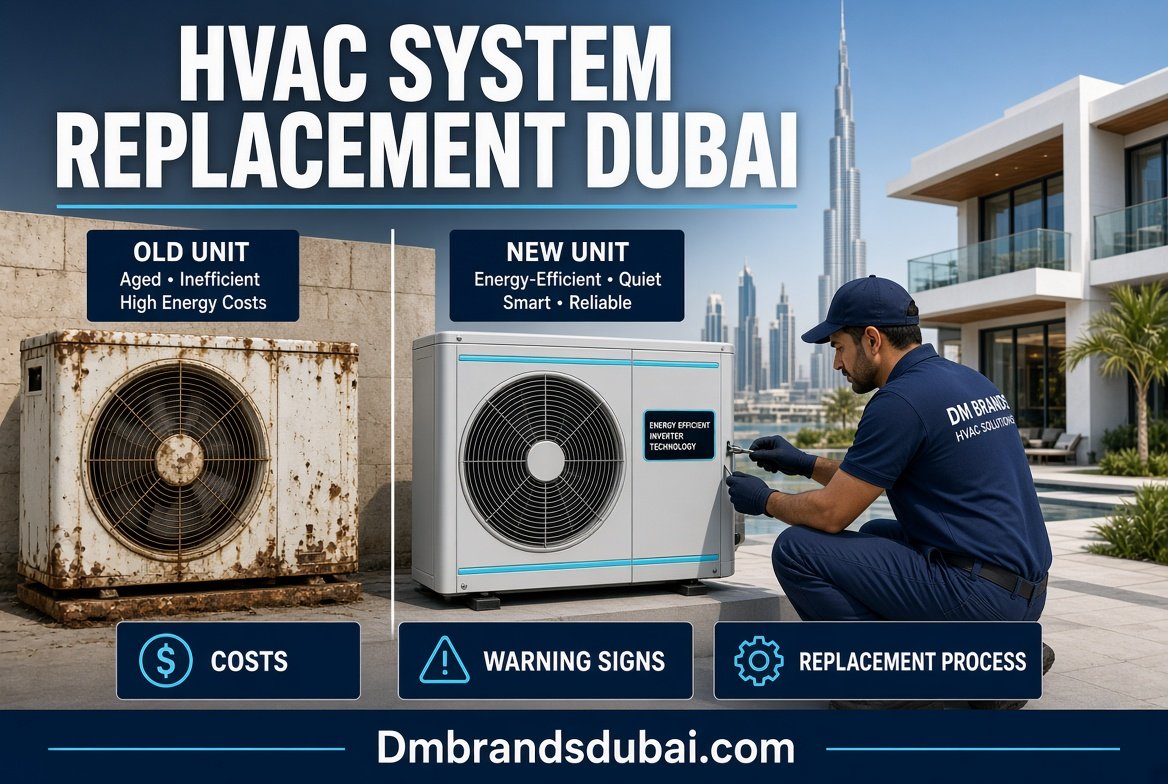
HVAC system replacement is the process of removing an old or failing heating, ventilation and air conditioning system and installing a new, correctly sized one. In Dubai, where cooling runs for most of the year, it is one of the biggest decisions a homeowner makes about comfort, running costs and reliability.
Most homes here rely on cooling rather than heating. That means an HVAC system in Dubai is mainly an air conditioning system, whether it is a single split unit in an apartment or a ducted network serving a whole villa.
DM Brands Dubai handles AC replacement and installation for villas, apartments and townhouses across the city. We survey the property, quote in writing before any work starts, and tell you honestly when repair is the better choice.
A replacement done well gives you lower DEWA bills, steadier temperatures and years without emergency call-outs. A replacement done badly gives you an expensive system that never quite cools the house.
HVAC system replacement usually makes sense when a system is around ten to fifteen years old, needs repeated repairs, uses an outdated refrigerant or has suffered a major failure such as the compressor. Costs in Dubai range from a few thousand dirhams for a single split unit to tens of thousands for a whole-villa or ducted system, so always ask for a written quote after a survey.
Table of Contents
What Is HVAC System Replacement?
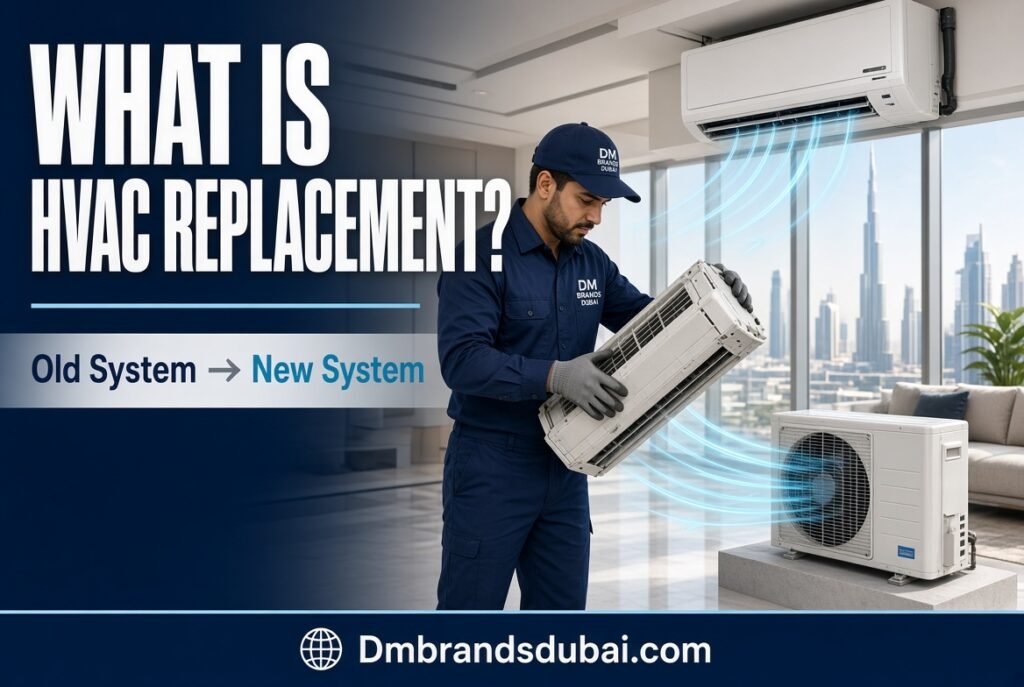
HVAC system replacement means swapping the main cooling equipment in a property for new equipment. That includes the outdoor unit, the indoor units or air handler, the refrigerant piping where needed, the controls and the commissioning work that proves it all performs.
It is different from repair, which fixes a fault in the existing system. It is also different from servicing, which keeps a healthy system clean and efficient.
What HVAC Means in a Dubai Home
HVAC stands for heating, ventilation and air conditioning. In Dubai, almost all of the load is cooling and dehumidifying, with ventilation playing a supporting role.
Heating is rarely a factor, so a replacement here is usually about air conditioning equipment, airflow, filtration and controls.
What a Full Replacement Includes
A complete replacement typically covers:
- Removal and responsible disposal of the old equipment
- New outdoor and indoor units, matched to each other
- New or checked refrigerant piping, drains and electrical supply
- Thermostats or controllers
- Duct inspection, cleaning or modification where relevant
- Commissioning, testing and handover with a written warranty
Full Replacement vs Partial Replacement
A partial replacement swaps a single component, such as an outdoor unit or a compressor. A full replacement changes the whole system so every part is new and matched.
Partial replacement costs less today but is only sensible when the rest of the system is young and compatible. Our AC replacement and installation service covers both routes and we explain which one fits your property.
Who Needs HVAC System Replacement?
Villa owners with ageing multi-unit systems, apartment owners whose splits have reached the end of their life and landlords managing several properties all face this decision. So do owners of new or renovated homes who need a system designed from scratch.
Tenants usually need to involve the landlord, because major equipment normally belongs to the property owner.
Signs You Need HVAC System Replacement
Systems rarely fail without warning. The signs below, especially when several appear together, suggest it is time to think about replacement rather than another repair.
The System Is Ten to Fifteen Years Old
Age is the first thing a technician checks. Many systems start to decline after ten years, and in Dubai the heat and dust can accelerate that decline.
A fifteen-year-old system may still run, but it is likely to be less efficient and more prone to costly failures.
Repairs Keep Coming
One repair is normal. Several repairs in a short period, especially on different parts, tell you the system is wearing out as a whole.
Each repair also takes time, disrupts your home and rarely improves the underlying efficiency.
Rising DEWA Bills With No Change in Use
An ageing system draws more power to deliver less cooling. If your DEWA bill climbs and your habits have not changed, the system is often the reason.
Cooling is the largest single line on most Dubai electricity bills, so efficiency matters more here than almost anywhere.
Uneven Cooling and Hot Spots
If some rooms stay warm while others turn cold, the system may be undersized, poorly balanced or suffering from duct leaks. Repairs can sometimes fix this, but not always.
When the original design no longer suits how you use the home, replacement is often the real solution.
High Humidity Indoors
A system that cools but leaves the air clammy is not dehumidifying properly. This can point to oversizing, a tired coil or aged components.
Persistent humidity also feeds mould, which affects air quality and damages finishes.
The Unit Uses R22 or Another Outdated Refrigerant
R22 is being phased out, which makes it scarcer and more expensive to service. Systems that use it are usually old, and a major refrigerant leak on such a system is a strong reason to replace.
Newer systems use refrigerants such as R410A and R32.
A Major Component Has Failed
A failed compressor, a corroded condenser coil or a cracked heat exchanger on a large system changes the maths. When the repair cost rivals the price of new equipment, replacement wins.
Constant Noise, Vibration or Smells
Persistent grinding, rattling, humming or musty smells suggest mechanical wear or mould. They can sometimes be fixed, but they often accompany an ageing system.
The System Is Undersized or Oversized
Homes change. Extensions, new glazing, extra occupants and heavier use can push cooling demand past what the original system can handle.
An oversized system cycles on and off too often. An undersized one runs flat out and never catches up.
Frequent Breakdowns in Summer
If your AC fails when the weather is hottest, the system is telling you it cannot cope with peak load. Waiting for the next failure risks a replacement under pressure instead of by choice.
HVAC Repair vs HVAC System Replacement
This is the decision most homeowners struggle with. The right answer depends on age, repair cost, efficiency, refrigerant and the reliability of the system so far.
A good company helps you compare both options in writing instead of pushing one.
When Repair Is the Better Choice
Repair usually wins when:
- The system is young and has been serviced regularly
- The fault is a single, inexpensive part
- The system uses a current refrigerant
- Cooling and efficiency are otherwise good
Our residential AC repair guide explains the common faults that look serious but are cheap to fix.
When Replacement Is the Better Choice
Replacement usually wins when:
- The system is old and repairs are frequent
- A major component such as the compressor has failed
- The refrigerant is outdated and costly
- Efficiency has dropped and bills keep rising
- The system is undersized or poorly suited to the property
Repair vs Replacement Comparison
| Factor | Repair | Replacement |
|---|---|---|
| Upfront cost | Lower | Higher |
| Best for | Young systems with isolated faults | Old systems with repeated or major faults |
| Efficiency | Restores existing performance | Often a significant improvement |
| Reliability | Depends on age of other parts | New equipment and a fresh warranty |
| Refrigerant | Existing type | Current refrigerant such as R32 or R410A |
| Disruption | Usually one visit | One to several days depending on system |
| Long-term cost | Can rise with repeated repairs | Lower breakdown costs in the early years |
The Fifty Percent Rule of Thumb
Many contractors use a simple guide. If a repair costs half or more of a new system and the system is already old, replacement is usually the better value.
If the repair is small and the system is young, repair wins. This is a guide, not a law, and a technician should look at the whole picture.
Think in Cost Per Year of Life
Divide the cost of each option by the years of reliable service you expect from it. A cheap repair that buys two years can cost more per year than a new system that lasts a decade or more.
Ask your technician for an honest estimate of remaining life, not just the price today.
Do Not Ignore Running Costs
A modern inverter system can use noticeably less electricity than an old fixed-speed one. Over several Dubai summers, that saving can offset part of the purchase price.
When you compare options, ask for the running cost difference as well as the installation price.
HVAC System Replacement Cost in Dubai
HVAC system replacement cost in Dubai depends mainly on the type of system, its capacity and the size of the property. A single split unit costs a fraction of a ducted villa system.
The figures below are general Dubai market ranges to help you plan. They are not fixed prices, and your quote will depend on the brand, model, site conditions and what is included.
Indicative HVAC Replacement Costs by System Type
| System Type | Typical Use | Indicative Installed Cost (AED) |
|---|---|---|
| Single split unit | One room or small apartment | 1,500 to 6,000 |
| Multi-split (2 to 3 indoor units) | Apartment or small villa | 5,000 to 15,000 |
| Several individual splits | Whole villa, 5 to 8 units | 10,000 to 40,000 |
| Ducted split system | Larger homes and villas | 8,000 to 25,000 |
| Packaged or rooftop unit | Villas and small commercial | 10,000 to 30,000 |
| VRF or multi-zone system | Large villas and mixed-use | Quoted after survey |
Costs usually include the equipment, standard installation and commissioning. Duct modification, electrical upgrades, building permits and difficult access are often priced separately.
How Replacement Compares With Repair
A single repair can cost a few hundred dirhams, while a full replacement costs thousands. That gap is why age and condition decide the right choice.
A system that needs one inexpensive part should be repaired. A system that needs a compressor and has other worn parts is usually a candidate for replacement.
Get a Written Survey and Quote
Never accept a price over the phone for a system replacement. A technician needs to see the property, measure the spaces and inspect the existing equipment.
DM Brands Dubai quotes in writing before work begins. You can also use our cost guide to get a feel for the numbers before a survey.
Factors That Affect HVAC System Replacement Cost
Two homes of the same size can receive very different quotes. These factors explain why.
System Type and Capacity
Capacity, measured in tons or BTU, follows the cooling load of the property. Larger systems need larger equipment, more refrigerant and more labour.
Ducted and VRF systems cost more than split systems because of their design and installation work.
Brand and Model
Premium brands and advanced models cost more than basic ones. Features such as inverter technology, quiet operation, air purification and smart controls add to the price.
Common brands in Dubai homes include Daikin, LG, Samsung, Carrier, Mitsubishi Electric, Gree, Midea, Hitachi, Panasonic, General and Trane.
Efficiency Rating
Higher efficiency equipment costs more upfront but uses less electricity. In a city where cooling is the largest part of the DEWA bill, efficiency can pay back over time.
Ask for the efficiency rating of each option and compare running costs, not just the purchase price.
Number of Indoor Units
Each indoor unit adds equipment, piping, drainage and electrical work. A villa with eight rooms to cool costs far more than an apartment with two.
Ductwork Condition
Existing ducts may be reused, repaired, cleaned or replaced. Leaky or undersized ducts waste energy and can undermine a new system.
Ductwork decisions can change the quote significantly, so it should be assessed at the survey.
Refrigerant Piping and Drainage
Pipe length, route and condition all matter. Long or hidden runs through walls and ceilings take more time, and old piping may need replacement to suit new refrigerant.
Condensate drainage must also be sloped and routed correctly to avoid leaks.
Electrical Requirements
New equipment may need updated wiring, isolators or a different supply capacity. Where electrical work is needed, our electrical services team can handle it.
Access and Location
Roof-mounted condensers, balcony racks and tight service areas make installation slower. Some buildings require lifts, permits or restricted working hours.
Tell the team about access when you request a quote.
Removal and Disposal
Old equipment must be removed and disposed of responsibly, with refrigerant recovered safely. Some quotes include this and some do not, so confirm it in writing.
Timing and Demand
In peak summer, demand is highest and installers are busiest. Replacement in winter or early spring gives you more choice, more time and often less pressure on price.
Types of HVAC Systems for Dubai Homes
Choosing the right system type matters as much as choosing the right brand. Each type suits different properties.
| System Type | Best For | Main Advantage | Main Limitation |
|---|---|---|---|
| Single split | One room or small apartment | Simple, affordable, easy to maintain | Needs one outdoor unit per room |
| Multi-split | Apartments and small villas | Fewer outdoor units | One outdoor fault affects several rooms |
| Ducted split | Larger homes | Hidden units, even air distribution | Needs good ductwork and ceiling space |
| Packaged unit | Villas and small commercial | Single outdoor cabinet | Larger and heavier equipment |
| VRF or multi-zone | Large villas and mixed-use | Zone control and high efficiency | Higher cost and specialist servicing |
| Cassette | Open-plan rooms | Even distribution from the ceiling | Needs ceiling void and drainage |
Single Split Systems
Split systems pair an indoor head with an outdoor condenser. They are the most common choice in Dubai apartments and many villas.
They are simple, reliable and easy to service. For one or two rooms, they are usually the best value.
Multi-Split Systems
One outdoor unit serves several indoor units. This reduces the number of outdoor units, which helps in buildings with limited space.
The trade-off is that a fault in the outdoor unit affects every room it serves.
Ducted Split Systems
Ducted systems cool many rooms through a central air handler and ductwork. The equipment is hidden, and the look is clean.
They suit larger homes, but the quality of the ductwork decides how well they work.
Packaged and Rooftop Systems
Packaged units combine the main components in a single cabinet. They are common on villa roofs and small commercial buildings.
They are robust, but they are heavy and need proper access.
VRF and Multi-Zone Systems
VRF systems vary refrigerant flow to match demand in each zone. They are efficient and flexible, and they suit large villas and mixed-use properties.
They need specialist design and servicing, and the initial cost is higher.
Cassette and Ceiling-Mounted Units
Ceiling cassettes distribute air in several directions from the ceiling. They work well in open-plan living areas.
They need a ceiling void and drainage planning to avoid leaks.
Chilled Water and District Cooling
Some towers and communities use chilled water from a central plant, with fan coil units in each apartment. Responsibility for the central system lies with building management, and occupant work is usually limited to the indoor units.
Check with building management before planning any change.
Getting the Size Right
Correct sizing is the single most important design step in HVAC system replacement. Size by guesswork and you can end up with a system that never feels right.
Why Sizing by Floor Area Alone Fails
Square metres tell you little about cooling demand. Glazing, orientation, insulation, ceiling height, occupancy and appliances all change the load.
A south-west facing living room with large windows needs far more cooling than a shaded bedroom of the same size.
What a Proper Cooling Load Assessment Covers
A proper assessment measures the rooms and considers the factors that drive heat gain. It also looks at ventilation needs and how each space is used.
The result is a recommended capacity for each room and for the system as a whole.
The Problem With Oversizing
An oversized system cools quickly, then switches off before it has removed enough moisture. The room feels cold but clammy, and the unit cycles on and off, which wastes power and wears components.
The Problem With Undersizing
An undersized system runs continuously and still struggles in the afternoon heat. It wears out faster and uses more electricity over its life.
Matching Equipment to the Property
The goal is a system that cools evenly, runs smoothly and cycles correctly. A good installer explains the sizing logic in plain language and shows you the numbers.
If a company sizes your system in a few minutes without measuring anything, treat the quote with caution.
Efficiency, Inverter Technology and Your DEWA Bill
Efficiency is where HVAC system replacement pays you back. A new system can deliver the same cooling for noticeably less electricity than an old one.
In Dubai, where systems run for months at a time, that difference shows up on every bill.
Fixed-Speed vs Inverter Systems
A fixed-speed system runs flat out until it reaches temperature, then switches off. An inverter system adjusts its speed to match demand, so it runs gently for longer and avoids constant stopping and starting.
Inverters cost more upfront but use less power and are quieter. They also reduce wear on the compressor.
Reading Efficiency Ratings
Efficiency ratings such as EER and SEER describe how much cooling a system delivers for the electricity it uses. Higher numbers mean better efficiency.
Look for the energy efficiency label on the unit and ask your installer to compare ratings across options.
How Much Can You Save?
Savings depend on the age of the old system, the new system’s efficiency, the size of the home and how you use it. Older systems that have lost performance often show the biggest improvement.
Ask the installer to explain the expected difference in plain terms rather than promising a fixed percentage.
Other Ways to Lower Cooling Costs
Shade sun-facing windows, set the thermostat to 24°C, keep filters clean and service the system before summer. These habits protect your investment and keep running costs down.
Refrigerants: R22, R410A and R32
The refrigerant in your system affects cost, availability and safety. It is worth understanding before you decide.
R22 Systems
R22 is an older refrigerant that is being phased out. Supply is shrinking and servicing becomes more expensive over time.
A system that still uses R22 is usually old. For most owners, replacing it is a sensible long-term decision.
R410A Systems
R410A is widely used in systems from the past couple of decades. It is readily available and well understood by technicians.
R32 Systems
R32 is common in newer equipment. It is efficient and needs a smaller charge, but it is mildly flammable, so installation must follow correct procedures.
Why Refrigerant Handling Matters
Refrigerant must be recovered before old equipment is removed and never vented. Only trained technicians with the right tools should handle it.
Choosing a Brand for Your Replacement System
Brand matters less than correct sizing and installation, but it still affects reliability, parts support and cost.
What to Compare Between Brands
- Availability of parts and service support in the UAE
- Warranty length and terms
- Efficiency ratings and noise levels
- Performance in high ambient temperatures
- Price relative to features
Installation Quality Beats Brand Name
A premium unit installed badly will underperform. A solid mid-range unit installed well will often serve you better.
Choose the installer as carefully as you choose the equipment.
Ductwork and Air Distribution
In a ducted system, the ducts are as important as the machine. Old, dirty or leaking ducts waste energy and spoil the performance of new equipment.
Inspecting Existing Ducts
The survey should include a look at duct condition, size, insulation and leakage. Visible damage, crushed sections and poorly sealed joints all reduce airflow.
Cleaning Before You Install
Dust, damp and microbial growth collect in ducts over time. Cleaning before a new system goes in prevents it from circulating that debris into your home.
Our duct cleaning service decontaminates the full duct run.
When to Repair or Replace Ducts
Minor leaks and loose joints can be sealed. Badly damaged, undersized or poorly routed ducts may need replacement to deliver the airflow the new system needs.
Reusing bad ducts to save money often undermines the whole investment.
Controls, Thermostats and Smart Features
Modern systems offer far more control than older ones. The right controls improve comfort and cut waste.
Thermostats and Remote Controllers
A good thermostat keeps temperature stable and avoids overcooling. Accurate sensors and sensible scheduling reduce run time.
Wi-Fi and Smart Control
Many new units offer app control, scheduling and usage monitoring. These features are useful for homes that are empty at times or for managing several rooms.
Check that the features you pay for are ones you will actually use.
Zoning
Zoning lets you cool only the areas in use. In a larger villa, it reduces waste and improves comfort.
Indoor Air Quality and Ventilation
Replacement is a good moment to improve the air you breathe. Dubai’s dust and humidity make filtration and cleanliness especially important.
Filtration
Better filters capture more dust and allergens. Ask what filtration the new system offers and how often the filters need cleaning.
Fresh Air and Ventilation
Sealed homes can feel stuffy. Ventilation brings in fresh air but also adds cooling load, so it should be designed deliberately.
Coils and Components Kept Clean
Clean coils and drains prevent mould and odours. Our coil cleaning service keeps heat-exchange surfaces working properly after installation.
How HVAC System Replacement Works Step by Step
A good replacement follows a clear sequence. Knowing it helps you judge whether a company is doing the job properly.
Step 1: Survey the Property
A technician visits, inspects the existing system, measures the rooms and discusses how you use the home. They check electrical supply, access and any building rules.
Step 2: Assess the Cooling Load
The load assessment decides the capacity of the new system. It considers room sizes, glazing, orientation, insulation and occupancy.
Step 3: Recommend Options
You receive options that suit your property and budget, with clear differences in cost, efficiency and features. Good advice includes a repair option where repair makes sense.
Step 4: Written Quote
The quote lists equipment, installation, materials, disposal, warranty and any extras. You approve it before any work begins.
Step 5: Schedule and Prepare
The installation date is agreed, and access, building permissions and parking are arranged. You clear the work areas and protect belongings.
Step 6: Remove the Old System
Refrigerant is recovered safely, then the old equipment is disconnected and removed. The area is cleaned and prepared for the new equipment.
Step 7: Install the New System
Outdoor and indoor units are mounted, piping and drains are run, electrical connections are made and controls are fitted. Pipework is pressure tested for leaks and evacuated before charging.
Step 8: Commission and Test
The system is charged to specification and run. Temperatures, pressures, airflow and electrical readings are checked to confirm it performs as designed.
Step 9: Handover and Warranty
The technician explains how to use the system and how to care for it. You receive written warranty details, and the site is left clean.
How Long Does HVAC System Replacement Take?
Time depends on the system type and the size of the property. The table below gives typical guidance.
| System | Typical Installation Time |
|---|---|
| Single split unit | Half a day to one day |
| Multi-split system | One to two days |
| Whole villa with several splits | Two to five days |
| Ducted system | Two to four days |
| VRF or large multi-zone system | Several days to a week or more |
These are general guides. Access, building rules, ductwork and unexpected findings can extend the timeline.
Living Without Cooling During the Work
For a short job, you may only lose cooling for part of a day. For larger projects, a good installer phases the work so some rooms stay cool.
Ask about phasing before you schedule, especially in summer.
How to Prepare Your Home for HVAC System Replacement

Preparation helps the work go smoothly and keeps your belongings safe.
Clear Access
Move furniture and valuables away from indoor units, ceiling areas and routes to the outdoor units. Clear balcony doors, roof access and parking.
Arrange Building Permissions
Apartment towers often need notice, permits, lift bookings or no-objection approval for outdoor unit changes. Tell building management well before the date.
Protect Floors and Furnishings
Cover floors and furniture near the work area. Keep children and pets away from tools and equipment.
Plan for Daily Life
Decide which rooms stay in use, arrange cooler places for family members if needed and look after elderly residents or infants during hot weather.
Partial Replacement Options: When You Do Not Need a Whole New System
Sometimes the best answer sits between repair and a complete new system. A partial replacement can extend the life of a healthy system at a lower cost.
The key is compatibility and the age of the parts you are keeping.
Replacing the Outdoor Unit Only
If the condenser is old or corroded but the indoor unit is sound, replacing only the outdoor unit may work. The two units must be compatible in refrigerant, capacity and controls.
Replacing the Compressor
On a young system with a single failed compressor, replacement can be good value. On an older system, the cost may approach that of a new unit, so compare both.
Replacing Indoor Units or Air Handlers
Worn indoor units, damaged coils or tired blower assemblies can be replaced individually if the outdoor equipment is healthy and compatible.
Why Mixing Old and New Can Backfire
Mismatched indoor and outdoor equipment can reduce efficiency, cause control faults and complicate the warranty. A technician must confirm compatibility before recommending a partial route.
Partial vs Full Replacement Comparison
| Factor | Partial Replacement | Full Replacement |
|---|---|---|
| Upfront cost | Lower | Higher |
| Efficiency | Limited by oldest part | Fully optimised |
| Warranty | Applies to new parts only | Covers the whole system |
| Compatibility risk | Higher | None, all parts matched |
| Best for | Young systems with one failed part | Old or repeatedly failing systems |
Building Rules, Permits and Landlord Approval
Replacing a system is not only a technical job. Buildings and landlords often have rules that need to be followed first.
Apartments and Towers
Many towers require notice, approved contractors, lift bookings and limited working hours. Changes to outdoor units, balconies or facades may need written approval from building management.
Villas and Communities
Some communities have guidelines on where outdoor units may sit and how they appear. Check any community rules before you decide on locations.
Landlord and Tenant Responsibilities
If you rent, major equipment usually belongs to the landlord. Ask for written approval before agreeing to a replacement, and share the technician’s written diagnosis and quote.
Your tenancy agreement decides who pays, so read it carefully.
Keep Records
Keep the quote, the invoice, the warranty and any approvals together. They help with building management, landlords and future servicing.
Warranty on HVAC System Replacement
A good warranty is part of the value of a new system. Always check what it covers and for how long.
Equipment Warranty
Manufacturers typically warrant the equipment, with longer cover on key components such as the compressor on some models. Terms vary by brand, so read them before you buy.
Installation Warranty
The installer’s warranty covers workmanship, such as piping, drainage, electrical connections and commissioning. DM Brands Dubai warrants its work in writing, and if a repair or installation does not hold, we come back to it.
What Can Void a Warranty
Poor installation, lack of servicing, unauthorised repairs and electrical damage can void cover. Keep service records to protect your position.
Questions to Ask About Warranty
- What is covered, for how long and by whom?
- Does the warranty include labour as well as parts?
- Are there servicing requirements?
- How do I make a claim?
How to Choose a Company for HVAC System Replacement
This is a large purchase, and the installer affects the result as much as the equipment. Take the time to compare companies properly.
What to Look for
- Technicians who are directly employed, not subcontracted by the day
- Valid licensing and insurance covering the work
- A site survey and a cooling load assessment
- An itemised written quote with equipment, labour and extras listed
- Clear advice on repair versus replacement
- A written warranty on equipment and workmanship
- A track record of aftercare and servicing
Questions to Ask Before You Sign
Ask how the system size was calculated. Ask which brands and models are quoted and why.
Ask what is included for removal, disposal, electrical work and ducts. Ask how long the work will take and how cooling will be maintained during it.
Red Flags
- A price given without visiting the property
- Sizing by floor area alone
- A single lump-sum quote with no breakdown
- Pressure to sign immediately or a “today only” price
- No mention of refrigerant recovery or disposal
- No licence, insurance or warranty information on request
- A price far below every other quote
Compare Quotes Like for Like
Compare the same capacity, efficiency rating, scope of work and warranty. A cheaper quote that leaves out ductwork, disposal or commissioning is not cheaper.
Our guide to the cheapest HVAC repair near me in Dubai explains how to compare prices without compromising quality.
Why Dubai Homeowners Choose DM Brands Dubai for HVAC System Replacement
DM Brands Dubai was built around fixing and installing things properly the first time. Replacement is where that matters most, because mistakes stay with you for years.
Directly Employed Technicians
Our technicians are our own staff, not day labour. The same standards apply on every job, and we stand behind the work.
Licensed and Insured Work
Every visit is fully covered, so you are protected if something unexpected happens while work is under way.
Written Price Before We Start
You receive a written quote before any work begins. Where a site visit is needed to price the job, we say so upfront.
There are no surprise extras. If the technician finds something else, you are told and you decide.
Honest Advice on Repair or Replace
If repair is the better value, we say so. Advice that costs us an installation but saves you money is still the right advice.
Written Warranty
The work is warranted in writing. If something does not hold, we come back to it.
One Team for the Whole Property
DM Brands Dubai covers AC service and repair, AC replacement and installation, duct cleaning, coil cleaning, plumbing, electrical, handyman work, painting and water tank cleaning.
That means one number to call and one company accountable for the result. If installation involves drainage, electrical upgrades or repainting, the same team can handle it.
Emergency Help When You Need It
If your system fails and you need urgent cooling, our emergency call-out is available without a contract. For related reading, see our guide to same day air conditioning service.
HVAC System Replacement by Property Type
The type of property changes the project. Access, system size and responsibility all differ.
Villas
Villas often have several units, roof-mounted condensers and sometimes a ducted system. Replacement may be phased across floors, and ductwork needs careful assessment.
A written record of each unit’s age and service history helps you decide what to replace first.
Apartments
Apartments usually have one to three splits or a multi-split system. Condensers may sit on balconies or racks, so building approval matters.
Where the building uses chilled water, check with management before changing anything.
Townhouses
Townhouses sit between apartments and villas, with several units across multiple floors. Costs and access fall somewhere in the middle.
Coastal Properties
Homes in areas such as Dubai Marina, JBR and Palm Jumeirah face salt in the air. Outdoor units corrode faster, so ask about corrosion protection and plan regular checks.
DM Brands Dubai serves communities including Dubai Marina, Jumeirah Village Circle, Palm Jumeirah, Downtown Dubai, Business Bay, Al Barsha, Arabian Ranches, Jumeirah, JBR and Al Quoz.
Commercial and Mixed-Use Properties
Offices and mixed-use properties need larger systems and often a maintenance plan. DM Brands Dubai also offers a commercial annual contract for ongoing care.
Best Time to Replace an HVAC System in Dubai
Timing affects price, availability and how much disruption you face. Planning around the seasons gives you more choice.
| Period | What to Do |
|---|---|
| October to January | Best window for full replacement, with cooler weather and quieter schedules |
| February to April | Final chance to replace before summer, book early for popular installers |
| May to September | Replace only when necessary, expect higher demand and longer waits |
Why Winter and Early Spring Work Best
Cooler weather makes it easier to live through the installation, and installers have more capacity. You can compare quotes calmly and schedule the work around your life.
Why You Should Not Wait for July
A system that struggles in spring will often fail in the first heatwave. Replacing in an emergency means less choice, less time to compare and more pressure on price.
Planning Ahead Saves Money
If your system is old, book a survey before summer even if it still works. You then have a plan ready if it fails, instead of making a rushed decision.
What to Do If Your System Fails in Peak Summer
Sometimes replacement cannot wait. A failed system in July needs a calm, practical plan.
Get a Fast Diagnosis
Call for an emergency visit and ask for a diagnosis first. Some failures that look terminal turn out to be repairable, which can bridge you to a planned replacement in cooler months.
Keep the Home Safe and Cool
Close blinds on sun-facing windows, use fans, keep one room cool and drink plenty of water. Look after children, elderly residents and anyone vulnerable to heat.
Ask About Temporary Options
If replacement will take days, ask whether a repair can restore partial cooling or whether one room can be prioritised. A good company explains the options honestly.
Do Not Skip the Survey
Even in an emergency, sizing and compatibility matter. A rushed install with the wrong capacity creates problems that last for years.
How to Save Money on HVAC System Replacement
A new system is a big spend, but there are sensible ways to keep costs under control without cutting corners.
Get a Proper Survey and Itemised Quote
Detailed quotes let you compare fairly and avoid surprises. Ask for equipment, labour, materials, disposal and warranty to be listed.
Compare Total Cost, Not Just the Price Tag
A higher-efficiency system may cost more now but less over several summers. Ask for the running cost difference between options.
Right-Size the System
An oversized system wastes money on equipment and electricity. A correctly sized one costs less to buy and run.
Replace in the Quieter Months
Winter and early spring give you more room to negotiate and schedule. Emergency summer installs rarely give you that flexibility.
Fix Ducts and Drains at the Same Time
Doing duct cleaning, drain work and electrical upgrades during the installation avoids repeat visits. One coordinated project is cheaper than several separate ones.
Protect Your Investment With Servicing
A maintenance plan keeps the system efficient and protects the warranty. The residential annual contract includes planned servicing, priority booking, plumbing and electrical call-outs and one fixed annual cost spread monthly.
Avoid False Economies
Choosing the cheapest quote, skipping the survey or reusing bad ducts usually costs more in the end. A system installed properly lasts longer and runs better.
Caring for Your New HVAC System
A new system still needs care. Good habits in the first years set the pattern for its whole life.
Our 14-Point AC Service
DM Brands Dubai follows the same sequence on every service, so nothing depends on who attends. Our AC service and repair visit covers:
- Cooling efficiency assessment, measuring supply and return air temperatures
- Filter cleaning or replacement, with a note of condition
- Evaporator coil cleaning on the indoor side
- Condenser coil cleaning outdoors, where Dubai dust does the most damage
- Component disinfection where damp and dust combine
- Drip tray and condensate line clearing
- Fan and blower assessment for wear, imbalance and fouling
- Refrigerant pressure check against manufacturer specification
- Electrical connection inspection
- Capacitor and contactor testing
- Thermostat calibration
- Air-flow balance assessment across outlets
- Noise and vibration check
- Written feedback on what was found, what was done and what needs watching
How Often to Service a New System
Most Dubai homes should be serviced twice a year, with one visit before summer in April and one mid-season around August. Homes near the coast or construction work do better on a quarterly schedule.
Read our guide to air conditioner maintenance for a full routine.
Everyday Habits That Protect the System
Wash filters monthly in summer. Keep at least half a metre clear around outdoor units. Shade them from direct sun where possible and set the thermostat to 24°C rather than far lower.
Do not repeatedly reset a tripping breaker. Switch the unit off and call a technician.
Keep Your Paperwork
Store the warranty, the installation record and every service report together. They support warranty claims and help future technicians.
Responsible Disposal of Old HVAC Equipment
Old equipment contains refrigerant, oil, metals and electrical parts that must be handled properly. Disposal is part of a professional replacement, not an afterthought.
Refrigerant Recovery
Refrigerant must be captured before the system is opened. Releasing it harms the environment and is not acceptable practice.
Equipment Removal
The old units, piping and debris should be removed and the area left clean. Confirm in your quote that removal and disposal are included.
Why It Matters
A company that skips recovery or leaves old equipment behind is cutting corners that may be present elsewhere in the job.
Common Mistakes in HVAC System Replacement
Most expensive mistakes are avoidable. Knowing them helps you protect your budget and your comfort.
Replacing Without a Survey
A quote without a site visit is a guess. Wrong sizing and missed site issues cause problems after installation.
Choosing the Cheapest Quote Only
Low quotes often leave out ductwork, disposal, commissioning or warranty. You pay for those later, often at a higher price.
Sizing by Habit
Copying the old system’s size without checking can repeat old problems. Homes change, and the load changes with them.
Ignoring the Ducts
New equipment connected to old, leaky ducts underperforms. Inspect and clean or repair ducts as part of the project.
Mixing Incompatible Equipment
Pairing new and old components without checking compatibility invites control faults and warranty headaches.
Waiting Until Total Failure
Leaving it until the hottest week removes choice and adds pressure. Planning ahead gives you better options.
Skipping Servicing After Installation
A new system still needs care. Skipping servicing risks early faults and can affect your warranty.
Forgetting Building Approvals
Installing without notifying building management can cause delays, fines or removal of equipment. Check the rules first.
Typical HVAC System Replacement Scenarios in Dubai
The three examples below are typical scenarios, not individual customer stories. They show how age, system type and diagnosis change the decision.
The Twelve-Year-Old Apartment Split
A twelve-year-old split in an apartment loses cooling and the compressor fails. The unit uses an older refrigerant, and the coil is corroded.
The repair quote is close to the price of a new inverter split. The owner chooses replacement, gaining better cooling and lower running costs.
The Villa With Failing Units
A villa has six splits of different ages. Two have failed in the past year, and DEWA bills have climbed steadily.
The owner plans a phased replacement over winter, starting with the oldest and least efficient units. The phased approach spreads the cost and avoids a summer emergency.
The Five-Year-Old System With a Single Fault
A five-year-old ducted system stops cooling. The first company recommends a full replacement.
A second diagnosis finds a failed capacitor and a blocked drain. A small repair restores the system, and a proper diagnosis saves a large sum.
What These Scenarios Teach
Age, condition and honest diagnosis decide the right choice. Replacement is sometimes smart and sometimes unnecessary, and a written comparison makes it clear.
How Long Does an HVAC System Last in Dubai?
A well-maintained system often lasts a decade or more. Heavy use, dust, heat and poor servicing shorten that.
In Dubai, systems run harder and longer than in temperate climates, so wear shows up sooner than the general figures quoted elsewhere.
What Shortens System Life
Dirty coils, low refrigerant, electrical stress, constant stopping and starting, poor installation and corrosion near the coast all cut life. Neglected servicing is the most common factor.
What Extends System Life
Regular servicing, clean coils, correct refrigerant charge, healthy electrical components and a clear space around outdoor units extend life. Correct sizing and good installation matter just as much.
Signs the End Is Near
Rising electricity use, longer run times, new noises, uneven cooling and repeated repairs suggest an ageing system. When two or three appear together, start planning rather than waiting.
What Happens During a Replacement Survey?
The survey is the foundation of a good replacement. It is where sizing, options and price are decided.
What the Technician Inspects
The technician looks at the existing equipment, its age, refrigerant and condition. They check outdoor unit locations, piping routes, drains, electrical supply and ductwork.
What the Technician Measures
Room dimensions, window sizes, orientation, ceiling heights and any heat-producing equipment are recorded. These feed the cooling load assessment.
What You Should Be Told
You should leave the survey with a clear understanding of what is wrong, what the options are and what they cost. A written quote follows, with each item listed.
What You Should Share
Tell the technician how you use the home, which rooms are hottest, how many people live there and whether you plan changes. Share past service records and any warranty documents you have.
HVAC Terms Explained in Plain Language
Quotes and technical conversations use jargon. This short glossary turns it into plain language.
Tonnage and BTU
Tonnage and BTU describe cooling capacity. One ton equals 12,000 BTU per hour, so a 2 ton unit delivers 24,000 BTU of cooling.
Condenser and Evaporator
The condenser is the outdoor coil that releases heat. The evaporator is the indoor coil that absorbs it.
Air Handler
The air handler is the indoor unit that moves air across the evaporator and through the ducts.
Compressor
The compressor pumps refrigerant around the circuit. It is the most expensive moving part in the system.
Inverter
An inverter varies compressor speed to match demand. It saves power and reduces wear.
EER and SEER
These ratings show how efficiently a system turns electricity into cooling. Higher is better.
Commissioning
Commissioning is the testing and adjustment of a new system after installation. It proves the system performs as designed.
Load Calculation
A load calculation estimates how much cooling each space needs. It is the basis for correct sizing.
Questions to Ask Yourself Before You Decide
A replacement is a decision about money, comfort and risk. A short list of questions makes it clearer.
How Old Is the System?
Age is the biggest single factor. Under about eight years, repair is usually sensible. Beyond about twelve, replacement deserves serious consideration.
Has the System Been Reliable?
A unit that has needed repeated repairs will likely need more. A reliable system with one fault is a better candidate for repair.
What Refrigerant Does It Use?
An R22 system faces supply and cost problems. R410A and R32 systems are better placed for repair.
How Long Will I Stay?
If you plan to stay for years, efficiency and reliability matter more. If the property is rented or you plan to move soon, cost and landlord approval matter more.
What Does the Written Comparison Say?
Ask for a repair quote and a replacement quote together, both in writing. Seeing the two numbers side by side makes the decision far easier.
HVAC System Replacement Checklist
A little organisation makes the project smoother and the outcome better.
Before You Approve the Work
- Get a site survey and a cooling load assessment
- Compare at least two written quotes like for like
- Check warranty terms and servicing requirements
- Confirm what is included for ducts, electrical work, removal and disposal
- Ask about brands, efficiency ratings and noise levels
- Check building rules and landlord approval
On Installation Day
- Clear access to indoor and outdoor units
- Arrange permits, lift bookings and parking
- Protect floors and furnishings
- Keep children and pets away from the work area
- Ask the technician to explain each step as it happens
After Installation
- Check that every room cools evenly and the system runs quietly
- Keep the invoice, warranty and commissioning record together
- Note the date for your first service
- Report any unusual noise or performance issue straight away
How to Read an HVAC System Replacement Quote Line by Line
A good quote tells a clear story. Each line should explain what you are paying for and why.
If a quote is a single number with no breakdown, ask for a detailed version before you decide.
| Quote Line | What It Should Tell You |
|---|---|
| Equipment | Brand, model, capacity, refrigerant and efficiency rating for each unit |
| Installation labour | The work included, such as mounting, piping, drainage and wiring |
| Materials | Copper piping, insulation, brackets, cabling, drain pipe and isolators |
| Electrical work | Any new circuits, upgrades or isolators required |
| Duct work | Cleaning, sealing, repair or replacement, if relevant |
| Removal and disposal | Refrigerant recovery and removal of the old system |
| Commissioning | Testing, charging and performance checks at handover |
| Warranty | Equipment and workmanship cover, with durations |
| Extras and exclusions | Anything not included, such as permits or civil work |
Equipment Details Matter
Check that the model, capacity and efficiency match what you discussed. A quote that lists only a brand name leaves room for substitution.
Watch for Exclusions
Exclusions are where cheap quotes hide extra costs. Ask what is not included, such as ceiling repairs, painting, building permits or extra piping beyond a standard length.
Ask for the Piping Length
Standard quotes often include a set length of piping. Longer runs cost extra, so confirm the length assumed and the price of additional metres.
Check Payment Terms
Payment terms should be clear and fair. Ask when deposits are due, what stage payments apply and when the final balance is paid.
A reasonable arrangement ties payment to progress. Be cautious of requests for full payment upfront.
Phasing an HVAC System Replacement in a Villa
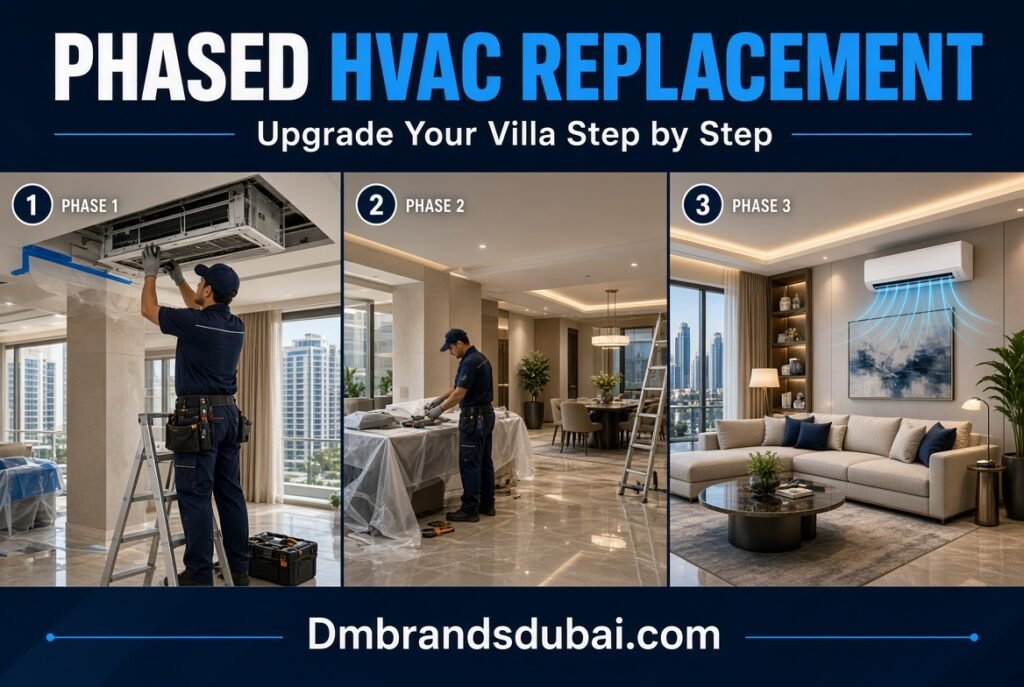
Replacing everything at once is not always necessary or affordable. A phased plan can spread the cost and reduce disruption.
Start With the Worst Performers
Replace the oldest, least efficient or most failure-prone units first. Units that run the longest hours, such as living areas and master bedrooms, often deliver the biggest savings.
Plan Around the Seasons
Schedule phases in the cooler months where possible. Finish the most critical rooms before summer, and keep the remaining work for the next winter.
Keep Equipment Compatible
When phasing, choose a consistent brand and technology where practical. This simplifies servicing, spare parts and control systems.
Keep a Master Record
Keep a record of each unit’s age, model, refrigerant and service history. It helps you plan the next phase and gives your technician a clear view of the whole property.
Reduce Your Cooling Load Before You Replace
A smaller cooling load means a smaller, cheaper system and lower running costs. Some simple changes can reduce the load before sizing is finalised.
Shading and Window Treatments
Blinds, curtains, external shading and solar control film reduce heat gain through glass. West and south-west facing windows make the biggest difference in Dubai.
Insulation and Air Sealing
Better insulation in roofs and walls and sealed gaps around doors and windows reduce the cooling needed. Air leaks bring in hot, humid air that the system must treat.
Efficient Lighting and Appliances
Lights and appliances give off heat. Switching to efficient lighting reduces the load in a small but real way.
Tell Your Installer What You Changed
If you improve shading or insulation, share it before the survey. The load assessment should reflect the home as it will be, not as it was.
Where to Put the Outdoor Unit
Outdoor unit placement affects performance, noise and the life of the equipment. A poor location causes problems that no amount of servicing can fix.
Airflow and Clearance
Outdoor units need clear space on all sides so air can flow freely. Keep at least half a metre clear and avoid enclosed spaces where hot air recirculates.
Shade and Heat
A unit in direct afternoon sun works harder. Shade that does not block airflow helps performance and extends life.
Noise and Neighbours
Place units away from bedrooms and neighbours’ windows where possible. Anti-vibration mounts reduce noise and protect fixings.
Access for Servicing
Technicians must be able to reach the unit safely. Units on awkward roofs or behind locked areas make servicing harder and more expensive.
Corrosion Protection Near the Coast
Homes near the sea face salt in the air. Ask about protective coatings and plan regular cleaning and checks to slow corrosion.
Managing Humidity and Comfort After Replacement
Comfort is more than temperature. A system that cools but leaves the air damp feels wrong and encourages mould.
Why Correct Sizing Controls Humidity
A correctly sized system runs long enough to remove moisture from the air. An oversized one cools quickly and stops before humidity has dropped.
Fan Speed and Settings
Lower fan speeds remove more moisture, while very high speeds can reduce dehumidification. Your installer can advise on the best settings.
Ventilation and Moisture Sources
Bathrooms, kitchens and drying clothes indoors add moisture. Good ventilation and extraction help the system keep humidity under control.
First-Week Checks After Your New System Is Installed
The first week reveals most installation problems. A short routine helps you catch issues early.
Check Cooling Performance
Run the system and confirm each room reaches the set temperature. Note any room that lags behind.
Listen for Noise
New systems should run quietly. Rattles, vibration, hissing or gurgling should be reported.
Look for Leaks and Condensation
Check indoor units, drain outlets and pipework for drips or damp patches. A small drain issue is easy to fix early and costly if ignored.
Test Controls
Try every mode, timer and remote function. Make sure the thermostat reads accurately and responds properly.
Report Issues Straight Away
If anything seems wrong, contact the installer immediately. Issues reported during the warranty period should be fixed without argument.
HVAC System Replacement for New Builds and Renovations
Replacing a system in an existing home differs from designing one for a new build or renovation. The principles are similar, but the opportunities are greater.
Design From the Start
In a renovation, ducts, drains and electrical routes can be planned before walls and ceilings are closed. That reduces cost and avoids awkward routes later.
Coordinate With Other Trades
Plumbing, electrical, painting and ceiling work all interact with HVAC. Coordinating them avoids rework and delays.
Plan for Future Servicing
Leave proper access to units, filters and drains. A beautiful ceiling that blocks access to the air handler becomes a problem the first time it needs servicing.
DM Brands Dubai provides plumbing, electrical, painting and handyman work alongside AC installation, so one team can coordinate the whole project.
Also Read:
- Residential AC Repair in Dubai: Same-Day Fixes, Real Costs and Expert Help 2026
- Cheapest HVAC Repair Near Me in Dubai: Affordable Fixes, Real Prices and Smart Savings 2026
- Heating & Air Conditioning Service Near Me: How to Find a Fast, Reliable Local HVAC Team 2026
- Same Day Air Conditioning Service in Dubai: Fast AC Repair & Maintenance by DMBrandsDubai 2026
- Air Conditioner Maintenance Tips for Dubai 2026
- Trane AC Repair Near Me: Common Problems and How to Find a Trusted Technician in 2026
- Local Air Conditioning Service in Dubai: Fast AC Repair and Maintenance 2026
Frequently Asked Questions (FAQs)
What is HVAC system replacement?
HVAC system replacement is the removal of an old or failing cooling system and the installation of a new, correctly sized one. In Dubai it usually means air conditioning equipment such as split, ducted, packaged or VRF systems.
How much does HVAC system replacement cost in Dubai?
A single split unit often costs from AED 1,500 to AED 6,000, while whole-villa and ducted systems cost much more. These are general market ranges, and you receive a written quote after a survey.
How do I know if I need a new HVAC system?
Common signs are age above ten to fifteen years, repeated repairs, rising DEWA bills, uneven cooling, high humidity and a failed major part such as the compressor. A technician can confirm after an inspection.
Should I repair or replace my HVAC system?
Repair suits young systems with a single inexpensive fault. Replacement suits old systems with frequent or major faults, outdated refrigerant or high running costs.
What is the fifty percent rule?
It is a rule of thumb. If a repair costs half or more of a new system and the system is already old, replacement is usually better value.
How long does an HVAC system last?
A well-maintained system often lasts a decade or more. Dubai’s heat, dust and long running hours can shorten that if servicing is neglected.
How long does HVAC system replacement take?
A single split takes half a day to a day. Whole-villa and ducted systems usually take several days, and VRF projects can take a week or more.
Do I need a survey before replacement?
Yes. A survey and cooling load assessment decide the correct size and options. Be cautious of any price given without visiting the property.
What size HVAC system do I need?
It depends on room sizes, glazing, orientation, insulation, ceiling height and occupancy, not floor area alone. A proper cooling load assessment gives the answer.
Is an inverter system worth it in Dubai?
Often yes. Inverters use less power and are quieter, and long running hours in Dubai make the efficiency gain valuable. Ask for the running cost difference between options.
What is the best time to replace an HVAC system in Dubai?
October to April is best, with cooler weather and quieter schedules. Summer replacement is possible but demand is higher and waits are longer.
Can I replace only the outdoor unit?
Sometimes, if the indoor unit is healthy and compatible in refrigerant, capacity and controls. A technician must confirm compatibility first.
Do I need to replace the ductwork too?
Not always. Ducts should be inspected, and they can often be cleaned or repaired. Badly damaged or undersized ducts may need replacement.
Does the quote include removal of the old system?
It should, but confirm it in writing. Removal, refrigerant recovery and disposal are part of a professional replacement.
What refrigerant will my new system use?
Most new systems use R32 or R410A. Older R22 systems are being phased out.
Will a new system lower my DEWA bill?
Often yes, especially when replacing an old, inefficient system. The size of the saving depends on the old and new systems and how you use the home.
Do I need building approval to replace my AC?
Often yes in apartment towers and some communities. Check with building management about notice, permits, lift bookings and outdoor unit rules before the work.
Who pays for HVAC replacement in a rented property?
It depends on your tenancy agreement. Major equipment usually belongs to the landlord, so get written approval and share the diagnosis and quote.
Does a new system come with a warranty?
Yes. Equipment is covered by the manufacturer, and installation work should be covered by the installer. DM Brands Dubai warrants its work in writing.
Do I need servicing after replacement?
Yes. Regular servicing keeps the system efficient and protects your warranty. Most Dubai homes do well with two visits a year.
Can you help if my AC fails in summer?
Yes. Our emergency call-out is available without a contract, and we aim for same or next-day visits subject to demand. We also tell you honestly whether repair or replacement is the better option.
Does DM Brands Dubai quote before starting work?
Yes. You receive a written price before work begins. Where a fault needs diagnosing first, the visit is charged and the repair is quoted separately once we know what is wrong.
Conclusion
HVAC system replacement is a major decision, and the right answer depends on age, condition, efficiency, refrigerant and correct sizing. A proper survey, an itemised written quote and an honest comparison with repair put you in control.
DM Brands Dubai offers directly employed technicians, licensed and insured work, written prices before work starts, warranted installations and honest advice on repair versus replacement. We also care for the system afterwards, so your investment keeps performing.
If your system is ageing, failing or costing too much to run, send us the details and we will come back with a written price, with no call-out charge to quote.
Get a Free Quote or call +92 308 862 4813. You can also message us on WhatsApp and our call centre answers 24 hours.