The first quote arrives, and the number at the bottom reads $14,200. A neighbor two streets over paid $6,300 for what sounds like the same job. Neither contractor is lying.
That gap is the strange truth about central air replacement cost. The price of a new system is not one number. It is a stack of choices about size, efficiency, ductwork, refrigerant, labor and timing, and each one can move the total by thousands of dollars.
Most homeowners meet that stack at the worst possible moment. The old unit has died in July, the house is climbing past 85°F, and a technician is standing in the driveway waiting for an answer.
You can avoid that scramble. Once you know what each line of a quote means, you can tell a fair price from an inflated one, spot the upsells that do nothing, and decide whether to repair, replace or upgrade.
Table of Contents
How Much Does Central Air Replacement Cost?
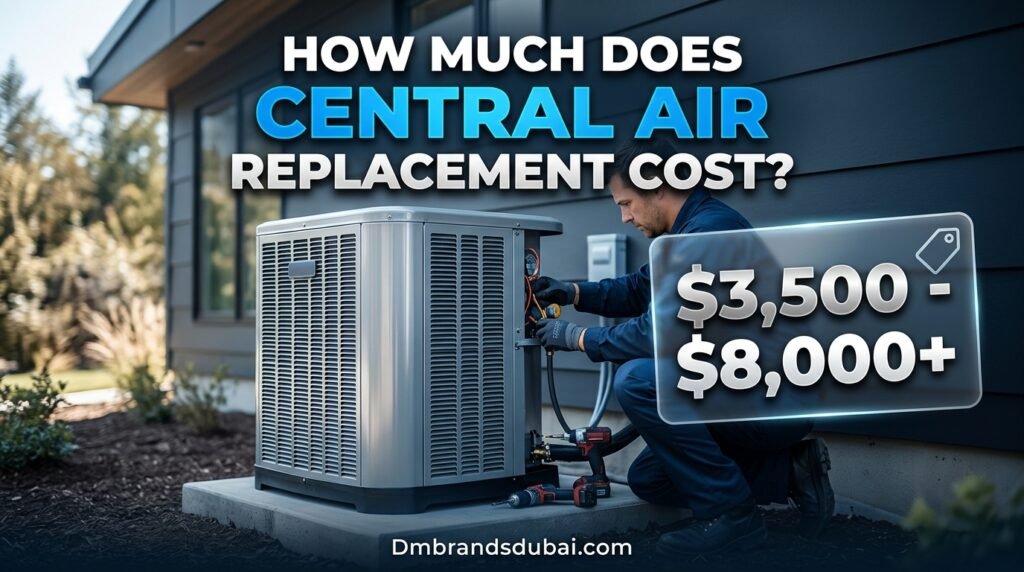
Most U.S. homeowners pay between $4,000 and $12,000 to replace a central air conditioner in 2026. The national average sits around $6,000 to $8,000 for a standard installation.
Costs climb well past $15,000 when you add new ductwork, a variable-speed system or a matching furnace. They fall near $3,000 only for small homes with simple, like-for-like swaps.
Central Air Replacement Cost at a Glance
| Replacement Scenario | Typical Installed Cost |
|---|---|
| AC condenser and coil only (like-for-like) | $3,500 – $8,000 |
| Standard central AC replacement (2–4 ton) | $4,000 – $9,000 |
| Central AC with new air handler | $5,500 – $11,000 |
| AC and furnace replacement together | $5,000 – $12,500 |
| High-efficiency or variable-speed system | $8,000 – $15,000 |
| Full system with new ductwork | $7,000 – $20,000 |
Why Published Prices Don’t Match
Open five cost guides and you will see five different averages. Angi reports a central air system at roughly $3,900 to $7,900. Forbes Home puts the average near $5,900, with most jobs between $3,600 and $8,200.
Bob Vila, citing Angi and HomeAdvisor, lists a $5,860 national average. HomeGuide shows a wider spread of $2,500 to $7,500 for the central AC itself.
The differences come from what each guide counts. Some price only the outdoor condenser and indoor coil. Others include the air handler, ductwork fixes, permits and disposal.
When you compare any quote, compare the scope first and the total second.
Average Central Air Replacement Cost in 2026
The honest national picture is a range, not a point. Equipment alone often runs $2,500 to $6,000, and labor adds roughly $1,500 to $3,500 on top.
Together, that puts the typical installed price of a standard system between $4,500 and $10,000. Where you land inside that range depends on a handful of factors covered below.
What the Major Cost Guides Report
| Source | Reported Range or Average | What It Generally Covers |
|---|---|---|
| Angi | $3,900 – $7,900 for a central air system | Equipment and typical installation |
| Forbes Home | Average about $5,900; range $3,600 – $8,200 | Central AC unit installed |
| Bob Vila | Average $5,860; range $3,882 – $7,903 | Central AC installation |
| HomeGuide | $2,500 – $7,500 for central AC | Central AC replacement |
| HomeGuide (AC and furnace) | $5,000 – $11,000 | Full replacement of both units |
| Angi (whole HVAC) | Average about $7,500 | Complete heating and cooling replacement |
Treat these as reference points rather than promises. They are national averages, and your local labor market, home layout and equipment choice will shift the final figure.
Average Cost by Price Tier
Think of central air as three broad tiers. Each tier trades upfront cost against comfort, noise and long-term energy use.
| Tier | Typical Installed Cost | What You Get |
|---|---|---|
| Budget | $3,500 – $6,000 | Single-stage unit at or near minimum SEER2, basic install |
| Mid-range | $6,000 – $9,500 | Two-stage unit, SEER2 15–18, better warranty and filtration |
| Premium | $9,500 – $15,000+ | Variable-speed unit, SEER2 18–22, smart controls, quieter operation |
Most homeowners in moderate climates do well in the budget-to-mid-range zone. Hot, humid regions often justify a step up because the system runs for more hours each year.
Why 2026 Prices Look Higher Than a Few Years Ago
Three shifts pushed prices up over the last few years. New efficiency rules raised the minimum SEER2 rating for every new system.
The refrigerant industry moved from R-410A to newer A2L refrigerants such as R-454B and R-32. That change required redesigned equipment and, in many cases, added leak-detection hardware.
Labor and material costs also rose across the home-services trades. Even a plain like-for-like swap now costs more than the same job did in the early 2020s.
Central Air Replacement Cost Breakdown: Where the Money Goes
A quote is easier to judge when you can see its pieces. Every legitimate proposal should itemize them, even if the contractor shows a single bundled price.
Here is how a typical $7,500 replacement divides up.
Equipment Cost
The outdoor condenser and indoor evaporator coil are the core of any central air system. Equipment usually accounts for 40 to 55 percent of the total bill.
Angi lists the average HVAC unit at about $4,750 when both heating and cooling equipment are included. For an AC-only job, expect $2,000 to $6,000 depending on tonnage, brand and efficiency.
If your furnace or air handler is also swapped, equipment costs rise accordingly. Matched systems perform better than mismatched ones, so partial swaps are not always the bargain they seem.
Labor and Installation Cost
Labor is the second-largest line. Angi puts average installation labor near $1,500, though complex jobs commonly reach $3,000 to $6,000.
A standard replacement needs one to two technicians for roughly one to two days. Attic air handlers, tight crawl spaces and rooftop units take longer and cost more.
Labor includes removing the old system, setting the new condenser, connecting refrigerant lines, wiring, charging the system and testing airflow.
Permits and Inspections
Many cities and counties require a mechanical permit for any central air replacement. Permit fees often run $100 to $600, with some jurisdictions charging more.
Angi’s planning figures place a typical HVAC permit around $250 to $400. A permit also triggers an inspection, which protects you if the work is ever questioned.
Skipping the permit may lower the quote, but it can cause trouble when you sell the home or file an insurance claim.
Refrigerant Lines, Pads and Electrical Work
The line set carries refrigerant between the indoor and outdoor units. Replacing it commonly adds $400 to $1,200, and long or insulated runs can cost more.
A new composite pad for the condenser usually adds $100 to $300. A new disconnect, whip or breaker can add $150 to $600 if the old electrical connection does not meet code.
These small items add up fast, so ask which ones are already included.
Disposal and Removal
Old equipment must be hauled away and its refrigerant recovered by a certified technician. Junk removal typically costs about $225 according to Forbes Home, though many contractors fold it into the labor line.
Federal rules prohibit venting refrigerant into the air. A contractor who offers to skip recovery to save money is a red flag.
Thermostat and Controls
A basic programmable thermostat costs $50 to $150 installed. A smart thermostat runs $200 to $500 with installation, and variable-speed systems often need a compatible control to work properly.
Ask whether the quote includes a thermostat and whether it supports the features of the equipment you are buying.
Cost Breakdown Summary Table
| Cost Component | Typical Range | Share of Total |
|---|---|---|
| Condenser and evaporator coil | $2,500 – $6,000 | 40–55% |
| Labor and installation | $1,500 – $3,500 | 20–30% |
| Refrigerant, line set and materials | $400 – $1,500 | 5–12% |
| Permit and inspection | $100 – $600 | 1–5% |
| Thermostat and controls | $50 – $500 | 1–5% |
| Disposal and refrigerant recovery | $0 – $300 | 0–3% |
| Ductwork repair or sealing (if needed) | $200 – $3,500 | Varies |
Central Air Replacement Cost by Size (Tonnage)
Tonnage is the single biggest driver of equipment price. One ton equals 12,000 BTU of cooling capacity per hour, and bigger homes need bigger systems.
Bigger is not always better, though. An oversized unit cools the air too fast, shuts off early and leaves the house clammy.
Installed Cost by Tonnage
| System Size | Typical Home Size* | Typical Installed Cost** |
|---|---|---|
| 1.5 ton | 600 – 900 sq ft | $2,500 – $5,000 |
| 2 ton | 900 – 1,400 sq ft | $2,800 – $6,000 |
| 2.5 ton | 1,300 – 1,700 sq ft | $3,500 – $7,500 |
| 3 ton | 1,500 – 1,900 sq ft | $4,500 – $9,000 |
| 3.5 ton | 1,800 – 2,200 sq ft | $5,000 – $10,500 |
| 4 ton | 2,000 – 2,400 sq ft | $5,500 – $12,000 |
| 5 ton | 2,400+ sq ft | $7,000 – $15,000 |
*Home size varies with climate, insulation, windows and ceiling height. **Planning ranges built from overlapping published guides. Tonnage-specific figures differ between sources, so treat them as ballpark numbers.
Contractor guides often quote $1,200 to $4,000 per installed ton, with roughly $2,200 per ton as a midpoint. That per-ton figure is a quick sanity check, not a substitute for a written quote.
2-Ton Central Air Replacement Cost
A 2-ton system suits small homes, condos and well-insulated ranch houses. Most installations land between $2,800 and $6,000.
This is the cheapest tier for equipment and labor. Smaller crews and lighter units keep installation time short.
3-Ton Central Air Replacement Cost
The 3-ton unit is the workhorse of American housing. It cools many 1,500 to 1,900 square foot homes in moderate climates.
Expect $4,500 to $9,000 installed. Some pricing guides report a ceiling closer to $10,500 when high-efficiency models or added ductwork are involved.
4-Ton Central Air Replacement Cost
Four tons fit larger two-story homes and houses with big windows or tall ceilings. Installed prices typically run $5,500 to $12,000.
Two-stage and variable-speed models are common at this size because the system runs long hours. They manage humidity better and cost more upfront.
5-Ton Central Air Replacement Cost
Five-ton systems serve large homes, often above 2,400 square feet or in hot, humid climates. Installed cost commonly ranges from $7,000 to $15,000.
Many homes this large use two separate systems instead of one big unit. Two zones can be more efficient and comfortable, though total cost rises.
Why Right-Sizing Matters More Than Tonnage
Replacing a 3-ton unit with another 3-ton unit simply because that is what was there is a common mistake. Homes change after insulation upgrades, new windows and added rooms.
A proper Manual J load calculation measures how much cooling your home actually needs. Ask every contractor whether they will perform one, and be cautious of anyone who sizes by square footage alone.
Central Air Replacement Cost by Square Footage
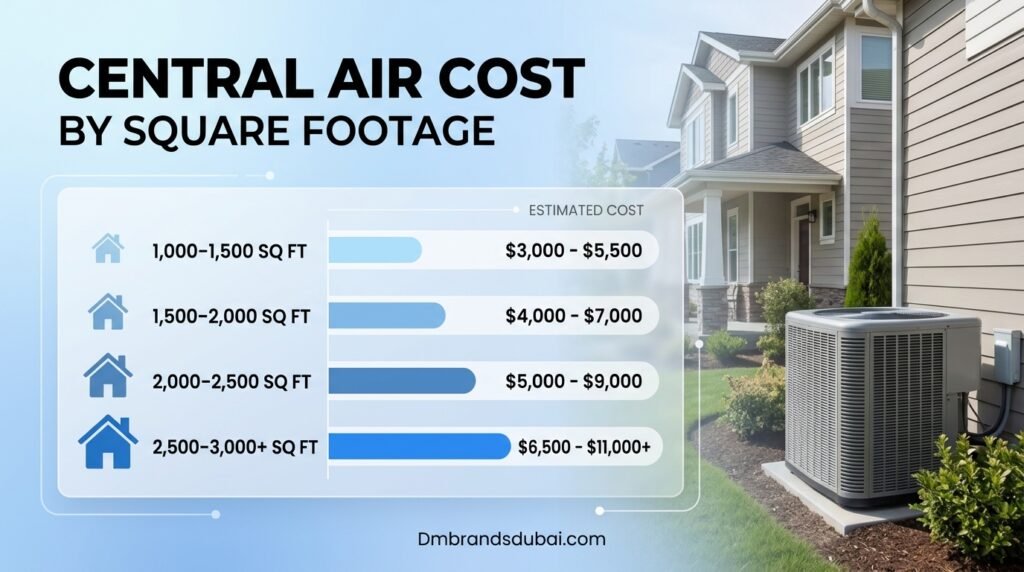
Homeowners often search by house size because it is the one number they know. Square footage gives a useful first estimate, even though it cannot replace a load calculation.
| Home Size | Recommended System | Estimated Installed Cost |
|---|---|---|
| 1,000 sq ft | 2 ton | $3,000 – $6,500 |
| 1,200 sq ft | 2 – 2.5 ton | $3,500 – $7,500 |
| 1,500 sq ft | 2.5 – 3 ton | $4,500 – $9,000 |
| 1,800 sq ft | 3 – 3.5 ton | $5,000 – $10,000 |
| 2,000 sq ft | 3.5 – 4 ton | $5,500 – $11,500 |
| 2,500 sq ft | 4 – 5 ton | $7,000 – $14,000 |
| 3,000+ sq ft | 5 ton or dual systems | $9,000 – $18,000+ |
Cost per Square Foot
Dividing the totals above gives roughly $3 to $7 per square foot for most replacements. Smaller homes sit toward the higher end of that scale because fixed costs like permits and labor spread across fewer square feet.
Forbes Home notes that each additional 500 square feet of living space can add about $1,000 to the replacement price. That rule of thumb is a decent shortcut when you are comparing homes of different sizes.
What Square Footage Does Not Capture
Two 2,000 square foot houses can need very different systems. A shaded, well-insulated home in Ohio may need three tons, while a sun-baked home in Arizona may need four.
Ceiling height, window area, attic insulation, duct leakage and local climate all affect the load. That is why a good contractor measures the home instead of guessing.
Central Air Conditioner Replacement Cost by SEER2 Rating
SEER2 measures how efficiently an air conditioner uses electricity over a typical cooling season. Higher numbers mean lower operating costs and higher purchase prices.
SEER2 replaced the older SEER rating in 2023 under a stricter test procedure. A unit once labeled 14 SEER is now roughly 13.4 SEER2, and a 16 SEER unit is about 15.2 SEER2.
Federal Minimum SEER2 Standards by Region
The Department of Energy sets different minimums depending on where you live. Contractors cannot legally install a new system below the minimum for your region.
| Region | Minimum SEER2 (Split-System AC) |
|---|---|
| North | 13.4 SEER2 |
| Southeast | 14.3 SEER2 (under 45,000 BTU); 13.8 SEER2 (45,000 BTU and above) |
| Southwest | 14.3 SEER2 (under 45,000 BTU); 13.8 SEER2 (45,000 BTU and above) |
Check your state’s classification before comparing quotes. A system that is legal in Minnesota may not be legal in Texas.
How SEER2 Affects Price
Moving up the efficiency ladder costs money. One pricing guide estimates that stepping from SEER 14 to SEER 18 adds roughly $1,000 to $3,000 for a 3-ton system.
Another rule of thumb puts each SEER step at $300 to $1,000 depending on brand and features. The increments are rarely linear, because higher tiers add compressors, motors and controls.
| Efficiency Level | SEER2 Range | Price Impact |
|---|---|---|
| Standard (minimum) | 13.4 – 15.1 | Baseline |
| High efficiency | 15.2 – 18 | +$800 to $2,500 |
| Premium | 18 – 24 | +$2,000 to $5,000 |
Is a Higher SEER2 Worth It?
The answer depends on how many hours your system runs. In Phoenix, Houston or Miami, a high-efficiency unit can recoup its extra cost faster than in Minneapolis or Boston.
Consider your electricity rate, your cooling season and how long you plan to stay. A system that saves $200 a year takes many years to repay a $2,500 premium.
For most homeowners, a mid-range SEER2 of 15 to 18 offers the best balance. Premium models make more sense in extreme climates or for people who prioritize quiet operation and humidity control.
Central AC Replacement Cost by System Type
“Central air” covers several equipment designs. Each one has its own price band and trade-offs.
Single-Stage Central AC
A single-stage unit runs at full capacity whenever it is on. It is the cheapest option, typically $3,400 to $7,600 installed according to one published guide.
The downside is temperature swings and less humidity control. These units cycle on and off more often, which can mean uneven comfort.
Two-Stage Central AC
Two-stage systems run at a low setting most of the time and switch to high only on the hottest days. Installed prices typically run $4,700 to $9,000.
They are quieter, more efficient and better at removing moisture than single-stage units. Many homeowners consider them the sweet spot.
Variable-Speed (Variable-Capacity) Central AC
Variable-speed systems adjust output in small increments to match the exact cooling load. Costs run $7,800 to $14,000 or more.
They deliver the best comfort, the tightest humidity control and the lowest operating cost. They also have more electronics, so they depend on a skilled installer and a proper commissioning.
Split System vs Packaged Unit
A split system has an outdoor condenser and an indoor coil or air handler. This is the most common design in American homes.
A packaged unit combines everything in one outdoor cabinet, often on a roof or beside the house. Bob Vila lists packaged AC systems at roughly $4,000 to $8,500 and packaged HVAC combinations at $9,200 to $10,800.
AC Only vs AC and Furnace
If your furnace is newer and in good shape, replacing only the AC can cost less up front. HomeGuide puts AC-only replacement at $2,500 to $7,500 versus $5,000 to $11,000 for a furnace-and-AC combination.
Matching a new AC with an old furnace can limit performance, though. Older blower motors may not move air properly across a modern high-efficiency coil.
Heat Pump as a Replacement
A heat pump cools like an air conditioner and also heats in winter. Installed costs commonly run $5,000 to $12,000, and some models work well in cold climates.
For homes with gas heating, a heat pump may not make financial sense. For homes with electric resistance or propane heating, it can lower annual costs substantially.
You can compare the process with a full replacement in our HVAC system replacement guide, which explains costs, signs and steps for whole-system upgrades.
Central Air Replacement Cost by Brand
Brand affects price through equipment quality, warranty terms and dealer networks. Installation quality still matters more than the logo on the cabinet.
Budget Brands
Goodman, Amana-built value lines, Payne and Rheem’s entry models sit at the lower end. One pricing guide places installed Goodman systems around $3,000 to $5,000 for 3 to 5 ton units.
These brands deliver reliable basic cooling. They often have fewer comfort features and shorter labor warranties.
Mid-Tier Brands
Carrier, Trane, Rheem, Ruud, American Standard and York populate the middle of the market. Installed prices commonly fall between $5,000 and $10,000.
You get a broader product line, stronger warranties and better parts availability. Many contractors specialize in one or two of these brands.
Premium Brands
Lennox, Daikin, Carrier Infinity and Trane XV lines lead the premium tier. One guide puts Lennox installs near $5,000 to $9,000 for standard sizes, with variable-speed models costing considerably more.
Premium systems offer quiet operation, advanced controls and tight humidity management. The extra price rarely pays back in energy savings alone.
How to Pick a Brand
Choose the brand your local contractor knows best. A mid-tier unit installed by an expert will outperform a premium unit installed badly.
Compare warranty terms, parts availability and the contractor’s track record. Then compare prices.
Central Air Replacement Cost by Region and State
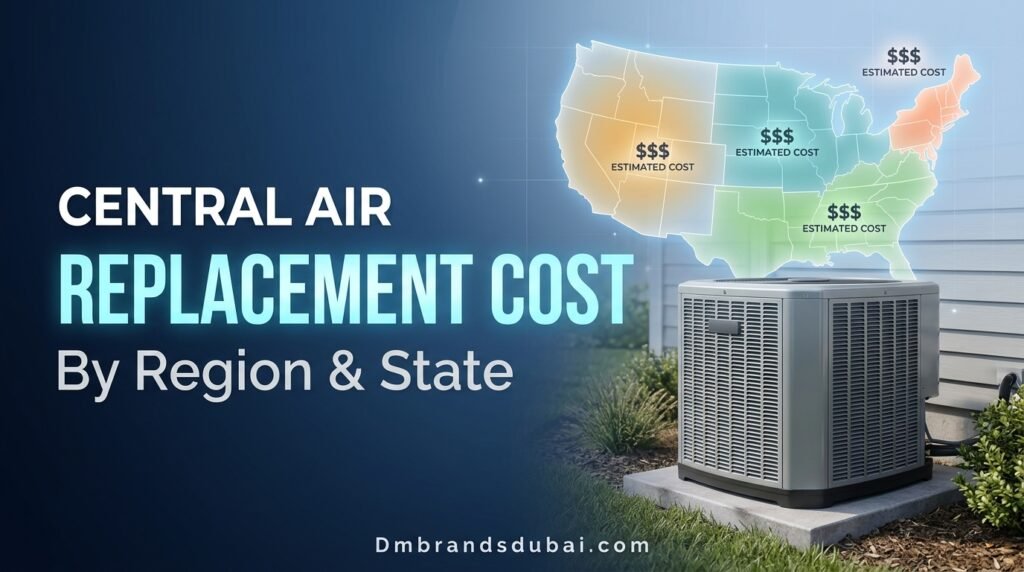
Where you live changes the price in three ways: labor rates, permit costs and climate-driven equipment needs.
Urban markets and coastal metros usually cost more than rural areas and small cities.
Regional Cost Examples
| Metro or Area | Reported Average or Range | Source Type |
|---|---|---|
| Phoenix, AZ | Average $6,892; range $5,091 – $8,837 | Angi city data |
| Los Angeles, CA | Average $7,428; range $4,790 – $10,100 | Angi city data |
| Denver area, CO | $7,500 – $14,500 | Local contractor guidance |
| Indianapolis area, IN | $6,800 – $14,500 | Local contractor guidance |
These figures use different definitions, so they are not perfectly comparable. They show that even within hot markets, prices vary by thousands of dollars.
Why Climate Shapes the Price
In hot, humid states, installers size equipment for longer run times and often recommend two-stage or variable-speed units. In northern states, summers are short and a basic unit can be enough.
Altitude matters too. Denver’s elevation changes how air carries heat, which is why local contractors adjust load calculations for it.
Regional Efficiency and Code Rules
The Southeast and Southwest require higher minimum SEER2 ratings than the North. That alone adds a few hundred dollars to equipment costs in those regions.
Some states and cities add their own rules for refrigerant handling, permits and inspection. Ask your contractor what applies in your county.
Readers comparing replacement costs in an extremely hot climate can see how the same factors play out in our AC replacement and installation service overview.
Central Air Replacement Cost With Ductwork
Ductwork is the biggest wildcard in any central air quote. Good ducts make a system perform. Leaky or undersized ducts waste half of what you paid for.
When Ductwork Needs Work
Ducts older than 20 to 25 years often leak, sag or collapse. Poor sealing can lose 20 to 30 percent of cooled air before it reaches a room.
Warning signs include weak airflow in some rooms, high energy bills, dust around vents and rooms that never reach the set temperature.
Duct Cost Ranges
| Duct Work | Typical Cost |
|---|---|
| Duct inspection or leakage test | $150 – $500 |
| Minor sealing and insulation | $200 – $1,200 |
| Partial duct repair or replacement | $8 – $35 per linear foot |
| Full duct replacement, average home | $2,000 – $8,000 |
| Optional new ductwork (planning figure) | About $3,500 |
HomeGuide reports $7,000 to $16,000 for installing a new HVAC system with ductwork. That is a different job from a simple replacement, because it includes designing and installing the duct system.
Duct Sealing vs Duct Replacement
If your ducts are structurally sound, sealing and insulation often delivers the best return. It improves comfort, lowers bills and costs a fraction of replacement.
Full replacement makes sense when ducts are crushed, moldy, undersized or poorly designed. Our guide to air duct replacement covers signs, materials and the full process.
Cleaning Before You Replace
Clean ducts help a new system work from day one. Dust and debris can restrict airflow and shorten the life of a fresh coil.
Professional duct cleaning removes buildup before it can clog the new equipment.
Cost to Replace Central Air When You Never Had It
Installing central air in a home without ducts is a much bigger project than replacement. Cost estimates run from $7,000 to $20,000 depending on home size and layout.
New Installation vs Replacement
Replacement reuses existing ducts, electrical service and the condenser location. New installation must build all of that from scratch.
Forbes Home notes that replacing a central AC unit costs less than installing central air in a home that never had it, because ductwork is the expensive part.
Alternatives for Homes Without Ducts
Ductless mini-splits avoid the cost of ducts entirely. Bob Vila lists ductless split systems at about $3,800 to $7,700 before labor in some cases, though multi-zone systems cost more.
Small-duct high-velocity systems fit older homes where standard ducts will not fit. They cost more than conventional central air but less than major renovation.
Cost to Replace an AC and Furnace Together
Many homeowners replace both units at once when the system is aging. Doing so can save on labor and ensure matching equipment.
Combined Replacement Prices
HomeGuide reports $5,000 to $11,000 for a furnace-and-AC replacement, with an average near $8,000 for whole HVAC replacement. Angi’s average is about $7,500.
High-efficiency furnaces and variable-speed air handlers push the total above $12,000. Add new ductwork and the figure can reach $16,000 to $22,000.
Benefits of Replacing Both
A matched system performs as designed. The furnace blower, coil and condenser work together instead of fighting each other.
You also pay for one mobilization, one permit and one inspection. Many contractors offer package pricing.
When to Replace Only the AC
If your furnace is under 10 years old and running well, replacing only the AC is usually smarter. Make sure the contractor confirms the blower and coil are compatible with the new condenser.
Partial Replacement Costs: Coil, Compressor and Condenser
Sometimes only one major part has failed. Replacing it can postpone a full replacement, though it is not always the best use of money.
Evaporator Coil Replacement
The evaporator coil sits indoors and absorbs heat from the air. Replacement typically costs $600 to $2,000, with about $1,500 as a commonly cited average.
Coils often fail from corrosion or refrigerant leaks. Regular coil cleaning reduces the risk by keeping surfaces free of dust and film.
Condenser Coil Replacement
The outdoor condenser coil releases heat. Replacement costs are similar to evaporator coils, often $1,000 to $2,500 with labor.
On older units, condenser coil failure usually signals that other parts are close behind.
Compressor Replacement
The compressor pumps refrigerant through the system. Forbes Home notes that compressor work can take up to six hours and add around $1,100 to a repair bill, though full compressor replacement often costs $1,500 to $2,800 with parts and labor.
For a compressor on a unit older than ten years, replacement of the whole system is usually wiser. You can read more about this decision in our guide to home AC compressor replacement cost.
Expansion Valve and Other Parts
Expansion valves cost around $500 to replace, according to Angi data cited by House Digest. Capacitors, contactors and fan motors run $150 to $800.
These small repairs are normal maintenance. Large or repeated failures are the sign to start pricing a new system.
How the R-410A Refrigerant Phase-Out Affects Replacement Cost
Refrigerant is no longer a background detail. The industry has moved away from R-410A, and the change affects what you pay and what gets installed.
What Changed
Under the AIM Act, new residential air conditioners and heat pumps manufactured after January 1, 2025 must use lower-impact refrigerants. The two main replacements are R-454B and R-32.
Both are classified as A2L, meaning mildly flammable. They have a much lower global warming potential than R-410A.
Why It Raises the Price
A2L systems need redesigned components and, in many designs, leak-detection sensors in the air handler. Technicians also need training and new tools for safe handling.
Manufacturers passed some of that development cost to buyers. Early A2L equipment carried a visible premium, and pricing continues to settle.
What It Means for Your Existing System
Your current R-410A system can keep running and can still be serviced. Supplies of R-410A will tighten over time, which may raise repair costs for older units.
If you are close to replacing anyway, switching to an A2L system now avoids being locked into a refrigerant that is being phased down.
Questions to Ask Your Contractor
- Which refrigerant does the proposed system use?
- Does the air handler include a leak sensor?
- Are your technicians trained for A2L handling?
- Is the refrigerant charge included in the quoted price?
Hidden Costs and Add-Ons That Change Your Final Bill
The line items you did not plan for are the ones that blow budgets. Knowing them in advance lets you decide which are worth paying for.
Common Add-Ons
| Add-On | Typical Cost | Worth It? |
|---|---|---|
| Smart thermostat | $200 – $500 | Yes, if the system supports advanced features |
| Media air filter | $300 – $900 | Good for allergies and dusty areas |
| UV air purifier | $400 – $1,200 | Optional; benefits vary |
| Whole-home dehumidifier | $1,200 – $3,000 | Valuable in humid climates |
| Zoning system | $1,500 – $4,000 | Helpful in multi-story homes |
| Surge protector | $150 – $400 | Cheap insurance for electronics |
| Return air upgrade | $600 – $2,000 | Often fixes poor airflow |
| Condensate safety switch | $50 – $200 | Strongly recommended |
| Extended labor warranty | $300 – $1,200 | Worth it if the contractor is reputable |
Electrical Upgrades
Older homes sometimes lack an adequate circuit for modern equipment. A panel upgrade can cost $1,500 to $4,000 and is a common surprise on big jobs.
Ask your contractor to inspect the panel during the estimate. It is far better to know the number before work starts.
Structural and Access Costs
Attic air handlers, rooftop units, crawl spaces and tight closets increase labor. Cranes or special rigging for rooftop equipment can add $500 to $2,000.
If the contractor needs to modify framing, platforms or drain lines, those costs should appear on the quote.
Drain and Condensate Work
Water has to go somewhere. A clogged or poorly pitched condensate line can cause ceiling damage, mold and system shutdowns.
A float switch and a clear drain path add little to the quote but prevent costly water damage.
Repair or Replace? How to Decide

The right choice depends on age, repair cost, efficiency and how often the system has broken. A single large repair on a young unit is very different from constant repairs on an old one.
The $5,000 Rule
Multiply the age of the unit by the repair cost. If the result exceeds $5,000, replacement is usually the better choice.
A 12-year-old unit needing a $500 repair scores $6,000, which points to replacement. A 5-year-old unit needing the same repair scores $2,500, so repair makes sense.
The 30 to 50 Percent Rule
Many contractors suggest replacing when a repair costs more than 30 to 50 percent of a new system. A $3,000 compressor job on a unit that would cost $7,000 to replace falls right in that zone.
Regional guides often cite 30 percent as a threshold. If your repair crosses it and the unit is over ten years old, get a replacement quote before committing.
Typical Repair Costs for Comparison
| Repair | Typical Cost |
|---|---|
| Service call or diagnostic | $75 – $200 |
| Capacitor or contactor | $150 – $450 |
| Refrigerant recharge (with leak repair) | $200 – $1,500+ |
| Fan motor | $350 – $900 |
| Evaporator coil | $600 – $2,000 |
| Compressor | $1,500 – $2,800 |
Forbes Home reports that the average central air repair falls between $125 and $600, with a typical $400 repair plus about $150 for the service call. Understanding these baselines helps you judge whether a repair bill is reasonable.
If repairs are mounting, a professional AC service and repair assessment can help you compare fixing and replacing without pressure.
Efficiency and Energy Bills
Older systems lose efficiency each year. A 15-year-old unit may be using noticeably more electricity than a modern model, even if it still cools.
When your bills climb without a change in usage, the system is telling you something. A replacement can reduce cooling costs and improve comfort at the same time.
Signs You Need Central Air Replacement
Systems rarely fail without warning. These signals show up months or years before a complete breakdown.
Age of the System
ENERGY STAR suggests considering replacement when an air conditioner is more than about 10 years old, especially if repairs are frequent and bills are rising. Many systems last 12 to 17 years with good maintenance.
Climate matters. Units in hot, dusty or coastal environments age faster than those in mild regions.
Performance Warning Signs
- Weak airflow or rooms that never get cool
- Short cycling, where the unit turns on and off rapidly
- Ice on the refrigerant lines or indoor coil
- Strange noises such as grinding, squealing or banging
- Persistent humidity even when the AC is running
- Water leaks near the indoor unit
Financial Warning Signs
If you have paid for two or more repairs in the last two years, replacement may already be cheaper than staying the course. Rising electric bills with no change in habits point to the same conclusion.
An R-410A system with a major refrigerant leak is also a strong candidate for replacement, because recharging an old system is increasingly expensive.
Comfort and Air Quality Signs
Uneven temperatures, dust buildup, musty smells and humidity problems all suggest the system or ducts are no longer doing their job. Sometimes the cause is ductwork rather than equipment, which is why a full inspection matters.
How Long Does a Central Air Conditioner Last?
Most central air systems last 12 to 17 years. Some reach 20 with careful maintenance, and others fail before 10 in harsh conditions.
Installation quality, maintenance habits and climate influence lifespan more than the brand name.
Factors That Shorten Lifespan
- Skipped annual maintenance
- Undersized or oversized equipment
- Poor installation and incorrect refrigerant charge
- Dirty coils and clogged filters
- Coastal salt air and extreme heat
- Frequent short cycling
How to Extend System Life
Change filters on schedule, keep the outdoor unit clear of debris and book a tune-up each year. Angi reports that a typical AC tune-up costs $70 to $150, which is small compared with the cost of an early replacement.
An annual maintenance contract bundles scheduled servicing and priority response, which removes the guesswork from upkeep.
Tax Credits, Rebates and Financing in 2026
Incentives can shave real money off a replacement, but the rules changed recently. Knowing what has expired saves you from relying on outdated advice.
The Federal 25C Credit Has Ended
The Energy Efficient Home Improvement Credit under Section 25C offered up to $600 for qualifying central air conditioners. Congress ended it for equipment placed in service after December 31, 2025.
If your system was installed in 2025, you can still claim the credit on that year’s return using IRS Form 5695. For installations in 2026, no federal tax credit applies to central air conditioners.
Be skeptical of any contractor page or ad that still advertises a $600 federal credit for new 2026 installs. Verify any claim on the IRS website.
Utility Rebates
Many electric utilities offer rebates for qualifying high-efficiency equipment or tune-ups. Indiana utilities, for example, commonly advertise $100 to $600.
Rebates vary by company and change often. Check your utility’s website or ask your contractor to confirm what is currently available.
State and Local Programs
Some states run home energy rebate programs, weatherization assistance and low-interest efficiency loans. Availability, income limits and funding levels differ widely.
Your state energy office is the best starting point for current information.
Manufacturer Promotions
Manufacturers and distributors run seasonal promotions, often in spring and fall. These may include cash-back offers, extended warranties or promotional financing.
Read the fine print. Some promotions require using a specific dealer or financing product.
Financing Options
| Option | Typical Use | Watch Out For |
|---|---|---|
| Contractor financing | Quick approval at signing | Deferred-interest traps and high APRs |
| Personal loan | Fixed payments, no collateral | Rates depend on credit |
| Home equity loan or HELOC | Lower rates for large projects | Your home is collateral |
| Credit card | Small balances or rewards | High interest if unpaid |
| PACE or property-assessed programs | Available in some regions | Liens and resale issues |
Compare the total cost of financing, not just the monthly payment. A cheaper-looking monthly number can hide thousands in interest.
How to Save Money on Central Air Replacement
Smart choices can trim hundreds or even thousands from the bill without cutting quality. The biggest wins come from timing, sizing and scope.
Get Three Written Estimates
Collect at least three itemized quotes. Compare equipment model numbers, SEER2 ratings, warranty terms and scope of work.
A quote that is thousands lower may leave out permits, disposal or electrical work. A quote that is thousands higher may reflect unnecessary extras.
Schedule in the Shoulder Season
Spring and fall are slower for HVAC contractors. Some guides estimate savings of 5 to 15 percent compared with emergency installs in peak summer.
You also get more scheduling flexibility and more time to compare bids.
Right-Size the System
Insist on a load calculation. A correctly sized unit avoids paying for capacity you do not need and keeps energy bills lower.
Dropping from a 4-ton to a 3-ton system, when the load supports it, can save $1,200 to $3,500 in equipment cost.
Choose Mid-Tier Efficiency
Premium SEER2 ratings cost more than most homeowners recoup in energy savings. Stepping from minimum to a mid-range rating often captures most of the benefit at a fraction of the cost.
Bundle Related Work
Combine replacement with duct sealing, thermostat upgrades or insulation improvements. Contractors sometimes discount bundled jobs because they reduce mobilization costs.
Maintain the New System
Register the warranty, schedule annual service and keep records. Many manufacturers require proof of maintenance to honor long warranties.
Avoid Unnecessary Upsells
Not every add-on pays off. Ask what problem each extra solves, and decline items that do not address a real need in your home.
How to Get an Accurate Central Air Replacement Quote
A reliable quote starts with a reliable visit. Phone estimates and online calculators give ballparks, but only an in-home assessment produces a price you can trust.
What a Good Estimate Includes
- A measured load calculation (Manual J) or a clear explanation of how the system was sized
- Equipment brand, model numbers, tonnage and SEER2 rating
- Refrigerant type and charge
- Itemized labor, materials, permits and disposal
- Duct inspection and any recommended repairs
- Warranty terms for parts and labor, in writing
- Start date, expected duration and payment schedule
How to Compare Quotes Fairly
Line up the three quotes side by side in a simple table. Match equipment tier, efficiency, scope and warranty before you look at price.
| Item to Compare | Quote A | Quote B | Quote C |
|---|---|---|---|
| Brand and model | |||
| Tonnage and SEER2 | |||
| Load calculation done? | |||
| Ductwork included? | |||
| Permit included? | |||
| Parts warranty | |||
| Labor warranty | |||
| Total price |
Online Estimators vs On-Site Quotes
Online cost calculators are useful for early budgeting. They cannot see your attic, your ducts or your electrical panel.
A tool like our cost guide and quote calculator shows how an estimate is built from inputs such as unit type and property size. Use any estimator as a starting point, then confirm with a written quote.
Red Flags in Quotes
- A price quoted over the phone without seeing the home
- No mention of a load calculation
- Pressure to sign the same day with a “today only” discount
- A large deposit, such as more than 30 to 50 percent upfront
- Vague line items like “miscellaneous materials”
- No license or insurance information
Central Air Replacement Process and Timeline
Knowing what happens on installation day reduces stress. A standard job follows a predictable sequence.
Step-by-Step Installation
- Assessment and quote. The contractor inspects the home, measures the load and reviews ducts, electrical service and equipment locations.
- Equipment selection and contract. You choose a system and sign a written agreement that lists equipment, scope and price.
- Permit and scheduling. The contractor files the permit and books an installation window.
- Old system removal. Technicians recover refrigerant legally and disconnect and remove the old equipment.
- New equipment setup. The condenser is set on a level pad, the coil or air handler is installed and the line set is connected.
- Electrical and drain connections. Wiring, disconnects, drain lines and safety switches are installed.
- Evacuation and charging. The lines are vacuumed to remove moisture, then the system is charged with the exact amount of refrigerant.
- Commissioning and testing. Technicians test airflow, temperature split, pressures and thermostat operation.
- Cleanup and walkthrough. The crew cleans the site and explains how the system works.
- Inspection and warranty registration. The city inspector approves the job and the contractor registers warranties.
How Long Does Replacement Take?
Most replacements finish in one day. Complex jobs with duct changes, attic access or air handler swaps can stretch into a second day.
Ductwork replacement can take two to four days depending on home size. Ask the contractor for a realistic schedule before you sign.
What You Need to Do
Clear access to the indoor unit, outdoor unit and electrical panel. Move vehicles, furniture and stored items out of the work area.
Arrange for pets to be kept away from the work zone. Plan to be without cooling for several hours.
How to Choose a Central Air Contractor
Installation quality drives performance more than any equipment feature. A great unit installed poorly will still waste energy and fail early.
Credentials to Verify
- State or local HVAC contractor license
- General liability and workers’ compensation insurance
- EPA Section 608 certification for refrigerant handling
- NATE certification or manufacturer training
- Proof of A2L refrigerant training for new systems
Reputation Checks
Read recent reviews on multiple platforms and look for patterns, not single complaints. Ask for local references and, if possible, visit a recent job.
Check how long the company has operated under the same name. Longevity usually reflects stable service and honored warranties.
Questions to Ask Before Hiring
- Will you perform a load calculation and share the results?
- Who will do the installation, employees or subcontractors?
- How long is your labor warranty?
- What happens if the system has a problem in the first year?
- Do you pull permits and schedule inspections?
- Can I see a sample contract?
Directly Employed Technicians vs Subcontractors
Companies that employ their own technicians have more control over quality and accountability. Subcontracted crews can be good, but responsibility becomes harder to trace when something goes wrong.
Our air conditioning specialists guide explains what trained AC professionals do and how to recognize a qualified team.
Warranties and Maintenance After Replacement
A warranty protects your investment, but only if you understand it. Terms vary widely between manufacturers and contractors.
Types of Warranties
| Warranty Type | What It Covers | Typical Length |
|---|---|---|
| Manufacturer parts warranty | Defective components | 5 – 10 years (often requires registration) |
| Compressor warranty | Compressor failure | 10 years to lifetime on some models |
| Contractor labor warranty | Installation work and labor on repairs | 1 – 10 years |
| Extended warranty | Added coverage beyond standard terms | Varies |
Register the equipment within the period the manufacturer requires. Missing the deadline can cut a long warranty in half.
What Voids a Warranty
Improper installation, skipped maintenance and unauthorized repairs can void coverage. Keep every invoice and service record.
Annual Maintenance Checklist
- Replace or clean filters every one to three months
- Rinse the outdoor condenser coil gently
- Check refrigerant charge and pressures
- Inspect electrical connections and capacitors
- Clear the condensate drain line
- Test thermostat accuracy
Professional coil cleaning and a full tune-up keep efficiency high and prevent early failures. For homes with several units, a scheduled plan can lower overall upkeep costs and avoid emergency call-outs.
Our residential AC repair guide shows how routine issues are diagnosed and fixed before they turn into replacement-level problems.
Energy Savings and Payback From a New Central AC
A new air conditioner changes your monthly bill. How much depends on the old unit’s efficiency, your climate and your electric rate.
How Efficiency Translates to Savings
Savings come from the difference between the old and new SEER2 ratings. Moving from a 10 SEER unit to a 16 SEER2 unit can cut cooling electricity use substantially.
The U.S. Department of Energy notes that cooling accounts for a significant share of household energy use in warm regions. That is why efficiency improvements matter most in the South and Southwest.
Simple Payback Illustration
The numbers below are an illustration of the math, not a guarantee. Your local rates and usage will change the result.
| Item | Example Value |
|---|---|
| Annual cooling cost with old system | $1,100 |
| Estimated reduction with efficient new system | 25% |
| Annual savings | $275 |
| Extra cost of high-efficiency option | $2,200 |
| Simple payback on the upgrade | About 8 years |
If the extra efficiency costs $2,200 and saves $275 a year, you recoup the premium in about eight years. In hot climates with expensive electricity, that period shortens.
Other Benefits of Replacement
New systems run quieter, filter air better and control humidity more precisely. Comfort improvements often matter as much as the savings.
Replacing an aging unit can also raise buyer confidence if you plan to sell. Angi notes in its city data that a new AC can increase home value, especially in hot markets.
Central Air Replacement Cost Examples
Real scenarios show how the pieces fit together. These are illustrative planning examples, not quotes.
Example 1: Basic Replacement in a Small Home
A 1,200 square foot home with good ducts and a 2-ton system. The owner chooses a standard-efficiency single-stage unit at the regional minimum SEER2.
| Item | Cost |
|---|---|
| Equipment | $2,400 |
| Labor and materials | $1,800 |
| Permit | $250 |
| Thermostat | $100 |
| Estimated total | $4,550 |
Example 2: Mid-Range Replacement in a Family Home
A 2,000 square foot two-story home with a 3.5-ton two-stage system at SEER2 16, a new line set and minor duct sealing.
| Item | Cost |
|---|---|
| Equipment | $4,200 |
| Labor and materials | $2,400 |
| Line set | $700 |
| Duct sealing | $600 |
| Permit and disposal | $450 |
| Smart thermostat | $300 |
| Estimated total | $8,650 |
Example 3: Premium Replacement With Duct Work
A 2,800 square foot home with a 4-ton variable-speed system, SEER2 20, a new air handler and partial duct replacement.
| Item | Cost |
|---|---|
| Equipment | $7,200 |
| Labor and materials | $3,600 |
| Partial duct replacement | $3,500 |
| Electrical upgrade | $900 |
| Permit and disposal | $600 |
| Zoning and filtration | $1,800 |
| Estimated total | $17,600 |
Central Air vs Other Cooling Options
Central air is not the only way to cool a home. The best option depends on your ducts, your climate and your budget.
Comparison Table
| System | Typical Installed Cost | Best For | Main Drawback |
|---|---|---|---|
| Central air | $4,000 – $12,000 | Homes with good ducts | Duct losses and upfront cost |
| Heat pump (ducted) | $5,000 – $12,000 | Year-round heating and cooling | Higher cost, less ideal in extreme cold |
| Ductless mini-split | $3,800 – $7,700+ per system | Homes without ducts or additions | Multiple indoor units cost more |
| Packaged unit | $4,000 – $8,500 | Homes without indoor space | Outdoor exposure |
| Window unit | $150 – $1,000 | Single rooms and renters | Limited coverage and noise |
When Central Air Wins
If your home already has functioning ducts, central air usually costs less than any alternative that covers the whole house. It also keeps the interior clean, with no wall units to see.
When to Consider Alternatives
Homes without ducts, additions and finished attics often suit ductless systems better. In moderate climates, a heat pump can replace both AC and furnace.
A professional can compare options for your layout. Our local air conditioning service guide explains what to expect from a hands-on assessment.
Common Mistakes to Avoid When Replacing Central Air
Most expensive regrets come from avoidable errors. These are the ones contractors see most often.
Buying Based on Price Alone
The cheapest quote usually leaves something out. It may use minimum equipment, skip the load calculation or leave out permits.
Compare total value, not just the total price.
Oversizing the System
Many homeowners assume bigger is safer. An oversized system short cycles, wears out sooner and fails to remove humidity.
Ignoring the Ducts
A new unit connected to leaky ducts is a half-fix. Always ask for a duct inspection and a plan for any problems.
Skipping the Permit
An unpermitted installation can cause trouble with insurance and with future home sales. It also removes the safety net of an inspection.
Waiting for Total Failure
Emergency replacements cost more and leave less room to compare. Plan ahead when your system is old or struggling.
Forgetting Maintenance
A new system without service can lose efficiency quickly and may violate warranty terms. Book the first tune-up before the warranty year ends.
Central Air Replacement Planning Checklist
Use this list to organize the project from start to finish.
Before You Call Contractors
- Note the age, brand and model of your current system
- Write down comfort problems in each room
- Check your electric bills for the last 12 months
- Measure or confirm your home’s square footage
- Decide your budget range and financing approach
During Estimates
- Ask for a load calculation
- Request itemized, written quotes
- Compare equipment, warranties and scope
- Verify license, insurance and certifications
- Ask about rebates and promotions available now
After You Sign
- Confirm the schedule and permit status
- Register warranties promptly
- Keep copies of the contract and invoices
- Schedule a first-year tune-up
- Replace filters on a regular schedule
Best Time of Year to Replace Central Air
Timing affects both price and availability. Contractors are busiest in the hottest months and quietest in spring and fall.
Spring and Fall
Shoulder seasons offer better scheduling, more negotiating room and often promotional pricing. Some guides estimate savings of 5 to 15 percent compared with peak summer.
Summer
Summer replacements are common but come at a premium. Emergency installs leave little time for comparison shopping.
Winter
In warm regions, winter is a quiet season for AC work. In cold regions, winter replacement is still possible, but manufacturer promotions are less common.
For homeowners comparing seasonal costs in a hot climate, our cheapest HVAC repair guide shows how timing and scope influence price.
Also Read
- HVAC System Replacement in Dubai: Costs, Signs and Process 2026
- Home AC Compressor Replacement Cost in Dubai: Real AED Prices and Smart Savings 2026
- Air Duct Replacement in Dubai: Signs, Costs, Materials and the Full Process 2026
- Air Conditioning Specialists in Dubai: Expert AC Repair, Installation and Maintenance 2026
- Residential AC Repair in Dubai: Same-Day Fixes, Real Costs and Expert Help 2026
- Local Air Conditioning Service in Dubai: Fast AC Repair and Maintenance 2026
- Cheapest HVAC Repair Near Me in Dubai: Affordable Fixes, Real Prices and Smart Savings 2026
Frequently Asked Questions (FAQs)
How much does it cost to replace a central air conditioner?
Most homeowners pay $4,000 to $12,000, with a national average between $6,000 and $8,000. Size, efficiency, ductwork and region decide where your quote lands.
What is the average cost to replace central air in a 2,000 square foot house?
A 2,000 square foot home typically needs a 3.5 to 4 ton system. Installed cost usually runs $5,500 to $11,500 depending on efficiency and duct condition.
How much does a 3-ton central AC replacement cost?
Expect $4,500 to $9,000 installed. High-efficiency models and added ductwork can push the total higher.
How much does a 4-ton central AC replacement cost?
A 4-ton system generally costs $5,500 to $12,000 installed. Two-stage and variable-speed options sit at the upper end.
Is it cheaper to replace just the AC or the whole HVAC system?
Replacing only the AC costs less up front, often $2,500 to $7,500. Replacing both the AC and furnace runs $5,000 to $11,000 or more but gives you a fully matched system.
Does central air replacement include ductwork?
Usually not. Standard quotes cover equipment and installation, while duct repair or replacement is priced separately.
How much does ductwork replacement add to the cost?
Minor sealing costs $200 to $1,200. Full duct replacement can add $2,000 to $8,000 depending on the size of the home.
How long does a central AC replacement take?
Most jobs finish in one day. Complex installations with duct or air handler changes can take two days or longer.
How long does a central air conditioner last?
Most last 12 to 17 years with proper maintenance. Harsh climates and skipped service shorten that range.
When should I replace my central air conditioner?
Consider replacement when the unit is over 10 years old, repairs are frequent or energy bills keep rising. A repair that costs more than 30 to 50 percent of a new system is another strong sign.
What is the $5,000 rule for AC replacement?
Multiply the unit’s age by the repair cost. If the result is above $5,000, replacement usually makes more sense than repair.
Is there a federal tax credit for central air replacement in 2026?
No. The Section 25C credit ended for installations after December 31, 2025. Systems installed in 2025 can still claim up to $600 on that year’s return.
Are there rebates available for a new central AC?
Some utilities, states and manufacturers offer rebates or promotions. Availability changes often, so confirm current offers before you sign.
What SEER2 rating should I choose?
Choose at least the minimum for your region, which is 13.4 in the North and 14.3 in the Southeast and Southwest for most split systems. A mid-range rating of 15 to 18 balances cost and savings for many homes.
What is the difference between SEER and SEER2?
SEER2 uses a stricter test that better reflects real-world conditions. A 14 SEER unit is roughly 13.4 SEER2.
Why is a new AC so expensive in 2026?
Higher efficiency standards, the shift to A2L refrigerants and rising labor and material costs all raised prices. Ductwork and electrical needs can add more.
What refrigerant do new air conditioners use?
New residential systems use lower-impact A2L refrigerants such as R-454B or R-32. R-410A can no longer be used in newly manufactured systems.
Can I replace only the outdoor unit?
Sometimes, but mismatched indoor and outdoor components often reduce efficiency and may void warranties. A matched system is almost always the better choice.
Do I need a permit to replace my central air?
Most jurisdictions require one. A permit usually costs $100 to $600 and triggers an inspection that protects you.
How can I lower the cost of replacing my central AC?
Get three written quotes, replace during spring or fall, right-size the system and choose mid-tier efficiency. Avoid add-ons that do not solve a real problem.
Is it worth paying more for a high-efficiency air conditioner?
It depends on your climate and electric rates. In hot regions with long cooling seasons, the savings can repay the premium sooner.
Should I buy a heat pump instead of a central air conditioner?
A heat pump can be a good choice if you want one system for heating and cooling. It makes the most sense where electricity is affordable or where you would otherwise heat with electric resistance or propane.
How do I know if my AC is the right size?
Ask for a Manual J load calculation. A correct size cools evenly, runs in long cycles and controls humidity.
What should a central AC replacement quote include?
Equipment models, tonnage, SEER2 rating, refrigerant type, labor, permits, disposal, warranty terms and any duct or electrical work. Everything should be listed in writing.
Conclusion:
Central air replacement cost is a puzzle with a lot of moving pieces, but it is a puzzle you can solve. Size, efficiency, ductwork, refrigerant, labor and timing explain almost every difference between quotes.
Start with a realistic budget of $4,000 to $12,000 for most homes. Demand a load calculation, compare three itemized proposals and weigh warranty and installer quality as heavily as price.
Remember that the federal 25C credit has ended for 2026, so rebates now depend on your utility and state. Schedule in spring or fall when you can, and keep the new system healthy with annual service.
If you are in Dubai and want a written, itemized price for a new system, request a free quote for AC replacement and compare it against your own checklist. You can also review the AC replacement and installation service or explore the full advice and guides library before you decide.