Dubai’s sun is beautiful — and relentless. Floor-to-ceiling windows, a signature of Dubai apartments and villas, turn living rooms into greenhouses by midday unless they are dressed properly. The right curtains or blinds do far more than look good: they cut heat, protect furniture from UV fading, give you privacy from neighbouring towers, and can noticeably reduce your DEWA cooling bill.
But choosing between curtains, blinds, shutters, and motorised systems — and finding a fitter who measures correctly — is harder than it looks. A curtain that pools on the floor in a showroom can drag in your home; a blind measured a centimetre short leaves a gap of glaring sun.
This guide covers every option available in Dubai, real 2026 installation costs, how measuring works, what suits villas versus apartments, and how to choose an installer who gets it right the first time.
Why Window Dressing Matters So Much in Dubai
Dubai homes face conditions few other cities match:
- Intense sun: South and west-facing glass receives brutal afternoon sun for much of the year. Unprotected rooms overheat and furniture, flooring, and artwork fade.
- Heat gain: Up to 40 percent of unwanted heat in a Dubai home can enter through windows. Good window dressing is one of the cheapest cooling upgrades available.
- Privacy: High-rise living means neighbours and passers-by can see in. Sheer curtains give daytime privacy while keeping light; blackout layers give full privacy at night.
- Dust and sand: Dubai’s dust finds every gap. Easy-clean fabrics and wipeable blinds cope far better than heavy, hard-to-wash drapes.
- Air conditioning efficiency: Blocking sun before it heats the room reduces AC load. Motorised blinds on timers or sun sensors automate this, closing during peak sun hours even when you are out.
Curtains vs Blinds vs Shutters: Which Is Right for You?
Curtains
Curtains are fabric panels hung from a track or rod. In Dubai, the most popular setup is a double layer: sheer voile for daytime privacy and light, plus a heavier blackout or dimout curtain for night and heat control.
Best for: Living rooms, master bedrooms, and anywhere you want softness, drama, and full coverage. Floor-to-ceiling curtains make windows look taller and rooms feel more luxurious.
Pros: Excellent heat and light control when layered, beautiful drape, huge fabric choice, good sound absorption.
Cons: Need professional cleaning occasionally, can collect dust, require more wall space for stacking when open.
Roller Blinds
A single sheet of fabric that rolls up and down. Available in sunscreen (open weave that preserves the view while cutting glare), light-filtering, and full blackout fabrics.
Best for: Apartments, offices, and rooms where a clean, minimal look matters. Sunscreen rollers are ideal for Dubai Marina and Downtown towers where the view is the point.
Pros: Affordable, neat, easy to clean, excellent for large windows.
Cons: Less insulation than layered curtains, limited decorative impact.
Roman Blinds
Fabric blinds that fold into soft pleats when raised. They combine the softness of curtains with the compact fit of blinds.
Best for: Bedrooms and dining rooms where you want a tailored, elegant look without full curtains.
Pros: Beautiful fabric range, good light control, fits inside the window recess.
Cons: Fabric needs cleaning, mechanisms need occasional servicing.
Venetian Blinds
Horizontal slats in aluminium, wood, or faux wood, tilted to control light precisely.
Best for: Kitchens, bathrooms, and home offices. Faux wood resists Dubai’s humidity better than real wood in wet areas.
Pros: Precise light control, durable, easy to wipe clean.
Cons: Slats collect dust, can look corporate if not styled well.
Vertical Blinds
Vertical vanes that slide and rotate, suited to wide patio doors and sliding glass panels common in Dubai villas.
Best for: Large sliding doors, floor-to-ceiling glass walls.
Pros: Practical for wide spans, affordable, easy to replace individual vanes.
Cons: Can look dated; fabric vanes need cleaning.
Plantation Shutters
Solid louvred panels, usually in PVC or composite for Dubai’s climate. Fitted inside the window frame.
Best for: Villas and premium apartments where a permanent, architectural look is wanted.
Pros: Superb insulation and light control, very durable, adds property value.
Cons: Highest cost, fixed to the window, not ideal for windows you open daily.
Motorised Curtains and Blinds
Battery or mains-powered systems controlled by remote, app, or smart-home integration. Somfy is the most common motor brand in Dubai, compatible with Alexa, Google Home, and KNX systems.
Best for: High windows, hard-to-reach glass, villas with many windows, and anyone who wants automated sun control.
Pros: Convenience, automation on timers or sun sensors, child-safe (no cords), impressive for resale.
Cons: Higher upfront cost, needs power planning for mains systems, occasional motor servicing.

Curtain and Blinds Installation Costs in Dubai (2026)
Prices depend on window size, fabric, and mechanism. Typical Dubai ranges, supplied and installed:
Curtains
- Sheer voile curtains: AED 80 – AED 180 per metre (fabric + making)
- Blackout/dimout curtains: AED 150 – AED 350 per metre
- Premium designer fabrics: AED 350 – AED 800+ per metre
- Curtain track (per window): AED 150 – AED 600
- Decorative rod: AED 200 – AED 800
- Motorised curtain track: AED 1,500 – AED 3,500 per window
- Typical apartment living room (one large window): AED 1,500 – AED 4,000
- Full villa (all windows): AED 8,000 – AED 30,000+
Blinds
- Roller blinds: AED 150 – AED 450 per window
- Sunscreen roller blinds: AED 200 – AED 550 per window
- Roman blinds: AED 400 – AED 1,200 per window
- Venetian blinds (aluminium): AED 250 – AED 600 per window
- Faux-wood Venetian: AED 450 – AED 900 per window
- Vertical blinds: AED 300 – AED 700 per window
- Plantation shutters: AED 800 – AED 2,000 per square metre
- Motorisation add-on (per blind): AED 600 – AED 1,500
What Affects the Price?
- Window size: Dubai’s floor-to-ceiling glass costs more simply because it uses more fabric and heavier mechanisms.
- Fabric grade: Sheer polyester is cheapest; lined linen, velvet, and designer brands cost far more.
- Lining and interlining: Blackout lining adds cost but transforms heat and light control.
- Motorisation: Adds AED 600 to AED 3,500 per window depending on system.
- Installation complexity: Bay windows, curved tracks, ceiling-mounted tracks, and high windows need more labour and hardware.
- Quantity: Dressing a whole villa in one order usually earns a better per-window rate than one room at a time.
Always get an itemised quote: fabric per metre, making charges, track or mechanism, motorisation, and installation listed separately. A single lump sum hides where the money goes.
How Measuring Works (and Why It Matters)
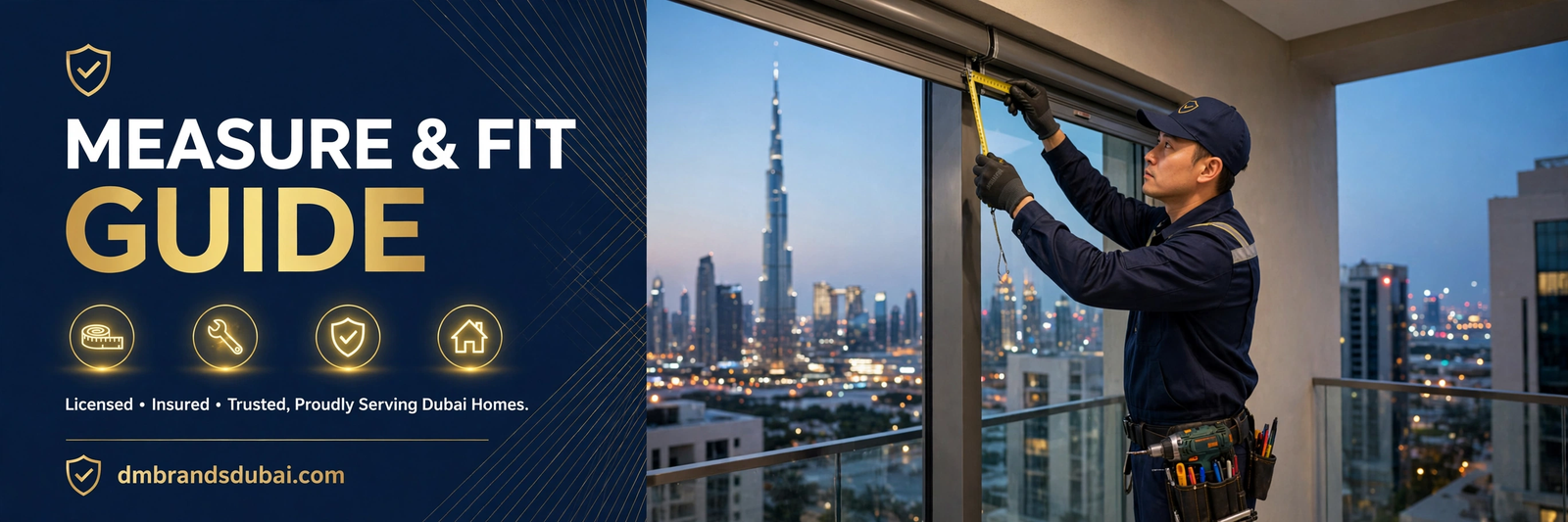
Bad measuring is the number one cause of curtain and blind problems. A professional installer will:
- Measure width in three places — top, middle, and bottom — and use the smallest or largest measurement depending on whether the blind fits inside or outside the recess.
- Measure drop in three places and account for floor level, skirting boards, and radiators or AC units below the window.
- Check the fixing surface — concrete, plasterboard, and aluminium frames all need different fixings. Dubai apartments often have plasterboard reveals that need specialist anchors.
- Confirm stack space for curtains: when open, curtains need room to gather at the sides without covering the glass. For a 3-metre window, allow 30 to 45 cm of stack space per side.
- Account for pelmets and ceiling tracks. Ceiling-mounted tracks are popular in Dubai’s modern apartments and need precise ceiling fixing.
Never order curtains or blinds from online measurements alone unless you are confident. Most Dubai suppliers offer free measuring visits, and the visit is worth it — a remake costs far more than the visit saves.
Inside vs Outside Mount
- Inside mount (within the recess) looks neat and modern but needs a square, deep-enough recess. Dubai’s window reveals are often shallow, limiting this option.
- Outside mount (on the wall or ceiling above the window) covers the whole window, blocks more light at the edges, and makes windows look larger. It is the most common choice in Dubai homes.
Choosing Fabrics for Dubai’s Climate
- Blackout fabrics: Essential for bedrooms, especially for shift workers and families with young children. A true blackout with side channels blocks nearly all light.
- Sunscreen fabrics: Open-weave rollers that cut glare and UV while keeping your view. Choose 1–5% openness for strong sun protection.
- Linen-look fabrics: Beautiful but wrinkle and fade faster in direct sun. Use them in rooms with indirect light, or behind a sunscreen layer.
- Easy-clean synthetics: Polyester blends resist dust, fading, and moisture, and many are machine washable. Practical for family homes.
- Thermal lining: A thermal or blackout lining behind decorative curtains cuts heat gain significantly and protects the face fabric from sun damage.
For south and west-facing windows, prioritise UV protection and heat control over decoration. Your furniture and flooring will thank you.
Curtains and Blinds for Apartments vs Villas
Apartments
Space is tighter and windows are often floor-to-ceiling sliders. Roller blinds and ceiling-track sheer curtains are the most popular combination — they stack neatly, preserve the view, and fit the modern apartment aesthetic. Check building rules before drilling into window frames; most buildings prefer wall or ceiling fixings. If you are also upgrading the apartment’s entrance security, see our guide to intercom installation in Dubai.
Villas
Villas have more windows, more variety (arched windows, skylights, patio doors), and more sun exposure. Layered curtains work beautifully in villa living rooms, while shutters suit bedrooms and street-facing windows. Budget for the whole house at once if possible — suppliers offer better rates on full-house orders, and consistent styling raises the home’s overall feel. Villas with large glass areas should also consider solar control window film as a complement to blinds, not a replacement.
Motorised Blinds: Worth It?
For most Dubai homes with more than a few large windows, yes — with caveats:
- Choose battery motors for retrofits. They avoid new wiring and last 6 to 12 months per charge with normal use.
- Choose mains power for new builds or renovations. It is tidier and never needs charging. Plan it during renovation, not after.
- Automate on schedules or sun sensors. Blinds that close automatically during peak afternoon sun cut cooling costs without you thinking about it.
- Check smart-home compatibility before buying. Somfy motors integrate with most systems, but confirm with your installer.
- Keep a manual override. Remote controls fail and batteries die; a pull cord or manual option avoids a stuck blind.
Installation Day: What to Expect
A standard apartment takes 2 to 4 hours; a full villa takes a full day or two. The installer should:
- Protect floors and furniture from dust.
- Fix tracks and brackets level and secure, using fixings matched to your wall type.
- Hang, steam, and dress curtains so they fall correctly.
- Test every blind and motor, and show you how to operate and clean them.
- Remove all packaging and old window dressings if agreed.
Check every window before the installer leaves: full travel up and down, even hems, no snagging, and motors responding to the remote. Snagging after the team has left is slower for everyone.
Mistakes to Avoid
1. Measuring yourself to save a visit fee. One wrong measurement means a remake or a gap of sunlight. Free measuring visits exist for a reason.
2. Choosing fabric for looks alone. That pale linen looks stunning in the showroom and fades in six months on a west-facing window. Match fabric to sun exposure.
3. Skimping on tracks and mechanisms. Cheap tracks stick, sag, and fail under heavy curtains. The mechanism is used daily; the fabric is not.
4. Ignoring the stack. Curtains that cover a third of the window when open waste the glass you paid for. Plan stack space before ordering.
5. Forgetting child safety. Corded blinds are a hazard for young children. Choose cordless, motorised, or cord-cleat systems, especially in nurseries and children’s rooms.
6. Ordering room by room from different suppliers. Colours and batches vary. A whole-house order keeps everything consistent and usually cheaper.
7. No blackout in bedrooms. Dubai’s summer sun rises early and sets late. Bedrooms without true blackout cost you sleep.
If your window project is part of a bigger refresh, coordinating it with other work saves repeat visits. A false ceiling installation pairs naturally with ceiling-mounted curtain tracks, and a bathroom update can be planned alongside — see our bathroom renovation cost guide for combined-project pricing.
Styling Tips by Room
Each room in a Dubai home has different needs, and the best window dressing varies accordingly.
Living rooms deserve the most attention, since they carry the home’s look. Floor-to-ceiling sheer curtains on a ceiling track create height and elegance, layered with blackout curtains for evenings. If the room has a view worth keeping — Marina skyline, sea, or golf course — sunscreen roller blinds preserve it while cutting glare, and curtains frame the glass beautifully when open.
Master bedrooms need true blackout and quiet operation. Layered curtains with blackout lining, or a blackout roller blind behind a decorative curtain, give the best sleep. Motorised operation is worth it here — closing every blind from bed is a small luxury you use daily.
Children’s rooms prioritise safety and sleep. Cordless or motorised blinds are essential, and blackout is highly recommended for naps and early summer sunrises. Choose washable fabrics, since children’s rooms take more wear.
Kitchens need wipeable, heat-resistant options. Aluminium Venetian blinds or roller blinds in a wipe-clean fabric cope with steam and cooking grease far better than fabric curtains. Avoid long curtains near hobs for fire safety.
Bathrooms need moisture resistance. Faux-wood Venetian blinds or PVC roller blinds handle humidity without warping. Sheer curtains are a poor choice here — they absorb moisture and mildew.
Home offices need glare control without darkness. Sunscreen roller blinds or light-filtering Venetians let you work by daylight without screen glare, and they look professional on video calls.
Smart Home Integration for Window Dressings
Motorised curtains and blinds become far more valuable when connected to a smart home system. The most useful automations for Dubai homes include:
- Sun schedules: Blinds close automatically on west-facing windows from 2pm to 6pm in summer, cutting cooling load without any input.
- Wake-up routines: Bedroom curtains open gradually at sunrise or at your alarm time, a gentler start than a phone alarm.
- Away mode: Blinds open and close on a varied schedule while you travel, making the home look occupied.
- Voice control: “Close all curtains” through Alexa or Google Home is genuinely useful in a villa with twenty windows.
- Scene integration: A “movie night” scene dims lights and closes living room curtains together.
Before buying, confirm compatibility. Somfy motors, the Dubai market standard, integrate with most platforms, but check that your chosen hub, voice assistant, or KNX system supports the exact motor model. Battery motors connect via radio hubs; mains motors may need additional controllers. Your installer should demonstrate the full automation before handover, not just the remote control.
One caution: smart features should never be the only control. Keep a physical remote or wall switch, so a Wi-Fi outage or a dead phone battery never leaves you unable to open a blind.
Caring for Curtains and Blinds in Dubai
Dubai’s dust and sun mean window dressings need more care than in milder climates, but a simple routine keeps them looking new for years.
Weekly: Vacuum curtains with an upholstery attachment and dust blind slats with a microfibre cloth or a blind duster. This takes minutes and prevents dust from embedding in fabric.
Monthly: Wipe roller and Venetian blinds with a damp cloth. Check curtain tracks for dust buildup and cords or chains for wear.
Twice a year: Have curtains professionally cleaned, or machine-wash them if the fabric allows. Check motorised blinds’ battery levels and recharge or replace as needed.
After sandstorms: Dust and rinse external-facing blinds, and vacuum curtains that were exposed to open windows. Sand is abrasive — do not grind it into fabric by rubbing dry.
Sun protection: Rotate or swap sheer curtains that face direct sun if they show fading, and consider a UV-protective lining behind expensive decorative fabrics. Fading is gradual and easy to miss until it is uneven.
Well-maintained window dressings last 8 to 12 years for curtains and 10 to 15 years for quality blinds and shutters. Neglected ones look tired in half that time.
Curtain and Blind Trends in Dubai for 2026
Dubai’s window-dressing market moves fast, and several trends are shaping what homeowners choose this year.
Motorisation is becoming standard, not luxury. Battery motors have fallen in price, and new-build villas increasingly include motorised tracks as standard. Retrofitting older homes with battery motors is now straightforward and affordable.
Layered treatments dominate. The single most popular Dubai combination remains sheer curtains plus blackout curtains on a double ceiling track, often paired with a sunscreen roller blind for daytime glare. Layering gives control for every time of day and every season.
Natural textures are in. Linen-look fabrics, woven wood blinds, and warm neutral palettes suit Dubai’s modern, light-filled interiors. They soften the hard edges of glass and concrete without darkening rooms.
Sustainability matters more. Recycled polyester fabrics, PVC-free blinds, and long-life mechanisms appeal to environmentally conscious buyers, and suppliers increasingly offer them at competitive prices.
Smart integration deepens. Beyond remotes, blinds now connect to full home automation — closing with the sunset, opening with the morning alarm, and responding to temperature sensors. For villas with extensive glass, this automation is as much an energy measure as a convenience.
Bold colour is back in feature rooms. While neutrals dominate living spaces, deep greens, terracotta, and navy curtains are appearing in dining rooms and master bedrooms as statement pieces. Keep bold choices to one room unless you are confident about the overall palette.
Working with an Interior Designer on Window Dressings
For a full-home project, an interior designer can coordinate window dressings with furniture, flooring, and paint — but the relationship works best when roles are clear.
Give the designer your budget and your practical requirements first: blackout in bedrooms, child-safe mechanisms, easy-clean fabrics for the kitchen. A designer who ignores practical needs in favour of looks will cost you twice.
Ask the designer to coordinate with the curtain supplier directly on measurements and track specifications. The most common failure in designer-led projects is a beautiful fabric choice paired with a track that cannot support its weight or a heading style that does not suit the fabric.
If budget is tight, hire a designer for one consultation to set the palette and style direction, then execute room by room with a curtain supplier. This gives you professional direction without full-service fees.
Finally, remember that window dressings are semi-permanent. A trend that looks exciting today should still please you in five years. Classic neutrals with one or two bold accents age better than a whole house of statement prints.
Measuring Checklist for Homeowners
If you want to sanity-check a supplier’s measurements, or you are ordering simple blinds yourself, use this checklist.
Tools you need: A metal tape measure, a notepad, and a pencil. Measure in centimetres, and measure every window separately — even windows that look identical can differ by a centimetre or two in Dubai buildings.
For inside-mount blinds:
- Measure the recess width at the top, middle, and bottom. Use the smallest measurement.
- Measure the drop on the left, middle, and right. Use the smallest measurement.
- Check the recess depth — you need at least 6 to 8 cm for most blind mechanisms.
- Note any obstructions: handles, vents, tiles, or uneven plaster.
For outside-mount blinds and curtains:
- Measure the full width you want covered, including any overlap beyond the frame — typically 10 to 15 cm per side for light blocking.
- Measure the drop from the track or fixing height to the desired end point: sill, below sill, or floor.
- For curtains, decide the stack space: allow 30 to 45 cm per side for a 3-metre window.
- Check the fixing surface and note whether it is concrete, block, or plasterboard.
General rules:
- Always measure twice and write down both readings.
- Photograph each window with the tape measure visible for reference.
- Tell the supplier about any bay windows, arches, or sloped ceilings before the measuring visit.
- Never assume windows are square. Dubai construction tolerances mean reveals are often slightly out of square, and professionals account for this.
If any measurement feels uncertain, book the free professional measuring visit. A remake costs far more than the visit ever would.
Frequently Asked Questions
How much does curtain installation cost in Dubai?
A single apartment window typically costs AED 1,500 to AED 4,000 for made-to-measure curtains including track and fitting. A full villa ranges from AED 8,000 to AED 30,000+ depending on window count, fabric, and motorisation.
Are blinds or curtains better for Dubai apartments?
Both work well. Roller blinds with sunscreen fabric suit modern apartments and preserve the view; layered sheer and blackout curtains suit bedrooms and living rooms where heat control and softness matter. Many Dubai homes combine both — blinds for day, curtains for night.
What are blackout curtains, and do I need them in Dubai?
Blackout curtains block almost all light and significantly reduce heat. In Dubai, where summer sun is intense and rises early, they are highly recommended for bedrooms, especially for children and shift workers.
How long does curtain and blind installation take?
A standard apartment takes 2 to 4 hours, and a full villa takes one to two days. Measuring visits happen beforehand and take 30 to 60 minutes.
Can I get motorised blinds in Dubai?
Yes. Battery and mains-powered motors from brands like Somfy are widely available, integrate with Alexa, Google Home, and smart-home systems, and can run on timers or sun sensors for automatic heat control.
Do I need building approval to install curtains or blinds?
Generally no, for internal window dressings. However, some buildings restrict drilling into window frames or require approval for external changes such as shutters. Check with your building management if in doubt.
How do I clean curtains and blinds in Dubai’s dusty climate?
Vacuum curtains weekly with an upholstery attachment and have them professionally cleaned once or twice a year. Wipe blinds with a damp cloth; roller and Venetian blinds are the easiest to maintain in dusty conditions.
What is the best window dressing for floor-to-ceiling windows?
Ceiling-track sheer curtains layered with blackout curtains, or large sunscreen roller blinds, work best. Both preserve the sense of height while controlling sun and privacy.
Are motorised blinds safe for children?
Yes — motorised and cordless blinds remove the cord hazard entirely, making them the safest option for nurseries and children’s rooms.
How do I stop my furniture fading in Dubai sun?
Combine UV-protective window dressings (sunscreen blinds or lined curtains) with closing blinds during peak afternoon sun. Sunscreen fabrics block up to 95% of UV while keeping the view.
Can blinds really reduce my cooling bill?
Yes. Blocking sun before it heats the room reduces air-conditioning load. Automated blinds that close during peak sun hours are particularly effective in west and south-facing rooms.
Should I choose inside or outside mount blinds?
Outside mount is more common in Dubai because window reveals are often shallow. It covers the whole window, blocks more edge light, and makes windows look larger. Inside mount looks neater but needs a deep, square recess.
What window dressing is best for a home office?
Sunscreen roller blinds or light-filtering Venetian blinds. They cut screen glare while keeping daylight, and they look professional on video calls.
How long do curtains and blinds last in Dubai?
Well-maintained curtains last 8 to 12 years, and quality blinds or shutters 10 to 15 years. Dust, sun, and poor cleaning shorten that significantly, so regular care pays off.
Can motorised blinds work without Wi-Fi?
Yes. Motorised blinds run on a remote control or wall switch regardless of Wi-Fi. Smart-home features add automation, but the basic remote always works — keep it as a backup.
How do I choose between sheer and blackout curtains?
Use both in layers: sheers for daytime privacy and light, blackout curtains for night, heat control, and sleep. The double-track combination is the most popular setup in Dubai homes for exactly this reason.
Do curtains help with Dubai’s summer heat?
Yes, significantly. Layered curtains with blackout lining block solar heat before it warms the room, reducing air-conditioning load. For maximum effect, close them on sun-facing windows during peak afternoon hours.
Are custom-made curtains worth the extra cost over ready-made?
In Dubai, usually yes. Ready-made sizes rarely fit floor-to-ceiling windows properly, and poor fit leaves light gaps and looks unfinished. Made-to-measure curtains fit exactly, last longer, and suit the window.
Can I install blinds myself to save money?
Simple roller blinds on a standard window are DIY-friendly, but floor-to-ceiling curtains, motorised systems, and plasterboard fixings are best left to professionals. A failed fixing can damage the wall, drop an expensive blind, or leave a light gap that defeats the purpose.
Conclusion
The right curtains or blinds transform a Dubai home — cooler rooms, better sleep, real privacy, and lower cooling bills, all from a single upgrade. The keys are choosing the right type for each room’s sun exposure, measuring professionally, investing in quality tracks and mechanisms, and considering motorisation for large or hard-to-reach windows.
Start with a free measuring visit and an itemised quote, and dress the sunniest rooms first if budget is tight. Your home — and your DEWA bill — will feel the difference immediately.
Ready to dress your windows? Contact DM Brands Dubai for a free measuring visit and an itemised curtain and blinds quotation — licensed, insured, and proudly serving Dubai homes.