Your cooker hood works hard every time you fry, grill, or simmer a meal. It pulls smoke, steam, and grease out of the air before they settle on your walls, cabinets, and lungs.
In Dubai, that job is even harder. High heat, heavy frying, and humid air push grease deep into filters, fans, and ducts faster than in cooler climates.
This guide explains everything about kitchen hood cleaning in Dubai. You will learn what professional cleaning involves, how much it costs in AED, how often to book it, and how to keep your kitchen safe between visits.
Quick Answer: What Is Kitchen Hood Cleaning?
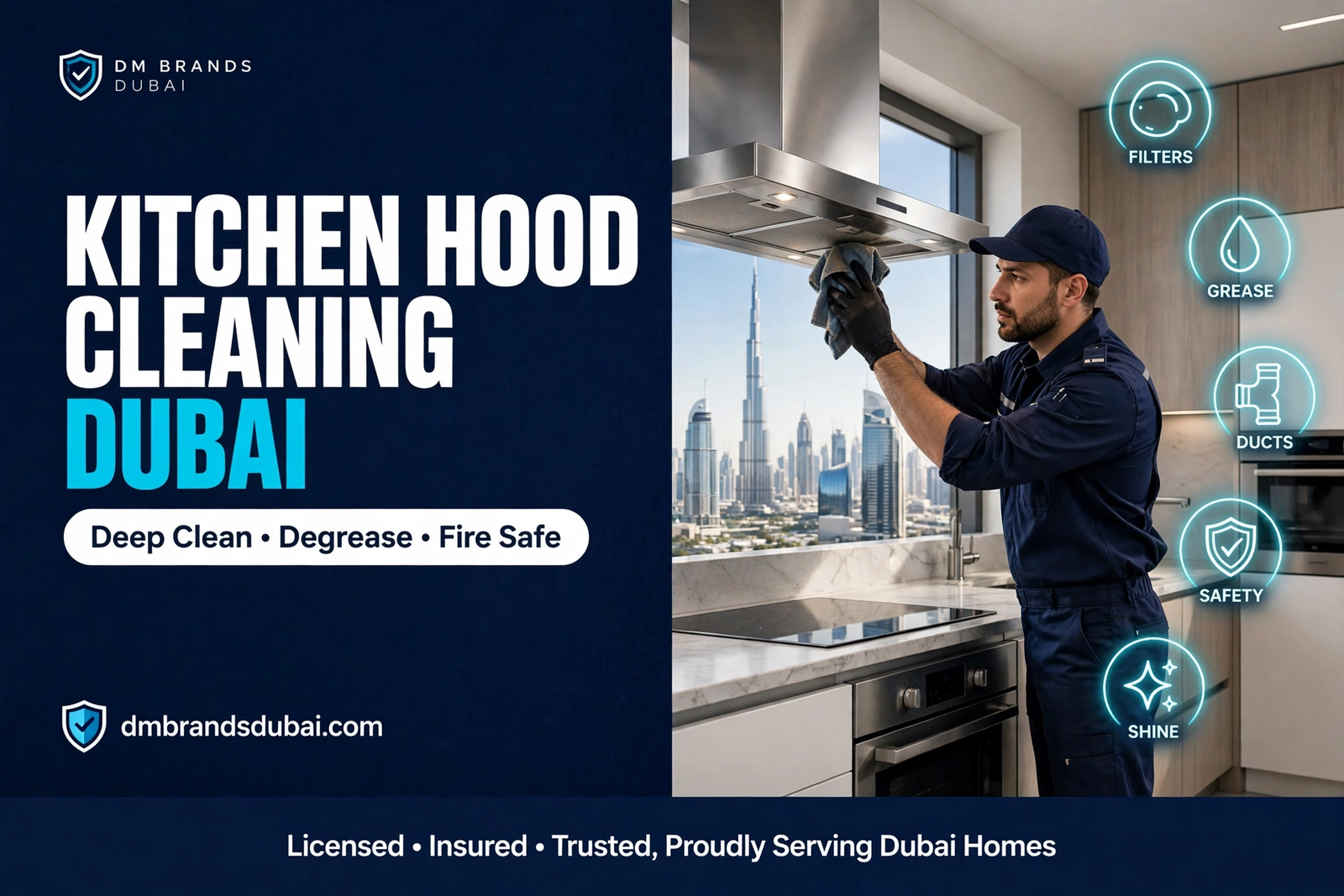
Kitchen hood cleaning is the professional degreasing of a cooker hood, its filters, fan, and exhaust duct. A technician removes the filters, soaks and scrubs away built-up grease, cleans the canopy inside and out, and clears the ductwork that carries cooking fumes outside.
For homes, the service usually covers the hood, filters, and the accessible part of the duct. For restaurants and commercial kitchens, it covers the full exhaust system, from the canopy to the rooftop fan.
Regular cleaning restores suction, removes stale cooking smells, and lowers fire risk. Grease is fuel, and a greasy duct is one of the most common ways a small kitchen fire spreads.
Key takeaway: If you cook most days, your hood needs a professional deep clean at least twice a year. Restaurants need it far more often.
What Is Kitchen Hood Cleaning?
A kitchen hood, also called a range hood or cooker hood, sits above your hob. Its fan draws cooking smoke, steam, heat, and airborne grease upward through filters and out through a duct.
Over weeks of cooking, grease coats every surface the air touches. Filters clog first. Then the fan blades, the inside of the canopy, and the duct walls collect a sticky layer that no surface wipe can reach.
Kitchen hood cleaning removes that layer properly. It is not a quick wipe of the outside steel. A proper service strips the system down, degreases each part with food-safe cleaners, and puts it back together working like new.
The work covers four parts of the system. The canopy is the visible hood above the hob. The filters trap grease before it reaches the fan. The fan, also called the extractor fan, moves the air. The duct carries the air outside the building.
A full service cleans all four. A partial service that only wipes the canopy leaves the most dangerous grease exactly where it is.
What Counts as a Deep Clean?
A deep clean goes beyond the surfaces you can see. The technician removes filters and baffles, soaks them in a degreasing solution, and scrubs them by hand.
The inside of the canopy is scraped and degreased. The fan housing and blades are cleaned. The duct is brushed and vacuumed as far as access allows.
After cleaning, the technician tests the fan, checks the lights, and makes sure airflow is strong again. That test is what separates a deep clean from a cosmetic wipe.
What Is Not Included in a Standard Clean?
Some jobs need extra work that falls outside a standard clean. Replacing a broken fan motor is a repair, not a cleaning task. Replacing damaged duct sections is ductwork, not cleaning.
Re-grouting tiles or repainting a stained wall is also separate. A good provider will flag these issues during the visit and quote them separately, rather than hiding them inside the cleaning price.
Why Kitchen Hood Cleaning Matters in Dubai
Dubai kitchens work harder than most. Families cook daily, often with frying, grilling, and high-heat methods that produce more grease than light boiling or steaming.
The climate adds to the problem. Heat and humidity keep grease soft and sticky, so it spreads further into the system instead of drying out. Dust from the desert air also mixes with grease, forming a thick residue that clogs filters faster.
Many Dubai homes have open-plan kitchens. When a hood stops extracting properly, cooking smoke and smells drift into the living room, settle on sofas and curtains, and linger for hours.
Apartments add another layer. Shared duct risers in towers mean one greasy duct can affect neighbours. Building management in many Dubai communities expects residents to keep kitchen exhaust systems maintained.
Fire Safety Is the Biggest Reason
Grease is flammable. A thin layer inside a duct can ignite from a flare-up on the hob, and a duct fire can travel quickly through a building.
This is why fire safety guidance for commercial kitchens, including the international standard NFPA 96 on ventilation control and fire protection of commercial cooking operations, places so much emphasis on regular exhaust cleaning. You can read the standard on the NFPA 96 page.
Dubai Civil Defence and Dubai Municipality set the local rules for fire safety in buildings and food businesses. Restaurants and cafes in Dubai must keep their kitchen exhaust systems clean and be able to show maintenance records during inspections. The Dubai Municipality portal at dm.gov.ae is the starting point for local food safety and building requirements.
A clean hood is not just about hygiene. It is a fire safety measure, and for food businesses it is a compliance duty.
Air Quality and Health
A clogged hood cannot remove smoke and steam. Cooking fumes stay in the room, and the people cooking breathe them in.
Grease and moisture inside a dirty hood also feed bacteria and mould. That growth creates stale odours and can contaminate the air around food preparation areas.
A clean hood pulls fumes out properly. The kitchen smells fresher, the air feels lighter, and cooking becomes more comfortable.
Your Appliances Last Longer
A fan working against clogged filters strains its motor. It runs hotter, louder, and less efficiently, and it wears out sooner.
Grease dripping from a saturated filter can stain the hob and damage the cooktop below. Regular cleaning protects the hood itself and the appliances around it.
A well-maintained hood also uses less energy. A free-flowing fan reaches the airflow it was designed for without running at full speed all the time.
How a Kitchen Hood Works
Understanding the parts helps you understand the cleaning. Air enters through the bottom of the canopy, passes through the filters, and reaches the fan.
The filters catch grease droplets. The fan pushes the air through the duct. The duct carries it outside, either through a wall vent or up to the roof.
Two designs exist. Ducted hoods send air outside through ductwork. Recirculating hoods pass air through a charcoal filter and return it to the room.
Ducted hoods are more common in Dubai villas and in commercial kitchens. Recirculating hoods appear in some apartments where external ducting is limited. Both types need cleaning, but ducted systems also need duct cleaning.
The Parts a Cleaner Must Reach
The canopy is the outer shell. Its underside collects grease drips and cooking splashes.
Filters sit inside the canopy. They are the first line of defence and the first part to clog.
The fan sits behind the filters. Its blades and housing collect a fine grease film that slows the motor.
The duct runs from the hood to the outside. Its inner walls gather grease over time, especially at bends and joints.
Lights, grease cups, and drip trays complete the system. A thorough clean covers all of them.
Types of Kitchen Hoods in Dubai
Dubai homes and restaurants use several hood designs. Each one cleans differently, and each has its own trouble spots.
| Hood Type | Where You Find It | Cleaning Notes | Typical Challenge |
|---|---|---|---|
| Canopy hood | Wall-mounted above hobs in villas and apartments | Filters and canopy interior need regular degreasing | Grease collects on the flat underside |
| Chimney hood | Modern kitchens with a tall flue to the ceiling | Chimney panels and upper duct need attention | Grease hides inside the tall flue |
| Island hood | Above island cooktops in open-plan kitchens | All four sides exposed, larger canopy area | Larger surface, more grease spread |
| Under-cabinet hood | Compact apartments and small kitchens | Small filters, tight access | Small parts clog quickly |
| Downdraft extractor | Island hobs without overhead hoods | Retractable unit, hidden duct below | Hard to reach, needs specialist tools |
| Commercial canopy | Restaurants, cafes, cloud kitchens | Full system clean including long ducts and rooftop fans | Heavy grease load, compliance records needed |
Canopy Hoods
Canopy hoods are the most common type in Dubai homes. They mount on the wall above the hob and vent through the wall or ceiling.
Their flat underside collects drips, and their filters sit in easy reach. They are the simplest to clean, which makes them the easiest to maintain well.
Chimney Hoods
Chimney hoods have a tall flue that runs from the canopy to the ceiling. They suit modern kitchens with high ceilings.
Grease rises into the flue, so a proper clean must reach inside it. A wipe of the canopy alone leaves the chimney dirty.
Island Hoods
Island hoods hang above a cooktop in the middle of the room. They are usually larger than wall hoods, with more surface to degrease.
Because they are visible from every side, they need a careful polish after cleaning. Streaks and smears show easily on island hoods.
Under-Cabinet Hoods
Under-cabinet hoods fit beneath a wall cabinet. They are compact and common in smaller apartments.
Their small filters clog fast. They need more frequent filter cleaning than larger hoods, even though the job itself is quick.
Commercial Kitchen Hoods
Commercial hoods are larger, heavier, and built to handle constant cooking. They serve restaurants, cafes, hotels, and cloud kitchens across Dubai.
They use baffle filters, long duct runs, and rooftop exhaust fans. Cleaning them is a bigger job that follows stricter standards and needs proper access equipment.
If you run a food business, your hood cleaning is not optional. It is part of your fire safety and food safety compliance.
Signs Your Kitchen Hood Needs Cleaning
Your hood will tell you when it needs attention. Watch for these signs.
Weak suction. Steam hangs in the air instead of being pulled away. This is the clearest sign that filters or ducts are blocked.
Grease drips. Yellow or brown drops fall from the hood onto the hob. This means the filters are saturated and grease is passing through.
Lingering smells. Cooking odours stay in the kitchen long after you finish. A clean hood removes smells quickly.
Sticky surfaces. The hood, nearby cabinets, and walls feel tacky. Grease is escaping the system and settling around the kitchen.
Louder fan noise. The fan sounds strained or rattles. Grease on the blades unbalances the fan and makes the motor work harder.
Visible grease. You can see a brown film inside the canopy or on the filters. If you can see it, the hidden parts are worse.
Smoke alarms going off. Cooking smoke is not being extracted, so it reaches the alarm. This is a safety warning, not just an annoyance.
If you notice two or more of these signs, book a clean rather than waiting. Grease build-up only gets harder and more expensive to remove with time.
The Paper Test
Hold a sheet of kitchen paper near the hood while the fan runs on high. A healthy hood should pull the paper toward the filters.
If the paper barely moves, suction is weak. If it does not move at all, the system needs a professional clean and possibly a fan check.
Step-by-Step: How Professionals Clean a Kitchen Hood
A professional kitchen hood cleaning follows a set process. Here is what the DM Brands Dubai team does on a typical residential visit.
Step 1: Inspection and Protection
The technician inspects the hood, filters, fan, and visible ducting. They check the fan speed, the lights, and the condition of the filters.
Then they protect your kitchen. The hob, counters, and floor around the cooker get covered. This keeps degreaser and dirty water off your surfaces.
Step 2: Power Off and Dismantle
The hood is switched off at the wall. Filters, grease cups, and drip trays are removed.
Baffles and removable panels come out too. Each part is labelled or set aside in order so reassembly is exact.
Step 3: Filter Degreasing
Filters go into a soak. A hot degreasing solution loosens the grease layer. After soaking, each filter is scrubbed by hand, rinsed, and left to dry.
Heavily clogged filters may need a second soak. Filters that are warped or damaged are flagged for replacement.

Step 4: Canopy Cleaning
The inside of the canopy is scraped to remove thick grease. Then it is sprayed with degreaser, left to dwell, and scrubbed.
The outside is cleaned and polished. Stainless steel is wiped in the direction of the grain to avoid scratches and streaks.
Step 5: Fan and Motor Housing
The fan housing is opened where access allows. Blades are wiped and degreased.
The motor itself is not soaked. It is wiped carefully and checked for wear, noise, and loose fittings.
Step 6: Duct Cleaning
Accessible duct sections are brushed and vacuumed. Grease is pulled out rather than pushed further down the duct.
For long or vertical ducts, the technician uses rotary brushes and a vacuum system. Full duct cleaning in commercial kitchens may need roof access.
Step 7: Extractor Fan Cleaning
The extractor fan is cleaned as part of the system. Its blades, housing, and grille are degreased so air flows freely again.
A clean fan is quieter and stronger. This step is often what restores the suction a customer notices most.
Step 8: Reassembly and Testing
Filters and parts go back in place. The hood is switched on and tested at each speed setting.
The technician checks airflow, listens for unusual noise, and tests the lights. Any fault found during testing is reported to you before they leave.
Step 9: Final Wipe and Handover
The hob and counters are wiped down. Protective covers come off. The technician shows you the cleaned filters and explains what was done.
You receive simple aftercare advice, such as how often to wipe the filters yourself between professional visits.
Hood Filter Cleaning: Types and Methods
Filters do most of the grease-catching work. They also need the most frequent attention.
| Filter Type | Material | How It Is Cleaned | How Often to Clean |
|---|---|---|---|
| Baffle filter | Stainless steel | Soak in degreaser, scrub, rinse | Every 1–3 months |
| Mesh filter | Aluminium mesh layers | Soak, gentle brush, rinse, dry fully | Every 2–4 weeks |
| Charcoal filter | Activated carbon | Cannot be washed; replace when saturated | Every 3–6 months |
| Grease cup / tray | Metal or plastic | Empty, degrease, wash | Every clean |
Baffle Filters
Baffle filters are the standard in commercial kitchens and higher-end home hoods. Their angled metal channels force air to change direction, which drops grease out of the airflow.
They are durable and dishwasher-safe in many cases, but a professional soak removes grease more thoroughly than a home dishwasher cycle.
Mesh Filters
Mesh filters use layers of fine aluminium mesh. They catch grease well but clog fast, because the mesh openings are small.
They need gentle handling. A hard brush can bend the mesh and damage the filter. Soaking is the safest way to clean them.
Charcoal Filters
Charcoal filters absorb odours in recirculating hoods. They cannot be washed, because water ruins the carbon.
When a charcoal filter is saturated, it must be replaced. A technician can tell you whether yours has reached that point.
Can I Clean Filters Myself?
Yes, for light maintenance. Soak mesh or baffle filters in hot water with dish soap or a degreaser, scrub gently, rinse, and dry fully before refitting.
Do this every few weeks for mesh filters. It keeps suction strong between professional visits. It does not replace a full system clean, because it leaves the fan and duct untouched.
Never put a filter back while it is wet. Damp filters trap moisture and encourage mould growth inside the hood.
Kitchen Exhaust and Duct Cleaning
The duct is the part of the system you never see. It is also where the worst grease collects, because it is warm, dark, and rarely cleaned.
Why Ducts Get So Dirty
Hot greasy air rises into the duct and cools as it travels. Grease condenses on the duct walls and stays there.
Bends and joints catch more grease than straight sections. Over months, the layer thickens and narrows the duct, which reduces airflow.
How Duct Cleaning Works
A technician accesses the duct from the hood end and, where possible, from the outlet end. Rotary brushes loosen the grease, and a vacuum pulls it out.
For residential ducts, this usually covers the accessible length. For commercial systems, the clean covers the full run to the rooftop fan, including access panels that are opened and resealed.
How Often Should Ducts Be Cleaned?
Residential ducts need cleaning during a full hood service, usually once or twice a year. Commercial ducts follow a stricter schedule based on cooking volume.
High-volume kitchens, such as those frying most of the day, need duct cleaning every few months. Your provider should set the interval based on what they find inside your system.
Duct Cleaning and Building Rules
In apartment towers, duct risers are shared infrastructure. Your building management may have rules about who can access them and when.
A professional team will coordinate with building management for access. Always check your tower's rules before booking a duct clean that needs roof or riser access.
Extractor Fan Cleaning Dubai
The extractor fan is the engine of the system. When it is dirty, everything else suffers.
What Goes Wrong With a Dirty Fan
Grease on fan blades adds weight and unbalances the spin. The motor draws more power and makes more noise.
Airflow drops. The hood pulls less smoke, and the kitchen fills with fumes. In time, the motor can overheat and fail.
What Fan Cleaning Involves
The fan cover and grille come off. Blades are degreased and wiped. The housing is cleaned and checked for cracks or loose fittings.
The motor is inspected but not washed. Bearings are checked for wear, and the fan is tested at every speed before the job is signed off.
If the fan is damaged or the motor is failing, cleaning alone will not fix it. A good technician will tell you honestly and quote a repair separately.
Fire Safety and Dubai Compliance
Grease fires are a real risk in kitchens. A clean exhaust system is one of the simplest ways to reduce that risk.
The Fire Risk in Numbers-Free Terms
No invented figures are needed to understand the risk. Grease ignites easily, it burns hot, and it sits inside a duct that acts like a chimney. A small flare-up on the hob can become a duct fire in seconds if the duct is coated in grease.
That is why fire safety guidance treats exhaust cleaning as a core control, not a cosmetic extra.
NFPA 96: The International Standard
NFPA 96 is the widely used standard for ventilation control and fire protection of commercial cooking operations. It covers hood design, duct construction, and cleaning frequency for commercial kitchens.
Dubai's own fire safety rules draw on such international standards. If you run a restaurant, your kitchen exhaust system is expected to meet recognised fire safety practice, and inspectors will look at it.
You can read more on the NFPA 96 standard page.
Dubai Municipality and Civil Defence
Dubai Municipality oversees food safety and public health rules for food businesses. Dubai Civil Defence oversees fire safety approvals and inspections.
Both expect commercial kitchens to keep exhaust systems clean and to hold maintenance records. A restaurant that cannot show cleaning records risks fines, failed inspections, or closure until the system is cleaned.
Homeowners are not inspected the same way, but the fire risk in a villa kitchen is the same. The same standard of care protects your family and your property.
For official guidance, start at the Dubai Municipality website, dm.gov.ae, and the Dubai Civil Defence website, dcd.gov.ae.
What Records Should a Restaurant Keep?
Keep every cleaning invoice and a dated service report. Note the areas cleaned, the condition found, and the next due date.
Photographs of the cleaned system help during inspections. A professional provider should supply a service report after every commercial clean.
Gas Safety and the Hood
Hoods sit above gas hobs in many Dubai kitchens. If your cooker uses gas, the hood cleaning visit is a good time to check that the hob and its connections are sound.
If you need gas work done, it must be handled by a qualified technician. Our team also handles gas cooker installation in Dubai for homes that need a safe, compliant gas connection.
Residential vs Commercial Kitchen Hood Cleaning
Home and restaurant hood cleaning share the same principles, but the scale and rules are very different.
| Factor | Residential | Commercial / Restaurant |
|---|---|---|
| System size | Single hood, short duct | Large canopy, long duct, rooftop fan |
| Grease load | Moderate | Heavy, daily build-up |
| Cleaning frequency | Every 6–12 months | Every 1–6 months, by cooking volume |
| Compliance | Best practice, fire safety | Mandatory, inspection records required |
| Access needed | Kitchen only | Kitchen, duct risers, roof access |
| Typical duration | 1–2 hours | Half day to full day |
| Report provided | Service summary | Full report with photos for inspectors |
Residential Cleaning
Home cleaning focuses on the hood, filters, fan, and accessible duct. It is a half-day job at most, often finished in one to two hours.
The goal is fresh air, strong suction, and a safer kitchen. Most Dubai homes book once or twice a year, or more often if they fry daily.
Commercial Cleaning
Commercial cleaning covers the full exhaust system. It includes the canopy, baffle filters, duct run, and rooftop exhaust fan.
It follows a documented schedule tied to cooking volume. High-volume kitchens need the most frequent cleaning, because grease builds up fastest.
Restaurants should also plan cleaning around trading hours. Most commercial cleans happen early in the morning or after closing, so the kitchen is free.
Cloud Kitchens and Cafes
Cloud kitchens and small cafes often cook at high volume in compact spaces. Their hoods work hard and clog fast.
They need the same commercial standard as a restaurant, even if the kitchen is small. A compact system with heavy use can be a higher fire risk than a large system with light use.
Kitchen Hood Cleaning Cost Dubai
Prices vary with hood size, grease level, access, and whether the job is residential or commercial. The figures below are typical indicative ranges for Dubai, not fixed quotes. Your exact price depends on an inspection of your system.
| Service | Typical Price Range (AED) | What It Covers |
|---|---|---|
| Residential hood + filter clean | 199–350 | Canopy, filters, fan wipe, accessible duct |
| Residential deep clean with duct cleaning | 350–600 | Full system including duct brushing and vacuuming |
| Under-cabinet / compact hood clean | 150–250 | Small hood, filters, fan |
| Island or chimney hood clean | 300–550 | Larger canopy, flue, filters, fan |
| Commercial kitchen hood clean | 800–2,500 | Canopy, baffles, duct, rooftop fan, report |
| Commercial duct-only clean | 500–1,500 | Duct run cleaning, access panels |
| Extractor fan clean (standalone) | 150–300 | Fan blades, housing, grille, test |
| Filter replacement (per filter) | 80–250 | Supply and fit of new mesh or baffle filter |
What Affects the Price?
Size matters most. A large island hood costs more than a compact under-cabinet unit. A long commercial duct costs more than a short residential one.
Grease level matters too. A system that has not been cleaned in years takes longer and needs more degreaser than one cleaned every six months.
Access matters as well. Roof access, shared risers, and after-hours work can add to the cost of a commercial job.
How to Get an Accurate Quote
A reliable provider will ask about your hood type, cooking frequency, and when it was last cleaned. For commercial jobs, they will usually inspect the system before quoting.
Be wary of prices far below the ranges above. A very cheap clean often skips the duct and the fan, which are the parts that matter most.
Is It Worth the Money?
A professional clean costs less than a replacement hood. It costs far less than fire damage, and far less than a failed inspection for a restaurant.
It also extends the life of the hood. A fan that runs clean lasts longer than one that fights clogged filters every day.
How Often Should You Clean Your Kitchen Hood?
There is no single answer, because it depends on how much you cook and what you cook.
| Cooking Level | Filter Wipe (DIY) | Professional Clean |
|---|---|---|
| Light cooking, few times a week | Monthly | Once a year |
| Daily home cooking | Every 2–3 weeks | Every 6 months |
| Daily frying or grilling | Weekly | Every 3–4 months |
| Restaurant, moderate volume | Weekly | Every 3–6 months |
| Restaurant, high volume frying | Weekly | Every 1–3 months |
A Simple Rule for Homes
If you cook most days, book a professional clean every six months. Wipe the filters yourself between visits.
If you fry often, shorten the interval. Heavy frying fills filters and ducts much faster than boiling or baking.
A Simple Rule for Restaurants
Set your cleaning schedule by cooking volume, not by the calendar alone. A busy frying kitchen needs cleaning more often than a cafe that mostly serves salads and sandwiches.
Your cleaning provider should inspect the system at each visit and adjust the interval based on what they find. That is better than a fixed schedule that ignores actual grease build-up.
DIY vs Professional Kitchen Hood Cleaning
You can handle light maintenance yourself. You cannot do a full system clean without the right tools and access.
| Task | DIY | Professional |
|---|---|---|
| Wipe the outside of the hood | Yes, weekly | Yes, as part of a service |
| Soak and scrub filters | Yes, every few weeks | Yes, with stronger degreasers |
| Clean inside the canopy | Light wipe only | Full scrape and degrease |
| Clean fan blades and housing | No, needs dismantling | Yes |
| Clean the duct | No, needs specialist tools | Yes, rotary brushes and vacuum |
| Test airflow and fan speeds | Basic check only | Full test at every speed |
| Provide a compliance report | No | Yes, for commercial kitchens |
| Work safely with electrics and gas | Limited | Trained, insured technicians |
What You Can Do Yourself
Wipe the outside of the hood weekly with a degreasing spray. Soak the filters regularly.
Keep the hob area clean, and wipe up grease splashes before they harden. These small habits make professional cleaning faster and cheaper.
What to Leave to Professionals
Anything inside the hood, the fan, and the duct is professional work. Dismantling a hood without training risks damage to the fan and the electrics.
Duct cleaning needs rotary brushes, vacuums, and access equipment. It also needs care, because pushing grease deeper into a duct makes the problem worse.
Mistakes to Avoid
Waiting until suction fails. By the time the fan cannot pull steam, the duct is already heavily coated. Book before it gets that bad.
Cleaning only the outside. A shiny canopy with dirty filters and a greasy duct is still a fire risk. The inside matters more than the outside.
Using the wrong cleaner. Abrasive cleaners scratch stainless steel. Caustic oven cleaners can damage filters and fan parts. Use food-safe degreasers made for kitchen exhaust systems.
Putting wet filters back. Damp filters breed mould and smell. Dry them fully before refitting.
Ignoring the duct. Many people clean the hood and forget the duct entirely. The duct is where grease hides and where fires spread.
Skipping the fan test. A clean that ends without testing the fan leaves you unsure whether the system works. Always ask for a test before the technician leaves.
Choosing on price alone. The cheapest quote often skips the duct, the fan, or the report. Ask exactly what is included before you book.
Forgetting restaurant records. A commercial clean without a written report is hard to prove during an inspection. Always keep the paperwork.
What to Expect During a Visit
Knowing what happens removes the guesswork. Here is the visit in plain terms.
Before the visit. Clear the hob and the counters near the cooker. Move small appliances away from the hood. Tell the technician when the hood was last cleaned and whether you have noticed any faults.
On arrival. The technician inspects the hood and confirms the price and scope. They protect the hob, counters, and floor.
During the clean. Expect some noise from scrubbing and vacuuming, and a mild degreaser smell. The kitchen stays usable, but cooking is paused while the hood is dismantled.
After the clean. The technician tests the fan, shows you the cleaned filters, and explains anything they found. You receive aftercare advice and the date for your next clean.
How long it takes. A residential clean usually takes one to two hours. A commercial clean takes longer, depending on the size of the system and the access needed.
Do I Need to Be Home?
Yes, for a residential visit. The technician needs access to the kitchen, the power supply, and water for rinsing.
For commercial jobs, a manager or key holder must be present to grant access to the kitchen, duct risers, and roof.
Expert Tips to Keep Your Hood Cleaner for Longer
Run the fan before you cook. Switch the hood on a few minutes before the hob. This builds airflow before smoke and grease appear.
Keep it running after cooking. Leave the fan on for ten minutes after you finish. It clears the last of the steam and grease from the air.
Use the right speed. High heat and frying need high fan speed. Low speed is fine for simmering, but it will not cope with a frying pan.
Wipe the canopy weekly. A quick wipe stops grease from hardening. Hardened grease needs far more effort to remove.
Soak filters on a schedule. Put filter cleaning on your calendar. A filter soaked every few weeks never reaches the clogged stage.
Use lids when frying. Lids cut the grease that reaches the hood. Less grease in the air means less grease in the system.
Check the grease cup. Empty the grease cup or drip tray before it overflows. An overflowing cup drips grease onto the hob.
Book the next clean before the technician leaves. A fixed date stops the job from slipping. Six months passes quickly, and grease does not wait.
Areas Served Across Dubai
DM Brands Dubai provides kitchen hood cleaning across the city, for villas, apartments, restaurants, and commercial kitchens.
Dubai Marina. High-rise apartments with shared duct risers and compact under-cabinet hoods.
Jumeirah Village Circle (JVC). Villas and townhouses with larger canopy and chimney hoods.
Arabian Ranches. Family villas with island and chimney hoods in open-plan kitchens.
Downtown Dubai. Apartments and restaurants near the Burj Khalifa, including high-volume food outlets.
Palm Jumeirah. Villas and apartments with premium kitchens and island hoods.
Business Bay. Apartments, offices with pantries, and restaurants serving the business district.
Al Barsha. Villas and apartments close to the Mall of the Emirates area, with a mix of hood types.
The Springs. Family villas with well-used daily kitchens.
Jumeirah Lake Towers (JLT). Tower apartments and restaurants in the cluster community.
Deira. Older villas, apartments, and long-established restaurants and cafes.
If your area is not listed, contact the team. Most parts of Dubai are covered, including newer communities and commercial districts.
Kitchen Hood Cleaning and Your Wider Kitchen
A hood clean is often the right moment to look at the rest of the kitchen. Grease and steam affect more than the hood.
If your kitchen sink drains slowly after years of grease going down the plughole, our team can help with kitchen plumbing repair in Dubai.
If you are planning a bigger change, a clean hood is a good starting point before a kitchen renovation in Dubai, where costs and scope need careful planning.
A hood clean pairs well with a full deep cleaning service in Dubai for the whole home, especially before moving in or after a long period without cleaning.
If you have just fitted a new cooker, our gas cooker installation in Dubai service makes sure the hob and hood work safely together.
New appliances need proper fitting too. Our dishwasher installation in Dubai service connects dishwashers without leaks or drainage problems.
Moving into a new home? A hood clean is one of the first jobs to book alongside move-in cleaning in Dubai, so the kitchen is safe and fresh from day one.
Frequently Asked Questions
How much does kitchen hood cleaning cost in Dubai?
Residential cleaning typically costs between AED 199 and AED 600, depending on hood size and whether duct cleaning is included. Commercial kitchen hood cleaning typically ranges from AED 800 to AED 2,500. The exact price depends on the size of the system, the grease level, and the access needed.
How often should I clean my kitchen hood in Dubai?
Most homes need a professional clean every six months. Homes that fry daily should book every three to four months. Restaurants need cleaning every one to six months, depending on cooking volume. Wipe filters yourself between professional visits.
What is included in a professional kitchen hood cleaning?
A full service includes filter removal and degreasing, canopy cleaning inside and out, fan and housing cleaning, accessible duct cleaning, and a fan test. Commercial services also include the full duct run, rooftop fan cleaning, and a written report for inspections.
Can I clean my kitchen hood myself?
You can wipe the outside and soak the filters yourself for light maintenance. You cannot clean the fan, the inside of the canopy, or the duct properly without specialist tools. A professional clean is needed at least once or twice a year.
How long does kitchen hood cleaning take?
A residential clean usually takes one to two hours. A commercial clean takes half a day to a full day, depending on the size of the system and the access needed.
Is kitchen hood cleaning required by law in Dubai?
For food businesses, keeping kitchen exhaust systems clean is part of fire safety and food safety compliance, and inspectors can ask for maintenance records. For homes, it is not inspected the same way, but the fire risk is the same and regular cleaning is strongly advised.
What is NFPA 96?
NFPA 96 is the international standard for ventilation control and fire protection of commercial cooking operations. It covers hood design, duct construction, and cleaning frequency for commercial kitchens. It is a key reference for fire safety in restaurant exhaust systems.
How do I know if my hood filter needs cleaning?
Hold the filter up to the light. If you cannot see light through the mesh or baffles, it is clogged. Other signs include weak suction, grease drips, lingering smells, and a sticky feeling on nearby surfaces.
Can a dirty hood cause a fire?
Yes. Grease is flammable, and a duct coated in grease can carry a fire quickly from the hob through the building. Regular cleaning is one of the most effective ways to reduce this risk.
Do you clean commercial kitchen hoods for restaurants?
Yes. DM Brands Dubai cleans commercial kitchen hoods for restaurants, cafes, hotels, and cloud kitchens. The service covers the canopy, baffle filters, duct run, and rooftop fan, with a written report for your records.
What is the difference between a range hood and a cooker hood?
There is no practical difference. Range hood, cooker hood, and kitchen hood are different names for the same appliance above the hob. Extractor hood and extractor fan are also used for the same system.
What is kitchen exhaust cleaning?
Kitchen exhaust cleaning is the cleaning of the full exhaust path, from the hood through the duct to the outside vent or rooftop fan. It is the deeper part of hood cleaning, and it is essential for fire safety in commercial kitchens.
How do you clean hood filters?
Filters are removed, soaked in a hot degreasing solution, scrubbed by hand, rinsed, and dried fully. Baffle filters and mesh filters can be washed this way. Charcoal filters cannot be washed and must be replaced when saturated.
My hood is making a loud noise. Will cleaning fix it?
Cleaning often helps, because grease on the fan blades causes noise and vibration. If the noise continues after cleaning, the fan motor or bearings may be worn and need repair.
Why does my kitchen still smell after cooking?
A clogged hood cannot remove cooking odours. Grease trapped in filters and ducts also gives off stale smells. A professional clean usually fixes this quickly.
Do you clean island hoods?
Yes. Island hoods are cleaned on all sides, including the canopy interior, filters, fan, and duct. They take slightly longer than wall hoods because of their larger surface area.
Can you clean a hood in an apartment tower?
Yes. Apartment hoods are cleaned in the kitchen, and accessible duct sections are covered. If roof or riser access is needed, the team coordinates with building management.
What areas of Dubai do you serve?
DM Brands Dubai serves Dubai Marina, JVC, Arabian Ranches, Downtown Dubai, Palm Jumeirah, Business Bay, Al Barsha, The Springs, JLT, Deira, and most other Dubai communities.
Should I replace my hood filters or clean them?
Baffle and mesh filters can be cleaned many times. Replace them when they are warped, damaged, or no longer clean properly after soaking. Charcoal filters must be replaced when saturated, usually every three to six months.
Does hood cleaning help with smoke alarms going off?
Often, yes. When a hood extracts properly, cooking smoke is pulled outside instead of reaching the alarm. If alarms still trigger after cleaning, the hood may need a fan repair or the alarm may need repositioning.
What should I do before the technician arrives?
Clear the hob and nearby counters. Move small appliances away from the hood. Tell the technician when the hood was last cleaned and whether you have noticed weak suction, noise, or smells.
Is the cleaning safe for my family and food?
Yes. Professional cleaners use food-safe degreasers for kitchen exhaust systems. Surfaces are rinsed and wiped after cleaning, so no chemical residue is left near food preparation areas.
Conclusion: A Clean Hood Is a Safe Kitchen
Your kitchen hood is a safety device, not just a kitchen accessory. It removes smoke, steam, and grease every time you cook, and it stands between a small flare-up and a serious fire.
In Dubai, where daily cooking, heat, and humidity push grease deep into the system, regular cleaning matters even more. A professional clean restores suction, clears stale smells, protects your appliances, and keeps your home or restaurant compliant with fire safety expectations.
Do not wait for weak suction or grease drips to force the issue. Book a clean on a schedule, keep the filters wiped between visits, and keep your records if you run a food business.
Book Kitchen Hood Cleaning in Dubai With DM Brands Dubai
DM Brands Dubai provides professional kitchen hood cleaning across Dubai for homes, restaurants, cafes, and commercial kitchens. Our trained, insured technicians clean the hood, filters, fan, and ducts, test the system, and leave your kitchen safer and fresher.
Book your kitchen hood cleaning in Dubai today. Contact DM Brands Dubai for a clear quote, a convenient time, and a service you can trust.
DM Brands Dubai — Licensed • Insured • Trusted, Proudly Serving Dubai Homes.