
The AC is the one system in a Dubai home you cannot afford to discover is broken after you’ve already moved in.
Move-In AC Inspection Dubai: Skip the inspection, and you could be facing your first summer arguing over who pays for a fault that was there before you signed the lease.
Table of Contents
What Does a Move-In AC Inspection Cover?

A move-in AC inspection in Dubai means testing every AC unit in the property before or immediately after you take possession — checking that it powers on, cools effectively, runs quietly, and shows no signs of leaks, mould, or damage — then photographing and recording the results in writing.
This creates a dated baseline of the unit’s condition, which protects you from being blamed for pre-existing faults later, and gives your landlord clear grounds to fix any real issue before you settle in.
Because Dubai’s climate makes air conditioning essential rather than optional, this is one of the highest-value five minutes you’ll spend on move-in day.
Why a Move-In AC Inspection Matters
- It protects your security deposit. A documented, dated record of the AC’s condition at move-in is your strongest evidence if a landlord later tries to deduct for a fault you didn’t cause.
- It catches problems while they’re still cheap to fix. A weak-cooling unit or a dirty filter found on day one is a quick fix; the same fault discovered mid-July, after weeks of strain, can mean a full breakdown.
- It establishes who is responsible for what. Under Dubai’s tenancy law, landlords are generally responsible for major AC faults — but only if the fault is properly reported and documented, ideally from the start.
- It prevents an avoidable summer without cooling. Dubai’s heat makes a functioning AC a habitability issue, not a comfort feature, so identifying problems before you’re relying on the unit daily is far better than discovering them mid-heatwave.
The Move-In AC Inspection Checklist
| Check | What to Look For | Red Flag |
|---|---|---|
| Power and start-up | Unit powers on immediately from both the remote and any wall switch | Delayed start, no response, tripped breaker |
| Cooling performance | Room reaches a comfortable temperature within 15–20 minutes | Weak airflow, warm air, or no noticeable cooling |
| Airflow and vents | Air flows evenly from all vents or the indoor unit | Blocked, dusty, or one-sided airflow |
| Noise levels | Quiet, steady hum during operation | Rattling, buzzing, grinding, or clicking sounds |
| Thermostat and controls | Remote or wall thermostat responds accurately to set temperature | Unresponsive buttons, display errors, inconsistent readings |
| Water leakage | No moisture, drips, or staining around the indoor unit or ceiling | Wet patches, water stains, active dripping |
| Odour | Neutral or clean smell when running | Musty, mouldy, or burning smell |
| Visible mould or dust | Clean vents and visible coil/filter areas | Black or grey buildup, visible mould around vents |
| Outdoor unit condition | Condenser unit clean, secure, and free of obstruction | Rust, loose panels, blocked airflow, standing water beneath it |
| Filters | Clean or recently replaced | Heavy dust buildup, damaged filter frame |
| Age and model | Note brand, model, and approximate installation date if available | No documentation, visibly outdated or heavily worn unit |
| Number of units vs rooms | Every bedroom and living area has adequate cooling | Missing units, or one unit serving too large a space |
How to Conduct the Inspection Step by Step
- Do it before or on move-in day, ideally with the landlord or agent present, or immediately after taking possession if not.
- Turn every unit on and let it run for 15–20 minutes. A quick blast of cold air on start-up doesn’t confirm sustained performance.
- Check every room separately. A property with five AC units needs five separate checks — a fault in one bedroom unit is easy to miss if you only test the living room.
- Photograph and video each unit, including the indoor unit, the thermostat display, and — if accessible — the outdoor condenser.
- Note the model and any visible service stickers or dates. This helps establish the unit’s age and last service history.
- Write down anything unusual — a smell, a sound, a slow start — even if it seems minor. Small issues on day one are your evidence if they become bigger issues by week three.
- Send your findings to the landlord or property manager in writing, ideally the same day, referencing your Ejari contract.
- Keep a copy for yourself. Email it to your own inbox or save it somewhere separate from your phone, in case you need it months later.
What Counts as a Red Flag vs a Normal Finding
| Normal at Move-In | Requires Action Before You Rely on the Unit |
|---|---|
| Slight dust on an accessible filter | Heavy mould or dust buildup inside vents |
| A brief delay before cool air starts | No cooling after 20+ minutes of running |
| A soft, steady hum | Grinding, rattling, or repeated clicking |
| Minor cosmetic wear on the unit casing | Visible rust, cracked casing, or loose panels |
| No visible service sticker | Active water leakage or staining on the ceiling |
If you see anything in the second column, report it in writing before you consider the inspection complete — these are the faults most likely to become disputes, or breakdowns, later.
Move-In Inspection vs Professional Snagging Inspection
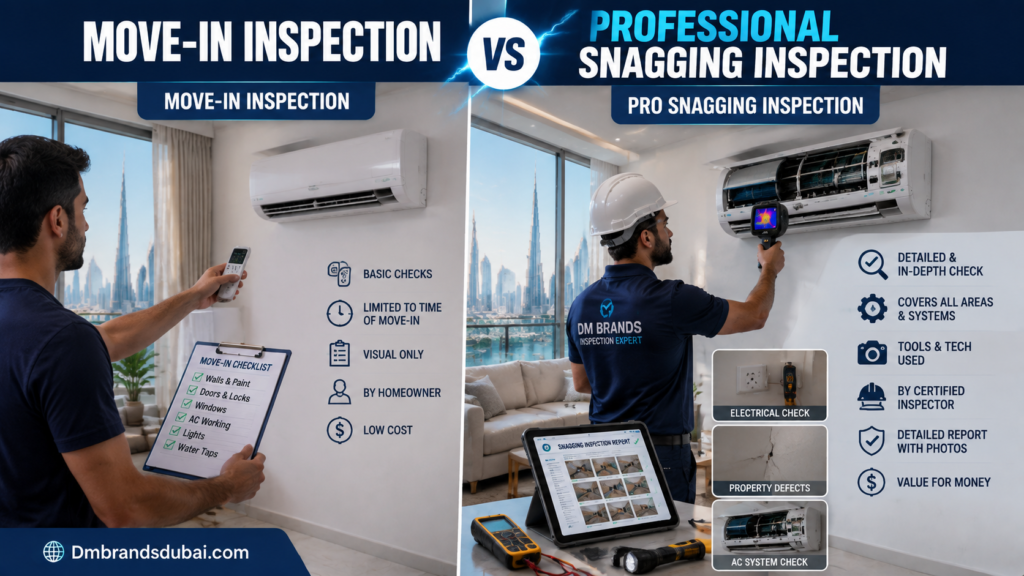
| Tenant Self-Inspection | Professional Inspection | |
|---|---|---|
| Cost | Free | Paid service |
| Speed | Same day, as part of move-in | Usually scheduled separately |
| Depth | Visual and functional checks | Technical diagnostics, coil/duct condition, refrigerant checks |
| Best for | Every tenancy, as a baseline | Older properties, units with a history of issues, high-value leases |
| Documentation | Tenant’s own photos and notes | Formal, dated inspection report |
A self-inspection is enough for most tenancies. But if a unit shows any red flags, or the property is older with no clear service history, a professional inspection gives you a technical, third-party record that carries more weight in a dispute.
What to Do If You Find a Problem
- Document it immediately with photos, video, and a written note of the date and issue.
- Report it to the landlord or property manager in writing before you start relying on the unit day to day.
- Ask for a repair timeline. Major AC faults are generally the landlord’s responsibility under Dubai’s tenancy law, and a documented move-in report strengthens your position if the issue isn’t addressed.
- Get an independent diagnosis if there’s disagreement about whether the fault is pre-existing or new — a professional inspection removes the guesswork.
- Don’t wait until summer to raise it. A fault reported and fixed in a cooler month is far less disruptive than one discovered during a heatwave.
Where DM Brands Dubai Fits In

If a unit fails your move-in check — or you’d rather have a professional confirm the condition before you settle in — DM Brands Dubai covers AC service and repair, AC replacement and installation, duct cleaning, and coil cleaning, alongside plumbing, electrical, and emergency call-outs, for villas, apartments, and offices across Dubai.
- A written quote before any work starts, useful as documentation if you need to show a landlord exactly what’s wrong and what it will cost to fix.
- Directly employed technicians who can inspect and diagnose a unit properly — not just confirm it “turns on,” but assess cooling performance, filter condition, and signs of wear.
- Same or next-day visits, so a fault found on move-in day doesn’t sit unresolved for weeks.
- Landlords bringing a property back between tenants can use a Residential Annual Maintenance Contract to keep units serviced and inspection-ready before every new move-in, avoiding disputes before they start.
You can request a free, no-obligation quote if you want a professional to check a unit before or right after you move in.
Related Articles
- Deep AC Cleaning Cost Dubai: Price Guide
- AC Mold Removal Dubai: Causes, Signs, Process and Prices
- How to Improve Indoor Air Quality Dubai: A Practical Home Guide
- Compare Residential vs Commercial Annual Contracts
- AC Service & Repair — What’s Included
Frequently Asked Questions (FAQs)
What is a move-in AC inspection?
A move-in AC inspection is a check of every AC unit’s condition and performance before or right after a tenant takes possession, done to establish a documented baseline and catch faults early.
Why is a move-in AC inspection important in Dubai?
Dubai’s climate makes AC essential to habitability, and a documented inspection protects your deposit, speeds up repairs, and prevents disputes over who caused a fault.
How long should I run the AC during a move-in check?
At least 15–20 minutes per unit, to confirm it reaches and holds a comfortable temperature rather than just blowing cold air briefly on start-up.
What are the biggest red flags during an AC inspection?
No cooling after 20 minutes, water leakage or staining, grinding or rattling noises, visible mould, and a musty or burning smell.
Do I need a professional for a move-in AC check?
Not always. A tenant self-inspection covers most cases, but a professional inspection is worth it for older properties, units with no clear service history, or any unit already showing red flags.
Who pays if the AC breaks shortly after move-in?
If the fault was documented at move-in and isn’t due to tenant misuse, it’s generally the landlord’s responsibility under Dubai’s tenancy law.
Should I photograph the AC units at move-in?
Yes. Photos and video of each indoor and outdoor unit, along with the thermostat display, are your strongest evidence if a dispute arises later.
What if the landlord isn’t present for the inspection?
Conduct the inspection yourself as soon as you take possession, document everything, and send your written findings to the landlord the same day.
Does every room need its own AC check?
Yes. Each unit should be tested individually — a working living room unit doesn’t confirm the bedroom units are also functioning correctly.
What should I do if I find mould in the AC vents?
Report it immediately in writing and avoid running the unit until it’s inspected, since mould can affect indoor air quality as well as cooling performance.
How does a move-in inspection protect my security deposit?
It creates a dated record of the AC’s condition before you started using it, so you can’t be blamed at move-out for a fault that already existed when you arrived.
Is a slight delay before cool air starts normal?
Yes, a brief delay on start-up is typical. The concern is a unit that never reaches a comfortable temperature after a sustained run.
What’s the difference between a move-in inspection and a snagging inspection?
A move-in inspection is a tenant’s own visual and functional check; a snagging inspection is a paid, professional, technical assessment — useful for higher-risk or older properties.
Should I check the outdoor condenser unit too?
If accessible, yes — look for rust, loose panels, obstructions, or standing water beneath it, all of which can affect performance and indicate maintenance needs.
What documentation should I keep from my move-in AC inspection?
Photos, video, written notes on each unit’s condition, and a copy of the message you sent the landlord — kept somewhere separate from just your phone.
Conclusion
A move-in AC inspection takes twenty minutes and can save you months of disputes, a broken deposit claim, or a summer spent without reliable cooling. Run every unit, document what you find, and report anything unusual in writing before you settle in.
If a unit needs a professional look before or right after move-in, get a free, written quote from DM Brands Dubai — a documented assessment and same-day availability if something needs fixing straight away.