A swimming pool is one of the most valued features of a Dubai villa — and one of the most demanding. In a desert climate, a pool faces intense sun, fine dust, high evaporation, and year-round use, all of which push water chemistry, filtration, and equipment harder than in temperate countries. Without regular maintenance, a sparkling pool turns cloudy within days, green within a couple of weeks, and expensive to recover soon after. This guide covers swimming pool maintenance in Dubai in full: the weekly routine, water chemistry, equipment care, common problems, realistic costs, and how to choose a maintenance service for your villa.
DM Brands provides swimming pool maintenance across Dubai's villa communities, including Arabian Ranches, Palm Jumeirah, Dubai Hills, Jumeirah Park, The Springs, Meadows, Emirates Hills, JVC, and Al Barsha. Whether you have a small plunge pool, a family-sized villa pool, or a larger pool with heating, lighting, and water features, the principles below apply — and the service options at the end explain how professional maintenance fits around your household routine.
Why Dubai Pools Need More Maintenance Than Pools Elsewhere
Dubai's climate creates a uniquely demanding environment for pool water and equipment. Ultraviolet radiation is intense for most of the year, and UV breaks down chlorine faster than in cooler climates, which means sanitiser levels fall quickly between doses. A pool that holds its chlorine level for a week in a temperate country may lose it in two or three days in a Dubai summer, leaving the water unprotected against bacteria and algae.
Dust is the second major factor. Fine desert dust settles on the water surface, blows into skimmers, clogs filters, and dulls the water's appearance. After a dusty day or a shamal wind, a pool can look visibly hazy even when its chemistry is correct, simply because of suspended particles. Dust also accumulates on pool surrounds and in planters, and it washes into the pool with the next rain or irrigation cycle, so the pool's surroundings matter as much as the pool itself.
Evaporation is the third factor, and it is substantial. A Dubai villa pool can lose several centimetres of water per week in summer, and evaporation concentrates dissolved minerals, raising calcium hardness and total dissolved solids over time. High calcium hardness causes scale on tiles, in heaters, and on salt chlorinator cells, while high dissolved solids make the water harder to balance and less pleasant to swim in. Regular partial water replacement — dilution — is part of long-term pool care in Dubai in a way it rarely is elsewhere.
Finally, year-round swimming means year-round maintenance. In countries with a closed winter season, pools rest for months; in Dubai, pools are used in every month, so there is no off-season in which to catch up on neglected maintenance. Equipment runs continuously, filters load constantly, and chemistry must be managed every week of the year. This is why a scheduled maintenance routine, rather than occasional attention, is essential.
The Weekly Pool Maintenance Routine
A well-maintained pool follows a weekly rhythm, and each task has a purpose that the others cannot replace. Skimming the surface removes leaves, insects, and dust before they sink and decompose, which consumes chlorine and clouds the water. In Dubai, skimming may be needed daily during dusty periods or when nearby trees shed, but at minimum it should be done several times a week.
Brushing the walls and floor is equally important and often skipped by homeowners who rely on automatic cleaners alone. Brushing dislodges algae spores and biofilm from surfaces, particularly in corners, steps, and shaded areas where circulation is weakest, and it pushes debris toward the main drain and skimmer where filtration can remove it. A pool that is vacuumed but never brushed will develop algae in exactly those corners and steps, because the vacuum passes over biofilm without dislodging it.
Vacuuming removes settled debris and fine dust from the floor. Manual vacuuming gives the most control, while robotic cleaners handle routine cleaning well but should not be relied on exclusively — they do not brush walls, and they can miss steps and corners. Whichever method you use, vacuum slowly: rushing stirs fine dust back into suspension, where it passes through the filter and resettles hours later.
Emptying skimmer and pump baskets is a small task with outsized importance. A full basket restricts water flow, starves the pump, raises filter pressure, and can cause the pump to run dry and overheat. Check baskets at least twice a week in summer, and daily during dusty weather or heavy leaf fall. Similarly, check the water level: it should sit at the middle of the skimmer opening. Too low, and the pump draws air; too high, and surface debris bypasses the skimmer.
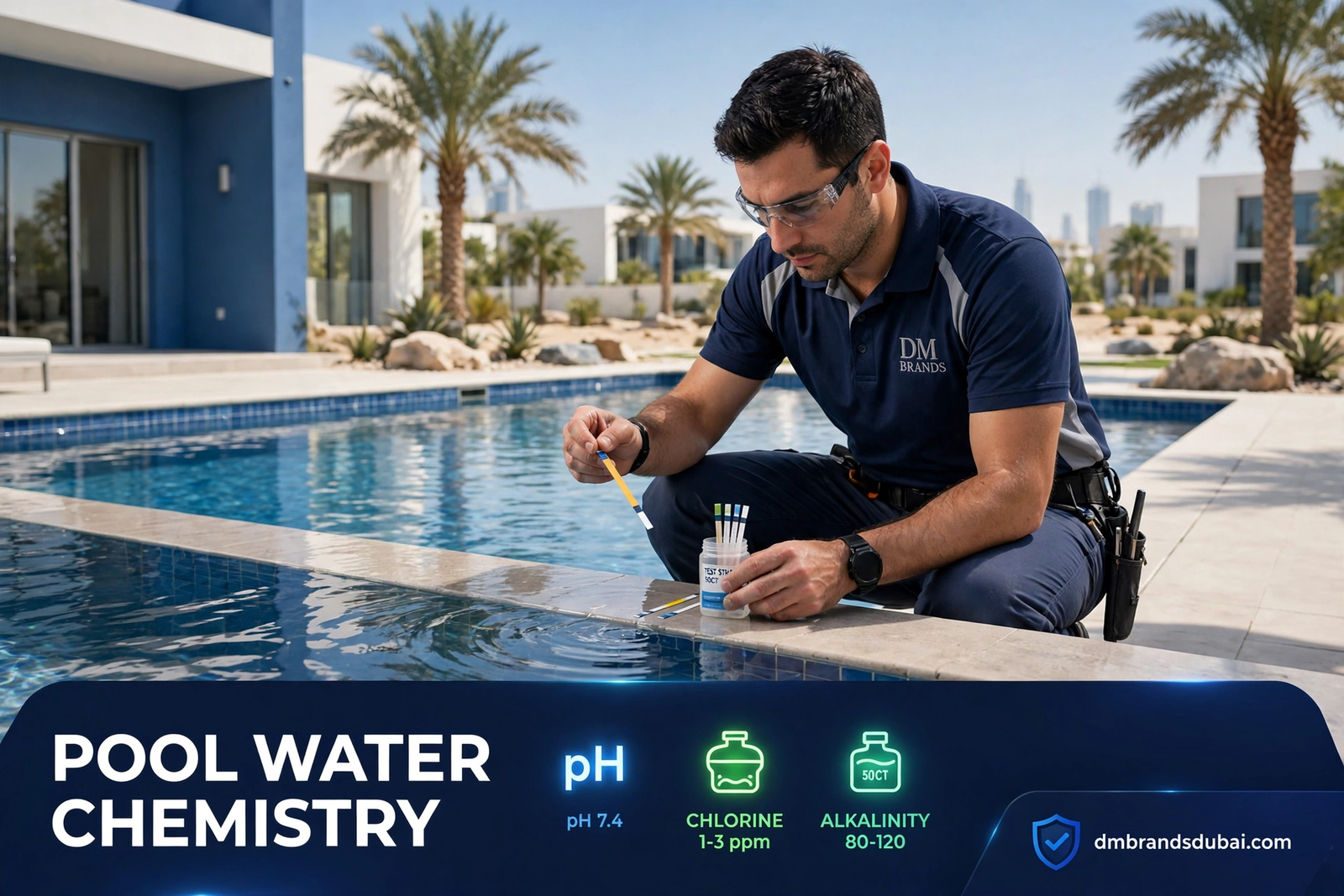
Water testing should happen at least twice a week in summer and weekly in winter. Test free chlorine, pH, and total alkalinity as a minimum, and test calcium hardness and cyanuric acid monthly. Record the results: a log of readings over time reveals trends — rising pH, falling chlorine, climbing hardness — that a single reading cannot, and it helps a maintenance technician diagnose problems quickly.
Pool Water Chemistry: What the Numbers Mean
Pool chemistry intimidates many villa owners, but it rests on a small number of measurements, each with a clear target range and a clear consequence when it drifts. Understanding them helps you judge whether a maintenance service is doing its job, and it helps you spot problems between visits.
Free chlorine is the sanitiser that kills bacteria and prevents algae. The target range for a residential pool is typically 1 to 3 parts per million (ppm). Below 1 ppm, the water is under-sanitised and algae can establish quickly, especially in Dubai's heat and sunlight. Above 5 ppm, the water irritates eyes and skin and can damage swimwear and pool surfaces. Chlorine demand rises with temperature, sunlight, bather load, and organic debris, so Dubai pools need more frequent dosing than the same pool would in a cooler climate.
pH measures how acidic or alkaline the water is, on a scale where 7 is neutral. The target range is 7.2 to 7.8, with 7.4 to 7.6 ideal. Low pH makes water corrosive: it irritates eyes and skin, etches plaster, and corrodes metal fittings and heaters. High pH makes chlorine less effective, causes cloudy water, and encourages scale formation on tiles and equipment. pH in Dubai pools tends to drift upward, partly because of aeration from water features and partly because of the local water supply, so regular adjustment downward is normal.
Total alkalinity buffers pH, preventing wild swings. The target range is 80 to 120 ppm. Low alkalinity makes pH unstable and difficult to control; high alkalinity makes pH resistant to adjustment and encourages scaling. Alkalinity should be corrected before fine-tuning pH, because adjusting pH while alkalinity is out of range is like steering a car with loose steering — the response is unpredictable.
Calcium hardness measures dissolved calcium, with a target range of 200 to 400 ppm for most pools. In Dubai, hardness climbs steadily because evaporation concentrates minerals and top-up water adds more calcium. Low hardness makes water aggressive toward plaster and grout; high hardness causes scale on tiles, in heaters, and on salt cells. Managing hardness long-term requires periodic partial draining and refilling with softer water, a task best planned with your maintenance provider rather than improvised.
Cyanuric acid, or stabiliser, protects chlorine from UV breakdown, which is critical in Dubai's sun. The target range is typically 30 to 50 ppm. Too little, and chlorine burns off within hours in summer sun; too much, and chlorine becomes less effective even though test readings look adequate — a condition known as chlorine lock, which can only be fixed by diluting the water. Stabilised chlorine products add cyanuric acid with every dose, so levels creep upward over time and must be monitored, particularly in pools that use chlorine tablets year-round.
Saltwater pools, increasingly common in Dubai villas, use a salt chlorinator cell to convert salt into chlorine. They still need the same chemistry monitoring — pH, alkalinity, hardness, and stabiliser — plus salt level checks and periodic cell cleaning to remove calcium scale. A scaled cell produces less chlorine, which looks like a chlorine problem but is really a cell-maintenance problem. Cell cleaning with a mild acid solution, done carefully and at the right interval, restores output and extends cell life significantly.
Pool Equipment: Pumps, Filters, Heaters, and Cleaners
Pool equipment is the machinery behind clear water, and its maintenance determines both water quality and running costs. The pump is the heart of the system: it circulates water through the filter and back to the pool, distributing sanitiser and removing debris. Pump problems show up as weak flow, unusual noise, leaks at the seals, or a pump that will not prime. A pump running dry — without water — overheats quickly and can destroy its seals and motor, so any loss of prime should be investigated immediately rather than left running.
Pump running times matter more than many owners realise. In Dubai's summer, a pool typically needs eight to twelve hours of circulation daily, split across the day to keep sanitiser distributed and to filter dust as it settles. Running the pump too little leaves dead zones where algae establishes; running it unnecessarily at full speed wastes electricity. Variable-speed pumps, which run longer at lower speed, filter more effectively for less energy than single-speed pumps run for short bursts, and they are worth considering when a pump needs replacement.
Filters come in three main types, each with its own maintenance. Sand filters are the most common in Dubai villas: water passes through a bed of sand that traps debris, and the filter is cleaned by backwashing — reversing the flow to flush trapped debris out. Backwash when the pressure gauge reads 8 to 10 psi above its clean baseline, not on a fixed calendar, because dust loading varies with weather. Sand itself lasts several years but eventually channels and loses effectiveness, and replacement sand must be the correct grade for the filter.
Cartridge filters use pleated cartridges that trap finer particles than sand, producing clearer water, but they must be removed and hosed clean regularly — monthly in Dubai's dusty conditions — and replaced when the fabric degrades. Diatomaceous earth (DE) filters trap the finest particles of all and produce the clearest water, but they require DE powder top-ups after backwashing and more careful handling. Whichever type you have, a filter that is never cleaned cannot clear cloudy water no matter how much chemical is added, and a surprising number of "chemical problems" are really filter problems.
Heaters extend Dubai's swimming season into the cooler months and are common in villas with year-round use. Gas heaters need burner and heat-exchanger inspection, heat-pump heaters need airflow and refrigerant checks, and electric heaters need element and thermostat checks. Scale from hard Dubai water is the main enemy of all heater types, reducing efficiency and eventually causing failure. A heater that takes longer to reach temperature, or that trips repeatedly, should be inspected before the cooler months when it will be needed most.
Automatic cleaners — suction cleaners, pressure cleaners, and robots — reduce manual vacuuming but do not replace brushing, skimming, or chemistry management. Their own maintenance matters: check hoses for leaks, clean filter bags or canisters after each use, and inspect brushes and tracks for wear. A cleaner that moves slowly or misses areas may have a worn part rather than a pool problem, and diagnosing the cleaner separately from the pool saves unnecessary chemical adjustments.
Pool lighting, water features, and automation add enjoyment but also add maintenance points. Lights need seal checks to prevent water ingress, which can trip safety devices. Water features aerate the water, which raises pH faster, so pools with fountains or waterfalls need more frequent pH adjustment. Automation systems — timers, salt chlorinators, and smart controllers — need periodic calibration and battery checks, and their settings should be reviewed seasonally as temperatures and usage change.
Common Pool Problems and How They Are Fixed
Cloudy water is the most common complaint, and it has several distinct causes that require different fixes. Fine dust suspended in the water, a dirty or channelling filter, low sanitiser, high pH, or high dissolved solids can each produce cloudiness. A technician diagnoses by testing chemistry, checking filter pressure, and inspecting circulation; adding clarifier without diagnosis may clear the water temporarily while the underlying cause — often the filter — remains.
Green water means algae, and it ranges from a light green tint to a thick, opaque bloom. Algae establishes when sanitiser falls too low, usually after a period of heavy use, a dust storm, or a pump failure. Treatment involves brushing all surfaces to break the algae's protective biofilm, shocking the pool with a high chlorine dose, running the filter continuously, and cleaning the filter afterwards to remove the dead algae it has captured. Severe blooms may need algaecide as well, but algaecide alone without brushing and shocking rarely works, because live algae clings to surfaces that chemicals alone cannot fully reach.
Stains on pool surfaces tell their own stories. Brown or reddish stains often indicate iron, sometimes from bore water or corroding fittings. Blue-green stains suggest copper, often from algaecides or corroding heater components. Black spots that resist brushing may be black algae, which roots into plaster and needs aggressive brushing and targeted treatment. White crusty deposits at the waterline are calcium scale, driven by high hardness and high pH. Each stain type has a different treatment, and misidentifying the stain wastes chemicals and can damage surfaces.
Foamy water usually comes from algaecides, low-quality chemicals, or contaminants such as lotions and detergents. It is rarely dangerous but looks unpleasant and indicates that the water needs partial replacement or a clarifier treatment. A persistent musty or chemical smell, despite correct chlorine readings, may indicate chloramines — combined chlorine formed when free chlorine reacts with sweat, sunscreen, and organic matter. Shocking the pool breaks down chloramines and restores fresh-smelling water.
Equipment problems have their own signatures. A pump that hums without starting may have a failed capacitor. A filter that loses pressure suddenly may have a broken lateral or a channelled sand bed. A salt chlorinator showing low output despite correct salt levels usually has a scaled cell. A pool losing water faster than evaporation explains — more than a centimetre a day in summer, or any loss in winter — may have a plumbing leak, a cracked skimmer, or a leaking light niche, and leak detection should be arranged promptly, because an undetected leak undermines the pool structure and wastes large volumes of water.
Pool Maintenance Costs in Dubai: What Is Reasonable?
Pool maintenance pricing in Dubai varies with pool size, equipment complexity, and visit frequency, but there are sensible benchmarks. A standard weekly maintenance visit for a typical villa pool — skimming, brushing, vacuuming, basket emptying, water testing, chemical balancing, and a filter check — typically costs between AED 600 and AED 1,200 per month on a contract basis, depending on pool size and location. Larger pools, pools with water features and heating, and pools in communities with difficult access sit at the higher end.
One-off services are priced individually. A green-pool recovery, involving brushing, shocking, continuous filtration, and filter cleaning, typically costs AED 800 to AED 2,000 depending on severity, because it requires multiple visits and significant chemical use. A filter sand change usually costs AED 600 to AED 1,200 including sand and labour. A pump repair ranges from AED 400 for a seal or capacitor to AED 1,500 or more for a motor replacement, and a full pump replacement typically costs AED 2,000 to AED 4,500 depending on size and type. Salt cell replacement is a major periodic cost, typically AED 1,500 to AED 3,500, with cells lasting three to seven years depending on use and scale management.
Several factors affect what you pay. Pools with heavy dust exposure or many overhanging trees need more frequent visits. Pools with salt chlorinators need cell cleaning included in the service, not charged as an extra each time. Pools that have been neglected cost more in the first months, because recovery and equipment servicing catch up on deferred maintenance before a steady routine can be established. A reputable company will explain this honestly rather than quoting a low monthly rate and adding surprise charges.
When comparing quotes, check what is included: chemicals, filter cleaning, equipment checks, and reporting. A contract that includes chemicals but charges separately for every chemical top-up is not the bargain it appears. Ask whether the company tests and records chemistry at each visit and shares the readings with you, because a service that cannot show you its readings is not a service you can verify. Also confirm response times for problems between visits — a pump failure in July cannot wait until next week's scheduled visit.
Choosing a Pool Maintenance Service in Dubai
Choosing a pool service is a longer-term decision than choosing a one-off repair, because the company will visit your home weekly and manage water your family swims in. Reliability matters more than the lowest price: a company that misses visits in August, when chlorine demand is highest, will cost you a green pool and a recovery bill that dwarfs any monthly saving.
Ask about the technician who will actually visit: will it be the same person each week, are they trained in water chemistry rather than just cleaning, and do they carry test equipment and record readings. Ask what chemicals are used and whether they are reputable brands stored and dosed correctly — improvised chemical handling is both ineffective and unsafe. Ask about insurance and about how equipment faults are reported and quoted: a good service flags a wearing pump seal or a rising filter pressure before it becomes a failure, rather than waiting for the breakdown.
Consider whether the company can handle the full range of villa maintenance, because pool problems often overlap with other systems. A pool pump fault may need an electrician, a pool surround drainage problem may need a plumber, and a pool area renovation may need tiling or painting. A company such as DM Brands, which covers plumbing leak repair Dubai, electrical repair services Dubai, and deep cleaning services Dubai, can coordinate these without you managing multiple contractors. For households with several properties, an annual maintenance contract Dubai that includes pool care simplifies management further, particularly when the owner is overseas.
Finally, be wary of contracts that lock you in for a year with no service standards, and prefer arrangements with clear visit schedules, chemistry reporting, and a defined process for problems between visits. A trial month is a reasonable request, and a confident company will agree to it.

Pool Safety Essentials for Dubai Villas
Pool safety deserves a dedicated section, because Dubai villas with pools are family homes, and the risks are real. Drowning prevention starts with barriers: a pool fence with a self-closing, self-latching gate, kept locked when the pool is not in supervised use, is the single most effective measure. Alarms on pool gates and doors leading to the pool area add a second layer, particularly for households with toddlers.
Chemical safety matters too. Pool chemicals should be stored in a cool, dry, ventilated place away from the house and from each other — chlorine and acid must never be stored together or mixed, because their combination produces dangerous gases. Chemicals should be kept in their original labelled containers, out of children's reach, and handled with gloves and eye protection. Never add water to chemicals; always add chemicals to water, and never mix different chemicals together.
Electrical safety around pools is critical. Lights, pumps, and heaters must be protected by appropriate safety devices and inspected regularly, because water and electricity are a lethal combination. Any tingling sensation in the water, any tripping of pool circuit protection, or any damaged cable or light fitting should prompt immediate switch-off and professional inspection before anyone swims again.
Supervision remains irreplaceable. No fence, alarm, or swimming lesson substitutes for an adult watching children in and around the pool without distraction. For households employing domestic staff, ensure that everyone who supervises children near the pool knows basic water safety and where the pool's emergency equipment — a reaching pole, a throwing ring, and a phone — is kept.
Pool Maintenance Across Dubai's Villa Communities
Pool profiles differ across Dubai's communities. Palm Jumeirah pools face salt air corrosion, high winds, and sand exposure, and their equipment needs more frequent inspection for corrosion and dust loading. Arabian Ranches and Dubai Hills pools are typically family-sized, heavily used, and surrounded by landscaping that sheds leaves and pollen, increasing skimming and filter loads. The Springs and Meadows include smaller pools where chemistry swings faster because the water volume is smaller — a dosing error that barely registers in a large pool can overshoot badly in a small one.
JVC and Al Barsha villas often have newer pools with modern equipment, including salt chlorinators and automation, where the maintenance emphasis is on calibration and cell care rather than basic cleaning. Emirates Hills and Jumeirah Park include larger pools with heating, lighting, and water features, where equipment maintenance dominates the workload. In every community, same-week service starts are usually possible, and emergency visits for pump failures or green pools are prioritised in summer.
When booking a service, mention your community, pool size and type, equipment brands, and any current problems. A pool that has gone green, a pump that has stopped, and a routine maintenance request are different jobs, and the dispatcher should prioritise them differently and send a technician with the right chemicals and parts.
Frequently Asked Questions About Swimming Pool Maintenance in Dubai
How often should my pool be serviced in Dubai?
Weekly servicing is the standard for villa pools in Dubai, with twice-weekly visits recommended in summer for heavily used pools, pools with many trees nearby, or pools that have had recurring algae problems. Water testing should happen at least twice a week in summer, even between professional visits.
Why does my pool keep going green despite regular chlorine?
The most common reasons are insufficient chlorine for Dubai's UV and temperature, poor circulation leaving dead zones, a dirty filter that cannot remove algae, or cyanuric acid so high that chlorine is ineffective. A technician should test all parameters and check circulation and filtration before simply adding more chlorine.
How much water does a Dubai pool lose to evaporation?
In summer, a typical villa pool can lose two to five centimetres per week, depending on size, wind, and whether a pool cover is used. A pool cover dramatically reduces evaporation and chemical loss, and it is one of the most cost-effective investments for a Dubai pool owner.
Is a saltwater pool easier to maintain than a chlorine pool?
Saltwater pools are more convenient day to day, because the chlorinator produces chlorine continuously, but they are not maintenance-free. Salt levels, cell scaling, pH, alkalinity, and hardness still need monitoring, and the cell itself is a significant periodic replacement cost. The choice is about convenience and swimmer comfort, not about eliminating maintenance.
Can I maintain my pool myself, or should I hire a professional?
Basic tasks — skimming, basket emptying, and water testing — are manageable for an engaged homeowner. Full maintenance, including chemical balancing, filter servicing, equipment diagnosis, and green-pool recovery, benefits from professional training and equipment. Many owners handle daily skimming themselves and rely on a weekly professional visit for the rest, which is a practical and effective combination.
What should I do if my pool pump stops working?
Switch the pump off, check the baskets and water level, and check the circuit breaker. If the pump still will not start or prime, do not keep running it — a pump running dry damages seals and motors quickly. Book a repair promptly, especially in summer, because circulation loss leads to algae within days.
How do I prepare my pool for a holiday?
Arrange for maintenance visits to continue while you are away — this is the most important step. Top up chemicals, clean the filter, check the water level and timer settings, and consider a pool cover to reduce evaporation and debris. Never leave a pool unattended for weeks in a Dubai summer and expect it to be swimmable on your return.
Book Your Swimming Pool Maintenance in Dubai Today
A Dubai villa pool rewards consistent care and punishes neglect quickly. The difference between a sparkling pool and a green one is rarely a single dramatic event — it is the accumulation of missed skimming, untested chemistry, uncleaned filters, and ignored equipment warnings. A regular professional routine prevents that accumulation, keeps running costs down, protects expensive equipment, and ensures the pool is ready whenever your family wants to swim.
If your pool needs a reliable weekly service, a green-pool recovery, equipment repair, or simply an honest assessment of its current condition, contact DM Brands today. Tell us your community, pool size and type, and any problems you have noticed, and we will arrange a visit at a time that suits you. We serve Arabian Ranches, Palm Jumeirah, Dubai Hills, JVC, and villa communities across Dubai, with transparent pricing, recorded water chemistry at every visit, and warranty-backed work. For wider household cover, ask about our annual maintenance contracts and our related services, including water tank cleaning Dubai and AC maintenance service Dubai.
Book your swimming pool maintenance in Dubai now, and enjoy a clean, safe, sparkling pool all year round.