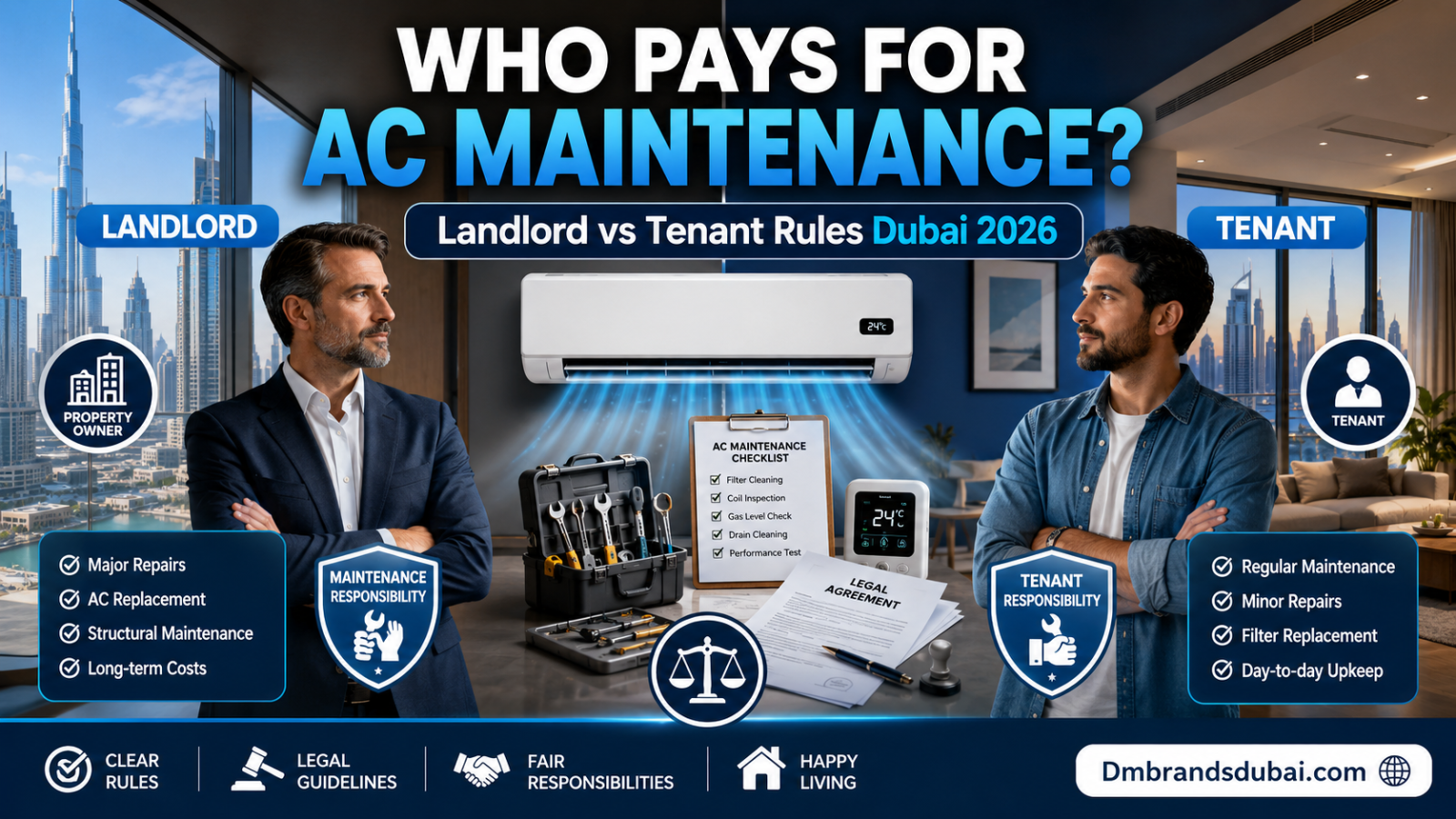
Who Pays for AC Maintenance in Dubai? If your AC has just died in August and you’re refreshing your tenancy contract on your phone, here’s the short version: in Dubai, the landlord is legally responsible for AC maintenance and repair, because a working AC is treated as essential to a habitable home — not an optional extra.
Tenants are only expected to cover small, routine upkeep. But “small” has a specific meaning under Dubai law, and getting it wrong can leave you paying a bill that was never yours to pay.
Table of Contents
Who Pays for AC Maintenance in Dubai?
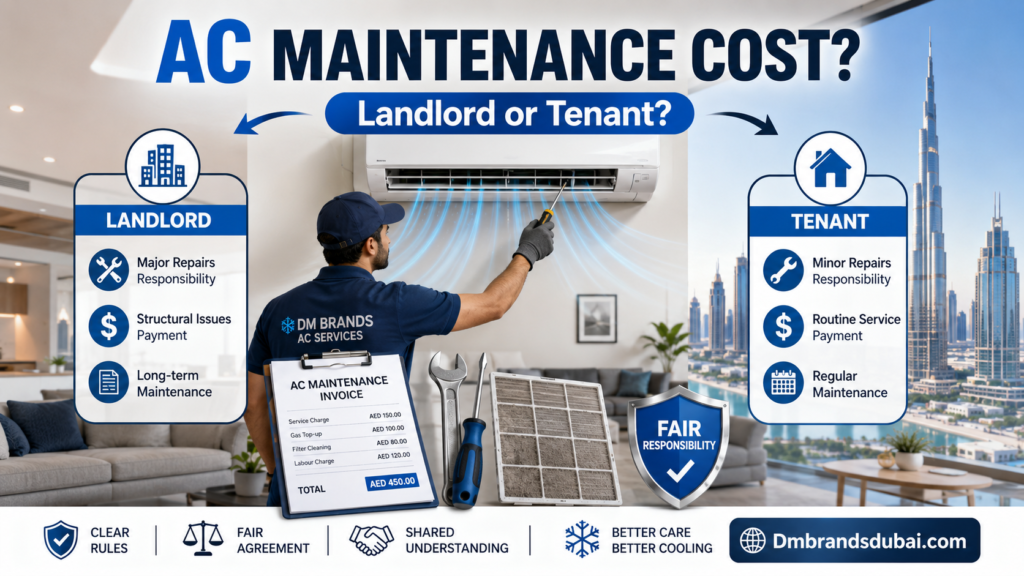
The landlord pays for AC maintenance in Dubai in almost every case. Under Article 16 of Dubai’s Tenancy Law (Law No. 26 of 2007, amended by Law No. 33 of 2008), the landlord must maintain the property and fix any defect that stops the tenant from using it as intended — and a non-functioning AC counts as exactly that kind of defect. Tenants are generally only responsible for light, routine upkeep, such as cleaning accessible filters, and for damage they cause themselves through misuse or negligence.
Most tenancy contracts translate this into a simple cost-threshold rule: repairs under a set amount (commonly AED 500–1,000, depending on the contract) are the tenant’s responsibility, while anything above that threshold falls to the landlord. Always check your specific contract, because this figure is not fixed by law — it’s a common contractual convention that sits on top of the legal default.
The Legal Basis: What Dubai Law Actually Says
Everything in this guide traces back to one law.
- Law No. 26 of 2007 (the Dubai Tenancy Law), as amended by Law No. 33 of 2008, governs the landlord–tenant relationship in Dubai.
- Article 16 states that the landlord is responsible, for the full term of the tenancy contract, for maintaining the property and rectifying any defect or fault that affects the tenant’s intended use of it — unless the parties have agreed otherwise in writing.
- The Ejari registration system records the official tenancy contract, and disputes are typically resolved with reference to that registered agreement.
- If a dispute can’t be resolved directly, it goes to the Rental Disputes Settlement Centre (RDSC) at the Dubai Land Department (DLD), which is overseen alongside the Real Estate Regulatory Agency (RERA).
The reasoning behind treating AC as a landlord responsibility is straightforward: Dubai’s climate makes air conditioning a habitability issue, not a comfort upgrade. For much of the year, a home without working AC is not reasonably usable — which is exactly the standard Article 16 is built around.
Landlord vs Tenant: Who Pays for What
| Responsibility | Typically Paid By | Examples |
|---|---|---|
| AC compressor failure | Landlord | Compressor stops cooling, needs replacement |
| Chiller or central system breakdown | Landlord | Building-level or ducted system failure |
| Duct damage or major duct cleaning | Landlord | Torn ductwork, mould in shared ducts |
| Gas refill / refrigerant leaks (not caused by tenant) | Landlord | Normal wear and tear leaks |
| AC unit replacement due to age | Landlord | Unit is old and inefficient, not tenant-damaged |
| Routine filter cleaning | Tenant | Wiping or replacing accessible air filters |
| Minor upkeep under the contract threshold | Tenant | Small repairs below the AED cut-off in the contract |
| Damage from tenant misuse | Tenant | Setting the thermostat to extreme lows for long periods, physical damage from cleaning with a high-pressure hose |
| DEWA electricity bills for running the AC | Tenant | Ongoing utility costs, not the unit itself |
| Building service charges | Property owner (not usually the tenant) | Shared HVAC infrastructure levies |
Key takeaway: the split isn’t really “big repairs vs small repairs” — it’s “was this normal wear and tear, or did the tenant cause it, and did the cost cross the threshold in the contract?” All three questions matter.
How the AED Cost-Threshold Rule Works
Many Dubai tenancy contracts add a practical rule on top of Article 16: a fixed AED amount that separates tenant-paid “minor” maintenance from landlord-paid “major” maintenance.
- The threshold most commonly cited sits somewhere between AED 500 and AED 1,000, but this varies by contract — it is a contractual clause, not a number fixed in the law itself.
- If a repair costs less than the threshold, the tenant typically pays.
- If it costs more than the threshold, the landlord typically pays — unless the damage was caused by the tenant’s negligence, in which case the tenant pays regardless of the amount.
- This is why your first move after any AC problem should be checking your Ejari-registered contract for the exact figure and wording used in your case, because “typical” practice does not override what you actually signed.
When the Tenant Pays Regardless of Cost
The cost threshold does not protect a tenant from damage they caused. Common examples that shift the bill to the tenant even for large repairs include:
- Physically damaging the unit — for example, breaking the fan by cleaning it with a high-pressure hose.
- Running the thermostat at extreme low settings for extended periods in a way that damages the compressor.
- Blocking vents, drains, or outdoor units in a way that causes a preventable breakdown.
- Any damage that is clearly the result of misuse rather than normal wear and tear.
If a landlord tries to bill you for age-related failure — “it’s a 12-year-old unit, so you pay” — that argument does not hold up under Article 16. Equipment age is the landlord’s risk to manage, not a reason to shift the cost to the tenant.
What to Do When Your AC Breaks: A Step-by-Step Guide
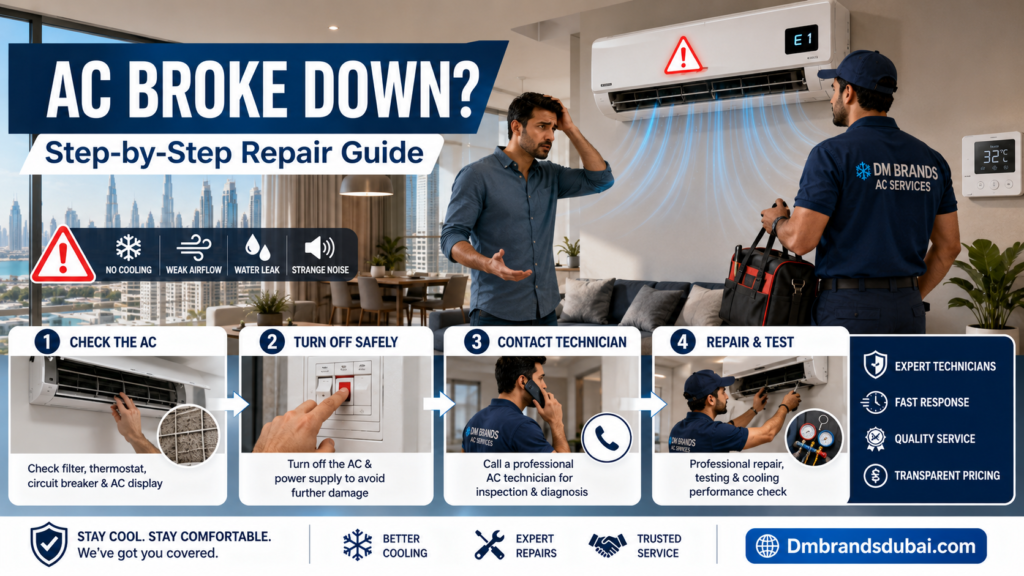
- Check your Ejari contract first. Look for the maintenance clause and any cost threshold before doing anything else.
- Report the issue in writing. Email or WhatsApp your landlord or property manager the moment you notice a problem — verbal requests are hard to prove later.
- Get a written quote. A professional diagnosis gives you a real number to send to the landlord, rather than a vague complaint.
- Send the quote and a deadline. Give the landlord a reasonable, documented window to act.
- Keep every record. Photos, dated messages, and the quote all become evidence if the dispute escalates.
- Escalate to the RDSC if needed. If the landlord refuses to act on a legitimate major repair, the Rental Disputes Settlement Centre at the Dubai Land Department is the formal route.
- Get it fixed if it’s urgent. For active water damage or total loss of cooling in summer, don’t wait on the paperwork before calling a technician — document everything and pursue reimbursement in parallel.
That last step is where most tenants get stuck: the legal process protects your rights, but it doesn’t cool your apartment down tonight. That’s usually the moment people call a same-day AC repair team while the landlord dispute runs in the background.
Preventing Disputes Before They Start
- Read the maintenance clause before you sign, not after something breaks.
- Photograph the AC units at move-in — this documents condition and protects both sides.
- Keep the tenancy contract and Ejari certificate somewhere you can find them fast, ideally saved on your phone.
- Report small issues early. A minor problem reported promptly is far cheaper to fix than one left until it becomes a major, landlord-scale repair.
- Consider who’s covered by an annual maintenance contract, since landlords who keep AC units on a scheduled servicing plan tend to face far fewer emergency-level (and disputed) repairs in the first place.
Where DM Brands Dubai Fits In
Whoever is legally responsible for the bill, someone still has to physically fix the AC — and that’s the part we handle. DM Brands Dubai is a Dubai-wide home maintenance company covering AC service and repair, AC replacement and installation, duct cleaning, coil cleaning, plumbing, electrical, and emergency call-outs for villas, apartments, and offices.
A few things worth knowing whether you’re a tenant trying to get a repair quote for your landlord, or a landlord managing the units directly:
- A written price before work starts. You get a quote you can forward straight to a landlord or tenant for approval — useful if you need documentation for a dispute.
- Directly employed technicians, not subcontracted labour, with same-day or next-day visits and a dedicated emergency call-out service for total cooling loss.
- Landlords managing multiple units can avoid repeat emergency-priced call-outs with a Residential or Commercial Annual Maintenance Contract — scheduled servicing plus priority response, which is also the simplest way to stay ahead of the “normal wear and tear” disputes covered above.
- Tenants needing an independent quote to send to a landlord can request one through the free quote form with no obligation.
If you’re not sure whether your specific issue counts as a tenant repair or a landlord repair, a technician can usually tell you on inspection — which also gives you the documented, professional opinion you need if the cost has to be argued over later.
Comparison: Ad Hoc Repair vs Annual Maintenance Contract
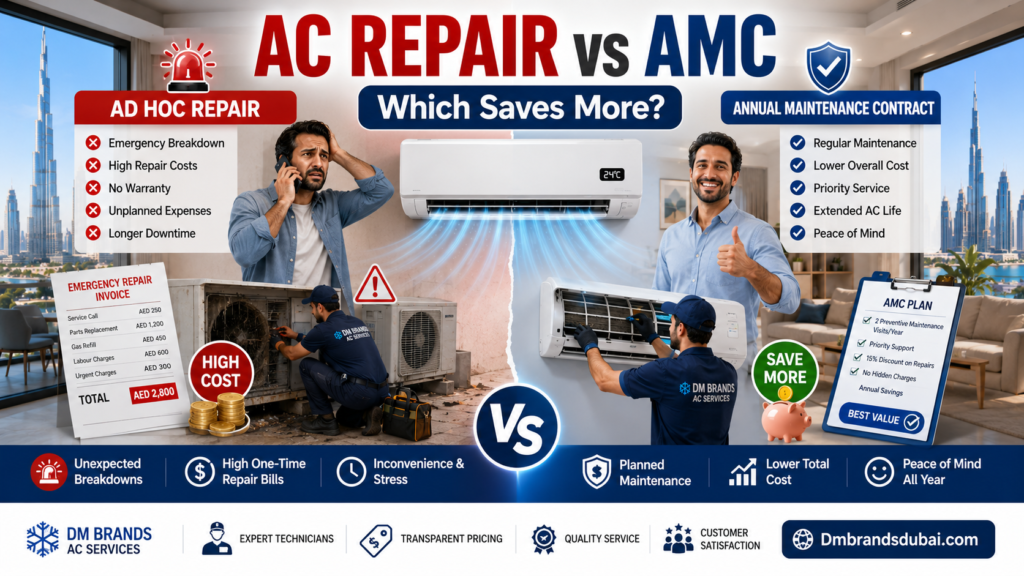
| Ad Hoc Repair | Annual Maintenance Contract | |
|---|---|---|
| Best for | One-off breakdowns, single-unit homes | Multiple AC units, landlords, managed buildings |
| Pricing | Quoted per job | One fixed annual cost, spread monthly |
| Response priority | Standard queue | Priority booking ahead of ad-hoc jobs |
| Prevents disputes over “wear and tear”? | No — issues are addressed reactively | Yes — scheduled servicing reduces breakdown frequency |
| Includes plumbing/electrical call-outs? | Priced separately | Often included |
| Commitment | None | Annual, no long lock-in beyond the year |
Related Articles
- Deep AC Cleaning Cost Dubai: Price Guide
- AC Mold Removal Dubai: Causes, Signs, Process and Prices
- How to Improve Indoor Air Quality Dubai: A Practical Home Guide
- Compare Residential vs Commercial Annual Contracts
- AC Service & Repair — What’s Included
Frequently Asked Questions (FAQs)
Does the landlord always pay for AC repair in Dubai?
In almost all cases, yes — under Article 16 of Law No. 26 of 2007, the landlord is responsible for repairs that affect the tenant’s ability to use the property, and AC is treated as essential. The main exception is damage caused by tenant misuse.
What is the AED threshold for tenant vs landlord AC repairs?
Many contracts set a cost cut-off, commonly between AED 500 and AED 1,000, below which the tenant pays and above which the landlord pays. This figure comes from the contract, not directly from the law, so always check your own Ejari agreement.
Who pays if the AC breaks from normal wear and tear?
The landlord. Age-related or wear-and-tear failure is the landlord’s responsibility, and they cannot use the unit’s age as a reason to bill the tenant.
Who pays if I damage the AC myself?
You do. If the damage is caused by misuse — for example, physically damaging the unit or running it in a way that harms the compressor — the tenant is responsible regardless of the repair cost.
Is routine filter cleaning the tenant’s job?
Yes. Basic, accessible filter cleaning is generally considered routine tenant upkeep, separate from major servicing or repair.
What law governs AC maintenance responsibility in Dubai?
Dubai Law No. 26 of 2007, as amended by Law No. 33 of 2008, with Article 16 specifically addressing maintenance obligations.
What if my landlord refuses to fix the AC?
Document the issue with photos and written communication, send a repair quote with a deadline, and if there’s no response, escalate to the Rental Disputes Settlement Centre (RDSC) at the Dubai Land Department.
Does my tenancy contract override the law?
Contracts can add detail — like a cost threshold — but they can’t remove the landlord’s core obligation under Article 16 unless both parties have genuinely agreed otherwise in writing.
Who pays for AC duct cleaning — landlord or tenant?
This depends on scale: routine, accessible duct or filter maintenance often sits with the tenant, while full ductwork cleaning or decontamination for damage or mould is typically a landlord-covered major service.
Who pays for AC gas refill in Dubai?
If the refrigerant leak is due to normal wear and tear, it’s a landlord expense. If it’s linked to tenant-caused damage, the tenant pays.
Does DEWA cover any part of AC maintenance?
No. DEWA bills cover electricity and water consumption, not the maintenance or repair of the AC unit itself.
Who pays for AC replacement if the unit is very old?
The landlord. An old, inefficient, or failing unit is the landlord’s responsibility to replace — tenants aren’t obligated to fund upgrades to equipment they don’t own.
Can a landlord make a tenant pay for AC repairs in the contract?
Only within reasonable limits and with the tenant’s written agreement — a blanket clause forcing the tenant to cover all AC repairs regardless of cause would conflict with the protections in Article 16.
How fast must a landlord respond to an AC breakdown in summer?
The law requires “timely” action given that AC affects habitability, and the DLD has tightened enforcement around response times for major repairs, though there’s no single fixed number of hours written into the law itself.
What evidence do I need for an RDSC maintenance case?
Your Ejari-registered contract, dated written communication with the landlord, photos of the issue, and a professional repair quote or diagnosis.
Is a dripping tap the same category as a broken AC?
No. A dripping tap is a minor, tenant-level issue, while total loss of cooling — especially in summer — is generally treated as an emergency affecting habitability.
Who pays for AC servicing under an annual maintenance contract?
Whoever holds the contract pays the fixed annual fee; landlords typically take these out to manage scheduled servicing and reduce emergency repairs across a property.
Does the tenant have to be present for AC repairs?
Not necessarily, but access needs to be arranged with reasonable notice, and it’s good practice for the tenant to be informed of what work was carried out.
What counts as an AC emergency in Dubai?
Total loss of cooling in summer, active water leaks from the unit, or anything causing ongoing damage to the property — as opposed to a routine performance issue.
Can I get a repair quote without committing to the landlord’s chosen contractor?
Yes — tenants can request an independent quote to forward to the landlord for approval, which is often useful in disputes over pricing.
Who is responsible for water damage caused by a leaking AC unit?
The landlord, if the leak stems from normal equipment failure. Document it immediately, since water damage in Dubai’s humidity can spread and worsen quickly.
Conclusion
For the vast majority of Dubai tenancies, the landlord pays for AC maintenance — the law is built around AC being essential to a liveable home, not a luxury add-on.
Tenants generally cover only small, routine upkeep, plus any damage they cause themselves.
The safest first step in any dispute is always the same: check your Ejari-registered contract for the specific cost threshold and wording, document everything in writing, and escalate to the RDSC if a landlord won’t act on a legitimate major repair.
While that plays out, the AC still needs to actually get fixed. Get a free, no-obligation quote from DM Brands Dubai — a written price before any work starts, same-day availability for genuine emergencies, and a documented quote you can hand straight to your landlord.