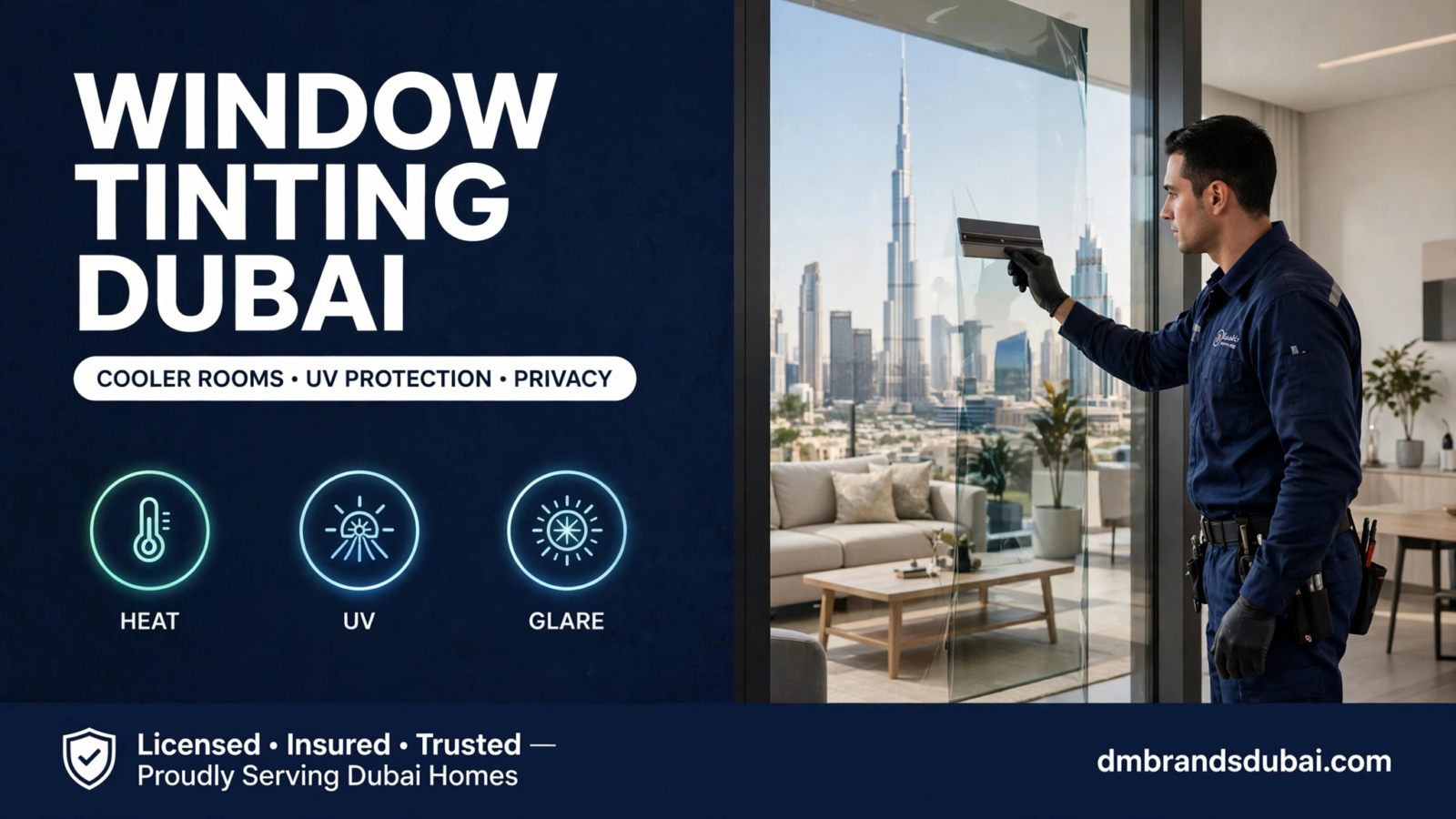
Window Tinting Dubai: The Complete Guide for Homes, Villas and Apartments
Window tinting Dubai homeowners choose today is no longer a luxury add-on. It is a practical response to intense sun, soaring summer temperatures, and air-conditioning bills that climb every year. A good window film can reject a large share of solar heat before it enters your living room. It can cut glare on television screens and laptops, protect sofas and wooden floors from fading, and give your family privacy without closing the curtains all day.
This guide explains everything you need to know before you book window tinting in Dubai. You will learn how window film works, how dyed, metallic, carbon, ceramic and security films compare, and what each type costs in AED. You will also learn how to choose the right visible light transmission level, what Dubai building rules allow, how professional installation works in a high-rise apartment or a villa, and how to avoid the most common mistakes.
DM Brands Dubai installs residential window film across Dubai Marina, Jumeirah Village Circle, Palm Jumeirah, Downtown Dubai, Arabian Ranches, Business Bay, Dubai Hills Estate, Al Barsha, Mirdif and Jumeirah. Whether you live in a sun-facing tower apartment or a large villa with floor-to-ceiling glass, the advice below will help you choose a film that stays cool, looks good, and lasts for years.
Quick Answer: Is Window Tinting Worth It in Dubai?
Yes, window tinting is worth it for most Dubai homes. The city receives intense direct sun for most of the year, and large glass windows turn living rooms into greenhouses. Quality ceramic or carbon film reduces heat and glare, blocks most ultraviolet light, and helps your air conditioning work less hard.
The best film depends on your priority. Choose ceramic film for maximum heat rejection without a dark look. Choose carbon film for strong heat rejection at a mid-range price. Choose security film if you want glass that holds together when it breaks. Choose a privacy film if neighbours or a nearby tower can see directly into your home.
A professional installer matters as much as the film itself. Poor installation causes bubbles, peeling edges, creases and a hazy finish. A licensed and insured team, such as DM Brands Dubai, measures every pane, cuts film precisely, and backs the work with a written warranty.
Key takeaway: Start with your main problem — heat, glare, privacy, fading or safety — then match the film type and tint level to that problem. Do not choose the darkest film by default.
What Is Window Tinting and How Does It Work?
Window tinting, also called window film, is a thin polyester layer applied to the inside surface of glass. The film is not paint and it does not replace the glass. It bonds to the pane with a clear adhesive and changes how sunlight passes through the window.
Sunlight carries three main parts. Visible light is the part you can see. Infrared radiation carries most of the heat you feel. Ultraviolet light is invisible, yet it causes fading and damages skin and furnishings over time. A good window film manages all three parts in different ways.
The film reflects or absorbs infrared radiation before it warms your room. It filters ultraviolet light, often blocking up to 99 percent of UV rays in quality products. It also reduces visible light to a controlled level, which cuts glare without making the room dark.
Modern films use several layers. A scratch-resistant hard coat protects the outer surface. A polyester base gives the film strength. Metal, carbon or ceramic particles provide heat rejection. An adhesive layer bonds the film to the glass. Each layer has a job, and the quality of the layers decides how long the film lasts.
How Heat Rejection Works in Practice
Heat enters a Dubai home through glass in two ways. Solar radiation passes directly through the pane and warms floors, furniture and people. Conducted heat moves through the glass itself as the pane heats up in the sun.
Window film tackles the first path most effectively. It reflects a share of solar energy back outside before it reaches the room. The glass may still feel warm, but the room stays cooler because less radiant heat reaches the interior.
The result is easier to feel than to describe. A west-facing living room in Dubai Marina that once felt hot at 4 pm becomes comfortable. The air conditioner cycles less often. Rooms on the sunny side stay closer in temperature to shaded rooms.
What Window Film Cannot Do
Window film improves comfort, but it does not turn a single-glazed window into a double-glazed unit. It cannot stop all heat transfer through glass. It also cannot fix a broken window seal, a draughty frame, or poor insulation in walls and ceilings.
Film also cannot make a room completely private at night. When interior lights are on after dark, people outside may still see silhouettes through lighter films. Reflective and privacy films work best during daylight, when outside light is stronger than inside light.
Understanding these limits helps you set realistic expectations. The right film delivers a clear improvement in heat, glare and UV protection. It does not promise a miracle.
Why Dubai Homes Need Window Tinting More Than Most Cities
Dubai combines long sunshine hours, high summer temperatures, and modern architecture with very large windows. Many apartments in Business Bay and Downtown Dubai have floor-to-ceiling glass. Many villas in Arabian Ranches, Dubai Hills Estate and Palm Jumeirah have large sliding doors and picture windows.
That design looks beautiful, but it creates a heat problem. A south- or west-facing window can receive direct sun for hours each afternoon. The glass heats up, the room heats up, and the air conditioner works harder to keep the temperature down.
Dubai summers regularly push outdoor temperatures above 40 degrees Celsius. Indoor comfort depends on keeping solar heat out, not only on cooling air that is already hot. Window film acts at the boundary, before heat enters the room.
The AC and DEWA Bill Connection
Air conditioning is one of the largest parts of a Dubai home electricity bill. DEWA, the Dubai Electricity and Water Authority, supplies power across the emirate, and cooling demand rises sharply in summer. When rooms gain less solar heat, the air conditioner runs for shorter periods and at lower load.
Homeowners often notice the difference in two ways. Rooms feel more even in temperature, with fewer hot spots near windows. The air conditioner also reaches the set temperature faster after it starts. Over a long Dubai summer, those small savings add up.
No honest installer can promise an exact percentage saving for your home, because insulation, window size, orientation and usage all vary. What you can expect is lower heat gain, less strain on the cooling system, and a more comfortable home. For authoritative guidance on saving energy at home, visit DEWA.
Fading, Glare and Privacy in Dubai Homes
Ultraviolet light fades fabrics, wood, artwork and flooring. In a bright Dubai villa, a sofa near a large window can fade unevenly within a few seasons. Curtains, rugs and wooden floors show the same damage. UV-blocking film slows that process and protects the investment you made in your interior.
Glare is another daily problem. Sunlight bouncing off a desk, television or kitchen worktop makes screens hard to read and rooms hard to use. Families in Jumeirah and Al Barsha often close curtains in the afternoon, which blocks the view and the daylight. Window film reduces glare while keeping the view.
Privacy matters too. In dense communities such as Jumeirah Village Circle and Dubai Marina, towers and villas sit close together. A neighbour on a higher floor may look directly into your living room or bedroom. Privacy film gives you daylight and a view out, while limiting the view in during the day.
Window Film Types Compared
Choosing the right film starts with understanding the five main types. Each type uses different materials, performs differently, and suits a different budget. The table below gives a quick comparison, followed by a detailed explanation of each type.
| Film Type | Heat Rejection | UV Protection | Glare Reduction | Signal Interference | Durability | Best For |
|---|---|---|---|---|---|---|
| Dyed film | Low | Good | Moderate | None | 3–5 years | Budget privacy and light glare control |
| Metallic film | High | Very good | High | Possible | 5–10 years | Strong heat rejection on a budget |
| Carbon film | High | Very good | High | None | 7–10 years | Balanced heat, colour stability and value |
| Ceramic film | Very high | Excellent | High | None | 10–15 years | Maximum heat rejection, clear look |
| Security / safety film | Low to moderate | Good | Low to moderate | None | 10–15 years | Shatter resistance and intrusion delay |
Prices vary by brand, thickness and installer. The table focuses on performance, not price. Cost tables appear later in this guide.
Dyed Window Film
Dyed film uses a layer of dye to absorb solar energy and darken the glass. It is the oldest and most affordable type of window film. It reduces glare and gives privacy, and it blocks a useful share of ultraviolet light.
Dyed film has clear limits. It absorbs heat rather than reflecting it, so the glass itself can become hot. Over time, strong Dubai sun can fade the dye and turn the film purple or brown. It also offers the lowest heat rejection of the five types.
Dyed film suits a shaded room, a small window, or a short-term need where budget matters most. It does not suit a west-facing villa window that receives direct sun all afternoon. For most Dubai homes, a carbon or ceramic film gives better long-term value.
Metallic Window Film
Metallic film contains tiny metal particles that reflect solar energy. It rejects heat well and gives glass a shiny, reflective look. It also blocks glare effectively and lasts longer than dyed film.
The main drawback is signal interference. Metal particles can weaken mobile phone, Wi-Fi, GPS and radio signals inside the home. That problem matters more in a modern smart home with many connected devices. If you use a smart home system, ask your installer about signal-safe alternatives.
Metallic film also looks more reflective than other films. Some building communities prefer a neutral, non-mirrored appearance. Check your building rules before choosing a highly reflective film, especially in a tower in Dubai Marina or Business Bay.
Carbon Window Film
Carbon film uses carbon particles to absorb infrared heat without metal. It rejects heat well, keeps a deep matte black look, and does not fade like dyed film. It also causes no signal interference.
Carbon film suits most Dubai homes. It balances performance, appearance and price. It works well in living rooms, bedrooms and home offices where you want strong heat rejection without a mirror finish.
The colour stays stable over time, which matters in Dubai sun. A carbon film installed today should look the same in five years if it is cleaned correctly. It is a strong choice for villas in Arabian Ranches and Dubai Hills Estate with large glass areas.
Ceramic Window Film
Ceramic film uses nano-ceramic particles to block infrared heat while staying optically clear. It offers the highest heat rejection of any non-reflective film. It can reject a large share of infrared energy even in a light tint that barely changes the look of the window.
Ceramic film also blocks up to 99 percent of UV light in quality products. It does not interfere with phone or Wi-Fi signals. It resists fading, bubbling and colour change, and it usually carries the longest manufacturer warranty.
The only real drawback is price. Ceramic film costs more than dyed, metallic or carbon film. For a sun-facing room, a home office, or a villa with large glass, the extra cost often pays back in comfort. Many Dubai homeowners choose ceramic film for the rooms they use most and a lower-cost film for less exposed windows.
Security and Safety Film
Security film is thicker than standard tint. It holds glass together when the pane breaks, whether from an accident, a storm, or an attempted break-in. The glass may crack, but the film keeps the pieces in place.
Security film comes in clear and tinted versions. A clear version protects without changing the look of the window. A tinted version combines safety with heat and glare control. Thicker films, often 8 mil or more, give stronger protection.
This film suits ground-floor villas, sliding doors, large picture windows, and homes with children. It does not make glass unbreakable, but it delays entry and reduces the risk of injury from shattered glass. For villas in Jumeirah, Palm Jumeirah and Mirdif, it adds a useful layer of protection.
Decorative, Frosted and Privacy Film
Decorative film covers a different need. Frosted film turns clear glass into a translucent surface that lets light through but blocks the view. It suits bathrooms, bedroom windows, glass partitions and front doors.
Privacy film includes one-way mirror film, which reflects daylight and limits the view in during the day. It also includes patterned and gradient films that add design while improving privacy. These films work well in apartments in JVC and Al Barsha where neighbours sit close.
Decorative film can also protect privacy in a home office or a study. It keeps daylight flowing while stopping passers-by from seeing inside. A professional installer can show samples so you can see the effect before you commit.
Benefits of Window Tinting in Dubai
Lower Heat and Better Comfort
The most immediate benefit is cooler rooms. Window film reduces solar heat gain through glass, which makes sun-facing rooms usable in the afternoon. You can sit near a window without feeling radiant heat on your skin.
Comfort also improves because temperatures become more even. Without film, the area near a window can feel several degrees warmer than the centre of the room. With film, the difference shrinks, and the whole room feels balanced.
Lower Air-Conditioning Load and DEWA Bills
When less heat enters, the air conditioner works less. It runs for shorter cycles, maintains the set temperature more easily, and puts less strain on the compressor. That can lower electricity use, especially in summer.
The saving depends on window size, orientation, insulation and how you use the air conditioner. A villa with large west-facing glass will benefit more than a small shaded apartment. Treat film as one part of a wider energy plan, alongside good curtains, sealed windows and regular AC maintenance.
UV Protection for People and Furnishings
Quality window film blocks most ultraviolet light. That protects skin during long hours near a window, especially for children and people who work from home. It also slows fading of sofas, curtains, rugs, wooden floors, artwork and photographs.
Fading is cumulative. Each hour of direct sun adds damage. Film does not stop fading completely, because visible light also contributes, but it removes the most harmful part of the spectrum. Over years, that protection preserves the look and value of your interior.
Glare Reduction Without Losing the View
Glare makes screens hard to read and rooms tiring to use. Window film cuts glare while keeping the view outside. You can keep curtains open, enjoy daylight, and still work on a laptop or watch television comfortably.
This benefit matters in home offices, which are now common in Dubai apartments and villas. A glare-free workspace improves focus and reduces eye strain. It also matters in living rooms with large televisions opposite a window.
Daytime Privacy
Privacy film limits the view into your home during daylight. You gain privacy without losing natural light. That is a major advantage over heavy curtains, which block both the view and the light.
Privacy is especially valuable in high-rise apartments. A tower in Dubai Marina or Business Bay may face another tower only a short distance away. Film gives you confidence to use the room freely during the day.
Safety and Shatter Resistance
Security film holds broken glass together. That reduces the risk of cuts if a window breaks. It also makes forced entry slower and noisier, which can deter an intruder.
Families with children value this benefit in villas with large sliding doors. The film acts as an invisible safety layer. It does not change the look of the home, yet it adds real protection.
Better Appearance and Kerb Appeal
A uniform tint gives a home a clean, modern look. It makes windows look consistent from outside, especially in a villa with many panes of different sizes. It also hides minor imperfections in older glass.
For a villa in Arabian Ranches or Dubai Hills Estate, a neat tint can improve kerb appeal. For an apartment, it gives the unit a finished, professional appearance. Choose a neutral shade that suits the building and the community.

Protecting Plants and Electronics
Direct sun can scorch indoor plants and overheat electronics near a window. Film softens the intensity of sunlight, which helps plants thrive and protects screens, speakers and other devices from heat damage.
This is a small benefit, but it matters in a bright Dubai home. A home office with a computer near a window, or a living room with a television opposite glass, benefits from reduced heat and glare.
Choosing the Right Tint Level: Understanding VLT
Visible Light Transmission, or VLT, measures how much visible light passes through the film and glass together. A VLT of 70 percent lets 70 percent of visible light through. A VLT of 20 percent lets only 20 percent through and looks much darker.
Lower VLT means darker glass, more privacy, and more glare reduction. Higher VLT means a clearer look, more daylight, and less privacy. Heat rejection does not depend only on VLT. A light ceramic film can reject more heat than a dark dyed film.
Common VLT Levels for Dubai Homes
A 70 percent VLT film looks almost clear. It suits rooms where you want maximum daylight and a natural view, such as a living room with a garden view. It still blocks UV and rejects a useful share of heat if it is ceramic.
A 50 percent VLT film gives a light tint. It suits bedrooms, kitchens and home offices where you want moderate glare control without darkening the room. It keeps the room bright while softening harsh sunlight.
A 35 percent VLT film gives a medium tint. It suits west-facing rooms, large sliding doors, and apartments where privacy matters. It cuts glare strongly and gives a noticeable tint from outside.
A 20 percent VLT film gives a dark tint. It suits rooms with severe glare, media rooms, and windows that face a neighbouring building directly. It can make a room feel darker, so use it carefully in small rooms.
How to Choose VLT for Each Room
Start with the direction the window faces. West-facing windows receive the strongest afternoon sun and often need a lower VLT or a ceramic film. East-facing windows receive morning sun and may need only a light tint. North-facing windows receive less direct sun and may need only UV protection.
Consider the room use. A bedroom needs privacy and darkness for sleep, so a lower VLT may suit. A living room needs daylight and a view, so a higher VLT may suit. A home office needs glare control without darkness, so a mid-range VLT with high heat rejection works well.
Consider the size of the room. A small room with a dark film can feel closed in. A large villa living room with high ceilings can handle a darker tint. Always ask the installer for samples and view them on the actual window before you decide.
VLT, Heat Rejection and Colour: Do Not Confuse Them
Many homeowners assume darker means cooler. That is not always true. A dark dyed film can look black yet reject less heat than a light ceramic film. The technology inside the film matters more than the shade.
Ask the installer for the film specification sheet. Look for total solar energy rejection, infrared rejection, UV rejection and VLT. Compare films on those numbers, not only on appearance. A reputable installer will explain the figures in plain language.
Window Tinting for Villas vs Apartments in Dubai
Villas: Large Glass, Sliding Doors and Privacy
Villas in Arabian Ranches, Dubai Hills Estate, Palm Jumeirah and Jumeirah often have large sliding doors, picture windows and glass balustrades. Those features bring light and views, but they also bring heat and privacy concerns.
Villa tinting usually covers many panes of different sizes. The installer must measure each pane, account for frames and handles, and work around furniture and curtains. Access is easier than in a tower, because most windows are at ground or first-floor level.
Security film is popular in villas, especially for sliding doors and ground-floor windows. Ceramic film is popular for large west-facing glass. Privacy film suits windows that face a neighbouring villa or a community walkway.
Apartments: High-Rise Access, Building Rules and Views
Apartments in Dubai Marina, Downtown Dubai, Business Bay and JVC often have floor-to-ceiling windows and stunning views. Tinting must preserve the view while cutting heat and glare. A light ceramic film often works best here.
High-rise installation needs care. The installer works from inside the apartment, so no external scaffolding is needed for most jobs. Large panes require two installers to handle the film safely. The team must protect floors, furniture and balcony doors during the work.
Building management may have rules about external appearance. Some towers require a neutral tint that looks uniform from outside. Others restrict reflective films. Always check with building management before installation, and ask DM Brands Dubai to provide a sample and specification sheet if the building asks for approval.
Townhouses and Duplexes
Townhouses combine villa and apartment features. They often have large windows on two floors, a staircase window, and a garden-facing sliding door. Tinting the staircase window reduces heat that rises through the home.
A townhouse in JVC, Al Barsha or Mirdif may face another townhouse across a narrow street. Privacy film on the front windows helps, while a lighter film on the garden side preserves the view. A site visit helps the installer recommend the right mix.
Dubai-Specific Rules: Building, Community and Car Tinting
Home and Building Window Tinting Rules
Home window tinting in Dubai is generally permitted, but buildings and communities can set their own rules. A tower may require approval for any change to the external appearance. A villa community may have guidelines on reflective finishes.
Dubai Municipality sets building standards for the emirate, and you can find official information on Dubai Municipality. For a villa, the owner usually decides. For an apartment, the building management or owners association may need to approve the film type and colour.
DM Brands Dubai can provide a sample, a specification sheet and a written description of the work. That paperwork helps building management approve the job quickly. Do not start work in a managed tower until you have written approval if the building requires it.
Car Tinting Rules Are Different
Car window tinting in Dubai follows RTA rules, which set a maximum tint level for vehicles. Those rules apply to cars, not to homes. Home window tinting does not follow the same VLT limits as car tinting.
This distinction matters because many homeowners search for car tinting rules and assume they apply to houses. They do not. Your home film can be darker or lighter than a car film, subject only to building and community rules.
If you also need car tinting, ask about RTA limits separately. For your home, focus on comfort, privacy and building approval, not on vehicle regulations.
High-Rise Safety and Access
Professional installers work from inside the apartment for almost all residential jobs. They do not need to hang outside the building. They use ladders and step stools for high windows and work in pairs for large panes.
Safety still matters. The team should protect floors with drop sheets, move furniture carefully, and keep the work area tidy. They should also check that windows open and close correctly after installation. A licensed and insured team carries public liability cover for accidents, which protects you and the building.
Window Tinting Cost in Dubai: AED Price Guide
Costs vary by film type, window size, number of panes, access, and brand. The tables below show typical Dubai market ranges. They are not fixed quotes. A site visit and exact measurements give an accurate price for your home.
Cost by Film Type per Square Metre
| Film Type | Typical Range per sqm (AED) | Notes |
|---|---|---|
| Dyed film | 80 – 150 | Budget option, lower heat rejection |
| Metallic film | 120 – 220 | Strong heat rejection, possible signal issues |
| Carbon film | 150 – 280 | Good balance of heat, colour and value |
| Ceramic film | 250 – 450 | Best heat rejection, clear look, longest warranty |
| Security / safety film (clear) | 200 – 400 | Shatter resistance, thickness matters |
| Security film (tinted) | 280 – 500 | Safety plus heat and glare control |
| Frosted / decorative film | 120 – 300 | Privacy and design, varies by pattern |
These ranges cover supply and professional installation for a standard residential job. Very large panes, difficult access, or premium brands can cost more. A small job with few windows may cost more per square metre because of call-out and setup time.
Cost per Window (Typical Dubai Home)
| Window Size | Dyed (AED) | Carbon (AED) | Ceramic (AED) |
|---|---|---|---|
| Small window, about 1 sqm | 120 – 200 | 200 – 350 | 300 – 550 |
| Standard window, about 2 sqm | 200 – 350 | 350 – 600 | 550 – 1,000 |
| Large window, about 4 sqm | 350 – 650 | 650 – 1,200 | 1,000 – 1,900 |
| Sliding door, about 5–6 sqm | 450 – 850 | 850 – 1,600 | 1,300 – 2,500 |
| Floor-to-ceiling panel, about 8 sqm | 700 – 1,300 | 1,300 – 2,400 | 2,000 – 3,700 |
These figures are typical Dubai market ranges for supply and installation. The final price depends on the exact measurements, the film brand, and the condition of the glass. Always ask for a written quote that lists the film type, the area in square metres, and the warranty.
Total Project Ranges: Residential vs Commercial
| Project Type | Typical Total Range (AED) | What It Usually Covers |
|---|---|---|
| One-bedroom apartment, 3–5 windows | 1,500 – 4,500 | Living room and bedroom windows, standard film |
| Two-bedroom apartment, 6–10 windows | 3,000 – 8,000 | Main living areas and bedrooms, carbon or ceramic |
| Three-bedroom villa, 12–20 windows | 6,000 – 15,000 | Sliding doors, living areas and bedrooms |
| Large villa, 20+ windows and doors | 12,000 – 30,000+ | Full-home ceramic or security film |
| Small office or shopfront | 3,000 – 10,000 | Front glass, glare and privacy control |
| Large commercial glass facade | 15,000 – 60,000+ | Multiple floors, high-performance film |
A full-home villa project costs more because it covers more glass. An apartment project costs less because it covers fewer panes. Commercial projects vary widely by glass area and access. Ask for a site visit so the installer can measure accurately.
What Affects the Price Most
Film type affects price most. Ceramic film costs more than dyed film because it uses advanced materials and carries a longer warranty. Security film costs more because it is thicker and harder to install.
Window size and number affect price next. Large panes use more film and take longer to install. A home with many small windows may cost more per square metre than a home with a few large panes, because each pane needs cutting, cleaning and finishing.
Access and condition also matter. High windows need ladders and extra time. Old glass with scratches, existing film, or damaged seals needs preparation. Removing old film adds labour and cost, so tell the installer if your windows already have film.
How to Compare Quotes Fairly
Compare quotes on the same basis. Check the film brand, the exact product name, the VLT, the heat rejection figures, and the warranty length. A cheap quote that uses a low-grade film may cost more in the long run if it fades or peels.
Ask whether the quote includes cleaning, removal of old film, protection of floors and furniture, and aftercare advice. Ask whether VAT is included. Ask for the quote in writing, with the total price and the payment terms clear.
Be cautious of a quote that is far below the market range. It may use a thin, short-life film or skip proper preparation. A reputable installer explains the price and shows samples, so you can see what you are paying for.
Professional Installation: Step by Step
Professional installation makes the difference between a film that lasts and a film that bubbles. The process is methodical, and a good team follows the same steps on every pane.
Step 1: Consultation and Site Visit
The installer visits your home, listens to your main problem, and inspects the windows. They note the direction each window faces, the size of each pane, the type of glass, and any existing film or damage.
They also check access, furniture, curtains and blinds. They discuss film samples on the actual window, so you can see the tint in real daylight. This visit ends with a written quote and a recommended film for each room.
Step 2: Measurement and Film Selection
Each pane is measured precisely. The installer records width and height, checks for uneven frames, and notes handles, locks and vents. They confirm the film type and VLT for each room.
For a villa, the installer may recommend ceramic film for west-facing glass and carbon film for shaded rooms. For an apartment, they may recommend a light ceramic film to preserve the view. The selection should match the room, not use one film for every window by default.
Step 3: Cleaning the Glass
Cleaning is the most important step. The installer washes the glass with a specialist solution, scrapes off dust and paint spots with a blade, and wipes the edges and frames. Any dust left on the glass will show as a bubble under the film.
This step takes time, especially on older windows. A rushed clean causes most installation failures. A professional team cleans thoroughly and inspects the glass in good light before applying film.
Step 4: Cutting and Applying the Film
The film is cut to size, slightly larger than the pane, then trimmed precisely to the edge. The installer sprays the glass with a slip solution, positions the film, and squeegees out water from the centre to the edges.
Large panes need two installers to hold the film flat and avoid creases. The team works from top to bottom, removing air and water as they go. They check for dust, hairs and bubbles before moving to the next pane.
Step 5: Trimming, Sealing and Final Check
The installer trims the film to a neat edge, usually leaving a tiny gap from the frame so water can escape. They press the edges firmly and wipe the glass clean. They then inspect each pane in daylight for bubbles, creases, dust and lifting edges.
Small water bubbles are normal in the first few days. They dry out as the adhesive cures. Large bubbles, creases or dust spots are not normal and should be fixed by the installer.
Step 6: Curing and Aftercare Advice
The film needs time to cure, usually 2 to 4 weeks in Dubai conditions. During that time, do not clean the film, do not open windows that press against it, and do not stick anything to it.
The installer should explain curing, cleaning and warranty in writing. They should also tell you when to call if a bubble does not clear. A good team follows up after installation to check that the film has cured correctly.
How Long Does Installation Take?
A small apartment with 3 to 5 windows usually takes half a day. A two-bedroom apartment takes a full day. A villa with 12 to 20 windows takes one to two days, depending on access and film type.
Removal of old film adds time. Large sliding doors add time. A commercial job takes longer and may need work outside normal hours. Ask the installer for a realistic schedule before you book, and plan furniture moves in advance.
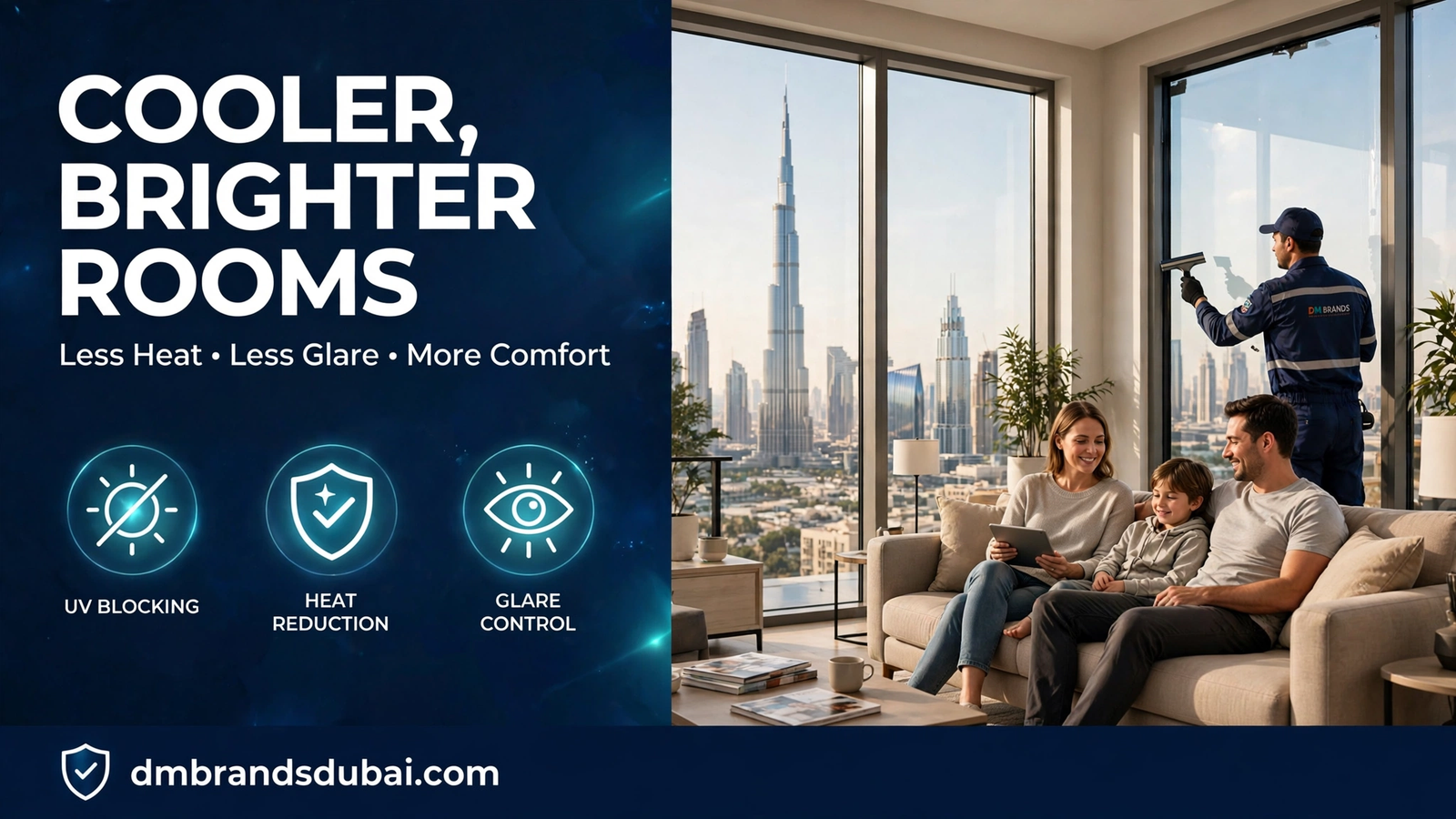
How to Choose a Window Tinting Installer in Dubai
Check Licensing, Insurance and Experience
Choose a licensed and insured company, not a lone worker with no cover. A licensed company follows Dubai rules, carries public liability insurance, and stands behind its work. DM Brands Dubai is licensed and insured and works across all Dubai communities.
Ask how long the company has installed window film in Dubai. Experience matters because Dubai glass, heat and building rules differ from other cities. An experienced team knows which films survive Dubai sun and which fail within a year.
Ask for Samples, Brands and Specification Sheets
A reputable installer shows physical samples on your window. They name the film brand and product, and they provide a specification sheet with VLT, heat rejection, UV rejection and warranty. They do not hide the brand or use vague terms such as "premium film" with no details.
Compare samples in daylight, not only in a showroom. View the film from inside and outside. Check the colour, the reflectivity and the clarity. A good sample tells you more than a brochure.
Read Reviews and Ask for Local Examples
Look for reviews from Dubai homeowners, not only generic testimonials. Ask for examples of recent jobs in your area, such as a villa in Arabian Ranches or an apartment in Dubai Marina. A local track record shows the installer understands your building type.
Ask about aftercare. Will the installer return if an edge lifts or a bubble remains after curing? Will they honour the warranty in writing? The answers tell you whether the company will still be there after payment.
Get a Written Quote and Warranty
A written quote should list the film brand and product, the VLT, the area in square metres, the number of panes, the total price including VAT, and the warranty length. It should also state what happens if the film fails.
Manufacturer warranties for ceramic and security films often last 10 to 15 years. Installer workmanship warranties usually last 1 to 5 years. Ask for both in writing. A verbal promise is not enough.
Common Mistakes to Avoid
Choosing the darkest film by default. Dark film does not always reject the most heat. A light ceramic film can outperform a dark dyed film. Choose by performance data, not by shade alone.
Buying on price alone. The cheapest film often fades, bubbles or peels within a year. Replacing it costs more than choosing a quality film first. Compare the total cost over the warranty life, not only the upfront price.
Skipping building approval. In a managed tower, installing a reflective film without approval can lead to a fine or a removal order. Check with building management first and keep the approval in writing.
Tinting only one window in a room. Tinting one pane while leaving the next pane clear creates uneven heat and light. It also looks untidy from outside. Tint all panes in the same room for a consistent result.
Cleaning too soon or with the wrong products. Cleaning film before it cures can lift edges. Using ammonia cleaners or abrasive pads can damage the hard coat. Wait for curing, then use a soft cloth and a mild, ammonia-free cleaner.
Ignoring the glass type. Some films do not suit certain glass, such as laminated or double-glazed units with a low-emissivity coating. Tell the installer the glass type and let them recommend a compatible film. The wrong film can cause thermal stress or void a glass warranty.
DIY installation on large panes. Small flat windows are manageable for a skilled DIYer. Large sliding doors and floor-to-ceiling panes are not. They need two people, specialist tools and a dust-free technique. A poor DIY job wastes expensive film and looks worse than no film.
Maintenance, Cleaning and Warranties
How to Clean Tinted Windows
Wait at least 30 days after installation before cleaning, or follow the installer's advice. Use a soft microfibre cloth and a mild, ammonia-free glass cleaner, or a mix of water and a small amount of dish soap.
Spray the cleaner on the cloth, not directly on the film, and wipe gently. Do not use abrasive pads, scrapers or ammonia-based cleaners. Do not stick suction cups, tape or decals on the film. For regular cleaning, pair film care with professional window cleaning services in Dubai so the glass stays clear without damaging the tint.
What to Expect During Curing
Small water bubbles and a hazy look are normal for the first few days. The adhesive needs time to dry and bond fully. In Dubai heat, curing usually takes 2 to 4 weeks, depending on film thickness and humidity.
Do not press bubbles or peel edges during curing. Most small bubbles disappear on their own. If a large bubble, crease or dust spot remains after 30 days, contact the installer. A reputable company will inspect and fix genuine defects under warranty.
Warranty: What It Should Cover
A good warranty covers bubbling, peeling, cracking, discolouration and adhesive failure. Ceramic and security films often carry a manufacturer warranty of 10 to 15 years. Carbon films often carry 7 to 10 years. Dyed films carry shorter warranties.
Read the warranty terms. Check whether it covers labour as well as materials, and whether it requires professional cleaning or specific care. Keep the warranty document, the invoice and the film specification sheet together. They prove the product and the installation date if you ever need a claim.
Window Tinting and Your Whole Home
Window film works best as part of a wider home-comfort plan. It pairs well with curtains and blinds, which add privacy at night and insulation in summer. If you are updating window dressings, see our guide to curtain and blinds installation in Dubai.
For a villa, film also pairs well with a full maintenance plan. A villa maintenance service in Dubai can check seals, frames and AC performance alongside the tinting job. For an apartment, a fresh paint job can complete the refresh — see our guide to apartment painting costs in Dubai.
A handyman can help with related jobs, such as refitting curtain rails or repairing window handles after tinting. See our handyman services in Dubai. For ongoing care, an annual maintenance contract in Dubai covers AC, plumbing, electrical and handyman visits through the year, so your home stays comfortable long after the film is installed.
Areas We Serve Across Dubai
DM Brands Dubai installs window tinting across the emirate. In Dubai Marina and Jumeirah Beach Residence, we tint high-rise apartments with floor-to-ceiling glass and strong afternoon sun. In Palm Jumeirah, we tint villas and apartments with sea-facing glass and high glare.
In Jumeirah Village Circle and Al Barsha, we tint apartments where neighbouring towers sit close and privacy matters. In Downtown Dubai and Business Bay, we tint towers with large glass facades and city views. In Arabian Ranches and Dubai Hills Estate, we tint family villas with sliding doors, large living rooms and garden-facing glass.
In Mirdif and Jumeirah, we tint villas and townhouses where heat, fading and privacy all matter. Wherever you live in Dubai, a site visit and exact measurements give you an accurate quote and a film recommendation for your home.
Frequently Asked Questions
How much does window tinting cost in Dubai?
Residential window tinting in Dubai typically costs AED 80 to 450 per square metre, depending on film type. A one-bedroom apartment usually costs AED 1,500 to 4,500, while a three-bedroom villa usually costs AED 6,000 to 15,000. A site visit gives an exact quote.
Which window film is best for Dubai heat?
Ceramic film is best for Dubai heat. It rejects the most infrared heat, blocks up to 99 percent of UV light, and stays clear without interfering with phone or Wi-Fi signals. Carbon film is a strong mid-price alternative.
Does window tinting really reduce heat?
Yes. Quality film reflects or absorbs solar energy before it enters the room, so sun-facing rooms feel cooler and the air conditioner works less. The improvement is most noticeable on west- and south-facing windows.
Will window tinting lower my DEWA bill?
It can help lower cooling costs because the air conditioner runs less when less solar heat enters. The saving depends on window size, orientation, insulation and usage. No installer can promise an exact percentage for your home.
How long does window film last in Dubai?
Dyed film lasts about 3 to 5 years, carbon film about 7 to 10 years, and ceramic or security film about 10 to 15 years. Lifespan depends on film quality, installation, sun exposure and cleaning.
Does window film block UV rays?
Yes. Quality films block up to 99 percent of ultraviolet light. That protects skin near windows and slows fading of sofas, curtains, rugs, wooden floors and artwork.
Will tinting make my home too dark?
Not if you choose the right VLT. A 70 percent VLT ceramic film looks almost clear yet still rejects heat. A 50 percent film gives a light tint. View samples on your window before you decide.
Can I tint windows in a Dubai apartment?
Yes, in most cases. Check with building management first, because some towers require approval or restrict reflective films. DM Brands Dubai can provide a sample and specification sheet for approval.
Is home window tinting legal in Dubai?
Yes. Home window tinting is generally permitted, subject to building and community rules. Car tinting follows separate RTA rules, which do not apply to homes.
Does window film affect phone or Wi-Fi signals?
Dyed, carbon, ceramic and security films do not interfere with signals. Metallic film can weaken mobile, Wi-Fi and GPS signals, so avoid it in a smart home or a home office.
Can window film be removed?
Yes. A professional can remove old film with steam and specialist tools. Removal adds labour cost, so tell the installer if your windows already have film.
Will film damage my windows?
No, when the correct film is used. The wrong film on certain laminated or low-emissivity glass can cause thermal stress, so tell the installer your glass type and let them recommend a compatible product.
How do I clean tinted windows?
Wait at least 30 days after installation, then use a soft microfibre cloth and a mild, ammonia-free cleaner. Do not use abrasive pads, ammonia cleaners, scrapers or suction cups on the film.
How long does installation take?
A small apartment takes about half a day, a two-bedroom apartment takes a full day, and a villa takes one to two days. Removal of old film and large sliding doors add time.
Does security film stop break-ins?
It does not make glass unbreakable, but it holds shattered glass together and delays forced entry. That gives more time to react and reduces injury risk from broken glass.
Is ceramic film worth the extra cost?
For sun-facing rooms, large glass areas and home offices, yes. Ceramic film rejects more heat in a lighter tint, lasts longer, and carries a longer warranty than cheaper films.
Can I tint only the sunny side of my home?
Yes. Many homeowners tint west- and south-facing windows first, then add other rooms later. Tint all panes in the same room for a consistent look and even comfort.
Does window tinting help with privacy at night?
Only partly. Privacy film works best during the day, when outside light is stronger. At night, with interior lights on, silhouettes may still show. Use curtains or blinds at night for full privacy.
What warranty should I expect?
Expect a manufacturer warranty of 7 to 15 years for carbon, ceramic and security films, plus a workmanship warranty from the installer. Get both in writing with the film brand and product name.
Can DM Brands Dubai give a free quote?
Yes. DM Brands Dubai offers a free consultation and quote across Dubai. The team visits your home, measures the windows, shows samples, and gives a written price with no obligation.
Conclusion: Cooler, Brighter and More Private — With the Right Film
Window tinting Dubai homeowners choose well does more than darken glass. It cuts heat before it enters the room, reduces glare without losing the view, blocks most UV light, protects furniture from fading, and gives daytime privacy. It also helps the air conditioner work less, which supports lower cooling costs through a long Dubai summer.
The right choice starts with your main problem. Choose ceramic film for maximum heat rejection, carbon film for balanced value, security film for safety, and frosted film for privacy. Choose the VLT by room, direction and use, not by darkness alone. Check building rules, compare quotes on the same film specification, and choose a licensed and insured installer who provides samples and a written warranty.
DM Brands Dubai installs residential window film across Dubai Marina, JVC, Palm Jumeirah, Downtown Dubai, Arabian Ranches, Business Bay, Dubai Hills Estate, Al Barsha, Mirdif and Jumeirah. Our team measures every pane, recommends the right film for each room, installs it cleanly, and backs the work with a written warranty.
Book your free consultation and quote today. Contact DM Brands Dubai, tell us which rooms feel hot or overlooked, and we will visit your home, show you samples on your own windows, and give you a clear written price. Enjoy a cooler, brighter and more private home — without closing the curtains on Dubai.