It starts with a small thing. The house feels a little stuffy, the vents blow air that is almost cool, and you tell yourself it will sort itself out by evening.
By nightfall the bedroom is 82°F, the outdoor unit is humming but not helping, and you are searching for an AC unit fix at 10 p.m. with a phone at 14 percent battery.
Here is the good news. Most air conditioner failures trace back to a short list of causes, and several of them take five minutes and no tools to rule out.
The rest need a trained technician, and knowing the difference saves you from two expensive mistakes: paying for a service call when a clogged filter was the culprit, and attempting a DIY repair that should never be touched without a license.
Table of Contents
What Is the Fastest AC Unit Fix?

Start with the simple checks. Confirm the thermostat is set to cool and below room temperature, replace a dirty filter, reset the tripped breaker once, and clear debris from the outdoor unit.
If the AC still blows warm air, freezes, leaks, trips the breaker again or makes grinding noises, switch it off and call a professional. Those symptoms point to refrigerant, electrical or mechanical faults that are unsafe or illegal to repair without certification.
AC Unit Fix at a Glance
| Symptom | Most Likely Cause | DIY Check | Needs a Pro? |
|---|---|---|---|
| Not cooling | Dirty filter, low refrigerant, dirty coil | Replace filter, check thermostat | Often |
| Won’t turn on | Tripped breaker, dead thermostat, bad capacitor | Reset breaker once, check batteries | Often |
| Freezing up | Restricted airflow or low refrigerant | Replace filter, thaw the unit | Yes, if it returns |
| Leaking water | Clogged condensate drain | Clear drain with wet/dry vacuum | If leak persists |
| Loud noises | Loose parts, failing motor or compressor | Tighten panels, clear debris | Yes |
| Bad smell | Mold in coil or drain pan, dirty ducts | Change filter, clean drain | Often |
| Short cycling | Oversized unit, dirty coil, low charge | Replace filter | Yes |
| Tripping breaker | Failing capacitor, compressor or wiring | None | Yes |
Safety First Before Any AC Unit Fix
An air conditioner combines high-voltage electricity, moving fans and pressurized refrigerant. A few minutes of caution protects you and the equipment.
Turn Off the Power
Switch the thermostat to off, then turn off the breaker for the indoor unit and the outdoor condenser. Most outdoor units also have a disconnect box near the wall that you should switch off.
Never open an electrical panel on a unit that is still powered. Capacitors can hold a dangerous charge even after power is cut.
What You Should Never Do Yourself
- Handle or release refrigerant, which requires EPA Section 608 certification in the United States
- Test or replace capacitors, contactors or compressors
- Bypass safety switches or breakers
- Pressure wash coils with high pressure that can bend delicate fins
- Run the unit while it is frozen solid
When to Call Immediately
Turn the system off and call for help if you smell burning, see smoke, hear loud banging or notice water near electrical components. These are safety issues, not comfort issues.
If it is after hours or a holiday, look for emergency AC call-out support rather than waiting for a normal appointment.
Five-Minute Checks Before You Call a Technician
Many “broken” air conditioners are not broken at all. Work through this quick list before spending money on a service visit.
Check the Thermostat
Confirm the mode is set to cool, not fan or heat. Lower the setting five degrees below the room temperature and wait a few minutes.
Replace the batteries if the display is dim or blank. A dead thermostat is one of the most common false alarms.
Inspect the Air Filter
Pull the filter and hold it to the light. If you cannot see through it, replace it.
A clogged filter restricts airflow, causes freezing, raises energy use and strains the blower motor. It is the cheapest and most common AC unit fix there is.
Check the Breaker and Disconnect
Look for a tripped breaker in your electrical panel and for an off switch at the outdoor unit. Reset a tripped breaker once. If it trips again, stop and call a professional.
Repeated resetting can overheat wiring and damage the compressor.
Look at the Outdoor Unit
Make sure the fan spins and the unit is free of leaves, grass clippings, cottonwood fluff and debris. Keep at least two feet of clear space around it.
Rinse the fins gently with a garden hose from the inside out if they look dirty. Never use a pressure washer.
Open Vents and Registers
Walk through the house and confirm vents are open and unblocked. Closed or covered registers raise pressure in the duct system and reduce cooling.
Check the Condensate Drain and Safety Switch
If your unit has a float switch, a full drain pan may have shut the system down. Clearing the drain line often brings it back to life.
AC Unit Not Cooling: Causes and Fixes
An AC that runs but does not cool is the most common complaint. The cause is rarely mysterious once you narrow it down.
Dirty Air Filter
Restricted airflow reduces cooling capacity and can freeze the evaporator coil. Replace the filter and give the system an hour to recover.
Check filters monthly in summer. Homes with pets, smokers or high dust levels may need changes every four to six weeks.
Dirty Evaporator or Condenser Coils
Dust and grime on the coils block heat transfer. The system then runs longer and cools less.
Professional coil cleaning uses approved cleaners and low pressure to restore performance without bending fins. Light rinsing of the outdoor coil is a safe DIY step.
Low Refrigerant
Refrigerant does not get used up. If the charge is low, there is a leak somewhere in the system.
Adding refrigerant without finding and fixing the leak is a short-term patch that wastes money. A certified technician should test, repair and recharge the system.
Failed Capacitor or Fan Motor
If the outdoor fan is not spinning or the compressor hums without starting, a capacitor may have failed. This is one of the most common electrical repairs and typically costs $150 to $450.
Capacitors store high-voltage energy and should only be handled by trained technicians.
Thermostat Problems
A miscalibrated or failing thermostat can tell the system to shut off before the house cools. Replacing a thermostat is straightforward, but wiring must match your equipment.
Leaky or Disconnected Ducts
Sometimes the AC is fine and the ducts are the problem. Leaks in an attic or crawl space can waste a large share of cooled air.
A professional inspection can pinpoint leaks and recommend sealing, or in severe cases air duct replacement.
Undersized or Aging Equipment
An older system may simply be unable to keep up with the home. Added rooms, new windows or hotter summers can overwhelm equipment that once worked well.
AC Unit Blowing Warm Air: How to Fix It

Warm air from the vents is the symptom people notice first. It narrows to a handful of causes.
Thermostat Set to Fan or On
If the fan setting is “on” instead of “auto,” the blower runs even when the compressor is off. That pushes room-temperature air through the vents.
Switch it to auto and cool, then check again after ten minutes.
Tripped Breaker for the Outdoor Unit
The indoor blower may run while the outdoor condenser has lost power. You will get airflow but no cooling.
Check the breaker and the outdoor disconnect.
Dirty Condenser or Failed Compressor
If the outdoor unit is clogged with dirt or the compressor has failed, the system cannot move heat outside. Compressor failure is serious and expensive.
Our guide to home AC compressor replacement cost helps you weigh repair against replacement.
Refrigerant Leak
Warm air with ice on the lines often means a leak. The refrigerant level has dropped too low to cool properly.
Frozen Evaporator Coil
When the coil freezes, air cannot pass through it. Switch the system to fan only to thaw it, then find the underlying cause.
AC Unit Not Turning On: What to Check
When nothing happens at all, the issue is usually electrical or control-related. Systematic checking saves time.
Step-by-Step Troubleshooting
- Confirm the thermostat has power and is set to cool.
- Replace thermostat batteries.
- Check the breaker and outdoor disconnect.
- Inspect the float switch and drain pan for water.
- Make sure the indoor access panel is closed fully.
- Listen for a click or hum from the outdoor unit.
Common Causes
| Cause | Typical Sign | Typical Fix |
|---|---|---|
| Tripped breaker | Nothing runs | Reset once, then investigate |
| Dead thermostat | Blank display | New batteries or thermostat |
| Blown fuse in disconnect | Outdoor unit dead | Pro replacement |
| Clogged drain safety switch | Water in pan | Clear line |
| Bad capacitor | Hum without start | Pro replacement |
| Failed control board | Erratic behavior | Pro replacement |
When the Breaker Keeps Tripping
A breaker that trips repeatedly is a warning, not a nuisance. The cause may be a short, a failing compressor or an overloaded circuit.
Resetting it again and again can start a fire. Turn the system off and book an inspection.
AC Unit Freezing Up: Causes and How to Fix It
Ice on the indoor coil or refrigerant line looks dramatic, but it follows simple physics. When airflow drops or refrigerant runs low, the coil gets too cold and moisture freezes on it.
How to Thaw a Frozen AC Unit
Turn the cooling off and set the fan to on. Keep the blower running for several hours until the ice melts completely.
Place towels or a pan under the unit, since melting ice can overflow the drain pan. Do not chip ice with tools, because the coil is fragile.
Why It Freezes
- A dirty or restricted air filter
- Closed or blocked vents and returns
- A dirty evaporator coil
- Low refrigerant from a leak
- A failing blower motor
- Running the AC when outdoor temperatures are very low
How to Prevent Freezing
Replace filters on schedule and keep supply and return vents open. Schedule a spring tune-up so a technician can check refrigerant pressure and coil condition.
If the unit freezes again within a few days of thawing, the cause is probably a leak or airflow problem that needs professional diagnosis.
AC Unit Leaking Water: Causes and Fixes
Water around the indoor unit is one of the most common AC complaints. It is also one of the more preventable.
Clogged Condensate Drain Line
Your AC removes humidity from the air and sends it out through a drain line. Algae, dust and slime can clog that line and send water back into the pan.
You can often clear it with a wet/dry vacuum on the outdoor end of the line. Pouring a cup of diluted white vinegar into the drain access can slow algae growth.
Cracked or Rusted Drain Pan
Older units can develop cracks or rust holes in the pan. Replacing a pan is a modest repair, but it should be done before water damages ceilings or floors.
Frozen Coil Melting
If the coil froze and then melted, the extra water can overwhelm the drain pan. Fix the freezing problem and the leak stops.
Disconnected or Poorly Pitched Drain Line
A drain line that sags or has slipped off its fitting cannot carry water properly. A technician can reroute and reslope the pipe.
Dirty Filter or Coil
Restricted airflow causes temperature swings and condensation problems. Cleaning solves many “mystery leaks.”
Water Damage Warning
Do not ignore leaks. Water can damage drywall, insulation and wiring, and it can encourage mold within 24 to 48 hours.
If water is dripping near electrical components, turn off power at the breaker and call a professional.
AC Unit Making Strange Noises: What They Mean
Different sounds point to different problems. Listening carefully can narrow down the cause before the technician arrives.
Noise Guide
| Sound | Likely Cause | Urgency |
|---|---|---|
| Rattling | Loose panel, debris in the fan, loose screws | Low to medium |
| Buzzing | Electrical issue, failing capacitor, dirty contactor | Medium |
| Clicking at startup | Normal relay, or failing control | Medium if constant |
| Squealing | Worn fan belt or motor bearing | Medium to high |
| Grinding | Failing motor bearings or compressor | High, shut off |
| Hissing | Refrigerant leak or valve problem | High |
| Banging | Broken or loose internal parts | High, shut off |
| Gurgling | Drain line or refrigerant issue | Medium |
Simple DIY Checks for Noise
Turn off power and look for loose panels, screws and debris near the outdoor fan. Remove sticks, leaves or toys that may have fallen into the cabinet.
Tighten loose panels and make sure the unit sits level on its pad.
When Noise Means Trouble
Grinding and banging suggest mechanical failure that can destroy a compressor if ignored. Shut the system off and call a technician.
AC Unit Smells Bad: Causes and Fixes

An air conditioner should not smell like anything. Odors usually signal moisture, microbial growth or electrical problems.
Musty or Moldy Smell
Mold grows on damp evaporator coils, drain pans and ducts. The odor is strongest when the system first starts.
Replace the filter, clean the drain pan and arrange professional coil cleaning if the smell returns.
Dirty Sock Smell
Bacteria on the coil can produce a sour, sock-like odor. A deep coil cleaning and drain treatment usually solves it.
Burning Smell
A brief dusty smell at the first startup of the season can be normal. A continuing burning smell, or one that smells like melting plastic, is not.
Shut the system off and call a technician, because it can indicate failing wiring or a motor overheating.
Rotten Egg or Chemical Smell
Natural gas smells like rotten eggs. If you smell it, leave the house and call your gas utility.
Chemical or sweet odors may indicate a refrigerant leak and warrant an immediate professional visit.
Dirty Ducts
Dust, dander and debris in ducts can create stale odors. Professional duct cleaning removes buildup and improves airflow.
AC Unit Short Cycling: Why It Turns On and Off
Short cycling means the unit starts, runs briefly and shuts off, then repeats. It wastes energy and wears out parts quickly.
Common Causes
- An oversized air conditioner that cools too fast
- A dirty filter or coil causing overheating
- Low refrigerant
- A faulty thermostat placement
- A failing compressor or relay
- Frozen evaporator coil
How to Fix Short Cycling
Replace the filter and clear the outdoor unit first. If that does not help, a technician should check refrigerant, airflow and controls.
If the equipment is oversized, the permanent fix may be a correctly sized replacement. Our AC replacement and installation page explains how sizing and installation work.
AC Unit Fan Not Spinning: What to Do
If the outdoor fan is not turning, the system cannot release heat. The compressor may overheat and shut down.
Possible Causes
- Failed run capacitor
- Dead fan motor
- Seized bearings
- Burnt contactor
- Wiring problems
What You Can Safely Do
Turn off power and check for obstructions. Do not push the fan blade to start it, a trick that circulates online, because the unit can restart unexpectedly and cause injury.
A fan motor repair typically costs $350 to $900, while a capacitor replacement costs $150 to $450.
AC Unit Tripping the Breaker
A breaker is a safety device. When it trips repeatedly, the system is drawing too much current or has a short.
Causes
- Failing capacitor
- Compressor drawing excessive current
- Damaged or loose wiring
- Dirty condenser coil forcing the system to overwork
- Overloaded circuit
- Water intrusion into electrical components
What to Do
Turn the AC off and do not reset the breaker more than once. A licensed electrician or HVAC technician should inspect it.
A electrical fault-finding service can trace wiring issues that a standard AC visit might miss.
AC Unit Compressor Problems and Fixes
The compressor is the heart of the system. It pumps refrigerant through the coils and is the most expensive part to replace.
Warning Signs of Compressor Failure
- Warm air despite a running outdoor unit
- Loud grinding or clanking
- Breaker tripping when the unit starts
- Hard starting or humming without starting
- Vibration in the outdoor cabinet
Compressor Repair vs Replacement Costs
| Option | Typical Cost |
|---|---|
| Hard-start kit | $150 – $400 |
| Compressor replacement | $600 – $2,800 (varies widely by source and unit size) |
| Full system replacement | $4,000 – $12,000 |
Replacement is often the smarter move on units older than ten years. If the compressor fails on a young unit, it may be covered by the manufacturer’s warranty.
For detailed price comparisons, read our guide to home AC compressor replacement cost.
AC Unit Capacitor and Contactor Fix
Capacitors give motors the burst of energy they need to start. Contactors act as switches for power to the compressor and fan.
Symptoms of a Failing Capacitor
- Outdoor fan not spinning
- Unit humming without starting
- AC starting slowly or intermittently
- Clicking sounds
- Higher electric bills
Cost and Time
Capacitor replacement usually costs $150 to $450 and takes less than an hour. Contactors cost similar amounts.
Because capacitors can store dangerous voltage, replacing them is a job for trained technicians.
AC Unit Refrigerant Leak Fix
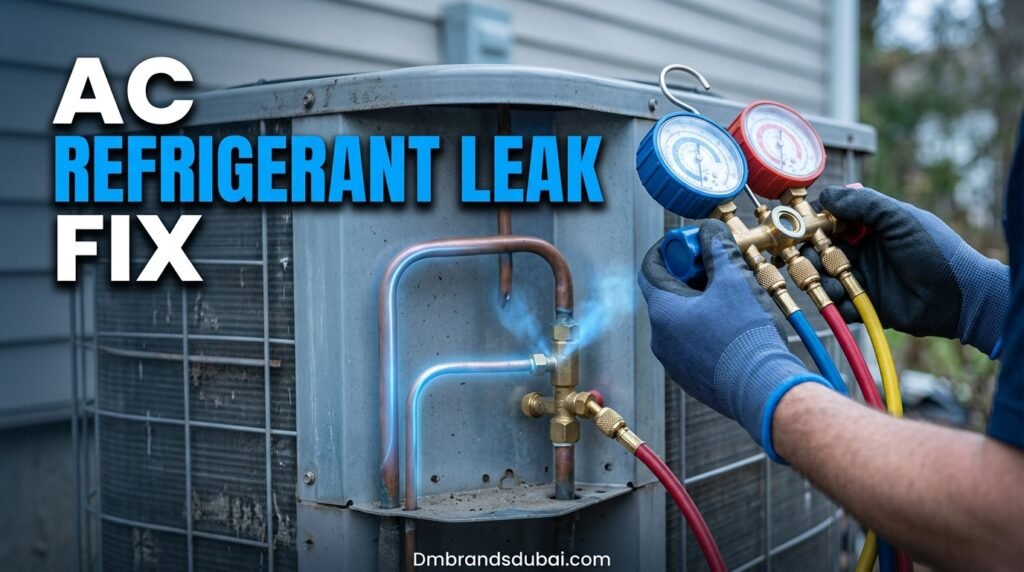
Refrigerant carries heat out of your home. A leak reduces cooling, freezes coils and eventually damages the compressor.
Signs of a Leak
- Hissing or bubbling sounds
- Ice on the refrigerant line or coil
- Weak cooling that gets worse over time
- Oily residue at fittings
- Rising electric bills
Cost to Fix a Refrigerant Leak
Fixr reports that AC leak repair and refill costs between $200 and $1,500, with an average around $800. Costs depend on the leak location, refrigerant type and system size.
Angi lists refrigerant replacement at about $125 on average for a simple top-up, but a top-up without a repair is not a real fix.
The Refrigerant Transition
New systems use A2L refrigerants such as R-454B and R-32, while older systems use R-410A or R-22. R-22 production ended years ago, which makes recharging old systems costly.
If your unit uses R-22 and has a significant leak, replacement is often more economical than repair.
AC Unit Thermostat Fix
A thermostat is the control center. Problems here can make a healthy system appear broken.
Common Thermostat Problems
- Dead batteries
- Wrong mode setting
- Poor location in direct sunlight or near vents
- Miscalibration
- Wiring faults
- Wi-Fi or app connectivity problems on smart models
Simple Fixes
Replace batteries, reset the device and confirm the settings. Move the thermostat away from heat sources if the readings are inaccurate.
When to Replace
A thermostat replacement typically costs $80 to $320, depending on the model and installation. Smart thermostats can reduce energy use when programmed properly.
AC Unit Clogged Drain Line Fix
A clogged drain is behind many leaks and shutdowns. The fix is simple when caught early.
How to Clear a Drain Line
- Turn off the AC at the thermostat and breaker.
- Locate the drain line outlet near the outdoor unit.
- Attach a wet/dry vacuum to the outlet and run it for one to two minutes.
- Pour a cup of distilled white vinegar into the access port.
- Wait 30 minutes, then flush with water.
- Turn the power back on and test.
Prevention
Pour vinegar into the drain access every few months during cooling season. Ask your technician to install a float switch if the unit does not have one.
AC Unit Fix Cost: What Repairs Really Cost in 2026
Price is the question behind every repair call. Costs vary by problem, system type, region and time of day, but national guides give a useful baseline.
Average AC Repair Cost
Fixr reports a national average of $375, with most repairs between $250 and $700. This Old House puts typical central air repairs at $150 to $650, with minor jobs like clogged drains and capacitors at $100 to $300.
InchCalculator lists an average near $410, with most homeowners paying between $175 and $650. Forbes Home cites a $400 average repair plus a service call near $150.
Cost by Type of Repair
| Repair | Typical Cost Range |
|---|---|
| Diagnostic or service call | $75 – $200 |
| Clearing a clogged drain line | $100 – $300 |
| Thermostat replacement | $80 – $320 |
| Capacitor or contactor | $150 – $450 |
| Fan motor or blower repair | $200 – $900 |
| Refrigerant leak repair and recharge | $200 – $1,500 |
| Circuit board | $200 – $800 |
| Evaporator coil | $600 – $2,000 |
| Compressor | $600 – $2,800 |
These are national ranges compiled from multiple published guides. Your final bill may differ based on parts, access and local labor rates.
Cost by Type of AC Unit
| Unit Type | Typical Repair Cost | Notes |
|---|---|---|
| Window unit | $50 – $300 | Often cheaper to replace than repair |
| Central air | $150 – $650 | Most common repair range |
| Heat pump | $200 – $900 | More components and a reversing valve |
| Ductless mini-split | $200 – $1,200 | Specialized parts and training |
| Packaged unit | $200 – $800 | Rooftop access may add cost |
Factors That Change the Price
- Parts availability: Rare or discontinued parts cost more and take longer.
- Labor rates: Urban and coastal markets charge more. Some guides estimate a 10 to 25 percent difference between regions.
- Time of day: Nights, weekends and holidays can add emergency fees.
- System age: Older units need more parts and have more compounding problems.
- Refrigerant type: R-22 systems are expensive to recharge.
- Access: Attics, crawl spaces and rooftops add labor time.
Emergency and After-Hours Costs
Emergency visits often carry a premium of $100 to $300 above normal rates. Peak summer weekends are the most expensive times to need help.
If you need service on a Saturday or Sunday, our weekend AC repair guide explains what to expect and how to avoid overpaying.
How to Avoid Surprise Charges
Ask whether the diagnostic fee is applied to the repair. Request an itemized written estimate before work begins.
Understand that a technician must diagnose before quoting. A fair company tells you upfront how the diagnostic charge works.
AC Unit Fix vs Replacement: How to Decide
A repair that costs $400 on a five-year-old unit is a good decision. The same repair on an 18-year-old system may be money thrown away.
The Age Rule
ENERGY STAR suggests considering replacement when an air conditioner is more than about 10 years old and needs frequent repairs. Many systems last 12 to 17 years with good care.
The $5,000 Rule
Multiply the unit’s age by the estimated repair cost. If the product exceeds $5,000, replacement usually makes more sense.
The 50 Percent Rule
If a repair costs more than half the price of a new system, replacement deserves serious thought. Some contractors apply a lower 30 percent threshold when the unit is old.
Decision Table
| Situation | Better Choice |
|---|---|
| Unit under 8 years old, single repair | Repair |
| Unit 8–12 years old, minor repair | Repair |
| Unit 10+ years old, major repair (compressor, coil) | Consider replacement |
| Multiple repairs in two years | Replace |
| Unit uses R-22 and leaks | Replace |
| Energy bills rising steadily | Replace or upgrade |
| Repair under $300 | Repair |
| Repair above 50% of replacement cost | Replace |
How Replacement Works
A replacement includes new condenser, coil, line set connections, refrigerant and commissioning. Prices typically range from $4,000 to $12,000 for most homes.
Our HVAC system replacement guide walks through signs, costs and the full process. For a quick estimate, our cost guide and quote calculator shows how a price is built.
Get a Second Opinion
If a technician recommends replacing a system that seems young or reliable, get another opinion. A free or low-cost second visit can save thousands.
DIY AC Unit Fix vs Professional Repair
Some tasks are safe for homeowners. Others involve risks that go far beyond the price of a service call.
Safe DIY Tasks
| Task | Skill Level | Notes |
|---|---|---|
| Replace air filter | Beginner | Do monthly in heavy use |
| Reset thermostat or replace batteries | Beginner | Check settings first |
| Reset breaker once | Beginner | If it trips again, stop |
| Clear debris around outdoor unit | Beginner | Keep two feet clear |
| Gently rinse outdoor coil | Beginner | Low pressure only |
| Clear condensate drain with a wet/dry vacuum | Intermediate | Turn off power first |
| Clean vents and registers | Beginner | Vacuum dust |
Tasks for Professionals Only
| Task | Why |
|---|---|
| Refrigerant handling | Requires EPA 608 certification and equipment |
| Capacitor, contactor or compressor work | High voltage and risk of shock |
| Motor and blower replacement | Needs correct parts and wiring knowledge |
| Evaporator coil cleaning or replacement | Delicate fins and refrigerant risk |
| Duct repair and sealing | Needs proper materials and testing |
| Electrical panel work | Fire and shock hazard |
Cost of DIY Gone Wrong
A DIY mistake can void your warranty, damage the compressor or cause injury. Forbes Home notes that DIY projects range from $5 to $2,000 in cost, and professional repair can run $275 to $3,300, yet mistakes often cost more than either.
When in doubt, call a professional. The service call fee is usually less than fixing a damaged compressor.
Window AC Unit Fix
Window units are simple machines, but they are often not worth repairing once they fail. A new unit can cost $150 to $600 depending on size.
Common Window AC Problems
| Problem | Likely Cause | Fix |
|---|---|---|
| Not cooling | Dirty filter or coil, low refrigerant | Clean filter and coil |
| Leaking inside | Unit tilted wrong, clogged drain | Adjust slope slightly outward |
| Noisy | Loose mounting, fan blade hitting | Tighten and clear obstructions |
| Won’t start | Tripped breaker, bad cord or control | Check power and reset |
| Freezing | Low airflow or low refrigerant | Clean and thaw |
When to Replace
If the repair costs more than half the price of a new unit, replace it. Window units rarely justify compressor repairs.
Ductless Mini-Split Fix
Mini-splits have an indoor head, an outdoor unit and refrigerant lines. They are efficient but need specialized care.
Common Mini-Split Problems
- Dirty indoor filters
- Clogged drain lines causing leaks
- Refrigerant leaks at flare fittings
- Remote or control board faults
- Error codes on the display
- Frozen coil from low airflow
What You Can Do
Wash the washable filters every month during use. Check the manual for the error code and try a power reset.
Anything involving refrigerant, boards or the outdoor unit needs a trained technician. Mini-split repairs can cost $200 to $1,200 depending on the issue.
Heat Pump Fix
Heat pumps cool like air conditioners and heat in winter through a reversing valve. They share many problems with ACs and add a few of their own.
Heat Pump-Specific Problems
- Reversing valve failure
- Defrost control faults
- Ice buildup on the outdoor unit in winter
- Auxiliary heat running constantly
Repair Costs
Heat pump repairs commonly run $200 to $900. Reversing valves and boards are the most expensive items.
Central Air Fix by Component
Understanding the parts helps you talk to a technician and judge a quote.
| Component | Function | Typical Failure Signs |
|---|---|---|
| Thermostat | Controls temperature | Blank display, wrong readings |
| Filter | Traps dust | Weak airflow, freezing |
| Evaporator coil | Absorbs heat indoors | Ice, poor cooling |
| Condenser coil | Releases heat outdoors | Overheating, high bills |
| Compressor | Pumps refrigerant | Warm air, noise, breaker trips |
| Capacitor | Starts motors | Hum, no start |
| Contactor | Switches power | Clicking, intermittent run |
| Blower motor | Moves air indoors | Weak airflow, noise |
| Fan motor | Moves air through condenser | Overheating |
| Expansion valve | Meters refrigerant | Poor cooling, freezing |
| Drain pan and line | Removes condensate | Leaks, shutdowns |
| Refrigerant lines | Carry refrigerant | Leaks, ice |
How to Find the Right AC Technician
The quality of the repair matters as much as the price. A good technician diagnoses accurately, explains options and stands behind the work.
Credentials to Check
- State or local HVAC license
- Liability and workers’ compensation insurance
- EPA Section 608 certification for refrigerant handling
- NATE certification or manufacturer training
- ACCA or SMACNA affiliation, which signals professional standards
Questions to Ask
- How is the diagnostic fee handled?
- Do you provide written estimates before starting?
- Do you guarantee parts and labor?
- Are your technicians employees or subcontractors?
- How soon can you come?
Red Flags
- Very low quoted prices that skyrocket on site
- Pressure to replace the whole system without explanation
- No license or insurance information
- Refusal to provide a written estimate
- Technicians who cannot explain the diagnosis in plain language
Local vs National Companies
Local companies often respond faster and know regional conditions. National brands may offer larger warranties and financing.
Our local air conditioning service guide explains how to evaluate a nearby team. If you want a tool for comparing options, our heating and air conditioning service near me guide covers how to find a reliable HVAC team.
Brand-Specific Repair
If you own Trane, Carrier, Lennox or another major brand, authorized technicians know the equipment well. Our Trane AC repair guide shows common problems and how to find a trusted technician for that brand.
What to Expect During an AC Repair Visit
Knowing the process helps you feel in control. A professional repair follows a logical sequence.
Step-by-Step Repair Visit
- Arrival and introduction. The technician checks in and asks about symptoms and history.
- Visual inspection. They look at the indoor unit, outdoor unit, filter, thermostat and drain.
- Electrical testing. They test capacitors, contactors, voltage and amperage.
- Refrigerant check. Gauges measure pressures and temperature split.
- Diagnosis. The technician explains the problem and options.
- Written estimate. You approve the scope and price before work begins.
- Repair. Parts are replaced or fixed and the system is tested.
- Final check and cleanup. The technician confirms operation and explains what was done.
How Long Does an AC Repair Take?
Most diagnostics take 30 to 90 minutes. Simple repairs finish in an hour or two, while compressor or coil replacements may take half a day.
What to Prepare
Clear access to indoor and outdoor units. Note the symptoms, when they started and any recent changes such as power outages or storms.
Warranty and Repair Coverage
Warranties can reduce or eliminate repair costs. Understanding what you have is worth a quick look.
Types of Coverage
| Coverage | What It Covers |
|---|---|
| Manufacturer parts warranty | Defective parts, often 5–10 years with registration |
| Compressor warranty | Often longer than other parts |
| Contractor labor warranty | Labor on installation and repairs |
| Home warranty | Covers repair costs under plan terms and service fees |
| Annual maintenance contract | Scheduled servicing and priority response |
Check Before You Pay
Look up your model and serial number to see if you are still under warranty. Registration may be required to unlock long coverage.
Annual Maintenance Contracts
A maintenance contract bundles scheduled servicing and priority response. It can reduce emergency pricing and catch problems early.
Our residential annual contract page explains what planned maintenance and priority call-outs include.
How to Prevent the Next AC Unit Fix
The cheapest repair is the one you never need. Most breakdowns follow neglect, and a simple routine prevents the majority of them.
Monthly Habits
Check the filter and replace it when dirty. Walk around the outdoor unit and clear leaves, grass and debris.
Listen for new sounds and watch for changes in airflow. Catching a small change early is the whole point.
Seasonal Habits
| Season | Task |
|---|---|
| Early spring | Professional tune-up, test run, coil check |
| Late spring | Replace filter, clear outdoor unit, check drain |
| Summer | Monthly filter checks, watch for icing or leaks |
| Early fall | Clean outdoor coil, check drain, inspect ducts |
| Winter | Cover or protect outdoor unit if recommended, schedule deep cleaning |
What a Professional Tune-Up Includes
- Cleaning the evaporator and condenser coils
- Checking refrigerant pressure and temperature split
- Testing capacitors, contactors and wiring
- Inspecting and clearing the drain line
- Lubricating motors where applicable
- Verifying thermostat accuracy
- Checking airflow and duct condition
Angi reports that a typical AC tune-up costs between $70 and $150, a small price compared with an emergency repair.
Keep Coils and Ducts Clean
Dirty coils make the system work harder and cool less. Dusty ducts spread debris through the house and restrict airflow.
Routine coil cleaning and periodic duct cleaning protect both efficiency and air quality.
Protect the Outdoor Unit
Trim plants back at least two feet. Avoid piling mulch or storing items against the cabinet.
Install a sturdy pad if the unit is sinking or tilting. A level base prevents compressor oil problems and noise.
Use the Right Filter
Higher MERV filters catch more particles but can restrict airflow if the system was not designed for them. Match the filter to your equipment and change it on schedule.
How Maintenance Lowers Repair Bills
Maintenance has a measurable effect on how often and how seriously a system fails. A clean, correctly charged unit runs cooler and wears more slowly.
Small Problems Become Big Ones
A weak capacitor strains the motor. A dirty coil overheats the compressor. A slow leak starves the system of refrigerant.
Each of these costs little to fix early and a lot to fix late. A tune-up is where they get caught.
Planned Servicing vs Emergency Calls
Scheduled visits happen in spring and fall when technicians have time. Emergency visits happen on the hottest day of the year when demand and prices spike.
For a villa or apartment with several units, planned service through the year can be the more economical path. Our AC service and repair page outlines scheduled servicing and same-day repair options.
Energy Bills and the AC Unit Fix
A struggling air conditioner often shows up on your electric bill before it shows up as a breakdown. A sudden increase deserves attention.
How a Failing System Raises Bills
Dirty coils, low refrigerant and failing motors force the system to run longer for the same cooling. Duct leaks waste a portion of the cooled air.
Over a summer, that can add up to hundreds of dollars in extra electricity.
Bill Warning Signs
- Higher bills with no change in thermostat settings
- A system that runs nearly nonstop
- Rooms that never reach set temperature
- Long recovery times after being off
Efficiency Fixes That Pay Off
| Fix | Typical Cost | Typical Benefit |
|---|---|---|
| New filter | $5 – $40 | Restores airflow |
| Coil cleaning | $100 – $400 | Improves heat transfer |
| Duct sealing | $200 – $1,200 | Reduces air loss |
| Thermostat upgrade | $80 – $320 | Better control and scheduling |
| Refrigerant leak repair | $200 – $1,500 | Restores capacity |
| Attic insulation | Varies | Reduces cooling load |
Smart Thermostat Tips
Raise the setpoint a few degrees when you are away and use schedules. Avoid large temperature swings, which force long recovery runs.
AC Unit Fix in Hot Climates
Systems in hot regions run longer, collect more dust and face higher stress. Fixes that are optional in mild climates are essential in extreme heat.
Why Heat Changes Everything
When outdoor temperatures climb past 100°F, the system has to move heat against a bigger temperature difference. Compressors work harder and run hotter.
Dust and sand also clog filters and coils faster, which makes maintenance more frequent.
Climate-Specific Advice
- Check filters every two to four weeks in dusty seasons
- Schedule a tune-up before the peak heat arrives
- Shade the outdoor unit without blocking airflow
- Seal and insulate ducts in attics
- Keep a plan for fast service during peak demand
Looking at Extreme-Heat Markets
Cities with long, intense cooling seasons offer a useful lens on why maintenance matters. Our air conditioning specialists guide and residential AC repair guide look at how repair and servicing work in a market where AC runs most of the year.
What to Do While You Wait for Repairs
A breakdown rarely happens at a convenient time. A few simple steps keep your home livable until help arrives.
Keep the House Cooler
- Close blinds and curtains on sun-facing windows
- Use fans to circulate air
- Avoid using the oven and other heat sources
- Move to the coolest room, usually on the lowest floor
- Open windows at night if outdoor temperatures drop
Protect Vulnerable People
Infants, older adults, pregnant people and anyone with health conditions are more vulnerable to heat. Watch for signs of heat illness such as dizziness, nausea, confusion and heavy sweating.
Move to a cooler location if indoor temperatures become unsafe, and seek medical help for severe symptoms.
Protect the Equipment
Do not keep running a system that is freezing, leaking or making loud noises. Turn it off to prevent further damage while you wait.
Common Mistakes People Make With an AC Unit Fix
Small errors can turn a modest repair into a costly one. These are the mistakes technicians see most often.
Ignoring Early Warning Signs
A strange noise or weak airflow is the system asking for help. Waiting until it fails completely usually costs more.
Resetting the Breaker Repeatedly
Each reset sends another surge into a system that is already in trouble. If it trips twice, stop.
Adding Refrigerant Without Finding the Leak
A top-up is a temporary patch. The leak continues, and you pay again next season.
Using Pressure Washers on Coils
High pressure bends fins and reduces airflow. Use a gentle hose or professional cleaning.
Choosing Only the Cheapest Technician
Rock-bottom prices often lead to misdiagnosis, repeat visits or hidden fees. Compare qualifications, warranty and clarity of the estimate.
Skipping Maintenance
Without regular service, problems accumulate. Most manufacturer warranties expect proof of maintenance.
Ignoring Drainage
A clogged drain can cause water damage that costs far more than the AC repair itself.
AC Unit Fix Troubleshooting Flowchart in Words
Use this decision path when you are not sure where to begin.
Start Here
- Is the thermostat on, set to cool and below room temperature? If no, fix the setting. If yes, continue.
- Is the filter clean? If no, replace it and wait an hour. If yes, continue.
- Is the breaker on and the outdoor disconnect on? If no, reset once. If yes, continue.
- Is the outdoor fan spinning? If no, call a professional. If yes, continue.
- Is there ice on the coil or lines? If yes, turn cooling off, run the fan to thaw, then call a professional. If no, continue.
- Is there water around the unit? If yes, clear the drain line. If the leak continues, call a professional.
- Is the air still warm or the cooling weak? Call a professional to check refrigerant, coils and airflow.
Homeowner AC Maintenance Log
Keeping records helps technicians diagnose faster and supports warranty claims. A simple log is enough.
| Date | Task | Notes | Cost |
|---|---|---|---|
| Filter change | Brand and size | ||
| Coil rinse | Condition of fins | ||
| Professional tune-up | Technician findings | ||
| Repair | Part replaced | ||
| Duct inspection | Leaks or damage |
Record the model number, serial number, installation date and refrigerant type. Store warranty paperwork where you can find it.
Choosing Between Repair Options
Some repairs have more than one path. Understanding your options helps you decide with confidence.
Repair Option Comparison
| Option | Best When | Trade-Off |
|---|---|---|
| Quick fix (filter, thermostat, breaker) | Simple cause | May not solve deeper issue |
| Component repair | Isolated part failure | Other parts may follow if old |
| Major repair (compressor, coil) | Young unit, under warranty | High cost |
| Replace the system | Old, inefficient, repeated failures | Highest upfront cost |
| Upgrade with duct work | Poor airflow or comfort | Larger project |
Questions to Ask Your Technician
- What exactly failed, and what caused it?
- Is this likely to happen again?
- What are my repair and replacement options?
- What does the warranty cover?
- How long will the repair take?
- Is there anything I should change to prevent a repeat?
Also Read
- Residential AC Repair in Dubai: Same-Day Fixes, Real Costs and Expert Help 2026
- Weekend AC Repair: Fast, Reliable Help When Your AC Fails on Saturday or Sunday 2026
- Home AC Compressor Replacement Cost in Dubai: Real AED Prices and Smart Savings 2026
- Trane AC Repair Near Me: Common Problems and How to Find a Trusted Technician in 2026
- Local Air Conditioning Service in Dubai: Fast AC Repair and Maintenance 2026
- Heating & Air Conditioning Service Near Me: How to Find a Fast, Reliable Local HVAC Team 2026
- Cheapest HVAC Repair Near Me in Dubai: Affordable Fixes, Real Prices and Smart Savings 2026
Frequently Asked Questions (FAQs)
What is the most common AC unit fix?
Replacing a dirty air filter is the most common and cheapest fix. Clearing a clogged drain line and replacing a failed capacitor are close behind.
Why is my AC running but not cooling?
Common causes include a dirty filter, dirty coils, low refrigerant, a failed capacitor or a compressor problem. Check the filter and thermostat first, then call a professional.
How much does it cost to fix an AC unit?
Most repairs cost between $150 and $700, with national averages around $375 to $410 depending on the source. Major repairs like compressors can exceed $1,500.
Can I fix my AC unit myself?
You can replace filters, reset the thermostat, clear debris and unclog a drain line. Refrigerant, capacitor, compressor and electrical work should be left to licensed professionals.
Why does my AC keep freezing up?
Restricted airflow or low refrigerant usually causes freezing. Replace the filter, thaw the unit with the fan on and call a technician if it returns.
Why is my AC leaking water inside?
A clogged condensate drain line is the most common cause. A cracked pan, frozen coil or disconnected line can also cause leaks.
Why does my AC smell musty?
Mold or bacteria on the coil, drain pan or ducts usually causes a musty smell. Replace the filter and arrange professional cleaning if it persists.
Why is my AC making a loud noise?
Rattling often means loose parts, while grinding or banging suggests motor or compressor trouble. Turn the system off for serious noises and call a technician.
Why does my AC trip the breaker?
A failing capacitor, compressor, wiring fault or dirty condenser can overload the circuit. Do not keep resetting it, and have a professional inspect the system.
Is it worth fixing an old AC unit?
It depends on age and repair cost. If the unit is over 10 years old and the repair is more than about 50 percent of replacement cost, replacement is usually wiser.
What is the $5,000 rule for AC repair?
Multiply the unit’s age by the repair cost. If the answer is above $5,000, replacement usually makes more sense than repair.
How long do AC repairs take?
Diagnostics take 30 to 90 minutes, and many repairs finish the same day. Compressor or coil replacement may take several hours.
How often should I service my AC?
Once a year is the standard recommendation, ideally before cooling season. Homes with heavy use, dust or pets may benefit from twice-yearly service.
How often should I change my AC filter?
Check monthly and replace every one to three months in most homes. Dusty environments or homes with pets may need more frequent changes.
Why is my AC blowing warm air?
The thermostat may be on fan, the outdoor unit may have lost power, or the system may have a refrigerant or compressor problem. Check the settings and breaker, then call a professional.
Can low refrigerant be fixed by adding more?
Adding refrigerant without repairing the leak is a temporary solution. A technician should locate and fix the leak before recharging.
How much does it cost to recharge an AC?
Simple top-ups can cost about $125 to $600 depending on refrigerant type. Leak repair plus recharge typically costs $200 to $1,500.
Why won’t my AC turn on?
Check the thermostat, batteries, breaker and outdoor disconnect. If those are fine, a failed capacitor, control board or safety switch may be the cause.
Is it safe to run an AC that is freezing?
No. Running a frozen unit can damage the compressor. Turn cooling off, run the fan to thaw it and find the cause.
Should I repair or replace my window AC?
Window units are usually cheaper to replace than repair once major components fail. If the repair exceeds half the price of a new unit, replace it.
Do I need a licensed technician for AC repair?
Yes for refrigerant, electrical and compressor work. In the United States, handling refrigerant requires EPA Section 608 certification.
How can I find a trustworthy AC repair company?
Verify licensing, insurance and certifications, read recent reviews and ask for a written estimate. Be wary of high-pressure sales or vague pricing.
Does regular maintenance really prevent repairs?
Yes. Cleaning coils, checking refrigerant and testing electrical parts catch small problems before they become breakdowns.
Are annual maintenance contracts worth it?
They can be, especially for homes with multiple units or where downtime is a problem. They bundle scheduled servicing and priority response for a predictable cost.
What should I do if my AC breaks on a weekend or holiday?
Run through the quick checks, then look for emergency or weekend service. Expect a premium for after-hours visits, and ask for the price before the technician arrives.
Conclusion
A good AC unit fix begins with a calm look at the basics. Check the thermostat, replace the filter, confirm power and clear the outdoor unit before assuming the worst.
When symptoms point to refrigerant, electrical or mechanical failure, stop and call a professional. Most repairs cost $150 to $700, and the right technician will explain the cause, the options and the price before starting.
Prevention is where the real savings live. A spring tune-up, regular filter changes and clean coils and drains prevent most of the breakdowns that arrive on the hottest day.
If you are in Dubai and need a written price for repair, servicing or replacement, request a free quote or explore AC service and repair. You can also browse the full advice and guides library for more help.